Print or Export
我哋食幾多點好呀?
ngo5 dei6 sik6 gei2 do1 dim2 hou2 aa3?
ngo5 dei6 sik6 gei2 do1 dim2 hou2 aa3?
Listen and Speak
Step 1
Listen to the time of each clock below. Complete the descriptions.
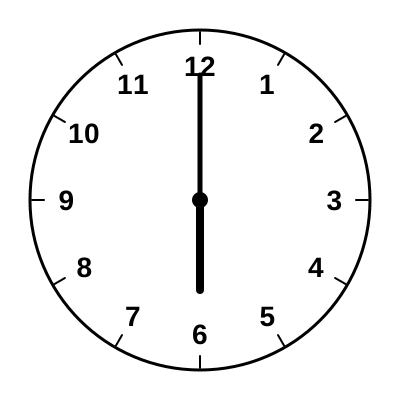 六點 六點luk6 dim2 6:00 | 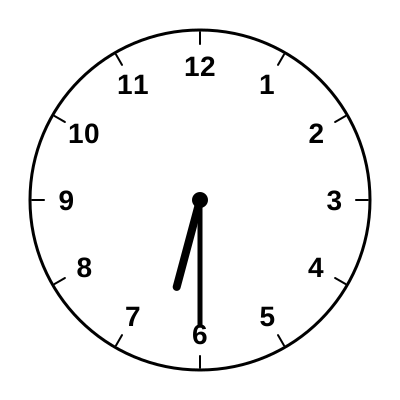 六點半 六點半luk6 dim2 bun3 6:30 | 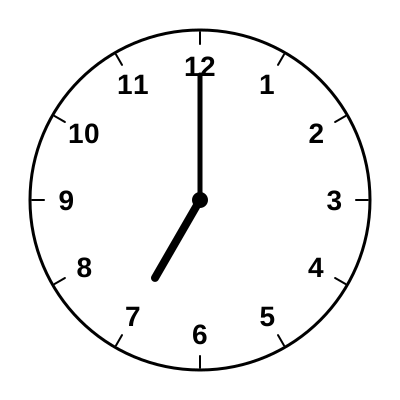 七點 七點cat1 dim2 7:00 |
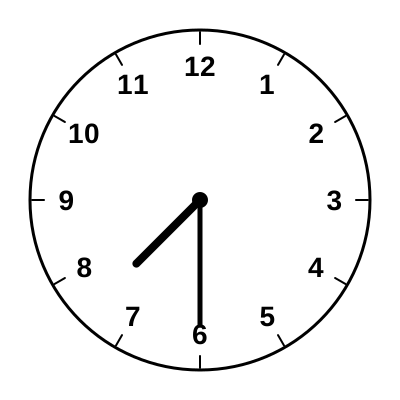 七點半 七點半cat1 dim2 bun3 7:30 | 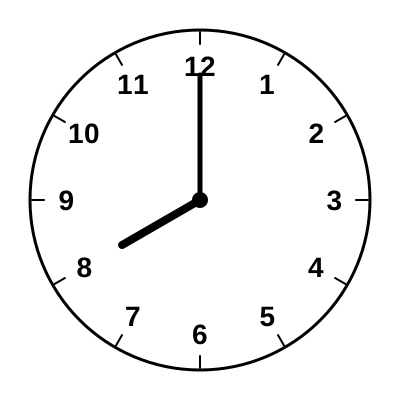 八點 八點baat3 dim2 8:00 | 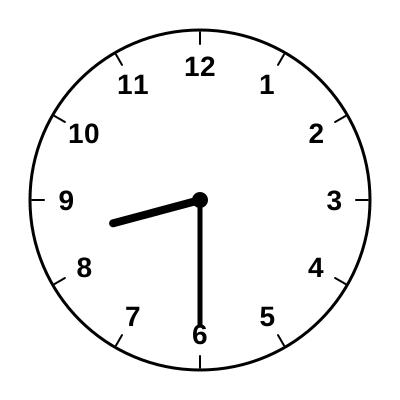 八點半 八點半baat3 dim2 bun3 8:30 |
The word ________ means ‘o’clock’. We put it after the hour of the time.
The word ________ means ‘half’. We put it after the word ________.
Step 2
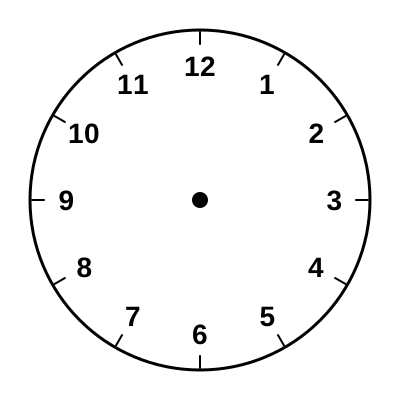
Listen to a conversation. The speakers will decide on the time for a meal. Draw the time on the clock.
| A | |
| B | |
| A | |
| B | |
| A |
Step 3
Listen to the conversation again. Read the script while listening. Check your answer.
| A | 我哋食幾多點好呀? ngo5 dei6 sik6 gei2 do1 dim2 hou2 aa3? We eat at what time will be good? [= What time should we eat?] |
| B | 我哋食六點半O唔OK呀? ngo5 dei6 sik6 luk6 dim2 bun3 ou1 m4 ou1 kei1 aa3? Is eating at 6:30 okay? |
| A | OK呀。 ou1 kei1 aa3. Okay. [= Yes. / Sure.] |
| B | 噉就食六點半啦,我一陣訂位吖。 gam2 zau6 sik6 luk6 dim2 bun3 laa1. ngo5 jat1 zan6 deng6 wai2 aa1. Let’s just eat at 6:30 then. Let me book the seats in a moment. |
| A | 好呀。 hou2 aa3. Good. |
Step 4
Listen and repeat.
Step 5
Replace the highlighted words in the script with the time below to make your conversations.
| 六點 luk6 dim2 6:00 | 六點半 luk6 dim2 bun3 6:30 | 七點 cat1 dim2 7:00 |
| 七點半 cat1 dim2 bun3 7:30 | 八點 baat3 dim2 8:00 | 八點半 baat3 dim2 bun3 8:30 |
Grammar and Vocabulary
In the Grammar and Vocabulary section, you will learn:
- Time
- The Question Word 幾多點 gei2 do1 dim2 / 幾點 gei2 dim2 (‘what time’)
- Forming Comparative Adverbs with the Suffix 啲 di1 (‘more’)
- Asking for Opinions on Suggestions with O唔OK ou1 m4 ou1 kei1 (‘Is … okay?’)
- Word Order of Time and Location
- Subject Movement
- Vocabulary List
- Vocabulary: Common Meeting Points in Hong Kong
22.1 Time
To indicate the hour of the time, we say the number of the hour and then the classifier 點 dim2 (‘o’clock’) or 點鐘 dim2 zung1 (‘o’clock’).
To mean ‘2 o’clock’, we use 兩 loeng5 instead of 二 ji6.
There are three methods to indicate the minute of the time when it is not zero.
Method 1
In this method, we first say the hour, and then the number of the minute and the classifier 分 fan1 (‘minute’). Note that if we indicate the minute, we usually only use 點 dim2 but not 點鐘 dim2 zung1 for the hour.
If the minute is 1 to 9, we add 零 ling4 before the number of the minute.
If the minute is 2, we use 二 ji6 instead of 兩 loeng5. Therefore, we use 兩 loeng2 before 點 dim2 or 點鐘 dim2 zung1, but 二 ji6 before 分 fan1.
Method 2
We can also use the number we see on a torque clock.
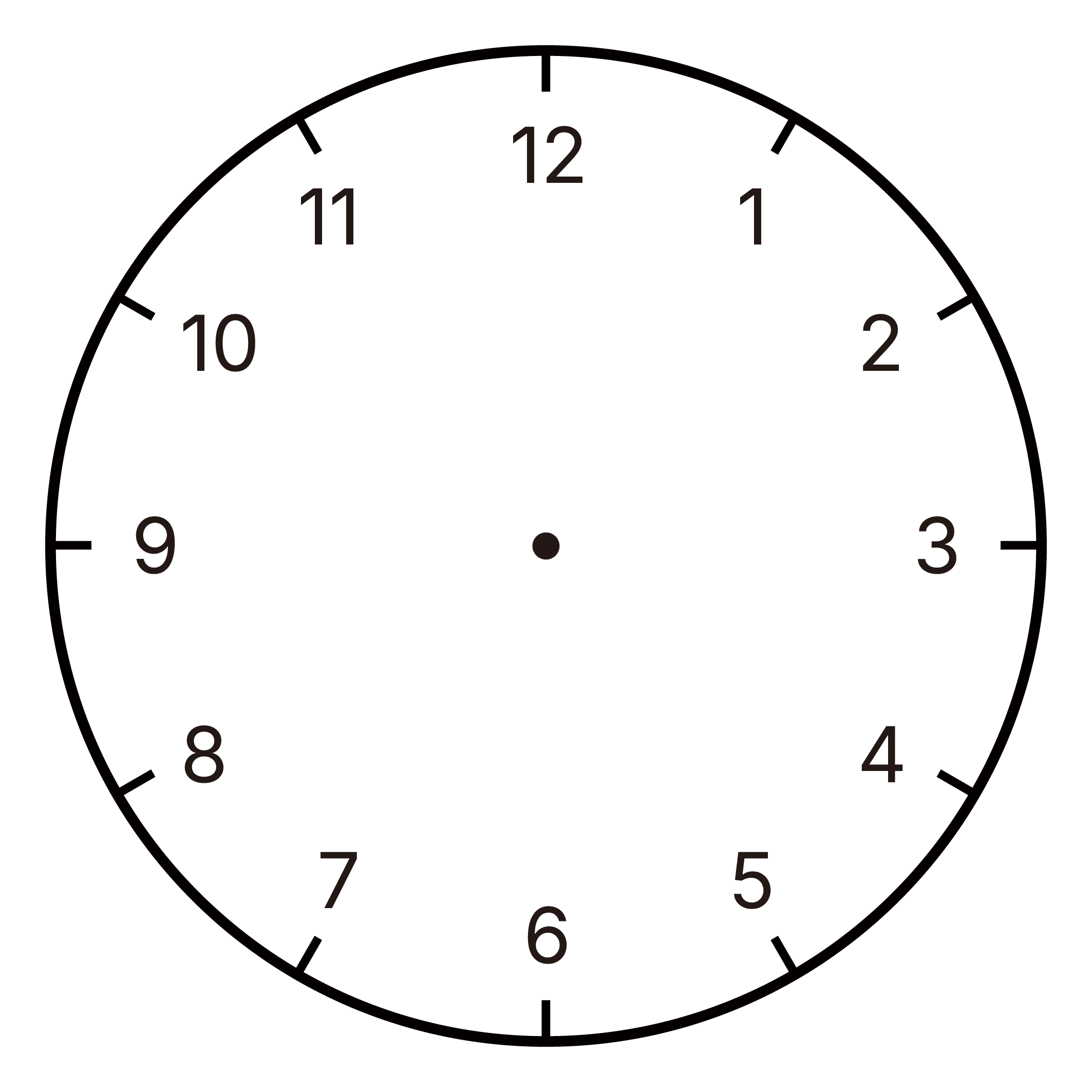
Notice the interval between one number and the next number is 5 minutes. For example, the interval between 12 and 1 is 5 minutes.
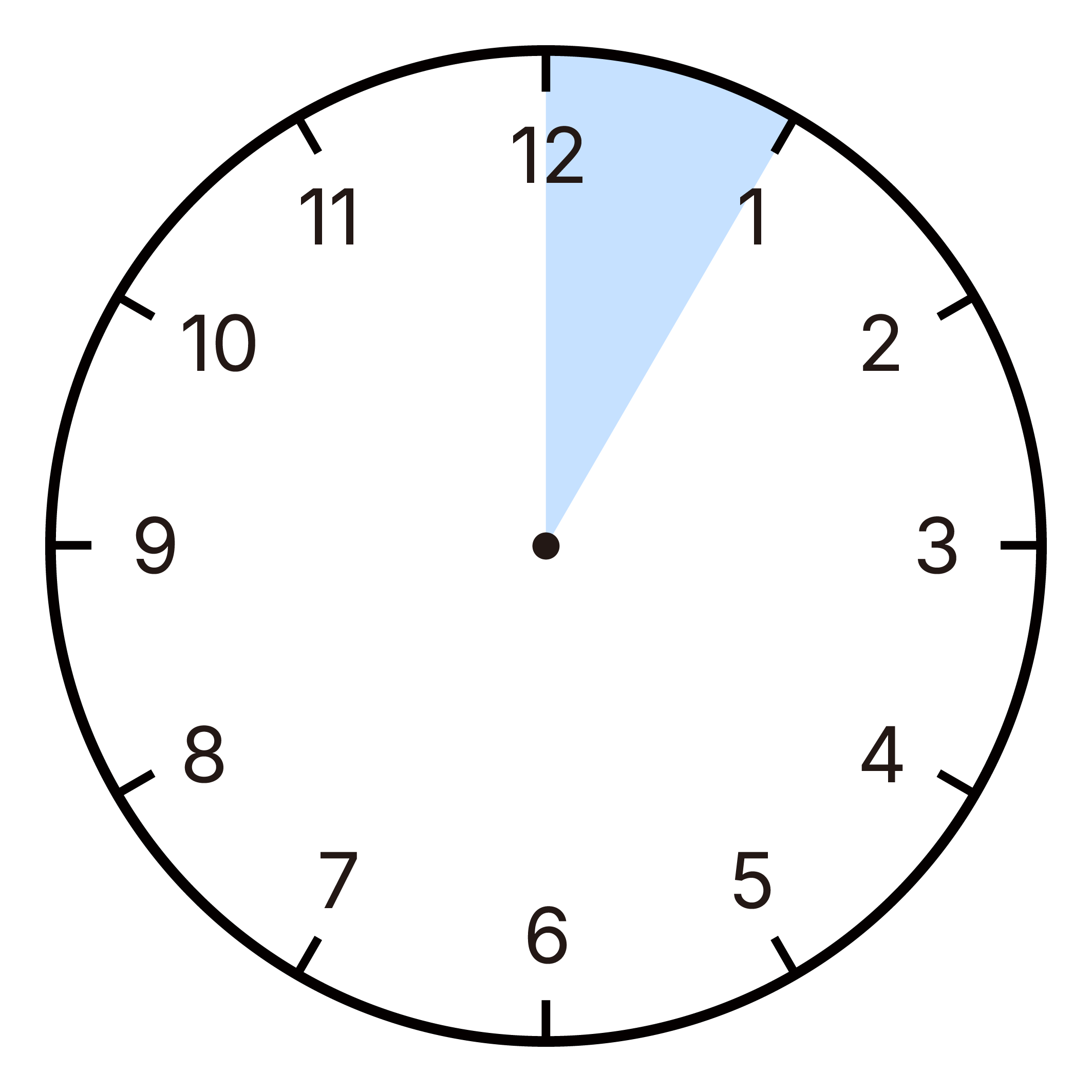
In this method, we first say the hour, and then 搭 daap6 (‘to step on’, also written as 踏) and the number which the minute hand is pointing to. 搭 daap6 here means that the minute hand is stepping on the number. We can often omit the word 搭 daap6. For example, when the time is 8:15, the minute hand will step on the number 3 so we can say 三 saam1 for the minute.
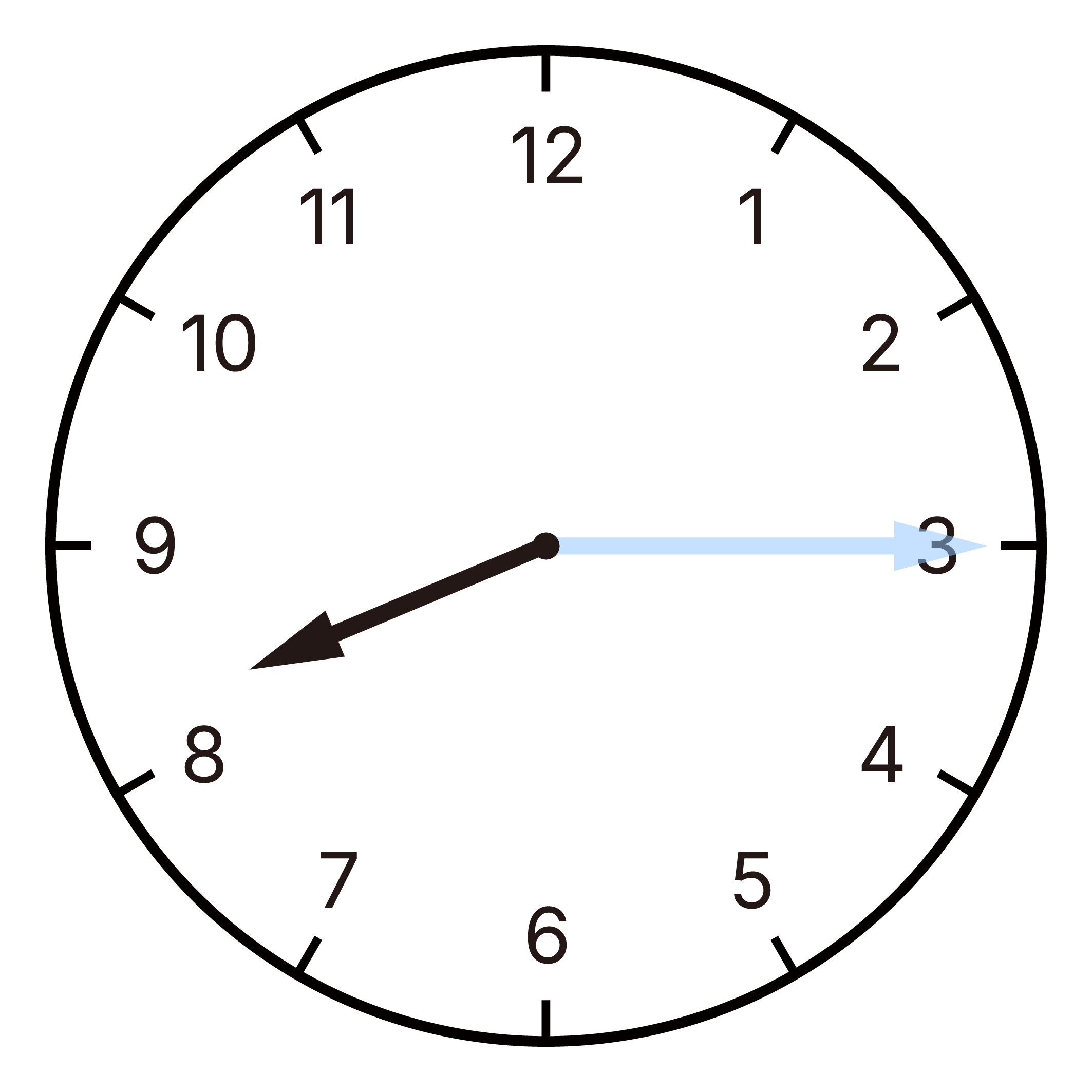
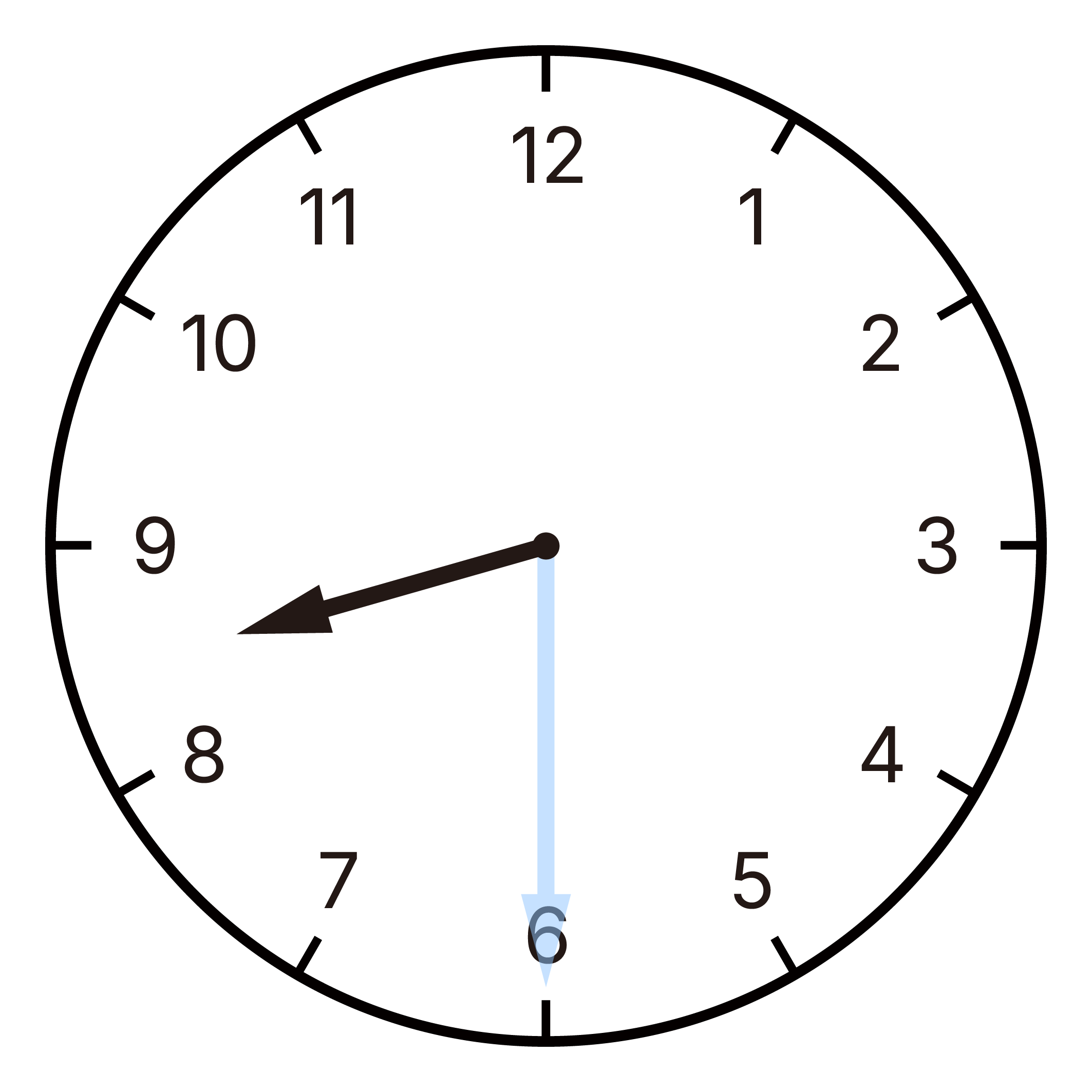
If the minute hand is pointing to 6, we usually say 半 bun3 (‘half’) instead of 六 luk6.
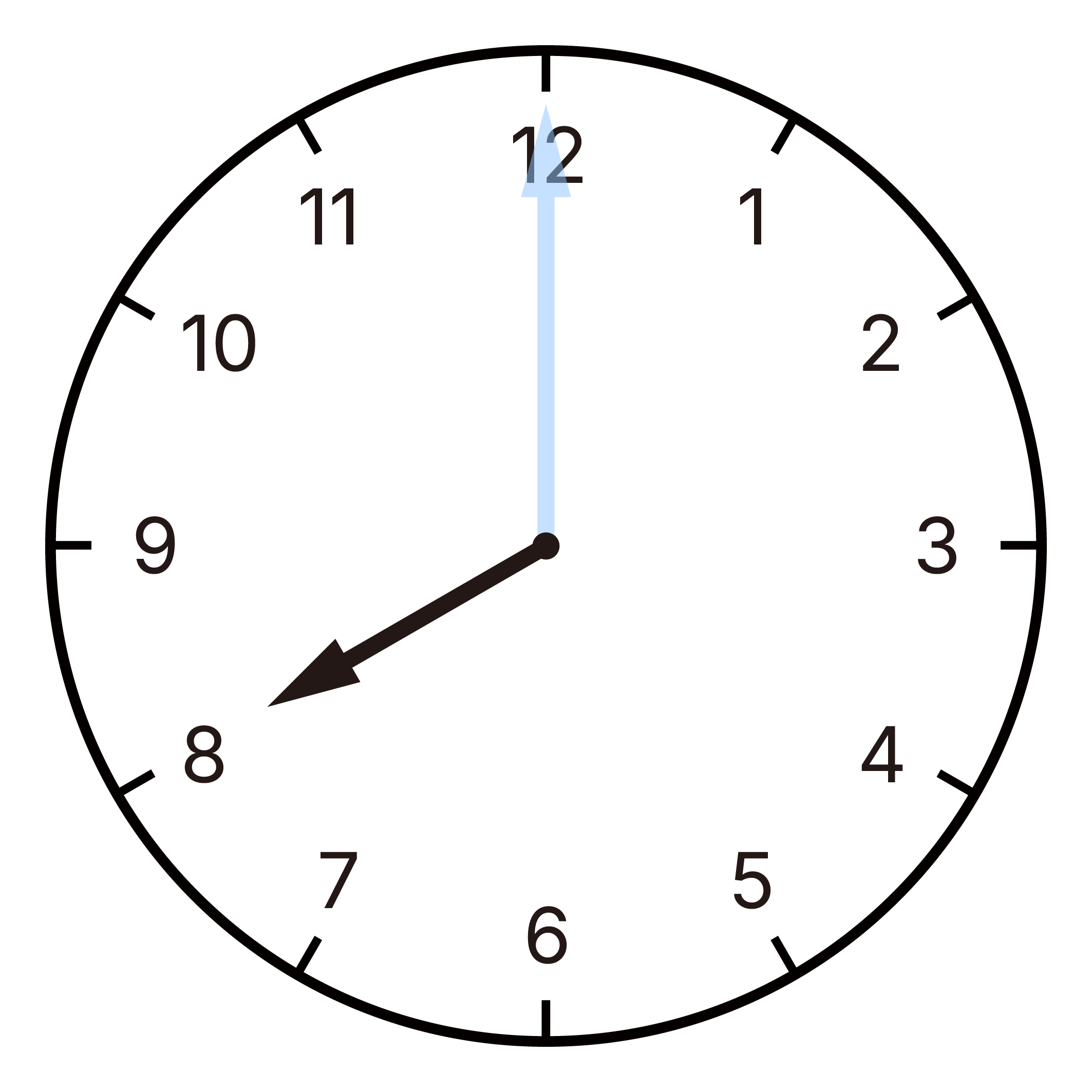
If the minute hand is pointing to 12, we usually say 正 zeng3 / zing3 (‘exact’) instead of 十二 sap6 ji6. Note that we only add 正 zeng3 / zing3 when we need to emphasize the time is exactly on the hour.
Method 3
We can also use the expression 個字 go3 zi6. 字 zi6 means ‘word’, which refers to the number we see on a torque clock. Here, we can understand 字 zi6 as ‘5 minutes’ because each 字 zi6 on a torque clock represents an interval of 5 minutes. 個 go3 is the classifier for 字 zi6.
In this method, we first say the hour, and then the number which the minute hand is pointing to and 個字 go3 zi6.
When the minute hand is pointing to the number 2, we use 兩 loeng5 instead of 二 ji6.
We don’t usually say 六個字 luk6 go3 zi6 when the minute hand is pointing to the number 6 or 十二個字 sap6 ji6 go3 zi6 when the minute hand is pointing to the number 12.
In daily conversations, we usually use Method 2 or Method 3 whenever possible. We use Method 2 more often than Method 3. We usually only use Method 1 when we can’t indicate the time with Method 2 or Method 3.
We can put the part of the day (e.g., 朝早 ziu1 zou2 ‘morning’, 晏晝 aan3 zau3 ‘afternoon’, 夜晚 je6 maan5 ‘evening, night’) before the time to indicate whether it is morning, afternoon or evening (See Grammar and Vocabulary 17.3 for parts of the day).
We put the time before the verb in a sentence, just as we do with other time expressions.
不如我哋七點食吖。
bat1 jyu4 ngo5 dei6 cat1 dim2 sik6 aa1.
Why don’t we eat at 7:00?
We can put the time after some verbs (e.g., 食 sik6 ‘to eat’ and 睇 tai2 ‘to watch’) to indicate the time of the activity.
不如我哋食七點吖。
bat1 jyu4 ngo5 dei6 sik6 cat1 dim2 aa1.
Why don’t we eat at 7:00?
However, we can only do so when the sentence doesn’t have an object.
❌ 不如我哋食早餐七點吖。
bat1 jyu4 ngo5 dei6 sik6 zou2 caan1 cat1 dim2 aa1.
✔️ 不如我哋七點食早餐吖。
bat1 jyu4 ngo5 dei6 cat1 dim2 sik6 zou2 caan1 aa1.
Why don’t we have breakfast at 7:00?
We can’t put the time 七點 cat1 dim2 after the verb 食 sik6 because the sentence has the object 早餐 zou2 caan1. We need to put 七點 cat1 dim2 before 食 sik6.
Grammar Practice 1
Say the time in as many ways as possible. Then, check your answers and repeat after the recordings.
1. 12:00 p.m.
2. 4:40 a.m.
3. 10:30 p.m.
4. 3:00 p.m.
5. 8:25 a.m.
6. 12:02 p.m.
7. 3:55 a.m.
8. 8:45 p.m.
9. 2:09 p.m.
10. 9:30 a.m.
22.2 The Question Word 幾多點 gei2 do1 dim2 / 幾點 gei2 dim2 (‘what time’)
The question word 幾多點 gei2 do1 dim2 is similar to what time in English. We form 幾多點 gei2 do1 dim2 by combining 幾多 gei2 do1 (‘how many, how much’) and the classifier 點 dim2 (‘o’clock’). We use 幾多點 gei2 do1 dim2 to form a question that elicits the time in hours and minutes as the answer.
| A: | 我哋食幾多點好呀? ngo5 dei6 sik6 gei2 do1 dim2 hou2 aa3? We eat at when will be good? [= When should we eat?] |
| B: | 不如食七點吖。 bat1 jyu4 sik6 cat1 dim2 aa1. Why don’t we eat at 7:00? |
We can also combine 幾多 gei2 do1 with the classifier 點鐘 dim2 zung1 (‘o’clock’) to form 幾多點鐘 gei2 do1 dim2 zung1, which means ‘what time’ as well.
我哋食幾多點鐘好呀?
ngo5 dei6 sik6 gei2 do1 dim2 zung1 hou2 aa3?
We eat at when will be good?
[= When should we eat?]
In Grammar and Vocabulary 11.6, we learned that when 幾多 gei2 do1 is followed by a classifier, 幾多 gei2 do1 can be contracted to 幾 gei2. Since 點 dim2 and 點鐘 dim2 zung1 are classifiers, we can contract 幾多 gei2 do1 to 幾 gei2 and say 幾點 gei2 dim2 and 幾點鐘 gei2 dim2 zung1.
我哋食幾點好呀?
ngo5 dei6 sik6 gei2 dim2 hou2 aa3?
我哋食幾點鐘好呀?
ngo5 dei6 sik6 gei2 dim2 zung1 hou2 aa3?
We eat at when will be good?
[= When should we eat?]
Therefore, there are four different forms:
幾多點
gei2 do1 dim2
幾點
gei2 dim2
幾多點鐘
gei2 do1 dim2 zung1
幾點鐘
gei2 dim2 zung1
what time
22.3 Forming Comparative Adverbs with the Suffix 啲 di1 (‘more’)
We can put the suffix 啲 di1 (‘more’) after an adverb to form a comparative adverb.
We can also put 啲 di1 after an adjective to form a comparative adjective. We will learn more about this in later lessons.
22.4 Asking for Opinions on Suggestions with O唔OK ou1 m4 ou1 kei1 (‘Is … okay?’)
In Grammar and Vocabulary 18.5, we learned to use the expression 好唔好 hou2 m4 hou2 (‘Is … good?’) to ask for opinions on a suggestion.
We can form a similar expression with the adjective OK ou1 kei1 (‘okay’). We combine the positive and negative forms of OK ou1 kei1 to form the expression O唔OK ou1 m4 ou1 kei1.
The expression O唔OK ou1 m4 ou1 kei1 means ‘Is … okay?’. We can add it after an option to suggest the option and ask for opinions on the option at the same time. It functions like Does it work if … ? in English (as in Does it work if we eat at 7:00?). We usually add the sentence particle 呀 aa3 (for questions) after O唔OK ou1 m4 ou1 kei1.
我哋食七點O唔OK呀?
ngo5 dei6 sik6 cat1 dim2 ou1 m4 ou1 kei1 aa3?
Is eating at 7:00 okay?
To answer the question, we can say OK呀 ou1 kei1 aa3 for ‘yes’ and 唔OK呀 m4 ou1 kei1 aa3 for ‘no’.
| A: | 我哋食七點O唔OK呀? ngo5 dei6 sik6 cat1 dim2 ou1 m4 ou1 kei1 aa3? Is eating at 7:00 okay? |
| B: | OK呀。 ou1 kei1 aa3. Okay. [= Yes. / Sure.] 唔OK呀。 m4 ou1 kei1 aa3. Not okay. [= No.] |
For a negative answer, we can also make a new suggestion directly.
| A: | 我哋食七點O唔OK呀? ngo5 dei6 sik6 cat1 dim2 ou1 m4 ou1 kei1 aa3? Is eating at 7:00 okay? |
| B: | 不如食八點吖。 bat1 jyu4 sik6 baat3 dim2 aa1. Why don’t we eat at 8:00? |
We can put a person before O唔OK ou1 m4 ou1 kei1 to specifically ask whether someone is okay with the suggestion.
我哋食七點你O唔OK呀?
ngo5 dei6 sik6 cat1 dim2 nei5 ou1 m4 ou1 kei1 aa3?
Is eating at 7:00 okay with you?
22.5 Word Order of Time and Location
In previous lessons, we learned that we can add the time or a location before the verb of a sentence.
If we want to add both the time and a location in a sentence, we usually put the time before the location.
In Grammar and Vocabulary 22.1, we learned that we can put the time after some verbs (e.g., 食 sik6 ‘to eat’, 睇 tai2 ‘to watch’). We usually don’t do so if we add a location at the same time.
❌ 我哋喺沙田食七點。
ngo5 dei6 hai2 saa1 tin4 sik6 cat1 dim2.
✔️ 我哋七點喺沙田食。
ngo5 dei6 cat1 dim2 hai2 saa1 tin4 sik6.
We eat in Shatin at 7:00.
22.6 Subject Movement
If a sentence has a sentence particle, we can optionally move the subject after the sentence particle.
我哋食幾多點好呀?
ngo5 dei6 sik6 gei2 do1 dim2 hou2 aa3?
↓
食幾多點好呀我哋?
sik6 gei2 do1 dim2 hou2 aa3 ngo5 dei6?
We eat at when will be good?
[= When should we eat?]
我哋不如食七點吖。
ngo5 dei6 bat1 jyu4 sik6 cat1 dim2 aa1.
↓
不如食七點吖我哋。
bat1 jyu4 sik6 cat1 dim2 aa1 ngo5 dei6.
Why don’t we eat at 7:00?
Grammar Practice 2
Complete the table.
22.7 Vocabulary List
- When 正 zeng3 / zing3 means ‘exact’, it is a non-predicate adjective (i.e. it is not used as a predicative adjective). For simplicity, 正 zeng3 / zing3 is labeled as an adjective here.
22.8 Vocabulary: Common Meeting Points in Hong Kong
In Hong Kong, we often arrange to meet at subway stations. To refer to a subway station, we say the station name and then 地鐵站 dei6 tit3 zaam6 (‘subway station’, usually referred as ‘MTR station’ in Hong Kong), 火車站 fo2 ce1 zaam6 (‘train station’) or 站 zaam6 (‘station’). People often use 火車站 fo2 ce1 zaam6 to refer to stations on the East Rail Line because this line was a train system operated separately from the subway system in the past.
旺角地鐵站
wong6 gok3 dei6 tit3 zaam6
Mong Kok Subway/MTR Station
沙田火車站
saa1 tin4 fo2 ce1 zaam6
Sha Tin Train Station
中環站
zung1 waan4 zaam6
Central Station
The subway stations in Hong Kong usually have lots of exits that connect to different places. We sometimes add the exit after the station. To refer to an exit, we say the exit name (usually a letter and sometimes with a number) and then 出口 ceot1 hau2 (‘exit’).
旺角地鐵站E2出口
wong6 gok3 dei6 tit3 zaam6 E2 ceot1 hau2
Exit E2 of Mong Kok Subway/MTR Station
If the restaurant is inside or near a shopping mall or a building, we often arrange to meet there too. In this lesson, we will see the following places in Hong Kong:
We can use put a location word after the shopping mall or building to specify the location.
If we want to meet inside or outside the restaurant, we can say:
餐廳 + 入邊
caan1 teng1 + jap6 bin6
restaurant + inside
inside the restaurant
餐廳 + 出邊
caan1 teng1 + ceot1 bin6
restaurant + outside
outside the restaurant
餐廳 + 門口
caan1 teng1 + mun4 hau2
restaurant + entrance
at the entrance of the restaurant
Communication
In the Communication section, you will learn:
- Deciding on the Time for a Meal
- Deciding on the Meeting Point and Time
Deciding on the Time for a Meal
- When using the verb 食 sik6 (‘to eat’), we can put 幾多點 gei2 do1 dim2 / 幾點 gei2 dim2 (‘when’) or the time before or after it.
We can add that we will book a table.
Deciding on the Meeting Point and Time
- 約幾多點 / 幾點 joek3 gei2 do1 dim2 / gei2 dim2 (‘to arrange what time’) + 等 dang2 (‘to wait’) is a serial verb construction. The second verb phrase 等 dang2 indicates the purpose of the first verb phrase 約幾多點 / 幾點 joek3 gei2 do1 dim2 / gei2 dim2. That is, we need to arrange the time because we will meet each other.
Exercises
Exercise 1
Complete the descriptions.
1.
To indicate the hour of the time, we use the classifiers ________ or ________.
2.
We can use three methods to indicate the minute of the time if it is not zero. In Method 1, we say the number of the minute and the classifier ________. In Method 2, we say ________ and the number which the minute hand of a torque clock is pointing to. In Method 3, we say the number which the minute hand is pointing to and the expression ________.
3.
We can use the question words ________ or ________ to ask for the time in hours and minutes.
4.
We can put the suffix ________ after an adverb to form a comparative adverb.
5.
We can put the expression ________ or ________ after an option to suggest the option and ask for opinions on the option at the same time
6.
When we add both the time and a location in a sentence, we usually say the ________ first and then the ________.
7.
If a sentence has ________, we can optionally move the subject to the end of the sentence.
Exercise 2
For each question, listen to the first sentence and then complete the conversation. If the minute of the time is not zero, use Method 2 with 搭 daap6 omitted to indicate it. Then, listen to the recordings to check your answers. Finally, repeat after the recordings.
Example
| A | 我哋食八點O唔OK呀? ngo5 dei6 sik6 baat3 dim2 ou1 m4 ou1 kei1 aa3? Is eating at 8:00 okay? |
| B | 不如食早啲吖。 bat1 jyu4 sik6 zou2 di1 aa1. Why don’t we eat earlier? |
| A | 噉食七點你O唔OK呀? gam2 sik6 cat1 dim2 nei5 ou1 m4 ou1 kei1 aa3? Is eating at 7:00 okay with you then? |
| B | OK呀。 ou1 kei1 aa3. Okay. [= Yes. / Sure.] |
1.
| A | ________ |
| B | ________ |
| A | ________ |
| B | ________ |
2.
| A | ________ |
| B | ________ |
| A | ________ |
| B | ________ |
3.
| A | ________ |
| B | ________ |
| A | ________ |
| B | ________ |
4.
| A | ________ |
| B | ________ |
| A | ________ |
| B | ________ |
5.
| A | ________ |
| B | ________ |
| A | ________ |
| B | ________ |
Exercise 3
Complete the conversations. If the minute of the time is not zero, use Method 2 to indicate it. Then, listen to the recordings to check your answers. Finally, repeat after the recordings.
Example
| 📍 | 灣仔地鐵站A3出口 waan1 zai2 dei6 tit3 zaam6 A3 ceot1 hau2 |
| 🕒 | 7:00 |
| A | 我哋喺灣仔地鐵站A3出口等O唔OK呀? ngo5 dei6 hai2 waan1 zai2 dei6 tit3 zaam6 A3 ceot1 hau2 dang2 ou1 m4 ou1 kei1 aa3? Is waiting at Exit A3 of Wan Chai Subway/MTR Station okay? [= Is meeting at Exit A3 of Wan Chai Subway/MTR Station okay?] |
| B | OK呀,噉我哋約幾點等呀? ou1 kei1 aa3, gam2 ngo5 dei6 joek3 gei2 dim2 dang2 aa3? Okay. [= Yes.] What time do we arrange to wait then? [= What time should we meet then?] |
| A | 我哋約七點等O唔OK呀? ngo5 dei6 joek3 cat1 dim2 dang2 ou1 m4 ou1 kei1 aa3? Is arranging 7:00 to wait okay? [= Is meeting at 7:00 okay?] |
| B | OK呀,噉就七點喺灣仔地鐵站A3出口等啦。 ou1 kei1 aa3, gam2 zau6 cat1 dim2 hai2 waan1 zai2 dei6 tit3 zaam6 A3 ceot1 hau2 dang2 laa1. Okay. [= Yes.] Let’s just wait at Exit A3 of Wan Chai Subway/MTR Station at 7:00 then. [= Let’s just meet at Exit A3 of Wan Chai Subway/MTR Station at 7:00 then.] |
1.
| 📍 | 中環地鐵站C出口 zung1 waan4 dei6 tit3 zaam6 C ceot1 hau2 |
| 🕒 | 8:00 |
| A | ________ |
| B | ________ |
| A | ________ |
| B | ________ |
2.
| 📍 | 時代廣場入邊 si4 doi6 gwong2 coeng4 jap6 bin6 |
| 🕒 | 12:15 |
| A | ________ |
| B | ________ |
| A | ________ |
| B | ________ |
3.
| 📍 | 餐廳門口 caan1 teng1 mun4 hau2 |
| 🕒 | 6:45 |
| A | ________ |
| B | ________ |
| A | ________ |
| B | ________ |
4.
| 📍 | 朗豪坊出邊 long5 hou4 fong1 ceot1 bin6 |
| 🕒 | 7:30 |
| A | ________ |
| B | ________ |
| A | ________ |
| B | ________ |
5.
| 📍 | 大埔火車站A3出口 daai6 bou3 fo2 ce1 zaam6 A3 ceot1 hau2 |
| 🕒 | 11:50 |
| A | ________ |
| B | ________ |
| A | ________ |
| B | ________ |
Activities
Activity 1
Listen to two conversations. The speakers will decide on the time for their meal, and the meeting point and time. Then, listen to the questions and choose the correct answers.
Conversation 1
1. ________
| A. | ________ |
| B. | ________ |
| C. | ________ |
Answer: ____
2. ________
| A. | ________ |
| B. | ________ |
| C. | ________ |
Answer: ____
3. ________
| A. | ________ |
| B. | ________ |
| C. | ________ |
Answer: ____
| A | |
| B | |
| A | |
| B | |
| A | |
| B | |
| A | |
| B | |
| A | |
| B | |
| A | |
| B | |
| A |
Conversation 2
1. ________
| A. | ________ |
| B. | ________ |
| C. | ________ |
Answer: ____
2. ________
| A. | ________ |
| B. | ________ |
| C. | ________ |
Answer: ____
3. ________
| A. | ________ |
| B. | ________ |
| C. | ________ |
Answer: ____
4. ________
| A. | ________ |
| B. | ________ |
| C. | ________ |
Answer: ____
| A | |
| B | |
| A | |
| B | |
| A | |
| B | |
| A | |
| B | |
| A | |
| B | |
| A | |
| B | |
| A | |
| B | |
| A |
Transcripts with Translation
Conversation 1
| A | 我哋食幾多點好呀? ngo5 dei6 sik6 gei2 do1 dim2 hou2 aa3? We eat at what time will be good? [= What time should we eat?] |
| B | 我哋食六點半O唔OK呀? ngo5 dei6 sik6 luk6 dim2 bun3 ou1 m4 ou1 kei1 aa3? Is eating at 6:30 okay? |
| A | 不如食晏啲吖。 bat1 jyu4 sik6 aan3 di1 aa1. Why don’t we eat later? |
| B | 噉食七點半你O唔OK呀? gam2 sik6 cat1 dim2 bun3 nei5 ou1 m4 ou1 kei1 aa3? Is eating at 7:30 okay with you then? |
| A | OK呀。 ou1 kei1 aa3. Okay. [= Yes. / Sure.] |
| B | 噉就食七點半啦,我一陣訂位吖。 gam2 zau6 sik6 cat1 dim2 bun3 laa1, ngo5 jat1 zan6 deng6 wai2 aa1. Let’s just eat at 7:30 then. Let me book the seats in a moment. |
| A | 好呀,噉我哋喺邊度等呀? hou2 aa3, gam2 ngo5 dei6 hai2 bin1 dou6 dang2 aa3? Good. Where do we wait then? [= Where should we meet then?] |
| B | 不如我哋喺海港城出邊等吖。 bat1 jyu4 ngo5 dei6 hai2 hoi2 gong2 sing4 ceot1 bin6 dang2 aa1. Why don’t we wait outside Harbour City? [= Why don’t we meet outside Harbour City?] |
| A | 好呀。 hou2 aa3. Good. [= Sure.] |
| B | 噉我哋約幾多點等呀? gam2 ngo5 dei6 joek3 gei2 do1 dim2 dang2 aa3? What time do we arrange to wait? [= What time should we meet?] |
| A | 我哋約七點三等O唔OK呀? ngo5 dei6 joek3 cat1 dim2 saam1 dang2 ou1 m4 ou1 kei1 aa3? Is arranging 7:15 to wait okay? [= Is meeting at 7:15 okay?] |
| B | OK呀。 ou1 kei1 aa3. Okay. [= Yes.] |
| A | 噉就七點三喺海港城出邊等啦。 gam2 zau6 cat1 dim2 saam1 hai2 hoi2 gong2 sing4 ceot1 bin6 dang2 laa1. Let’s just wait outside Harbour City at 7:15 then. [= Let’s just meet outside Harbour City at 7:15 then.] |
Conversation 2
| A | 後日食幾點好呀我哋? hau6 jat6 sik6 gei2 dim2 hou2 aa3 ngo5 dei6? We eat at what time the day after tomorrow will be good? [= What time should we eat the day after tomorrow?] |
| B | 食八點半好唔好呀? sik6 baat3 dim2 bun3 hou2 m4 hou2 aa3? Is eating at 8:30 good? [= What do you think about eating at 8:30?] |
| A | 不如食早啲吖。 bat1 jyu4 sik6 zou2 di1 aa1. Why don’t we eat earlier? |
| B | 噉食七點你O唔OK呀? gam2 sik6 cat1 dim2 nei5 ou1 m4 ou1 kei1 aa3? Is eating at 7:00 okay with you then? |
| A | 好呀。 hou2 aa3. Good. [= Yes.] |
| B | 噉就食七點啦,我聽日打去book枱吖。 gam2 zau6 sik6 cat1 dim2 laa1, ngo5 ting1 jat6 daa2 heoi3 buk1 toi2 aa1. Let’s just eat at 7:00 then. Let me make a call to book a table tomorrow. |
| A | 好呀,噉喺邊度等呀我哋? hou2 aa3, gam2 hai2 bin1 dou6 dang2 aa3 ngo5 dei6? Good. Where do we wait then? [= Where should we meet then?] |
| B | 喺旺角地鐵站等好唔好呀? hai2 wong6 gok3 dei6 tit3 zaam6 dang2 hou2 m4 hou2 aa3? Is waiting at Mong Kok Subway/MTR Station good? [= What do you think about meeting at Mong Kok Subway/MTR Station?] |
| A | 定係喺朗豪坊門口等呀? ding6 hai6 hai2 long5 hou4 fong1 mun4 hau2 dang2 aa3? Or we wait at the entrance of Langham Place? [= Or we meet at the entrance of Langham Place?] |
| B | 好呀,噉我哋約幾點等呀? hou2 aa3, gam2 ngo5 dei6 joek3 gei2 dim2 dang2 aa3? Good. [= Sure.] What time do we arrange to wait? [= What time should we meet?] |
| A | 約六點半等你O唔OK呀? joek3 luk6 dim2 bun3 dang2 nei5 ou1 m4 ou1 kei1 aa3? Is arranging to meet at 6:30 okay with you? [= Is meeting at 6:30 okay with you?] |
| B | 不如約遲啲吖。 bat1 jyu4 joek3 ci4 di1 aa1. Why don’t we arrange to meet later? [= Why don’t we meet later?] |
| A | 噉六點九呢?你O唔OK呀? gam2 luk6 dim2 gau2 ne1? nei5 ou1 m4 ou1 kei1 aa3? How about 6:45? Is it okay with you? |
| B | OK呀。 ou1 kei1 aa3. Okay. [= Yes.] |
| A | 噉就六點九喺朗豪坊門口等啦我哋。 gam2 zau6 luk6 dim2 gau2 hai2 long5 hou4 fong1 mun4 hau2 dang2 laa1 ngo5 dei6. Let’s just wait at the entrance of Langham Place at 6:45 then. [= Let’s just meet at the entrance of Langham Place at 6:45 then.] |
Activity 2
Form a pair. Use the notes below to make four conversations. Swap your roles after Conversation 2.
For each conversation, discuss the following items in turn:
When discussing each item, Role B should suggest before Role A. Choose the options with ✔️ at the end.
Conversation 1
Conversation 2
Conversation 3
Conversation 4
Sample Conversation
| A | 我哋食幾點好呀? ngo5 dei6 sik6 gei2 dim2 hou2 aa3? |
| B | 我哋食六點O唔OK呀? ngo5 dei6 sik6 luk6 dim2 ou1 m4 ou1 kei1 aa3? |
| A | 不如食早啲吖。 bat1 jyu4 sik6 zou2 di1 aa1. |
不如食晏啲吖。 bat1 jyu4 sik6 aan3 di1 aa1. | |
不如食遲啲吖。 bat1 jyu4 sik6 ci4 di1 aa1. | |
| B | 噉食八點你O唔OK呀? gam2 sik6 baat3 dim2 nei5 ou1 m4 ou1 kei1 aa3? |
| A | OK呀。 ou1 kei1 aa3. |
| B | 噉就食八點啦,我一陣訂位吖。 gam2 zau6 sik6 baat3 dim2 laa1, ngo5 jat1 zan6 deng6 wai2 aa1. |
噉就食八點啦,我一陣book枱吖。 gam2 zau6 sik6 baat3 dim2 laa1, ngo5 jat1 zan6 buk1 toi2 aa1. | |
| A | 好呀,噉我哋喺邊度等呀? hou2 aa3, gam2 ngo5 dei6 hai2 bin1 dou6 dang2 aa3? |
| B | 我哋喺銅鑼灣地鐵站等好唔好呀? ngo5 dei6 hai2 tung4 lo4 waan1 dei6 tit3 zaam6 dang2 hou2 m4 hou2 aa3? |
| A | 定係喺時代廣場入邊等呀? ding6 hai6 hai2 si4 doi6 gwong2 coeng4 jap6 bin6 dang2 aa3? |
| B | 好呀。 hou2 aa3. |
| A | 噉我哋約幾多點等呀? gam2 ngo5 dei6 joek3 gei2 do1 dim2 dang2 aa3? |
| B | 不如我哋約七點九等吖。 bat1 jyu4 ngo5 dei6 joek3 cat1 dim2 gau2 dang2 aa1. |
| A | 不如約早啲吖。 bat1 jyu4 joek3 zou2 di1 aa1. |
不如約晏啲吖。 bat1 jyu4 joek3 aan3 di1 aa1. | |
不如約遲啲吖。 bat1 jyu4 joek3 ci4 di1 aa1. | |
| B | 噉約七點半等你O唔OK呀? gam2 joek3 cat1 dim2 bun3 dang2 nei5 ou1 m4 ou1 kei1 aa3? |
| A | OK呀。 ou1 kei1 aa3. |
| B | 噉就七點半喺時代廣場入邊等啦。 gam2 zau6 cat1 dim2 bun3 hai2 si4 doi6 gwong2 coeng4 jap6 bin6 dang2 laa1. |
Activity 3
Form a group of three. Use the notes below to make a conversation.