Print or Export
我應該點行呀?
ngo5 jing1 goi1 dim2 haang4 aa3?
ngo5 jing1 goi1 dim2 haang4 aa3?
Listen and Speak
Step 1
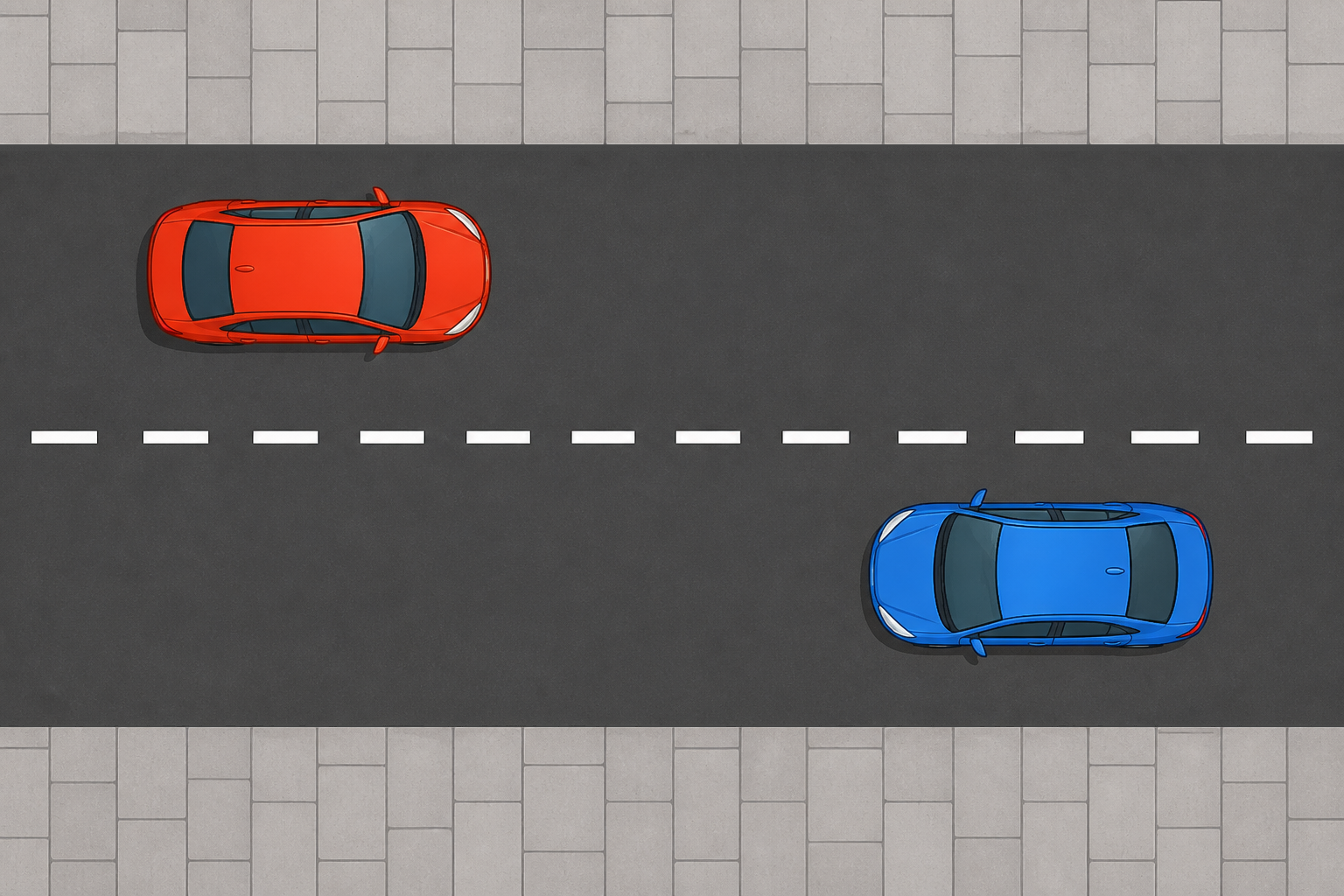
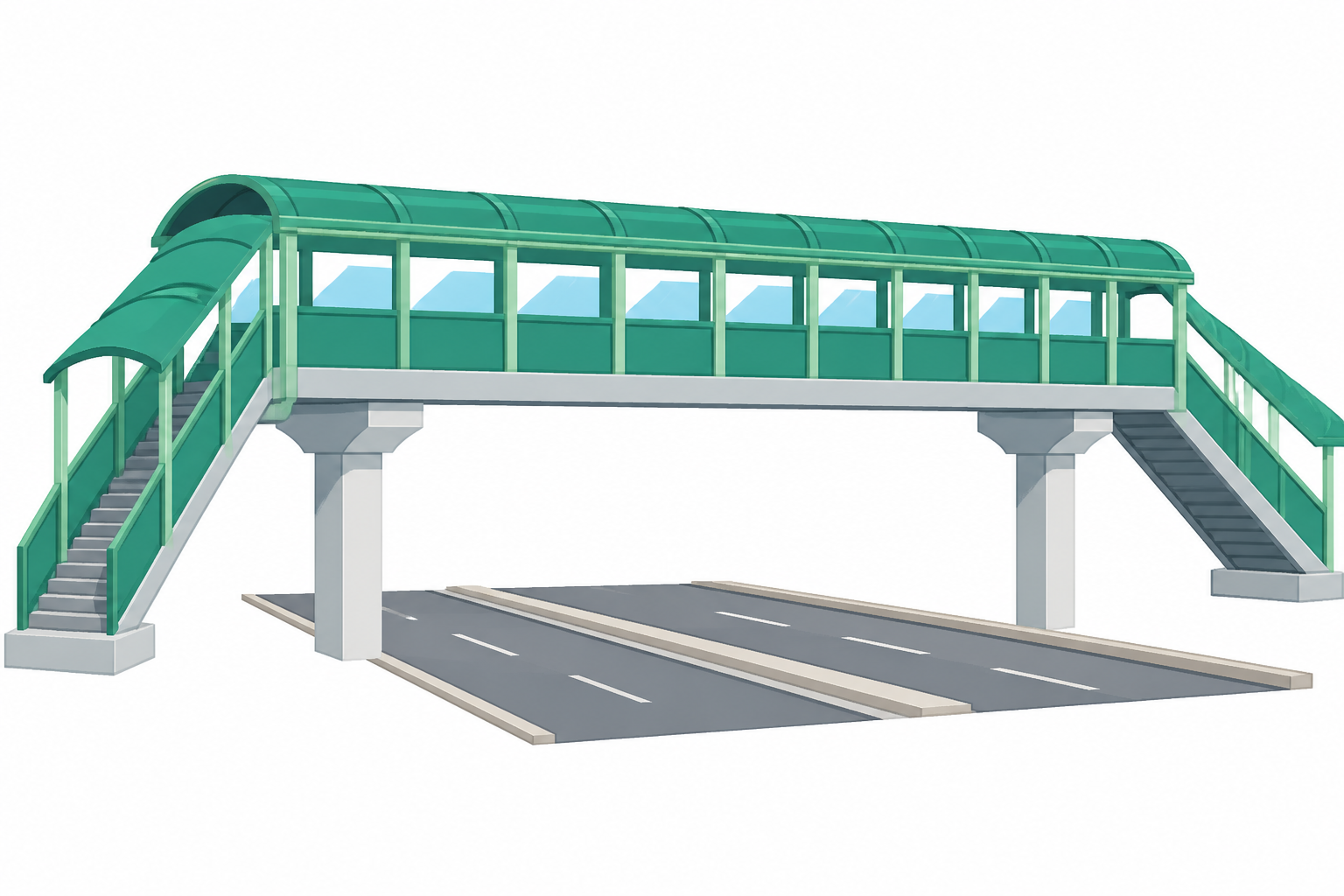
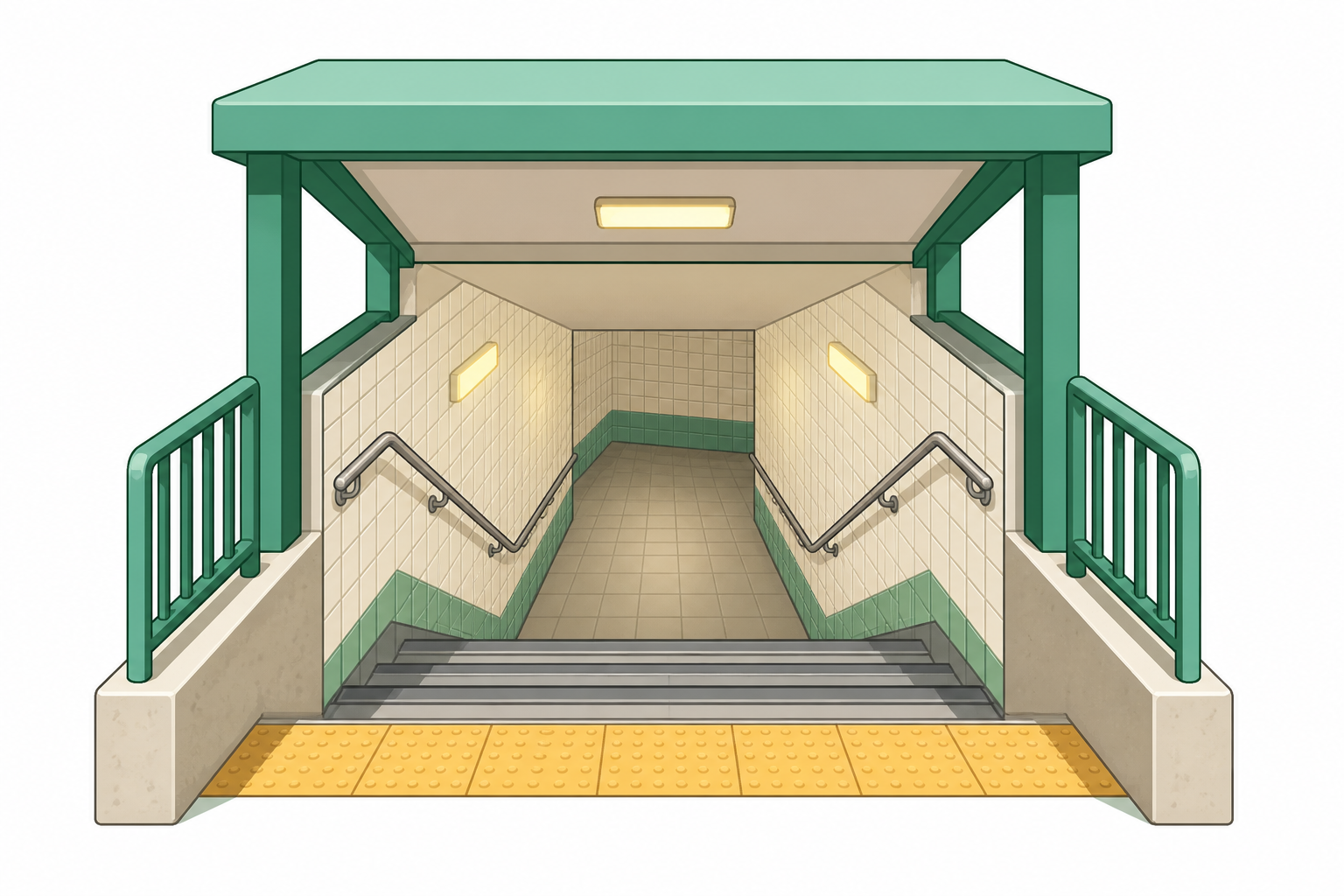
Listen to the words for things we see on the street. Match each word to the correct picture.
| 1. | 2. | 3. |
 |  |  |
| ________ | ________ | ________ |
| road (for vehicles) | bridge | subway (pedestrian crossing) |
Step 2
Listen to a phone conversation. The speakers will meet at a specific place. They will talk about directions for getting there. Arrange the following steps in the correct order.
| A. | 轉左 zyun2 zo2 |
| B. | 行天橋過對面 haang4 tin1 kiu4 gwo3 deoi3 min6 |
| C. | 向公園嗰邊行 hoeng3 gung1 jyun2 go2 bin6 haang4 |
| D. | 直行 zik6 haang4 |
____ → ____ → ____ → ____
| A | |
| B | |
| A | |
| B | |
| A | |
| B |
Step 3
Listen to the conversation again. Read the script while listening. Check your answers.
| A | 喂? wai2? Hello? |
| B | 你喺邊度呀? nei5 hai2 bin1 dou6 aa3? Where are you? |
| A | 我而家喺地鐵站呀,我應該點行呀? ngo5 ji4 gaa1 hai2 dei6 tit3 zaam6 aa3, ngo5 jing1 goi1 dim2 haang4 aa3? I am at the subway station now. How should I walk? |
| B | 你首先向公園嗰邊行,跟住會有條天橋,你行天橋過對面,之後轉左,跟住直行就到。 nei5 sau2 sin1 hoeng3 gung1 jyun2 go2 bin6 haang4, gan1 zyu6 wui5 jau5 tiu4 tin1 kiu4, nei5 haang4 tin1 kiu4 gwo3 deoi3 min6, zi1 hau6 zyun3 zo2, gan1 zyu6 zik6 haang4 zau6 dou3. First, walk toward the park that direction. And then, there will be a bridge. Take the bridge to go over to the opposite side. And that, turn left. And then, if you walk straight, then you arrive. |
| A | 好,一陣見。 hou2, jat1 zan6 gin3. Good. [= Okay.] See you later. |
| B | 一陣見。 jat1 zan6 gin3. See you later. |
- 條 tiu4 = (Classifier for 馬路 maa5 lou6, 天橋 tin1 kiu4 and 隧道 seoi6 dou6)
Step 4
Listen and repeat.
Step 5
Replace the highlighted words in the script with the words below to make your own conversations.
Grammar and Vocabulary
In the Grammar and Vocabulary section, you will learn:
- The Preposition 沿 jyun4 (‘along’)
- The Verbal Particle 到 / 倒 dou2 (‘to be able to’)
- Comparison Between 到 / 倒 dou2 and 咗 zo2
- The Verbal Particle 返 / 番 / 翻 faan1 III (‘back’)
- The Adverb 就 zau6 II (‘exactly’)
- The Adverb 再 zoi3 I (‘further’)
- The Conjunctions 之前 zi1 cin4 (‘before’) and 之後 zi1 hau6 (‘after’)
- Serial Verb Constructions VI (Successive Actions)
- Vocabulary List
- Vocabulary: Places in a Community III
- Vocabulary: Roads
- Vocabulary: Directions on the Street
39.1 The Preposition 沿 jyun4 (‘along’)
The preposition 沿 jyun4 means ‘along’. We use 沿 jyun4 to indicate movement that follows a path. We put the path after 沿 jyun4 to form a prepositional phrase. The path is often a street.
We usually add the aspect particle 住 zyu6 after 沿 jyun4. 住 zyu6 here indicates that the state of following the path is continuous. We haven’t learned this use of 住 zyu6 yet. For now, simply remember 沿住 zyu6 jyun4 as a fixed expression.
We put the prepositional phrase before the verb we want to modify.
39.2 The Verbal Particle 到 / 倒 dou2 (‘to be able to’)
We use the verbal particle 到 dou2 (also written as 倒) to indicate that we are able to complete an action or have completed an action successfully. It functions like to be able to in English (as in I was able to find the subway station).
We put 唔 m4 (‘not’) before 到 dou2 to negate 到 dou2.
We also add 到 dou2 after a verb of perception (見 gin3 ‘to see’, 聽 teng1 ‘to hear’, 聞 man4 ‘to smell’, etc.) to indicate that we are able to perceive something. We put the thing we perceive after 到 dou2.
Notice we don’t add a classifier before 公園 gung1 jyun2 for this meaning.We can also add 到 dou2 when forming yes-no questions with the X-not-X construction.
To answer the questions, we can give a long answer or a short answer. We give a short answer more often. In the short answers, we will keep 到 dou2.
⚠️ The verbal particle 到 dou2 (‘to be able to’) and the verbal particle 到 dou3 (arrival) are different in their tone. We say 到 dou2 with the high rising tone and 到 dou3 with the mid level tone.
39.3 Comparison Between 到 / 倒 dou2 and 咗 zo2
Both the verbal particle 到 dou2 (also written as 倒) and the aspect particle 咗 zo2 indicate that an action has been completed, but 到 dou2 emphasizes the success of completing the action. We often use 到 dou2 when the action is something that we weren’t sure we could complete, considering the situation. It can also be an action that we had failed to complete previously. Compare:
我上咗巴士。
ngo5 soeng5 zo2 baa1 si2.
I have got on the bus.
我上到巴士。
ngo5 soeng5 dou2 baa1 si2.
I was able to get on the bus.
[= I have got on the bus successfully.]
One possible situation to use 到 dou2 here is that the speaker wasn’t sure he or she could catch the bus before getting to the bus stop.
我買咗雞蛋。
ngo5 maai5 zo2 gai1 daan2.
I have bought eggs.
我買到雞蛋。
ngo5 maai5 dou2 gai1 daan2.
I was able to buy eggs.
[= I have bought eggs successfully.]
One possible situation to use 到 dou2 here is that the speaker wasn’t sure the supermarket was already closed before getting there to buy the eggs.
39.4 The Verbal Particle 返 / 番 / 翻 faan1 III (‘back’)
In Grammar and Vocabulary 34.4, we learned that the verbal particle 返 faan1 (also written as 番 or 翻) can add the meaning of ‘back’ to the sentence (as in let me give you back the card), and we can use 返 faan1 to indicate that something is returned to someone.
We can also use 返 faan1 to indicate that someone moves back to their original or previous location. In this use, we often use 返 faan1 with a verb involving moment of a person.
We can use 返 faan1 with 去 heoi3 (‘to go’) or 嚟 lai4 (‘to come’).
We can also use 返 faan1 with a directional verb.
If 去 heoi3 or 嚟 lai4 is added after the directional verb to indicate the direction of the movement, we put 返 faan1 between the directional verb and 去 heoi3 or 嚟 lai4.
It is possible to use the verbal particle 返 faan1 with the directional verb 返 faan1 (‘to go back; to come back’, also written as 番 and 翻).
We also often use the verbal particle 返 faan1 with the verb 行 haang4 (‘to walk’). If we want to indicate the destination, we can add 去 heoi3 or 嚟 lai4. We put 返 faan1 between 行 haang4 and 去 heoi3 or 嚟 lai4.
If we don’t want to indicate the location explicitly, we can use the separable verb 返轉頭 faan1 zyun3 tau4 (‘to go back’, usually along the same path). We put the verbal particle 返 faan1 between the verb part 返 faan1 and the object part 轉頭 zyun3 tau4.
39.5 The Adverb 就 zau6 II (‘exactly’)
In Grammar and Vocabulary 17.11, we learned that we can use the adverb 就 zau6 to show determination.
The adverb 就 zau6 can mean ‘exactly’. We can add 就 zau6 before 係 hai6 (‘to be’) to emphasize that something is exactly something.
對面就係圖書館。
deoi3 min6 zau6 hai6 tou4 syu1 gun2.
The opposite is exactly the library.
前邊就係信和中心。
cin4 bin6 zau6 hai6 seon3 wo2 zung1 sam1.
The front is exactly the Sino Centre.
We can also add 就 zau6 before 喺 hai2 (‘to be in, on or at’) to emphasize that something is exactly in, on or at a specific location.
圖書館就喺對面。
tou4 syu1 gun2 zau6 hai2 deoi3 min6.
The library is exactly on the opposite side.
信和中心就係前邊。
seon3 wo2 zung1 sam1 zau6 hai6 cin4 bin6.
The Sino Centre is exactly in front.
39.6 The Adverb 再 zoi3 I (‘further’)
In Grammar and Vocabulary 24.13, we learned that the adverb 再 zoi3 means ‘again’.
你見到公園就再打俾我。
nei5 gin3 dou2 gung1 jyun2 zau6 zoi3 daa2 bei2 ngo5.
When you see the park, then call me again.
The adverb 再 zoi3 can also add the meaning of ‘further’ to a sentence. We can use 再 zoi3 to indicate an action or a state is continued further for a longer distance or period.
你要再行多兩條街。
nei5 jiu3 zoi3 haang4 do1 loeng5 tiu4 gaai1.
You need to walk further for two more streets.
你再揾唔到就問下人啦。
nei5 zoi3 wan2 m4 dou2 zau6 man6 haa5 jan4 laa1.
If you are not able to find it further, then ask people.
[= If you are still not able to find it, then ask people.]
39.7 The Conjunctions 之前 zi1 cin4 (‘before’) and 之後 zi1 hau6 (‘after’)
We can use the conjunctions 之前 zi1 cin4 (‘before’) and 之後 zi1 hau6 (‘after’) to indicate the temporal sequence of two actions in a sentence.
We put 之前 zi1 cin4 (‘before’) after the action happening later in the sentence. If the two actions have the same subject, we often omit the subject in one of the two actions.
We put 之後 zi1 hau6 (‘after’) after the action happening first in the sentence. Again, if the two actions have the same subject, we often omit the subject in one of the two actions.
Notice above that 之前 zi1 cin4 or 之後 zi1 hau6 is put after the action, but not before the action like in English.
39.8 Serial Verb Constructions VI (Successive Actions)
In Grammar and Vocabulary 8.5, 16.4, 18.2, 23.2 and 38.9, we learned to form serial verb constructions.
We will see another meaning relationship in this lesson: the actions in the verb phrases happen in successive order. That is, the action in the first verb phrase happens first, and then the action in the second verb phrase happens next.
The first verb phrase 行到去最尾 haang4 dou3 heoi3 zeoi3 mei5 and the second verb phrase 轉右 zyun3 jau6 are successive actions. The speaker asks the listener to first walk to the end and then turn right. The first verb phrase 上返嚟 soeng5 faan1 lai4 and the second verb phrase 轉左 zyun3 zo2 are successive actions. The speaker asks the listener to first come back up and then turn left.39.9 Vocabulary List
39.10 Vocabulary: Places in a Community III
The rightmost column is the classifiers we use with the nouns.
39.11 Vocabulary: Roads
The classifier 條 tiu4 is used with things in a long shape. We will use it with several things below.
The rightmost column is the classifiers we use with the nouns.
39.12 Vocabulary: Directions on the Street
Below are some common expressions for giving directions on the street.
Communication
In the Communication section, you will learn:
- Finding a Place on the Street II
Finding a Place on the Street II
When we need to meet someone at a specific place, we may sometimes talk about directions for getting there over the phone.
Half an hour later… 😬
Route A: Yes
- We can put a modal verb before a predicative adjective. In this sentence, we put 應該 jing1 goi1 (‘should’) before 啱 ngaam1 (‘correct’). We will learn more about this in later books.
Route B: No
To ask a passer-by for directions, we can say:
Exercises
Exercise 1
Complete the descriptions.
1.
We use the preposition ________ to indicate movement that follows a path. We usually add the aspect particle ________ after it.
2.
We use the verbal particle ________ to indicate that we are able to complete an action or have completed an action successfully.
3.
We add ________ after a verb of perception (e.g., 見 gin3 ‘to see’) to indicate that we are able to perceive something.
4.
We can use the verbal particle ________ to indicate that someone moves back to their original or previous location.
5.
We can add the adverb ________ before 係 hai6 to emphasize that something is exactly something, or before 喺 hai2 to emphasize that something is exactly in, on or at a specific location.
6.
We can use the adverb ________ to indicate an action or a state is continued further for a longer distance or period.
7.
We can use the conjunctions ________ and ________ to indicate the temporal sequence of two actions in a sentence.
Exercise 2
Add the words in brackets to each sentence. Then, listen to the recordings to check your answers. Finally, repeat after the recordings.
Example
你沿彌敦道行。 (住)
nei5 jyun4 nei4 deon1 dou6 haang4. (zyu6)
nei5 jyun4 zyu6 nei4 deon1 dou6 haang4.
Walk along Nathan Road.
1.
對面係醫院。 (就)
deoi3 min6 hai6 ji1 jyun2. (zau6)
2.
你行去巴士站。 (返)
nei5 haang4 heoi3 baa1 si2 zaam6. (faan1)
3.
你行多一個街口。 (再)
nei5 haang4 do1 jat1 go3 gaai1 hau2. (zoi3)
4.
你沿左邊條街行兩個街口。 (住)
nei5 jyun4 zo2 bin6 tiu4 gaai1 haang4 loeng5 go3 gaai1 hau2. (zyu6)
5.
巴士站喺前邊。 (就)
baa1 si2 zaam6 hai2 cin4 bin6. (zau6)
6.
我見到消防局。 (唔)
ngo5 gin3 dou2 siu1 fong4 guk2. (m4)
7.
你行嚟火車站。 (返)
nei5 haang4 lai4 fo2 ce1 zaam6. (faan1)
8.
你行多三條街。 (再)
nei5 haang4 do1 saam1 tiu4 gaai1. (zoi3)
Exercise 3
Listen to A and complete B. Then, listen to the recordings to check your answers. Finally, repeat after the recordings.
Example
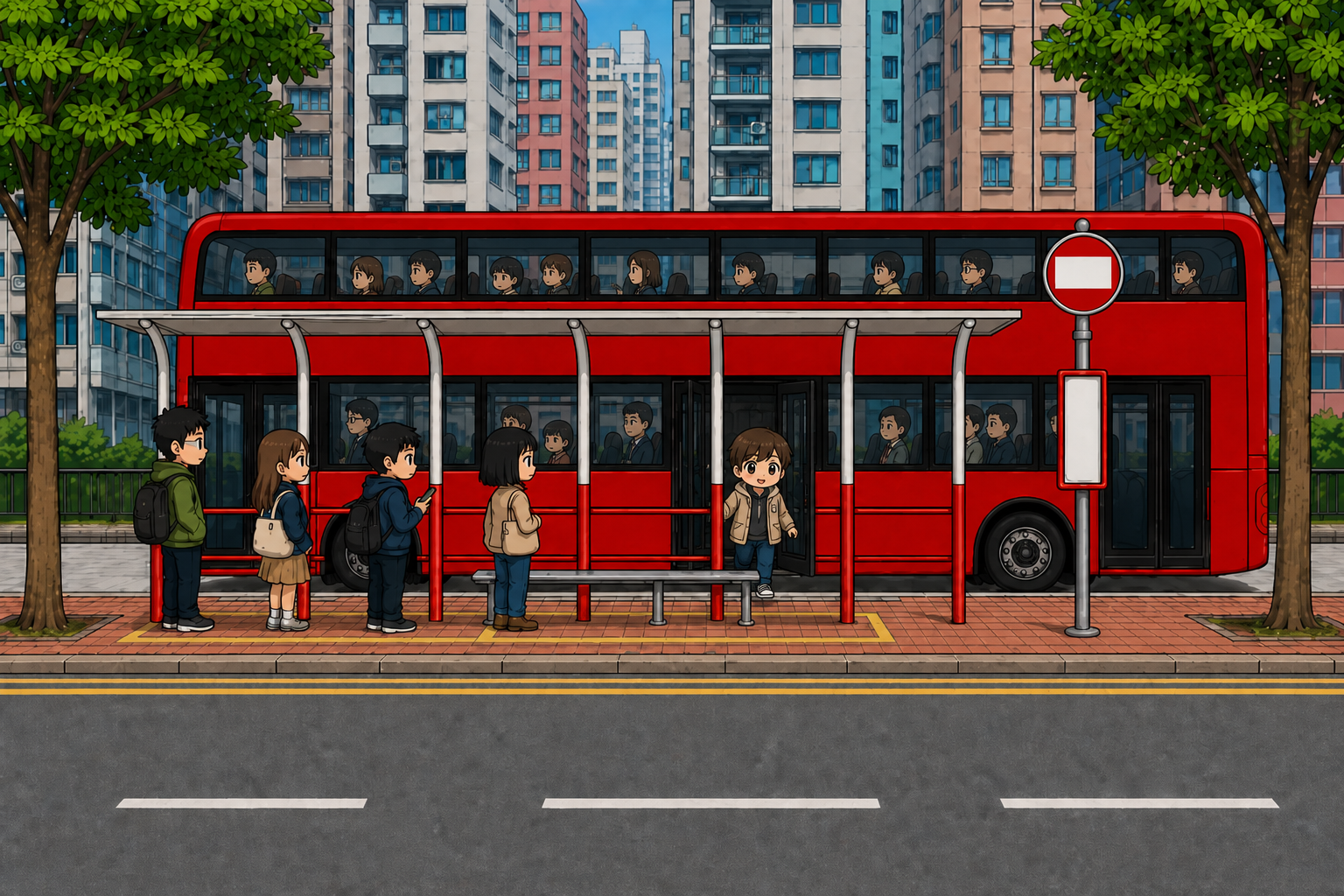
| A | 你見唔見到個巴士站呀? nei5 gin3 m4 gin3 dou2 go3 baa1 si2 zaam6 aa3? Do you see a bus stop? |
| B | 見到呀,我見到個巴士站呀。 gin3 dou2 aa3, ngo5 gin3 dou2 go3 baa1 si2 zaam6 aa3. Yes, I see a bus stop. ⭐ Give both long and short answers in this exercise. |
1.
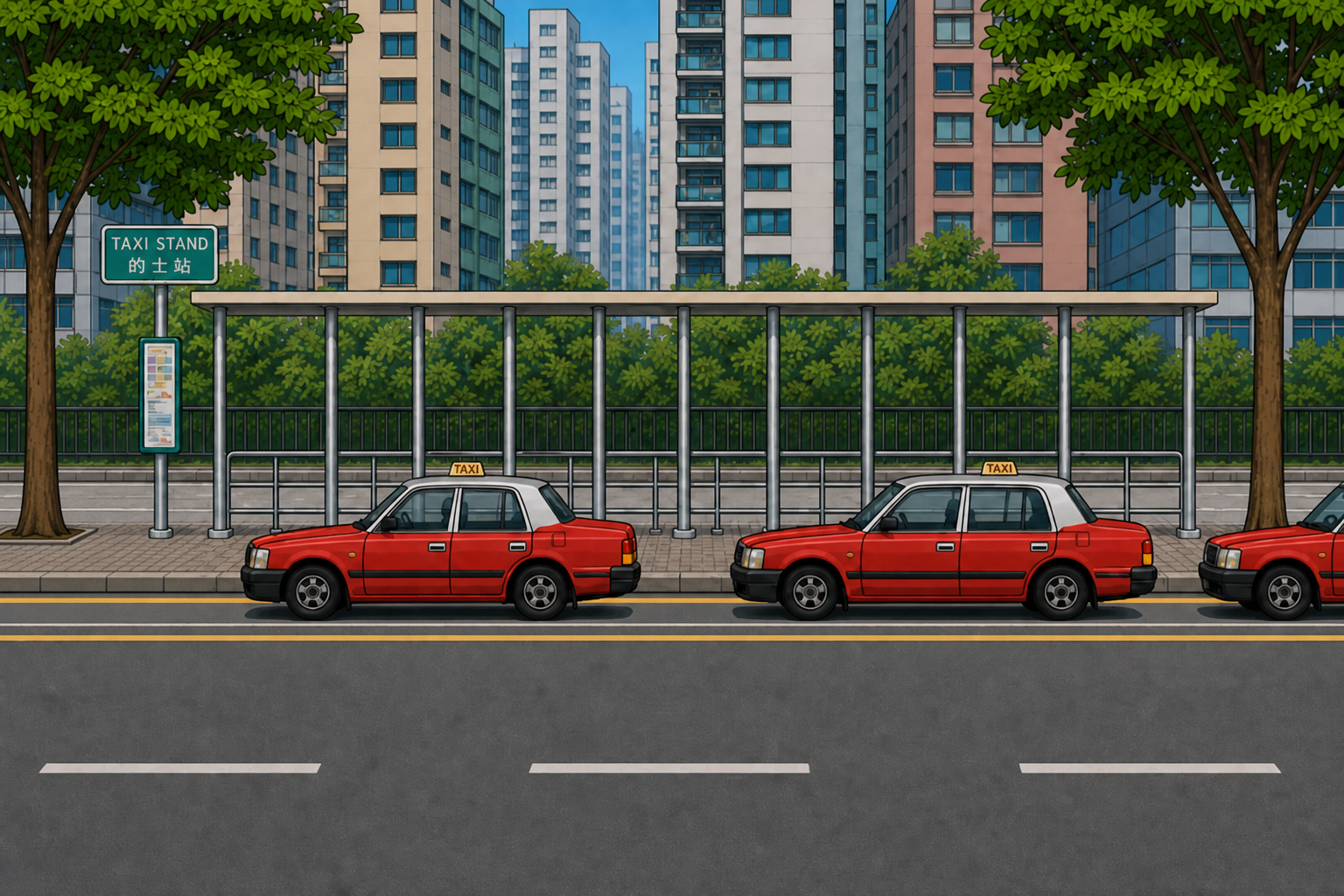
| A | ________ |
| B | ________ |
2.
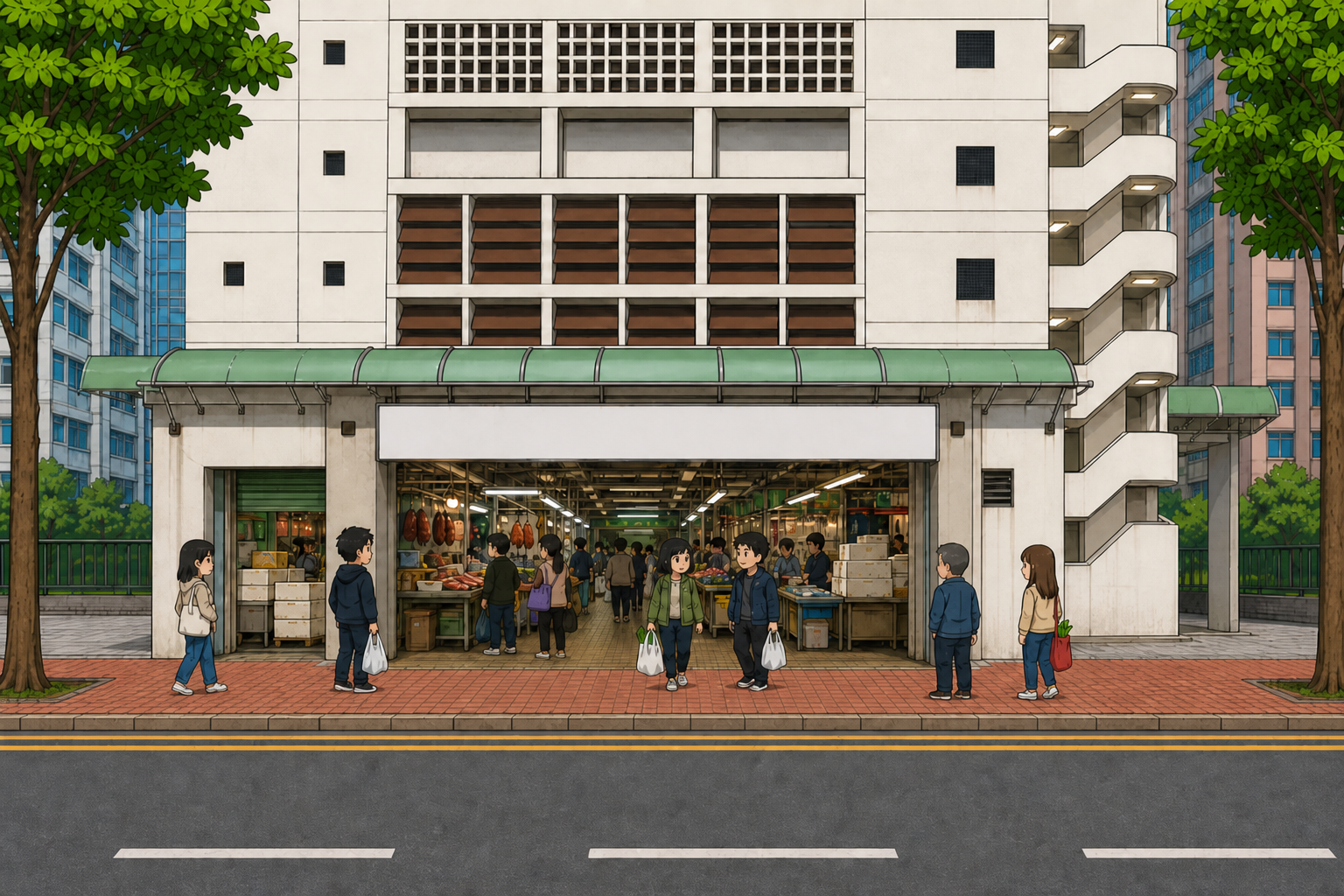
| A | ________ |
| B | ________ |
3.
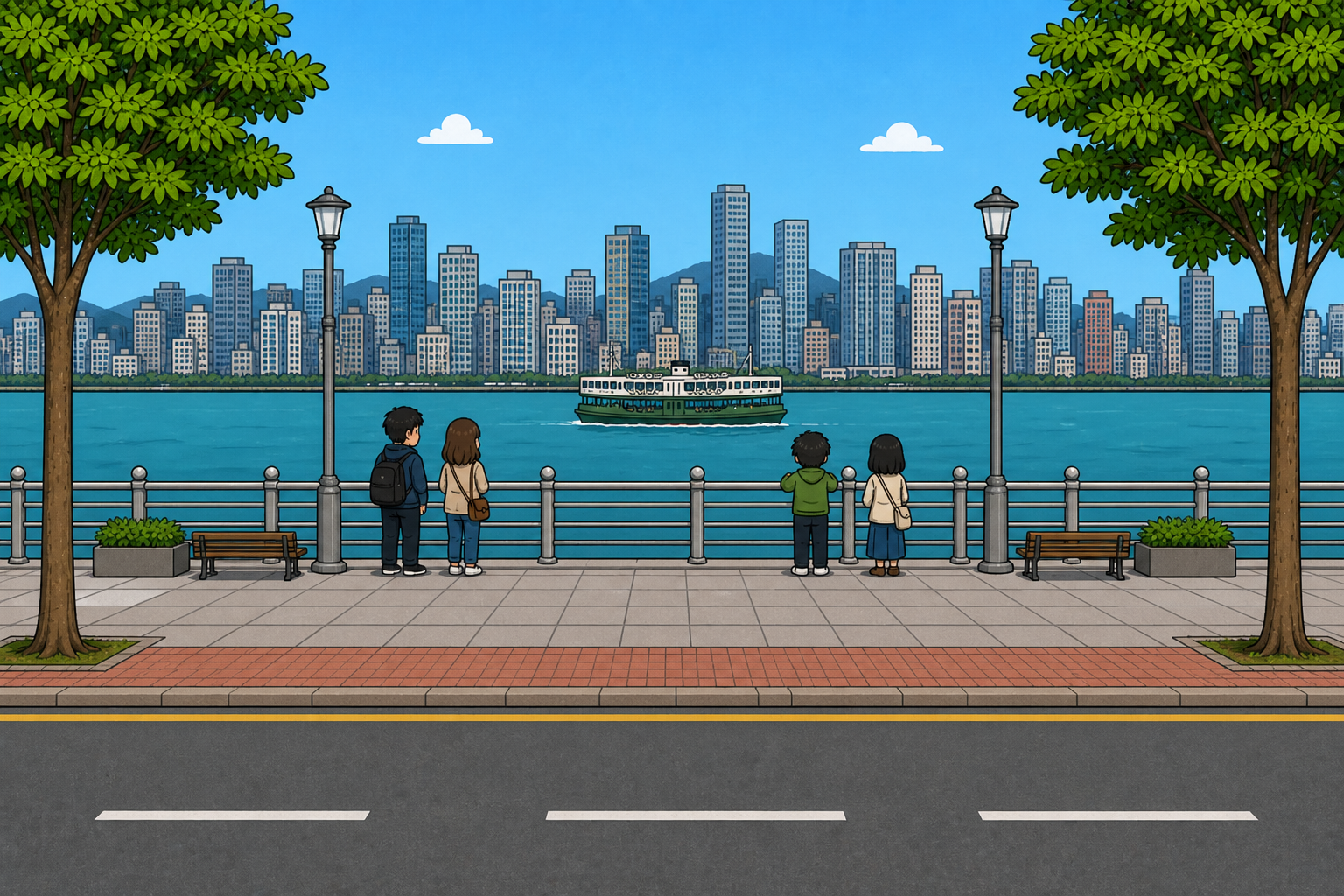
| A | ________ |
| B | ________ |
4.
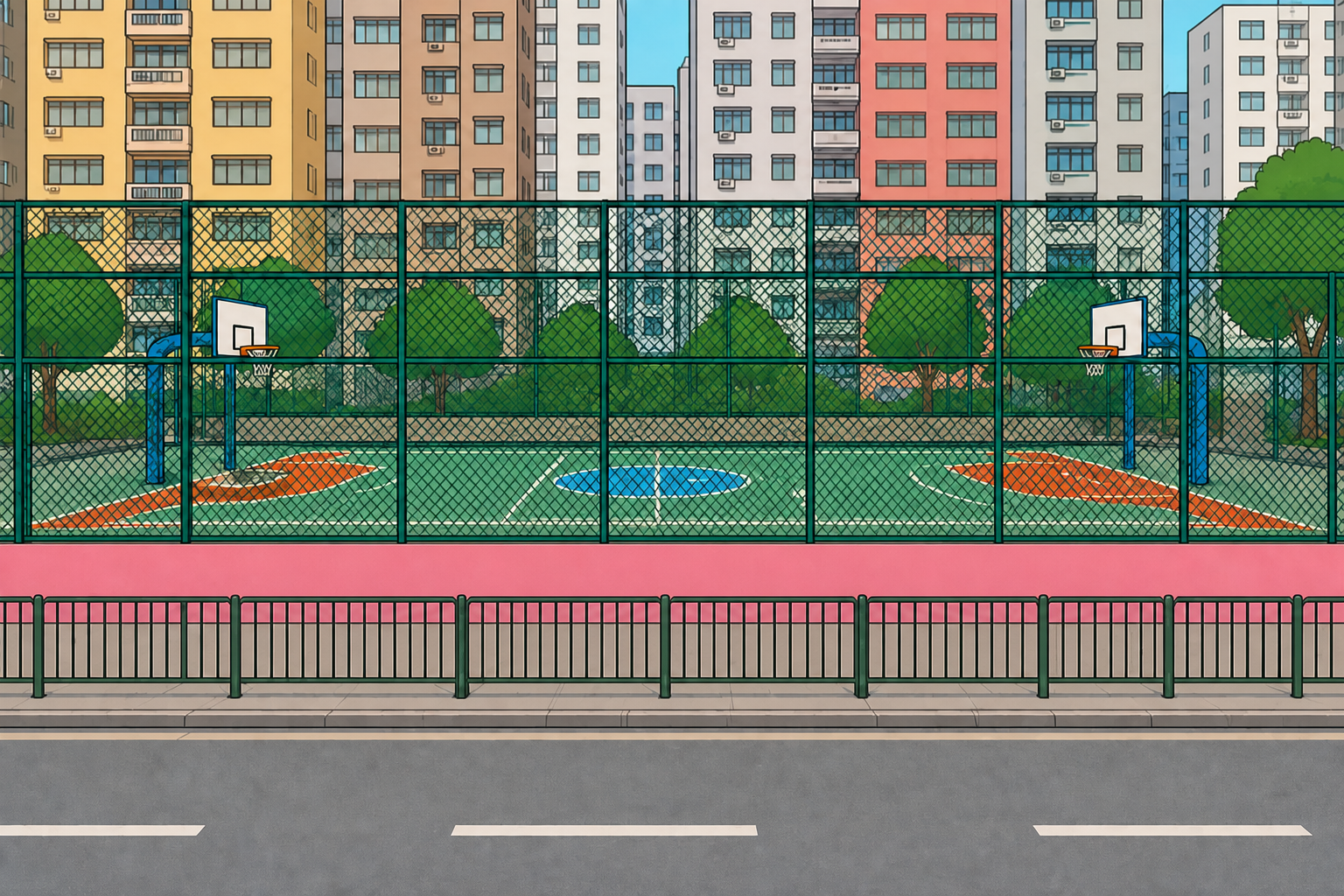
| A | ________ |
| B | ________ |
5.
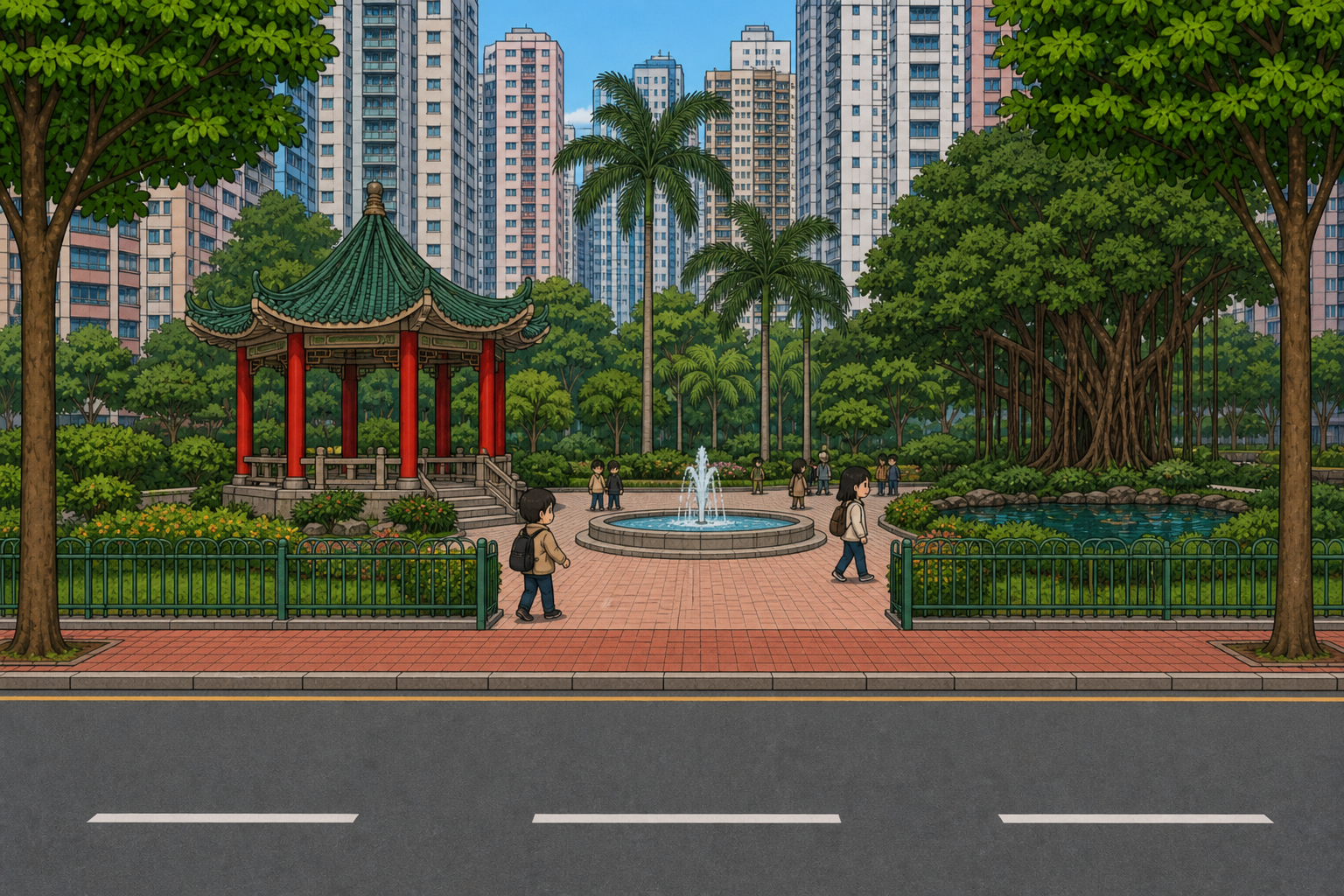
| A | ________ |
| B | ________ |
6.
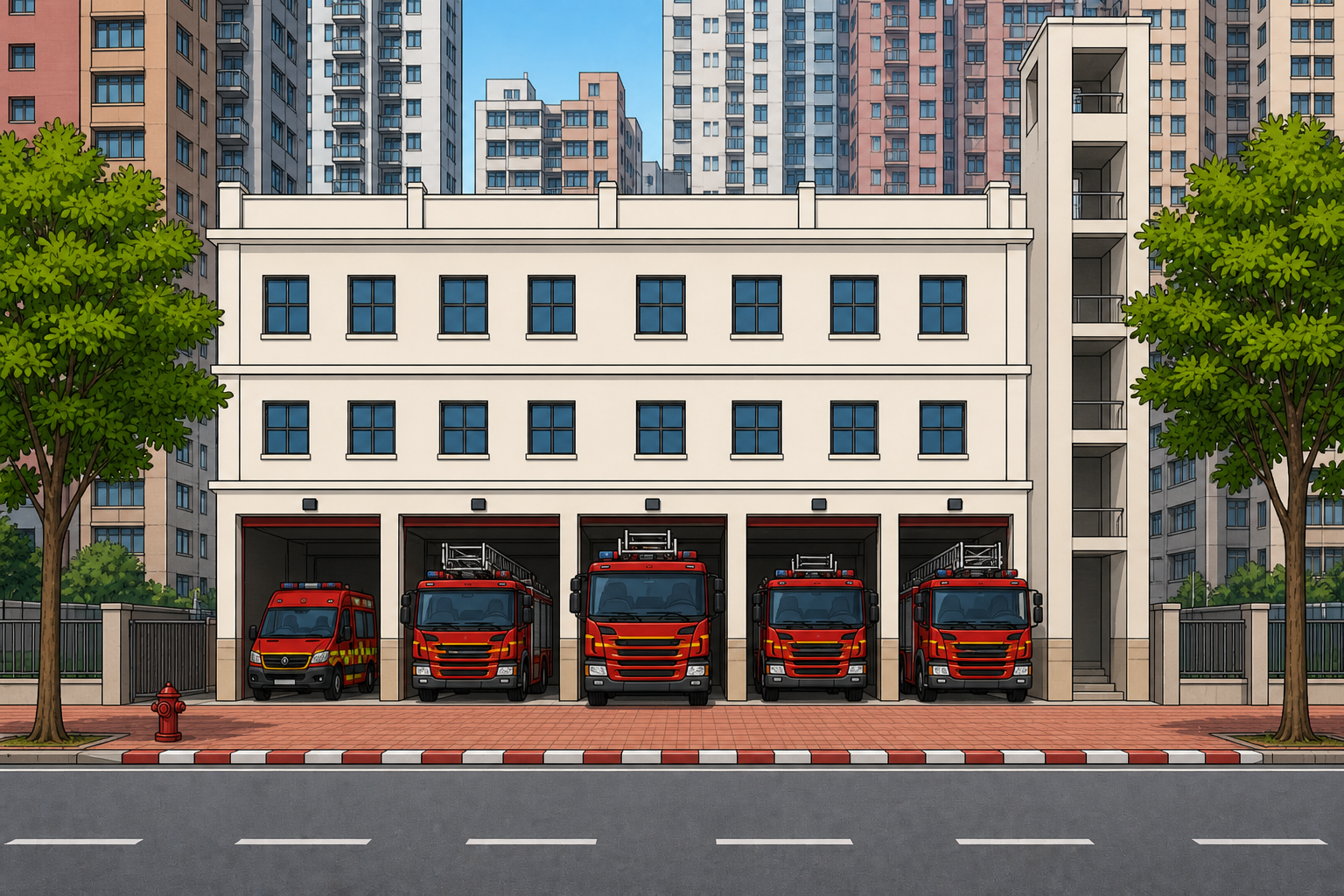
| A | ________ |
| B | ________ |
Exercise 4
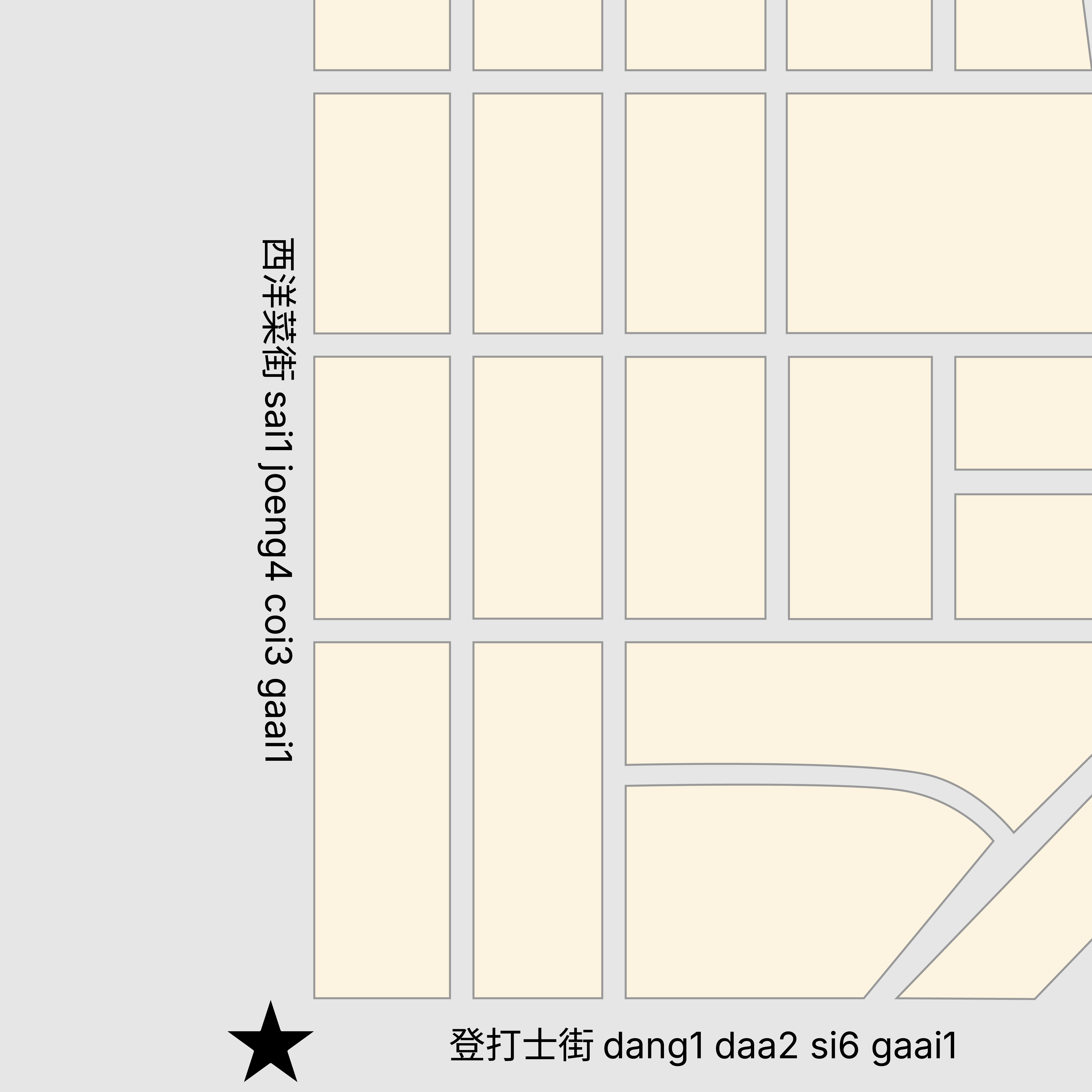
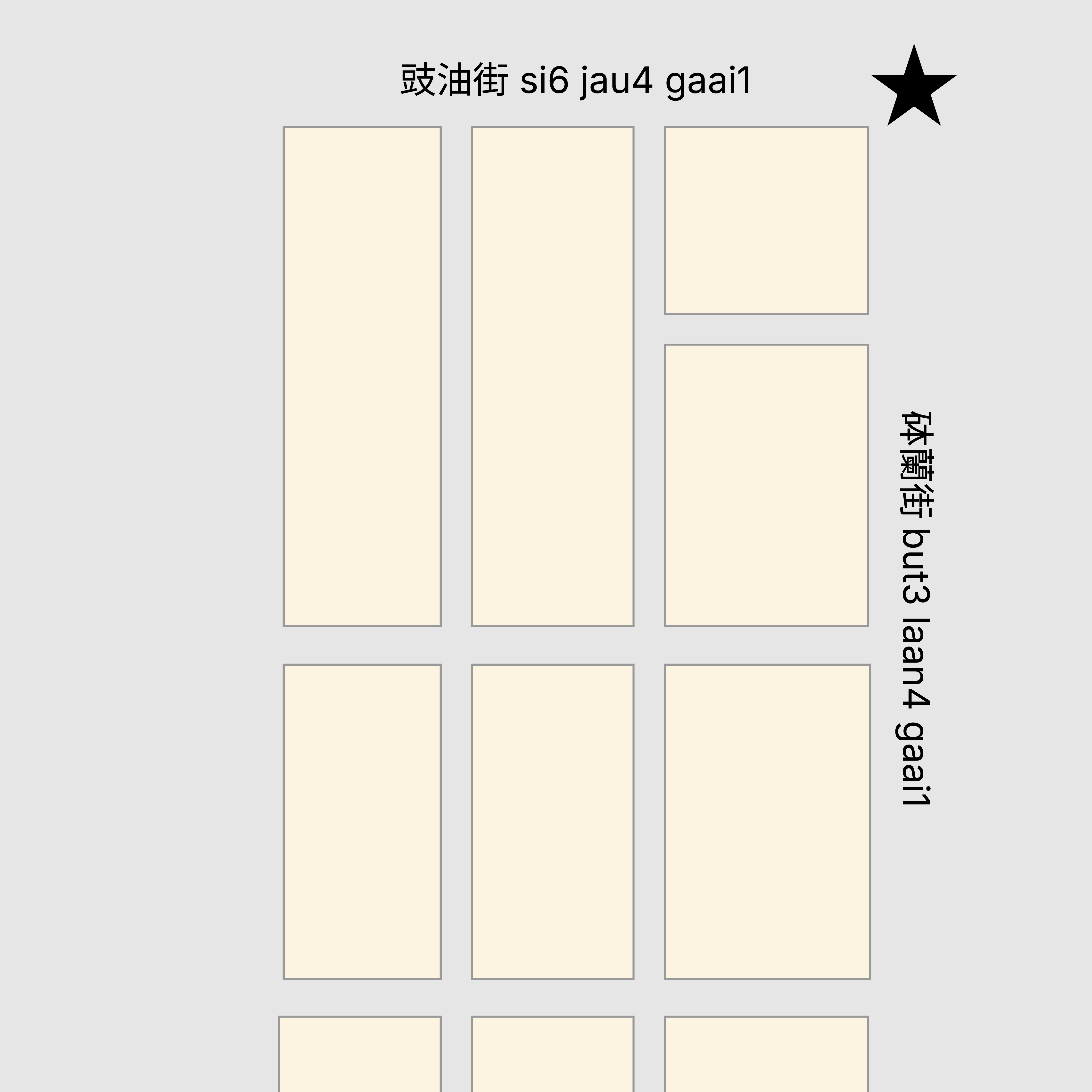
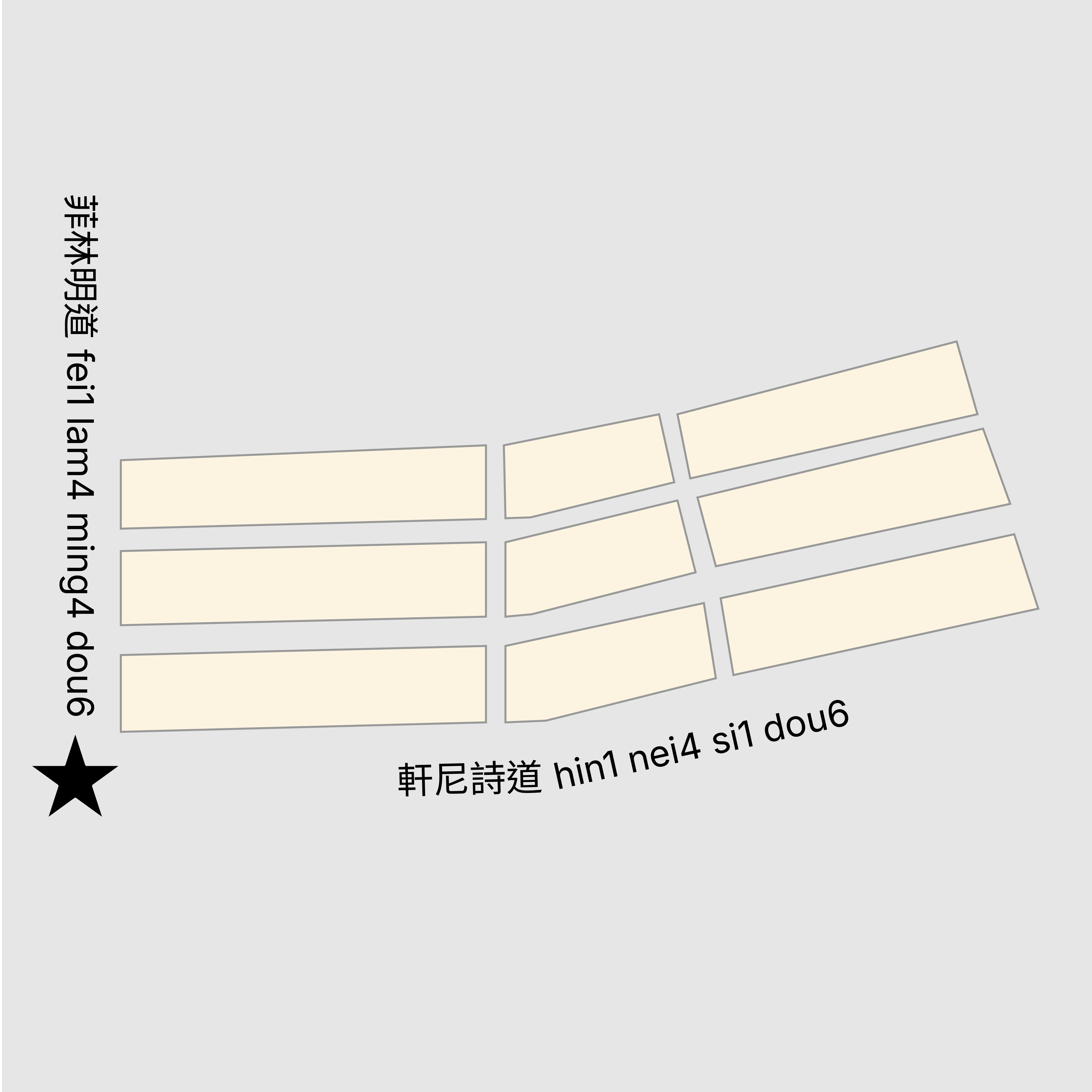
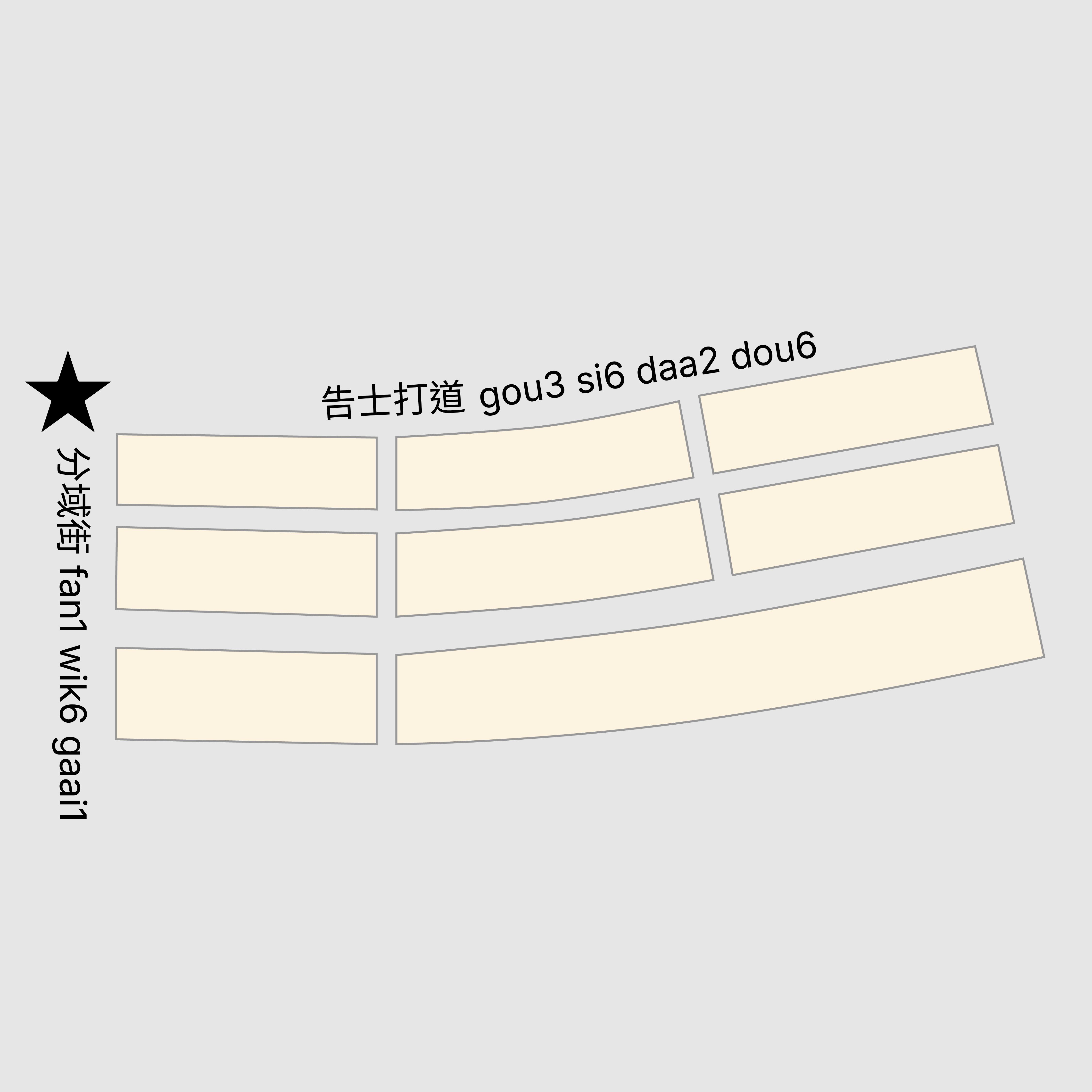
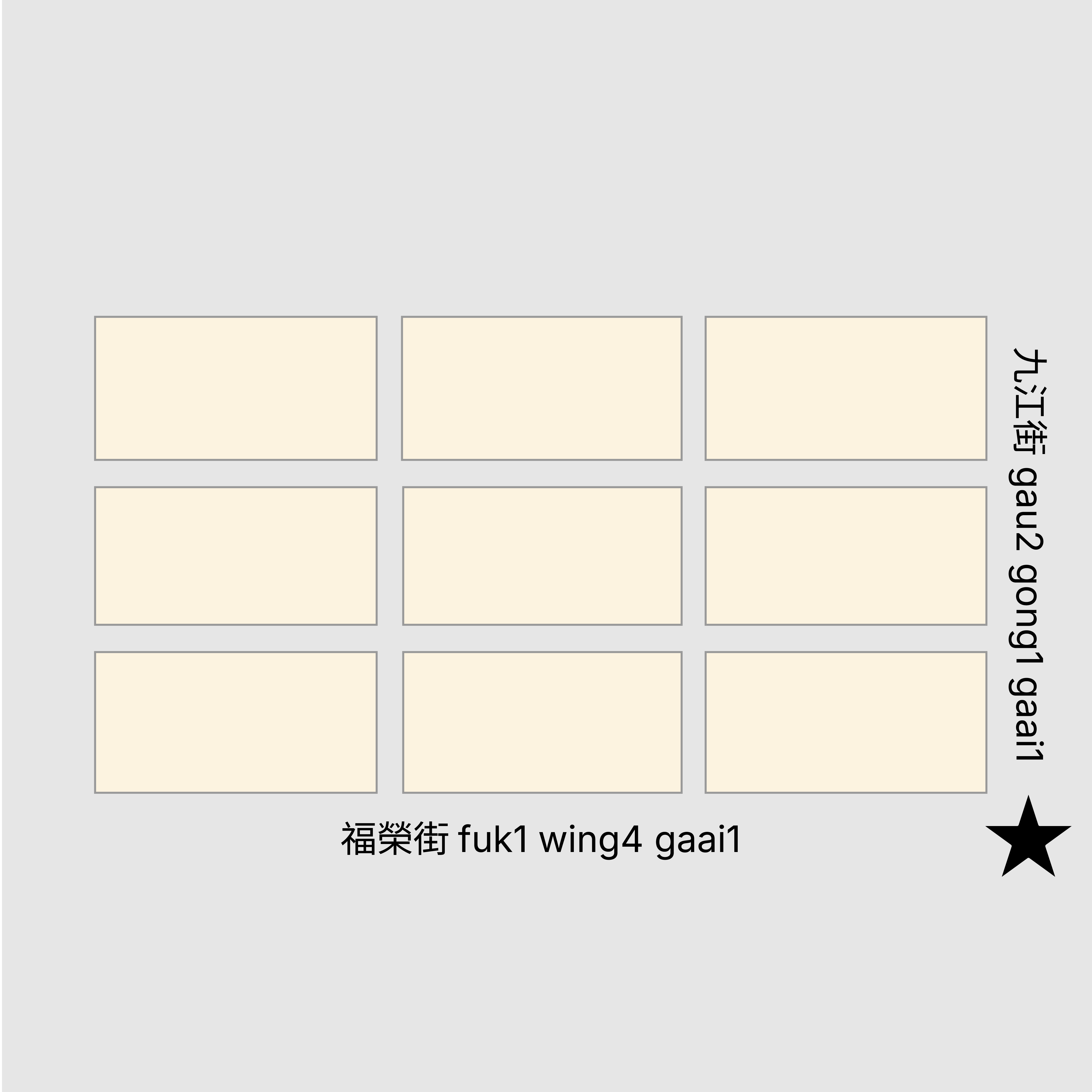
For each question, listen to the sentence and draw the route on the map. Then, repeat after the recordings.
Example
你沿住彌敦道行兩條街。
nei5 jyun4 zyu6 nei4 deon1 dou6 haang4 loeng5 tiu4 gaai1.
Walk along Nathan Road for two streets.
⭐ The star indicates your current location.
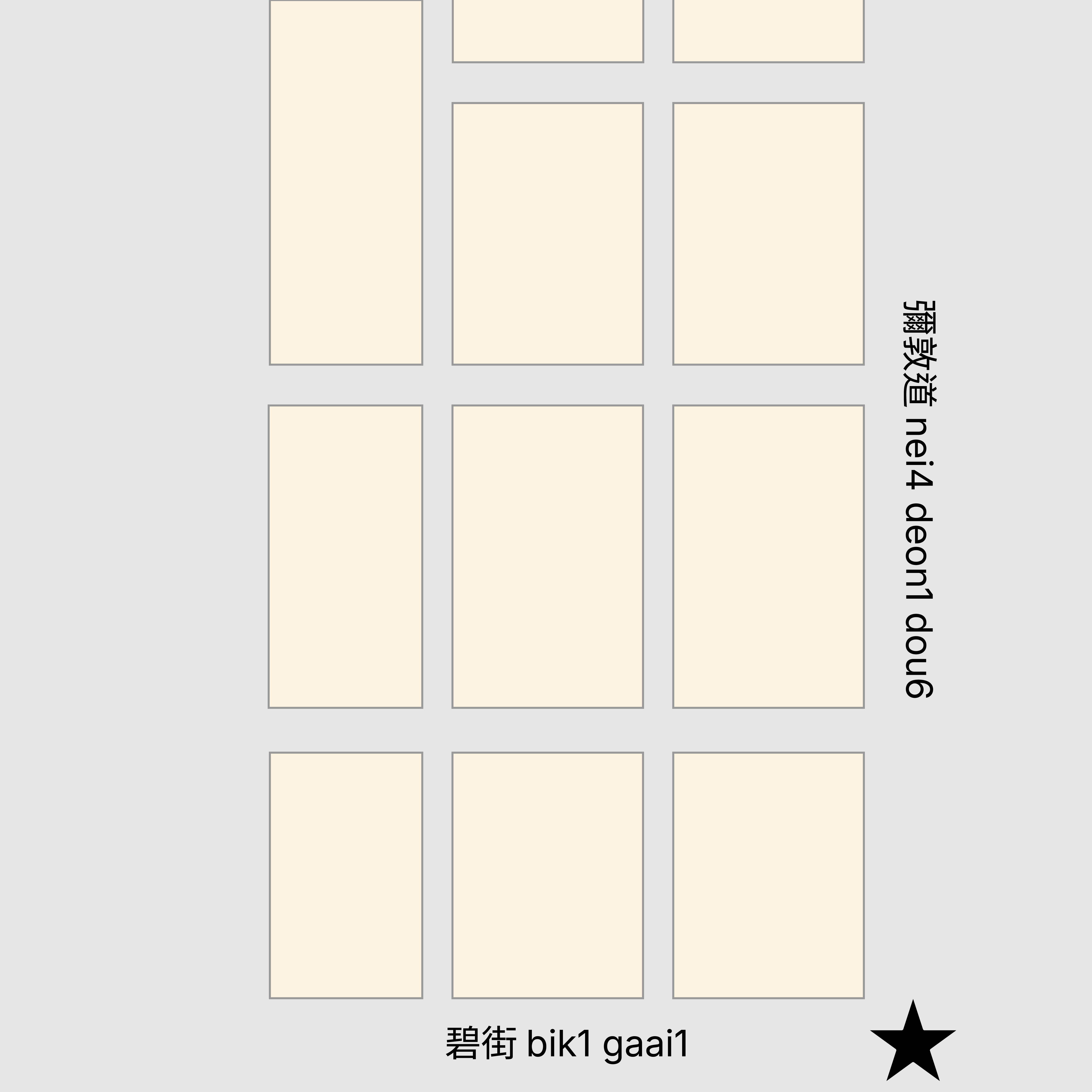
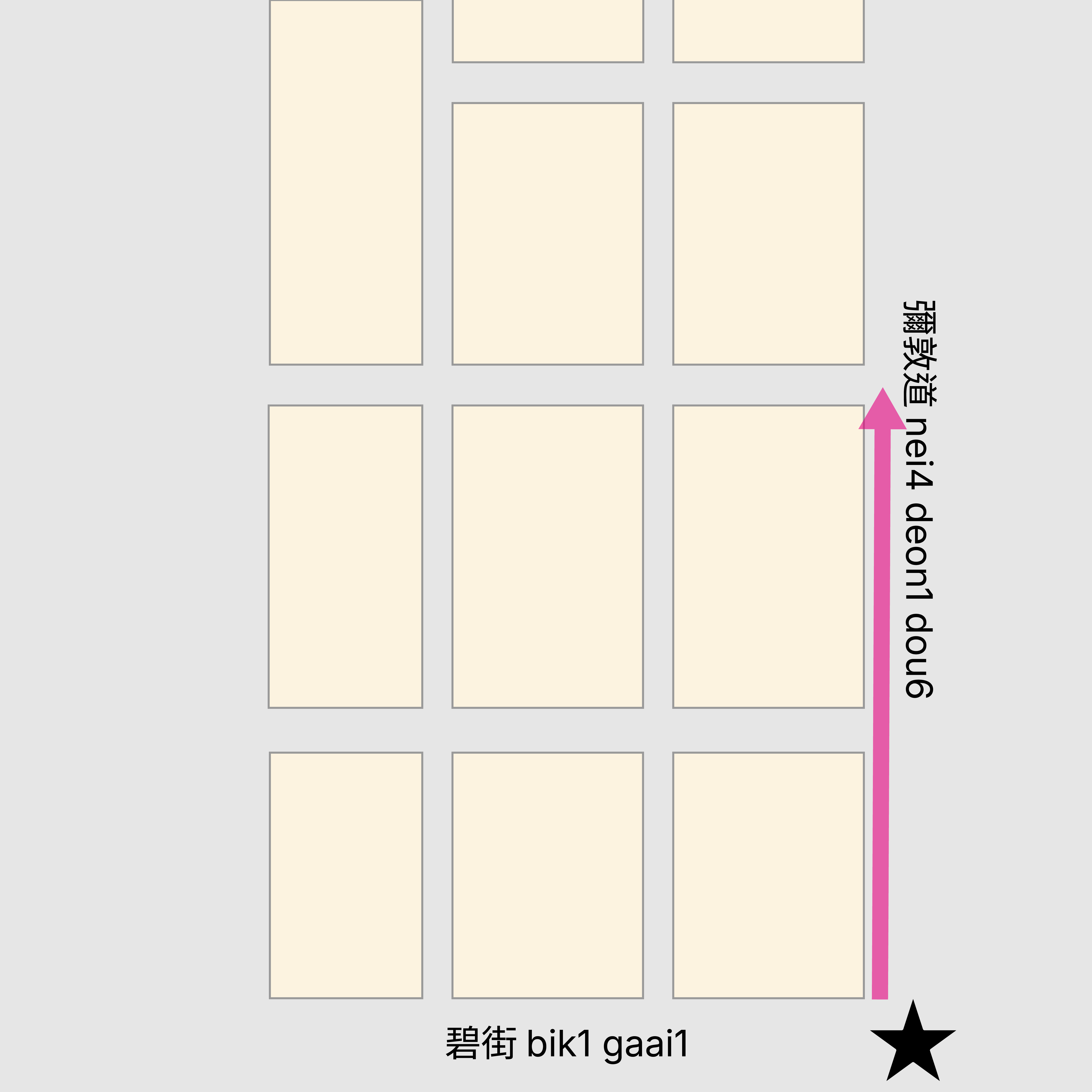
1.
________
2.
________
3.
________
4.
________
5.
________
Exercise 5
For each question, listen to the directions and write down the route. Then, repeat after the recordings.
Example
你首先向地鐵站嗰個方向行,
nei5 sau2 sin1 hoeng3 dei6 tit3 zaam6 go2 go3 fong1 hoeng3 haang4,
First, walk toward the subway station that direction.
行兩條街之後會見到條隧道,
haang4 loeng5 tiu4 gaai1 zi1 hau6 wui5 gin3 dou2 tiu4 seoi6 dou6,
After you walk for two streets, you will see a subway.
你行隧道過對面,過到對面之後直行轉左。
nei5 haang4 seoi6 dou6 gwo3 deoi3 min6, gwo3 dou3 deoi3 min6 zi1 hau6 zik6 haang4 zyun3 zo2.
Take the subway to go over to the opposite side. After you have gone over to the opposite side, walk straight and turn left.
hoeng3 dei6 tit3 zaam6 go2 go3 fong1 hoeng3 haang4 → haang4 loeng5 tiu4 gaai1 → haang4 seoi6 dou6 gwo3 deoi3 min6 → zik6 haang4 → zyun3 zo2
1.
________
________
________
2.
________
________
________
3.
________
________
________
4.
________
________
________
5.
________
________
________
6.
________
________
________
Activities
Disclaimer: The maps below are not real.
Activity 1
Listen to two phone conversations. The speakers will meet at a specific place. They will talk about directions for getting there. Correct the mistakes in the routes below.
Conversation 1
Route
| A | |
| B | |
| A | |
| B | |
| A | |
| B | |
| A | |
| B |
Conversation 2
Route
| A | |
| B | |
| A | |
| B | |
| A | |
| B | |
| A | |
| B |
Transcripts with Translation
Conversation 1
| A | 喂? wai2? Hello? |
| B | 你而家去到邊度呀? nei5 ji4 gaa1 heoi3 dou3 bin1 dou6 aa3? Where have you gone to now? |
| A | 我而家喺巴士站呀,我唔識路呀。 ngo5 ji4 gaa1 hai2 baa1 si2 zaam6 aa3, ngo5 m4 sik1 lou6 aa3. I am at the bus stop now. I don’t know the way. |
| B | 你見唔見到個迴旋處呀?個迴旋處應該喺你嘅左手邊。 nei5 gin3 m4 gin3 dou2 go3 wui4 syun4 cyu5 aa3? go3 wui4 syun4 cyu5 jing1 goi1 hai2 nei5 ge3 zo2 sau2 bin6. Do you see a roundabout? The roundabout should be on your left-hand side. |
| A | 迴旋處⋯⋯迴旋處⋯⋯呀,我見到個迴旋處呀。 wui4 syun4 cyu5… wui4 syun4 cyu5… aa3, ngo5 gin3 dou2 go3 wui4 syun4 cyu5 aa3. Roundabout… Roundabout… Oh, I see a roundabout. |
| B | 你首先向迴旋處嗰個方向行,你行到街尾嗰陣時,會見到條天橋,你行天橋過對面,落咗天橋之後向左邊行,行三個街口就到。 nei5 sau2 sin1 hoeng3 wui4 syun4 cyu5 go2 go3 fong1 hoeng3 haang4, nei5 haang4 dou3 gaai1 mei5 go2 zan6 si4, wui5 gin3 dou2 tiu4 tin1 kiu4, nei5 haang4 tin1 kiu4 gwo3 deoi3 min6, lok6 zo2 tin1 kiu4 zi1 hau6 hoeng3 zo2 bin6 haang4, haang4 saam1 go3 gaai1 hau2 zau6 dou3. First, walk toward the roundabout that direction. When you have walked to the end of the street, you will see a bridge. Take the bridge to go over to the opposite side. After you have gone down from the bridge, walk toward the left. If you walk for three intersections, then you arrive. |
| A | 好,一陣見。 hou2, jat1 zan6 gin3. Good. [= Okay.] See you later. |
| B | 一陣見。 jat1 zan6 gin3. See you later. |
Conversation 2
| A | 喂? wai2? Hello? |
| B | 你而家去到邊度呀? nei5 ji4 gaa1 heoi3 dou3 bin1 dou6 aa3? Where have you gone to now? |
| A | 我啱啱落咗車,我應該點行呀? ngo5 ngaam1 ngaam1 lok6 zo2 ce1, ngo5 jing1 goi1 dim2 haang4 aa3? I have got off the vehicle just now. How should I walk? |
| B | 你而家見到咩呀? nei5 ji4 gaa1 gin3 dou2 me1 aa3? What do you see now? |
| A | 左邊有個球場,右邊有個商場。 zo2 bin6 jau5 go3 kau4 coeng4, jau6 bin6 jau5 go3 soeng1 coeng4. There is a field for ball games on the left. There is a shopping mall on the right. |
| B | 你首先向球場嗰邊行,行到街尾之後會見到條隧道,你落隧道,落到隧道之後轉左直行到尾,跟住轉右上返嚟,之後直行兩個街口,轉彎就到。 nei5 sau2 sin1 hoeng3 kau4 coeng4 go2 bin6 haang4, haang4 dou3 gaai1 mei5 zi1 hau6 wui5 gin3 dou2 tiu4 seoi6 dou6, nei5 lok6 seoi6 dou6, lok6 dou3 seoi6 dou6 zi1 hau6 zyun3 zo2 zik6 haang4 dou3 mei5, gan1 zyu6 zyun3 jau6 soeng5 faan1 lai4, zi1 hau6 zik6 haang4 loeng5 go3 gaai1 hau2, zyun3 waan1 zau6 dou3. First, walk toward the field for ball games that side. After you have walked to the end of the street, you will see a subway. Go down to the subway. After you have gone down to the subway, turn left and walk straight to the end. And then, turn right and come back up. After that, walk straight for two intersections. If you make a turn, then you arrive. |
| A | 好,我揾唔到就再打俾你。 hou2, ngo5 wan2 m4 dou2 zau6 zoi3 daa2 bei2 nei5. Good. [= Okay.] If I am not able to find it, then I will give you a call again. |
| B | 好,一陣見。 hou2, jat1 zan6 gin3. Good. [= Okay.] See you later. |
Activity 2
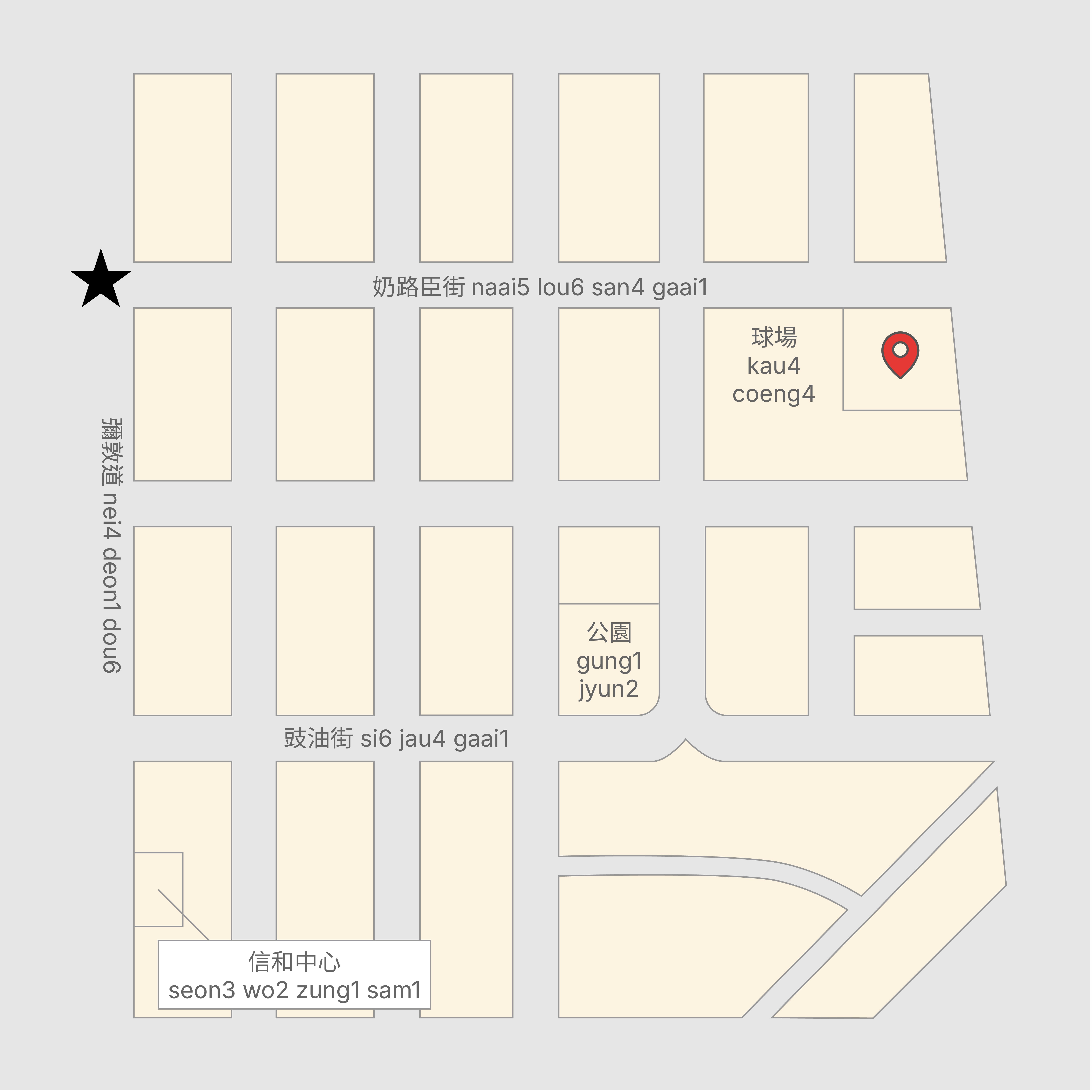
Listen to a phone conversation. The speakers will meet at a specific place. They will talk about directions for getting there. One speaker will take the wrong way. Draw the original route and the actual route.
| A | |
| B | |
| A | |
| B | |
| A | |
Half an hour later… | |
| B | |
| A | |
| B | |
| A | |
| B | |
Half an hour later… | |
| A | |
| B | |
| A | |
| B | |
| A | |
| B | |
| A | |
| B | |
| A | |
| B | |
| A | |
| B |
Transcripts with Translation
| A | 喂? wai2? Hello? |
| B | 你而家去到邊度呀? nei5 ji4 gaa1 heoi3 dou3 bin1 dou6 aa3? Where have you gone to now? |
| A | 我啱啱上咗車。 ngo5 ngaam1 ngaam1 soeng5 zo2 ce1. I have got on the vehicle just now. |
| B | 噉你落咗車就打俾我啦。 gam2 nei5 lok6 zo2 ce1 zau6 daa2 bei2 ngo5 laa1. Then, when you have got off the vehicle, then give me a call. |
| A | 好。 hou2. Good. [= Okay.] |
Half an hour later… | |
| B | 喂? wai2? Hello? |
| A | 我啱啱出咗地鐵站,我要點樣行呀? ngo5 ngaam1 ngaam1 ceot1 zo2 dei6 tit3 zaam6, ngo5 jiu3 dim2 joeng2 haang4 aa3? I have gone out from the subway station just now. How do I need to walk? |
| B | 你沿住奶路臣街行四個街口,去到麥花臣之前會見到個球場,再直行就到。 nei5 jyun4 zyu6 naai5 lou6 san4 gaai1 haang4 sei3 go3 gaai1 hau2, heoi3 dou3 mak6 faa1 san2 zi1 cin4 wui5 gin3 dou2 go3 kau4 coeng4, zoi3 zik6 haang4 zau6 dou3. Walk along Nelson Street for four intersections. Before you have gone to MacPherson [a stadium], you will see a field for ball games. If you walk straight further, then you arrive. |
| A | 好,一陣見。 hou2, jat1 zan6 gin3. Good. [= Okay.] See you later. |
| B | 一陣見。 jat1 zan6 gin3. See you later. |
Half an hour later… | |
| A | 喂? wai2? Hello? |
| B | 你喺邊度呀? nei5 hai2 bin1 dou6 aa3? Where are you at? |
| A | 死喇,我好似行錯路呀。 sei2 laa3, ngo5 hou2 ci5 haang4 co3 lou6 aa3. Oh no. I seem to have taken the wrong way. |
| B | 你而家喺咩街呀? nei5 ji4 gaa1 hai2 me1 gaai1 aa3? Which street are you on now? |
| A | 我喺咩街?呀,喺彌敦道呀。 ngo5 hai2 me1 gaai1? aa3, hai2 nei4 deon1 dou6 aa3. Which street am I on? Oh, I am on Nathan Road. |
| B | 彌敦道?你點解行咗去彌敦道嘅?噉你而家見到咩呀? nei4 deon1 dou6? nei5 dim2 gaai2 haang4 zo2 heoi3 nei4 deon1 dou6 ge3? gam2 nei5 ji4 gaa1 gin3 dou2 me1 aa3? Nathan Road? Why have you walked to Nathan Road? Then, what do you see now? |
| A | 我見到⋯⋯我見到信和中心呀。 ngo5 gin3 dou2… ngo5 gin3 dou2 seon3 wo2 zung1 sam1 aa3. I see… I see the Sino Centre. |
| B | 吓!你行咗去信和中心呀?你行錯方向呀,你返返轉頭啦。 haa2! nei5 haang4 zo2 heoi3 seon3 wo2 zung1 sam1 aa4? nei5 haang4 co3 fong1 hoeng3 aa3, nei5 faan1 faan1 zyun3 tau4 laa1. What! You have walked to the Sino Centre? You walk to the wrong direction. Go back. |
| A | 好。 hou2. Good. [= Okay.] |
| B | 你返返轉頭,見到豉油街就轉右,之後直行,跟住你會見到個公園,過咗個公園之後轉左,再直行就會見到個球場,過咗個球場之後轉右,再直行就係麥花臣。你再揾唔到就問下人啦! nei5 faan1 faan1 zyun3 tau4, gin3 dou2 si6 jau4 gaai1 zau6 zyun3 jau6, zi1 hau6 zik6 haang4, gan1 zyu6 nei5 wui5 gin3 dou2 go3 gung1 jyun2, gwo3 zo2 go3 gung1 jyun2 zi1 hau6 zyun3 zo2, zoi3 zik6 haang4 zau6 wui5 gin3 dou2 go3 kau4 coeng4, gwo3 zo2 go3 kau4 coeng4 zi1 hau6 zyun3 jau6, zoi3 zik6 haang4 zau6 hai6 mak6 faa1 san2. nei5 zoi3 wan2 m4 dou2 zau6 man6 haa5 jan4 laa1! Go back. When you see Soy Street, then turn right. After that, walk straight. And then, you will see a park. After you have passed the park, turn left. If you walk straight further, then you see a field for ball games. After you have passed the field for ball games, turn right. If you walk straight further, then it is MacPherson. If you are not able to find it further, then ask people. [= If you are still not able to find it, then ask people.] |
| A | 好。 hou2. Good. [= Okay.] |
| B | 一陣見。 jat1 zan6 gin3. See you later. |
Culture
麥花臣 mak6 faa1 san2 is a venue where many live music shows are held.
Activity 3
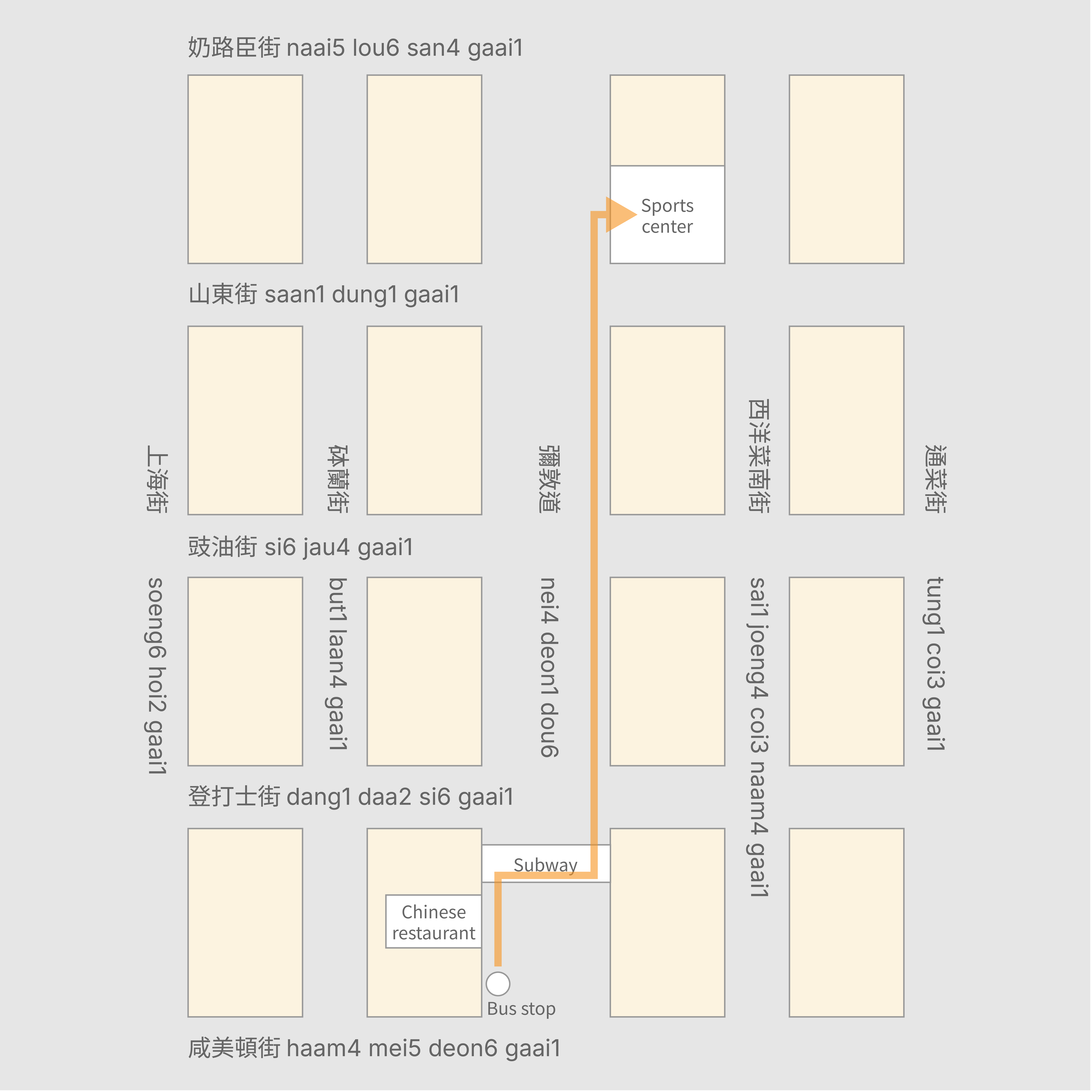
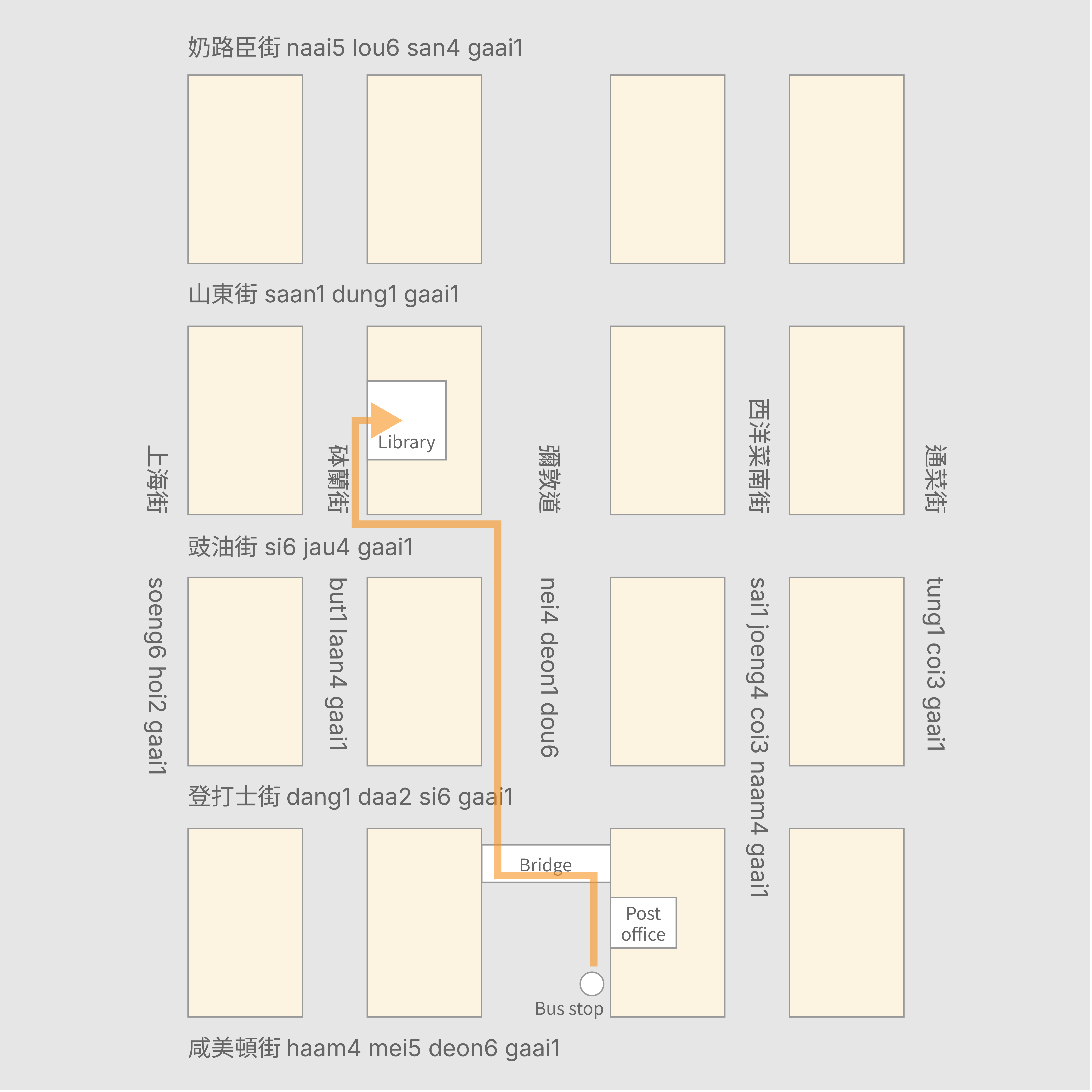
Form a pair. Make four conversations based on the routes shown in the maps below. In each conversation, Role A will ask for directions to a place, and Role B will give directions. Swap your roles after each conversation.
Conversation 1
Conversation 2
Conversation 3
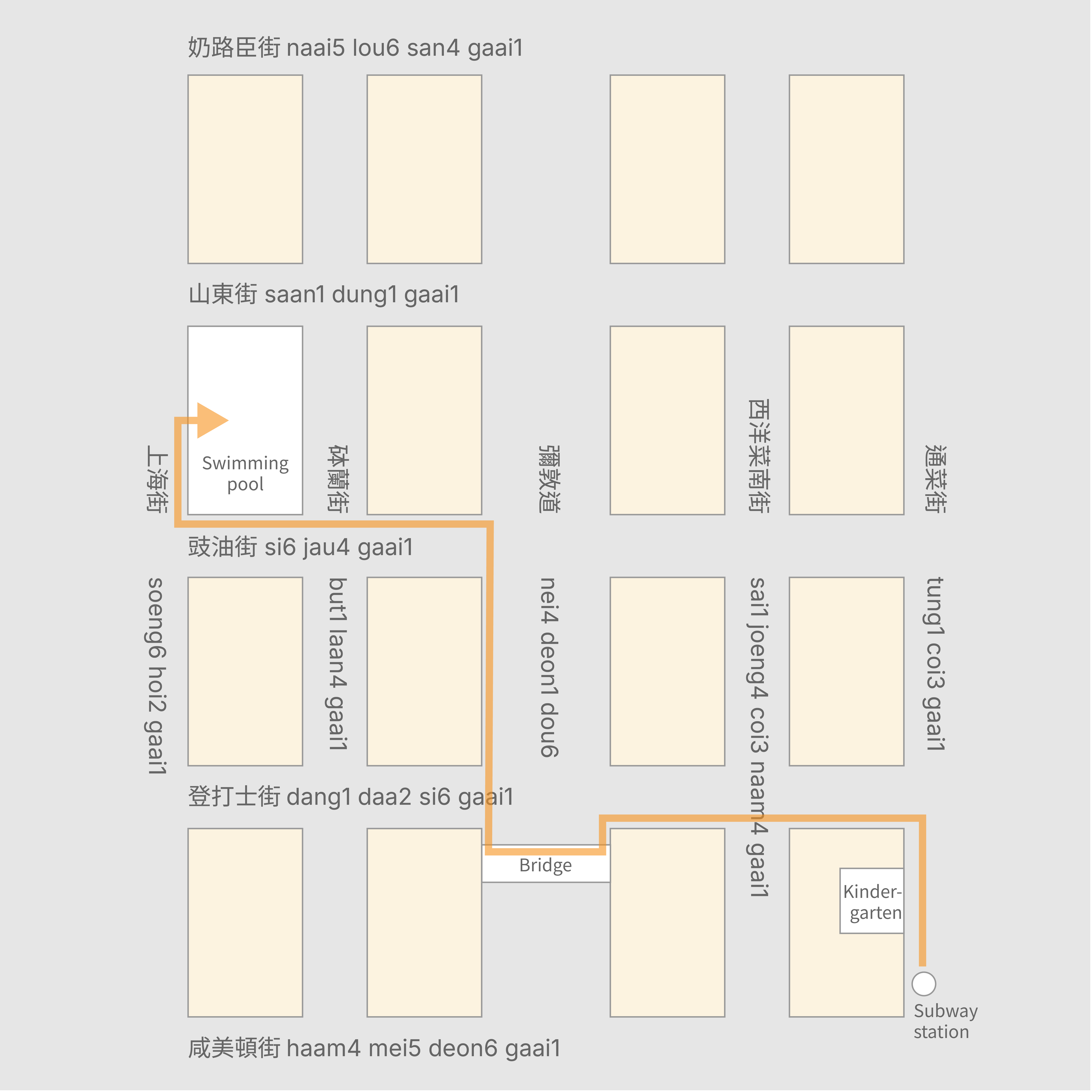
Conversation 4
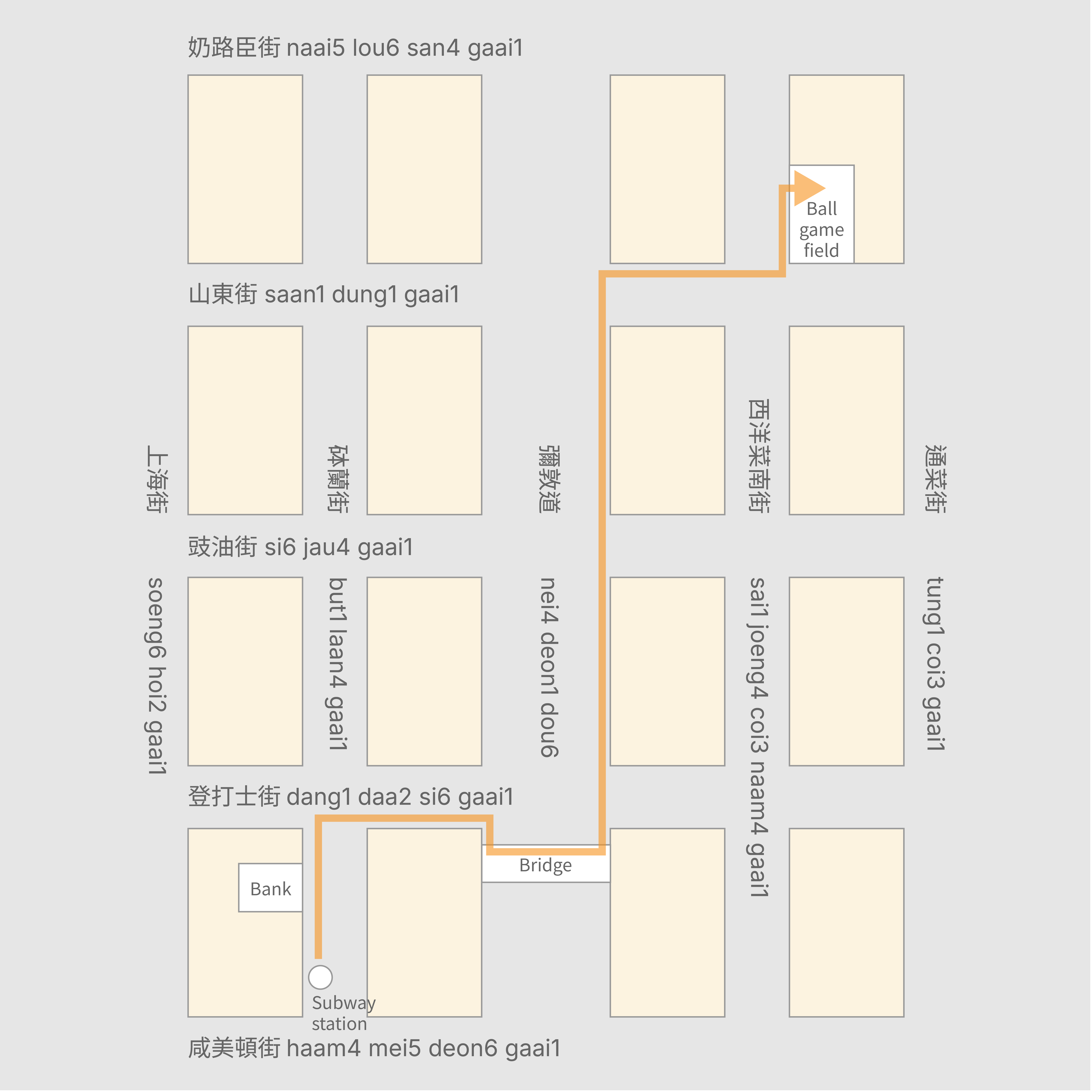
Activity 4
Form a pair. Each of you will choose a route on Google Map (e.g., from your current location to a nearby destination). In turn, show your route to your partner and make a conversation similar to those in Activity 3. Your partner will give directions for your route, and you will give directions for theirs. Try to get lost in your conversations!