Print or Export
呢度附近邊度有糖水舖呀?
ni1 dou6 fu6 gan6 bin1 dou6 jau5 tong4 seoi2 pou2 aa3?
ni1 dou6 fu6 gan6 bin1 dou6 jau5 tong4 seoi2 pou2 aa3?
Listen and Speak
Step 1
Recall and complete the following location expressions.
| 1. ____邊 ____ bin6 front | ||
| 3. ____邊 ____ bin6 left | 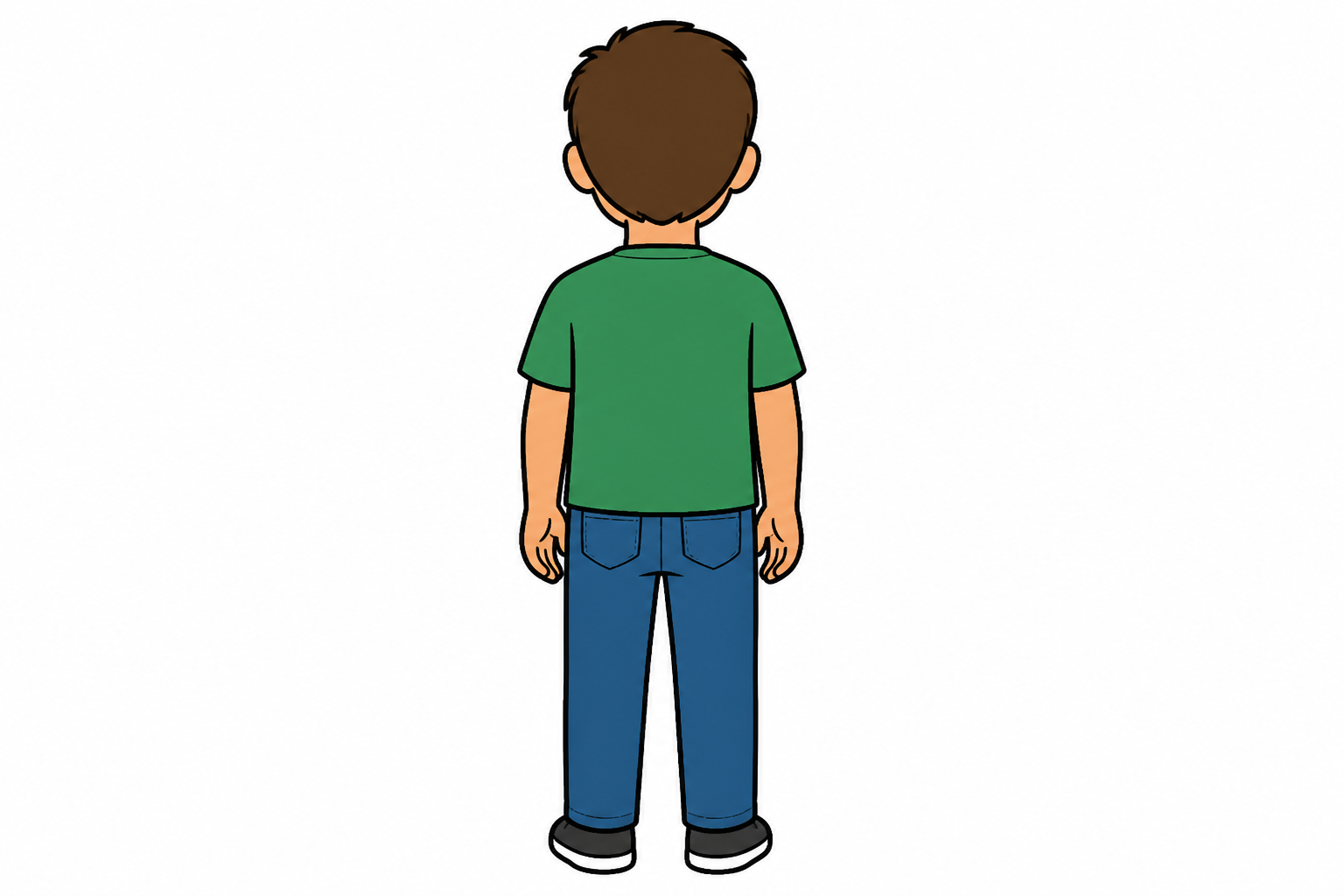 | 4. ____邊 ____ bin6 right |
| 2. ____邊 ____ bin6 back, behind |
Step 2
Listen to the location expressions. Check your answers.
Step 3
Listen to a conversation. The speakers are on the street. One speaker wants to find a place to do an activity. Write down the location expression they mentioned.
________| A | |
| B | |
| A | |
| B |
Step 4
Listen to the conversation again. Read the script while listening. Check your answer.
| A | 我想食下午茶呀,呢度附近有冇茶餐廳呀? ngo5 soeng2 sik6 haa6 ng5 caa4 aa3, ni1 dou6 fu6 gan6 jau5 mou5 caa4 caan1 teng1 aa3? I want to have afternoon tea. Is there a cha chaan teng near here? |
| B | 前邊條街有間茶餐廳呀。 cin4 bin6 tiu4 gaai1 jau5 gaan1 caa4 caan1 teng1 aa3. The street in front has one cha chaan teng. |
| A | 前邊條街呀?不如我哋而家去吖。 cin4 bin6 tiu4 gaai1 aa4? bat1 jyu4 ngo5 dei6 ji4 gaa1 heoi3 aa1. The street in front? Why don’t we go now? |
| B | 好呀。 hou2 aa3. Good. [= Sure.] |
- 附近 fu6 gan6 = near
- 條 tiu4 = (Classifier for streets)
- 街 gaai1 = street
Step 5
Listen and repeat.
Step 6
Replace the highlighted words in the script with the words below to make your conversations.
Grammar and Vocabulary
In the Grammar and Vocabulary section, you will learn:
- Demonstrative Expressions for Locations II
- Location Expressions II
- The Preposition 向 hoeng3 (‘toward’)
- The Modal Verb 應該 jing1 goi1 (‘should’)
- The Verb 即係 zik1 hai6 (‘to be equal to, to mean’)
- The Conjunction 即係 zik1 hai6 (‘that means’)
- The Noun 嘢 je5 (‘thing’) III
- Vocabulary List
- Vocabulary: Street Names in Hong Kong
- Vocabulary: Places in a Community II
37.1 Demonstrative Expressions for Locations II
Note that some of the expressions below have more than one pronunciation. For these expressions, we will only use the highlighted pronunciations in this book. You can focus on them first and learn the other pronunciations later.
In Grammar and Vocabulary 26.2, we learned that we can use 呢 ni1 / nei1 and 嗰 go2 to form demonstrative expressions to refer to a specific location based on its distance from us. Here are the expressions we learned previously:
In this lesson, we will sometimes refer to a specific area based on its distance from us. We combine 呢 ni1 and 嗰 go2 with 頭 tau4 to mean ‘this area’ and ‘that area’. 頭 tau4 means ‘head’ in other contexts, but it doesn’t express this meaning here.
To refer to the side of a place, we can put 呢邊 ni1 bin6 (‘this side’) or 嗰邊 go2 bin6 (‘that side’) after the place. We usually use 呢 ni1 if we are currently at the place, and 嗰 go2 if we are not currently at the place. Note that the actual meaning will often be the area of a place.
To refer to the area of a place, we can put 呢頭 ni1 tau4 or 嗰頭 go2 tau4 after the place. We use 呢 ni1 if we are currently at the place and 嗰 go2 if we are not currently at the place.
We can combine 邊 bin1 (‘which’) with 邊 bin6 / bin1 (‘side’) or 面 min6 (‘side’) to mean ‘which side’. Note that we usually say 邊邊 bin1 bin6 / bin1 bin1.
邊邊有商場呀?
bin1 bin6 jau5 soeng1 coeng4 aa3?
Which side has shopping malls?
地鐵站喺邊邊呀?
dei6 tit3 zaam6 hai2 bin1 bin6 aa3?
Which side is the subway station on?
We can combine 邊 bin1 (‘which’) with 頭 tau4 to form ‘which area’.
邊頭有商場呀?
bin1 tau4 jau5 soeng1 coeng4 aa3?
Which area has shopping malls?
地鐵站喺邊頭呀?
dei6 tit3 zaam6 hai2 bin1 tau4 aa3?
Which area is the subway station on?
Culture
The expression 嗰頭近 go2 tau4 kan5 (‘that area’ + ‘close’) means ‘to be near death’.
Grammar Practice 1
Follow the examples to complete the expressions. Use 邊 bin6 for expressions that can end with 邊 bin6 / bin1 or 面 min6.
37.2 Location Expressions II
In Grammar and Vocabulary 26.3, we learned that we can use the location expressions below to refer to different locations. Most of them end with 邊 bin6 / bin1 (‘side’) or 面 min6 (‘side’). 邊 bin is usually more often pronounced with Tone 6 (bin6) nowadays, except in the words for ‘left’, ‘right’, ‘left-hand side’ and ‘right-hand side’, where 邊 bin is still commonly pronounced with both Tone 6 (bin6) and Tone 1 (bin1).
For expressions with more than one pronunciation, we will only use the highlighted pronunciations (the ones with bin6) in this book. You can focus on them first and learn the other pronunciations later.
In this lesson, we will learn these new location expressions:
The location expressions for compass directions end with 邊 bin6 / bin1 (‘side’) or 面 min6 (‘side’). For ‘east’, ‘south’, ‘west’ and ‘north’, 邊 bin can be pronounced with Tone 6 (bin6) or Tone 1 (bin1). For ‘northeast’, ‘southeast’, ‘southwest’ and ‘northwest’, 邊 bin is usually only pronounced with Tone 6 (bin6).
| 西北邊 sai1 bak1 bin6 西北面 sai1 bak1 min6 | 北邊 bak1 bin6 / bak1 bin1 北面 bak1 min6 | 東北邊 dung1 bak1 bin6 東北面 dung1 bak1 min6 |
| 西邊 sai1 bin6 / sai1 bin1 西面 sai1 min6 | 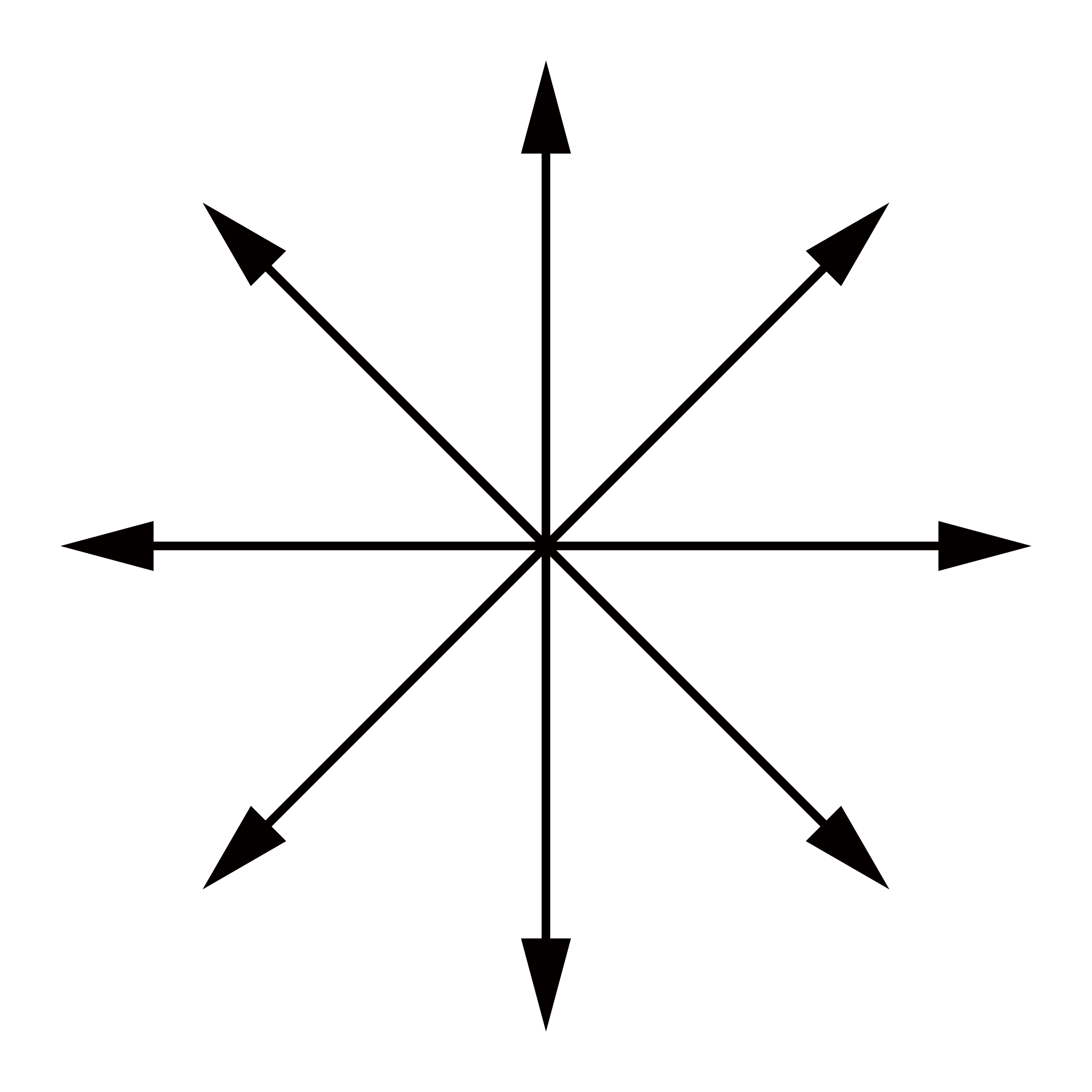 | 東邊 dung1 bin6 / dung1 bin1 東面 dung1 min6 |
| 西南邊 sai1 naam4 bin6 西南面 sai1 naam4 min6 | 南邊 naam4 bin6 / naam4 bin1 南面 naam4 min6 | 東南邊 dung1 naam4 bin6 東南面 dung1 naam4 min6 |
We will learn several structures with a location expression below. Pay attention to the word order. It may be different from English.
To refer to a location relative to a place, we can put the reference point before a location expression. We can optionally add the particle 嘅 ge3 between the reference point and the location expression. 嘅 ge3 functions like the apostrophe s (’s) in English here.
In grammar, a location expression put right after a noun without 嘅 ge3 is called a postposition. Postpositions are similar to prepositions, but postpositions appear after a noun. Postpositions can also be called localizers because they are usually related to locations.
To refer to a location between two places, we can use 中間 zung1 gaan1 (‘between’) with the structure below. We use 同 tung4 / 同埋 tung4 maai4 (‘and’) to connect the two reference points.
We can use the structure below to refer to something at a specific location.
We sometimes don’t indicate a reference point. We often do so when the reference point is our current position.
We can add 呢 ni1 or 嗰 go2 before the classifier to indicate whether the thing is close to or far away from us.
We can use the verb 喺 hai2 / 响 hoeng2 (‘to be in, on, at’) to indicate the location of something with this structure:
We can use the verb 有 jau5 (‘to have’) or 冇 mou5 (‘to not have’) to indicate a specific location has or doesn’t have something with this structure:
Grammar Practice 2
Follow the examples to complete the expressions. Use 邊 bin6 for expressions that can end with 邊 bin6 / bin1 or 面 min6.
Structure 1
Structure 2
Structure 3
Structure 4
Structure 5
37.3 The Preposition 向 hoeng3 (‘toward’)
The preposition 向 hoeng3 means ‘toward’. We use 向 hoeng3 to indicate the direction or the place we move toward. We put a direction or a place after 向 hoeng3 to form a prepositional phrase.
We put the prepositional phrase before the verb we want to modify.
If the location expression after 向 hoeng3 ends with 邊 bin6 / bin1 or 面 min6 (e.g., 前邊 cin4 bin6 ‘front’, 東邊 dung1 bin6 ‘east’), we can optionally omit 邊 bin6 / bin1 or 面 min6 in it.
However, we don’t omit 邊 bin6 / bin1 or 面 min6 in these location expressions:
37.4 The Modal Verb 應該 jing1 goi1 (‘should’)
The modal verb 應該 jing1 goi1 is similar to should in English. We can use 應該 jing1 goi1 to indicate what we should do (as in we should walk toward this side). We put a verb after 應該 jing1 goi1.
We may sometimes add a prepositional phrase to the sentence. We can put the prepositional phrase before or after 應該 jing1 goi1, depending on the meaning we want to express. In this lesson, we will see examples in which the prepositional phrase is put after 應該 jing1 goi1.
We can also use 應該 jing1 goi1 to indicate that something is very likely to be true or correct (as in there should be a supermarket near the wet market).
37.5 The Verb 即係 zik1 hai6 (‘to be equal to, to mean’)
The verb 即係 zik1 hai6 means ‘to be equal to, to mean’. We use it to introduce information that helps the listener to identify the thing or person in the subject. We put the information after 即係 zik1 hai6 (as a subject complement).
We can also use 即係 zik1 hai6 in a question to ask for information that helps us to identify the thing or person in the subject. We put a question word after 即係 zik1 hai6.
Let’s look at the sentences and questions above in pairs:
| A: | 彌敦道即係邊條街呀? nei4 deon1 dou6 zik1 hai6 bin1 tiu4 gaai1 aa3? Which street is Nathan Road equal to? |
| B: | 彌敦道即係隔籬條街呀。 nei4 deon1 dou6 zik1 hai6 gaak3 lei4 tiu4 gaai1 aa3. Nathan Road is equal to the next street. |
| A: | Jason即係邊個呀? Jason zik1 hai6 bin1 go3 aa3? Who is Jason equal to? |
| B: | Jason即係Amy男朋友呀。 Jason zik1 hai6 Amy naam4 pang4 jau5 aa3. Jason is equal to Amy’s boyfriend. |
37.6 The Conjunction 即係 zik1 hai6 (‘that means’)
In Grammar and Vocabulary 37.5, we learned that the verb 即係 zik1 hai6 means ‘to be equal to, to mean’.
We can also use 即係 zik1 hai6 as a conjunction. When used as a conjunction, 即係 zik1 hai6 means ‘that means’. We can use it to introduce our interpretation of a situation. We use 即係 zik1 hai6 to start a new clause and put the interpretation after it.
37.7 The Noun 嘢 je5 (‘thing’) III
In Grammar and Vocabulary 18.6 and 21.4, we learned that the word 嘢 je5 (‘thing’) can sometimes refer to things that are not usually referred as thing in English.
In this lesson, we will see that 嘢 je5 can mean ‘shop’ if it is obvious in the context.
| A: | 我想食糖水呀,呢度附近有冇糖水舖呀? ngo5 soeng2 sik6 tong2 seoi2 aa3, ni1 dou6 fu6 gan6 jau5 mou5 tong4 seoi2 pou2 aa3? I want to eat sweet soup. Is there a sweet soup shop near here? |
| B: | 隔籬條街有間糖水舖呀。 gaak3 lei4 tiu4 gaai1 jau5 gaan1 tong4 seoi2 pou2 aa3. There is a sweet soup shop on the next street. |
| A: | 間嘢叫咩名呀? gaan1 je5 giu3 me1 meng2 aa3? What is the shop’s name? |
| B: | 間嘢叫糖老鴨。 gaan1 je5 giu3 tong4 lou5 aap3. The shop’s name is Tonald Duck. |
37.8 Vocabulary List
For expressions with more than one pronunciation, we will only use the highlighted pronunciations in this book. You can focus on them first and learn the other pronunciations later.
😈 Sensitive Content
37.9 Vocabulary: Street Names in Hong Kong
Most street names in Hong Kong end with one of the following words:
37.10 Vocabulary: Places in a Community II
All the places below are shops. We use the classifier 間 gaan1 with them.
Communication
In the Communication section, you will learn:
- Finding a Place on the Street I
Finding a Place on the Street I
If we’re on the street and want to find a place to do an activity, we can say:
Culture
糖水 tong4 seoi2 (‘sweet soup’) is a type of Chinese dessert. It is similar to soup or congee but with sweet flavor. 糖水舖 tong4 seoi2 pou2 (‘sweet soup’ + ‘shop’) is a place where people can enjoy sweet soup and chat after dinner. Nowadays, many of these shops also serve other types of dessert, such as cakes, waffles and shaved ice. Therefore, they are also often referred to as 甜品舖 tim4 ban2 pou2 (甜品 tim4 ban2 ‘dessert’ + 舖 pou2 ‘shop’).
Route A: Yes
- The original noun phrase after 有 jau5 is 一間糖水舖 jat1 gaan1 tong4 seoi2 pou2 (‘one sweet soup shop’). The number 一 can be omitted as the noun phrase appears after a verb. The noun 糖水舖 tong4 seoi2 pou2 can also be omitted as it is obvious in the context. So only the classifier 間 gaan1 is left!
Route B: No
Route C: Don’t know
- 用Google Map揾下 jung6 Google Map wan2 haa5 is a serial construction. The first verb phrase 用Google Map jung6 Google Map is the method of doing the second verb phrase 揾下 wan2 haa5. We will learn more about it in the next lesson.
A few moments later…
If there are some shops nearby, we can suggest going now.
If there is more than one shop available, we can ask which one we should go.
If we want to know the shop’s name, we can ask:
We can then start finding the shop. Note that we can also use the expressions below when we are driving. The word 行 haang4 can mean ‘to move’ in the context of driving.
As we walk, we may need to change direction.
Sometimes, we may want to check if we need to change direction.
Sometimes, we may need to ask for the street number of our current location and the number of the shop.
When we finally arrive, we can say:
😈 Sensitive Content
When we realize we are heading the wrong way, we can say the swear word 仆街喇 puk1 gaai1 laa3 (‘Shit!’) or 屌 diu2 (‘Fuck!’) to express stronger emotions.
Exercises
Exercise 1
Complete the descriptions.
1.
We combine 呢 ni1 / nei1 and 嗰 go2 with ________ to mean ‘this area’ and ‘that area’.
2.
The preposition ________ means ‘toward’.
3.
The modal verb ________ means ‘should’.
4.
The word ________ means ‘to be equal to, to mean’ as a verb and ‘that means’ as a conjunction.
Exercise 2
In each question, you will hear a demonstrative expression or a location expression. Say the opposite expression. Use 邊 bin6 for expressions that can end with 邊 bin6 / bin1 or 面 min6.
Exercise 3
In each question, you will hear a sentence that includes a location. Identify the location and explain its meaning in English.
Example
地鐵站嗰頭應該有間。
dei6 tit3 zaam6 go2 tau4 jing1 goi1 jau5 gaan1.
There should be one in the subway station that area.
dei6 tit3 zaam6 go2 tau4
the subway station that area
1.
________
2.
________
3.
________
4.
________
5.
________
6.
________
7.
________
8.
________
9.
________
10.
________
Exercise 4
Follow the examples to complete the conversations. Then, listen to the recordings to check your answers. Finally, repeat after the recordings. Use 邊 bin6 for expressions that can end with 邊 bin6 / bin1 or 面 min6.
Example
| A | (to add value to the Octopus card) 我想增值呀,呢度附近有冇便利店呀? ngo5 soeng2 zang1 zik6 aa3, ni1 dou6 fu6 gan6 jau5 mou5 bin6 lei6 dim3 aa3? I want to add value to the Octopus card. Is there a convenient store near here? |
| B | (this street in the front) 前邊呢條街應該有間呀。 cin4 bin6 ni1 tiu4 gaai1 jing1 goi1 jau5 gaan1 aa3. There should be one on this street in the front. ⭐ In this exercise, there may be more than one correct place for an activity. |
1.
| A | (to drink Chinese herbal tea) ________ |
| B | (that street behind) ________ |
2.
| A | (to post something) ________ |
| B | (the shopping mall next to the wet market) ________ |
3.
| A | (to get money from an ATM) ________ |
| B | (the subway station that area) ________ |
4.
| A | (to have a haircut) ________ |
| B | (this street on the left) ________ |
5.
| A | (to buy bread) ________ |
| B | (in the wet market) ________ |
6.
| A | (to have afternoon tea) ________ |
| B | (the shopping mall near the library) ________ |
7.
| A | (to buy cigarettes) ________ |
| B | (opposite the sports center) ________ |
8.
| A | (to stroll for a while) ________ |
| B | (the swimming pool that side) ________ |
Activities
Disclaimer: The maps and shops below are not real.
Activity 1
Listen to three conversations. In each conversation, the speakers are on the street, and one speaker wants to find a place to do an activity. Then, listen and choose the correct description for each conversation.
Conversation 1
| A. | ________ |
| B. | ________ |
| C. | ________ |
Answer: ____
| A | |
| B | |
| A | |
| B |
Conversation 2
| A. | ________ |
| B. | ________ |
| C. | ________ |
Answer: ____
| A | |
| B | |
| A | |
| B |
Conversation 3
| A. | ________ |
| B. | ________ |
| C. | ________ |
Answer: ____
| A | |
| B | |
| A | |
| B |
Transcripts with Translation
Conversation 1
| A | 我想買啲啤酒上去呀,呢度附近邊度有便利店呀? ngo5 soeng2 maai5 di1 be1 zau2 soeng5 heoi3 aa3, ni1 dou6 fu6 gan6 bin1 dou6 jau5 bin6 lei6 dim3 aa3? I want to buy some beer to go up. Is there a convenience store near here? |
| B | 後邊嗰條街應該有間便利店。 hau6 bin6 go2 tiu4 gaai1 jing1 goi1 jau5 gaan1 bin6 lei6 dim3. There should be one convenience store on that street behind. |
| A | 噉不如我哋而家去吖。 gam2 bat1 jyu4 ngo5 dei6 ji4 gaa1 heoi3 aa1. Then, why don’t we go now? |
| B | 好呀。 hou2 aa3. Good. [= Sure.] |
Conversation 2
| A | 呢度附近邊度有郵局呀?我要去郵局問啲嘢呀。 ni1 dou6 fu6 gan6 bin1 dou6 jau5 jau4 guk2 aa3? ngo5 jiu3 heoi3 jau4 guk2 man6 di1 je5 aa3. Where is the post office near here? I need to go to the post office to ask something. |
| B | 郵局呀?商場附近有間呀。 jau4 guk2 aa4? soeng1 coeng4 fu6 gan6 jau5 gaan1 aa3. Post office? There is one near the shopping mall. |
| A | 我哋而家去得唔得呀? ngo5 dei6 ji4 gaa1 heoi3 dak1 m4 dak1 aa3? Is it okay if we go now? |
| B | 好呀。 hou2 aa3. Good. [= Sure.] |
Conversation 3
| A | 呢頭有冇珍珠奶茶舖呀?我突然好想飲珍珠奶茶呀。 ni1 tau4 jau5 mou5 zan1 zyu1 naai5 caa4 pou2 aa3? ngo5 dat6 jin4 hou2 soeng2 jam2 zan1 zyu1 naai5 caa4 aa3. Is there a bubble tea shop in this area? I suddenly want to drink bubble tea very much. |
| B | 珍珠奶茶舖呀?球場隔籬個商場好似有一間。 zan1 zyu1 naai5 caa4 pou2 aa4? kau4 coeng4 gaak3 lei4 go3 soeng1 coeng4 hou2 ci5 jau5 jat1 gaan1. Bubble tea shop? There seems to be one in the shopping mall next to the field for ball games. |
| A | 不如我哋而家去睇下吖。 bat1 jyu4 ngo5 dei6 ji4 gaa1 heoi3 tai2 haa5 aa1. Why don’t we go there to have a look now? |
| B | 好呀,我帶你去吖。 hou2 aa3, ngo5 daai3 nei5 heoi3 aa1. Good. [= Sure.] Let me take you there. |
- 珍珠奶茶 zan1 zyu1 naai5 caa4 = bubble tea (literally ‘pearl + milk tea’)
- 突然 dat6 jin4 = suddenly
- 帶 daai3 + Person + 去 heoi3 / 嚟 lai4 + Location = to take someone to a location
Activity 2
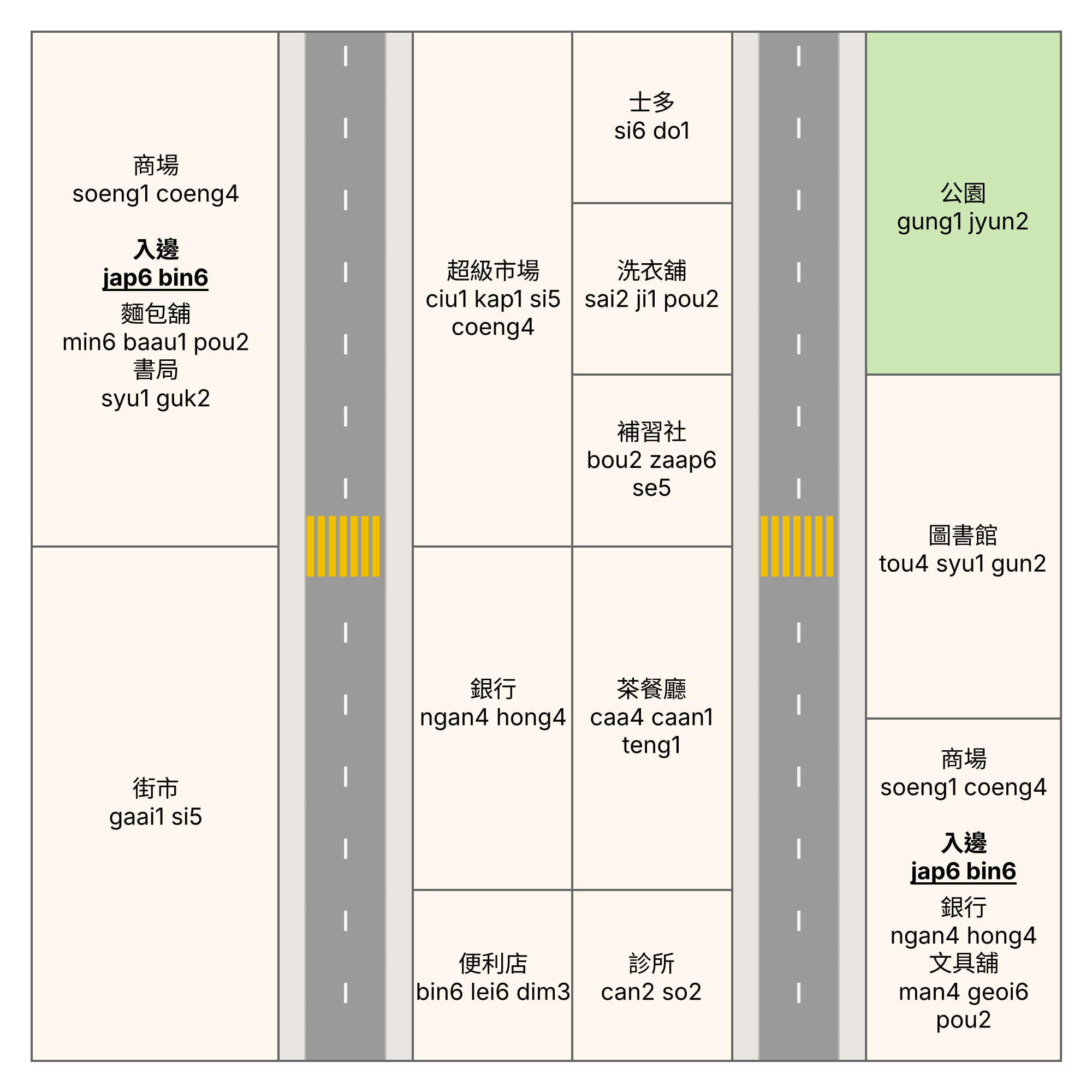
Form a pair. Based on the map below, make four conversations like those in Activity 1. Begin your conversations with the sentences provided. Randomly choose your current location and the direction that you are facing for each conversation. You can put your fingers on the map to pretend that you are walking on the street. Swap your roles after each conversation.
Activity 3
Listen to three conversations. In each conversation, the speakers are on the street and are walking to a place. Choose the routes they use.
Conversation 1
A.
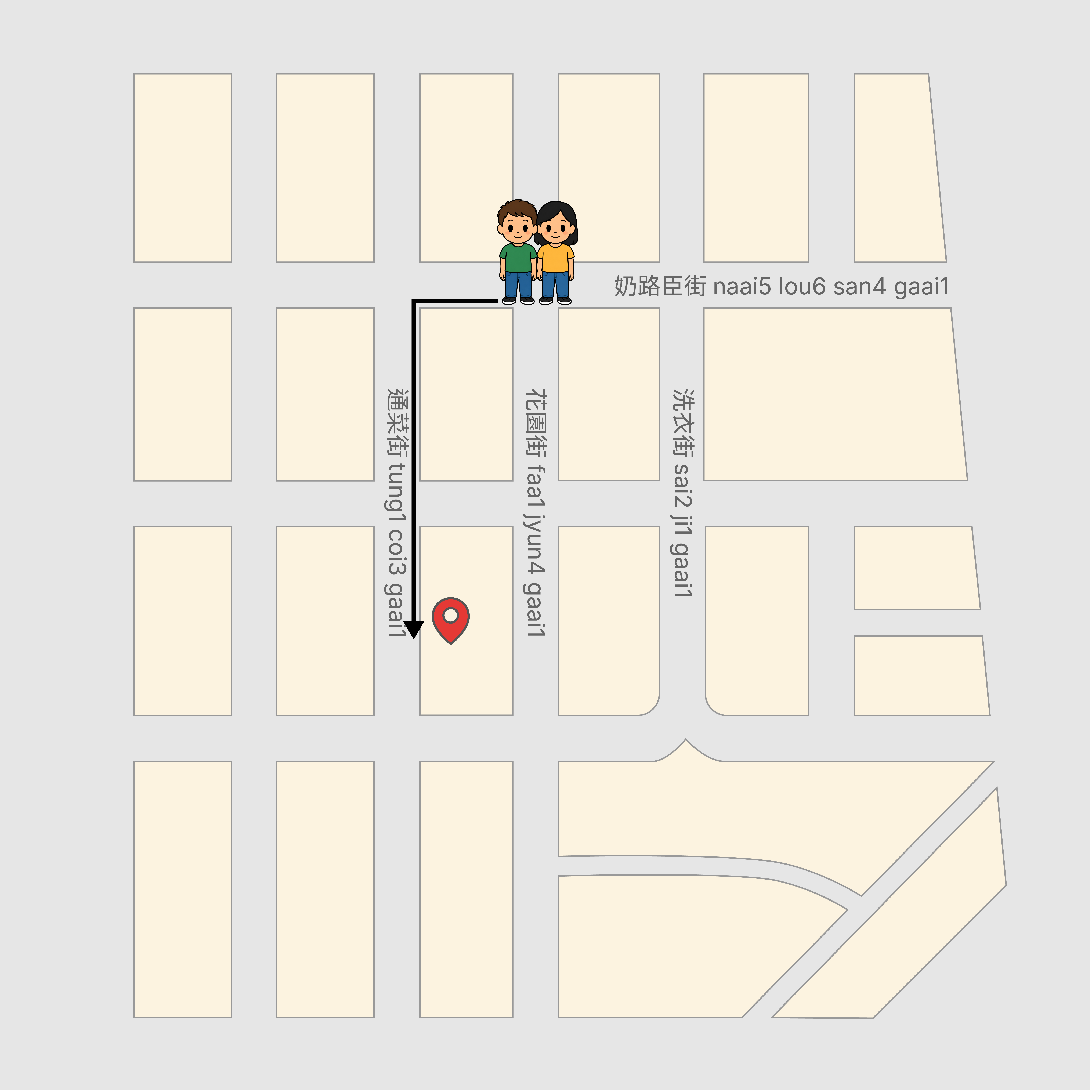
B.
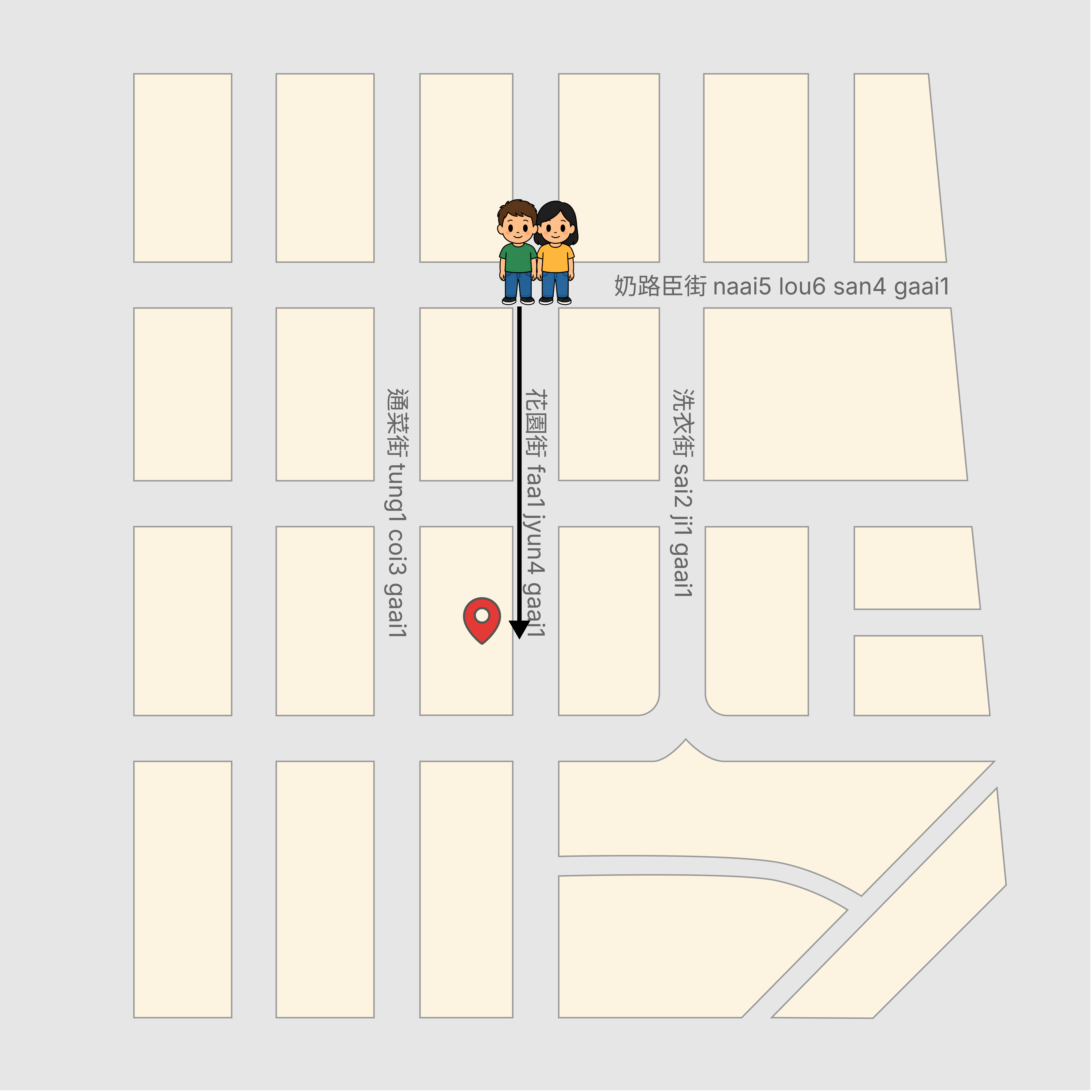
C.
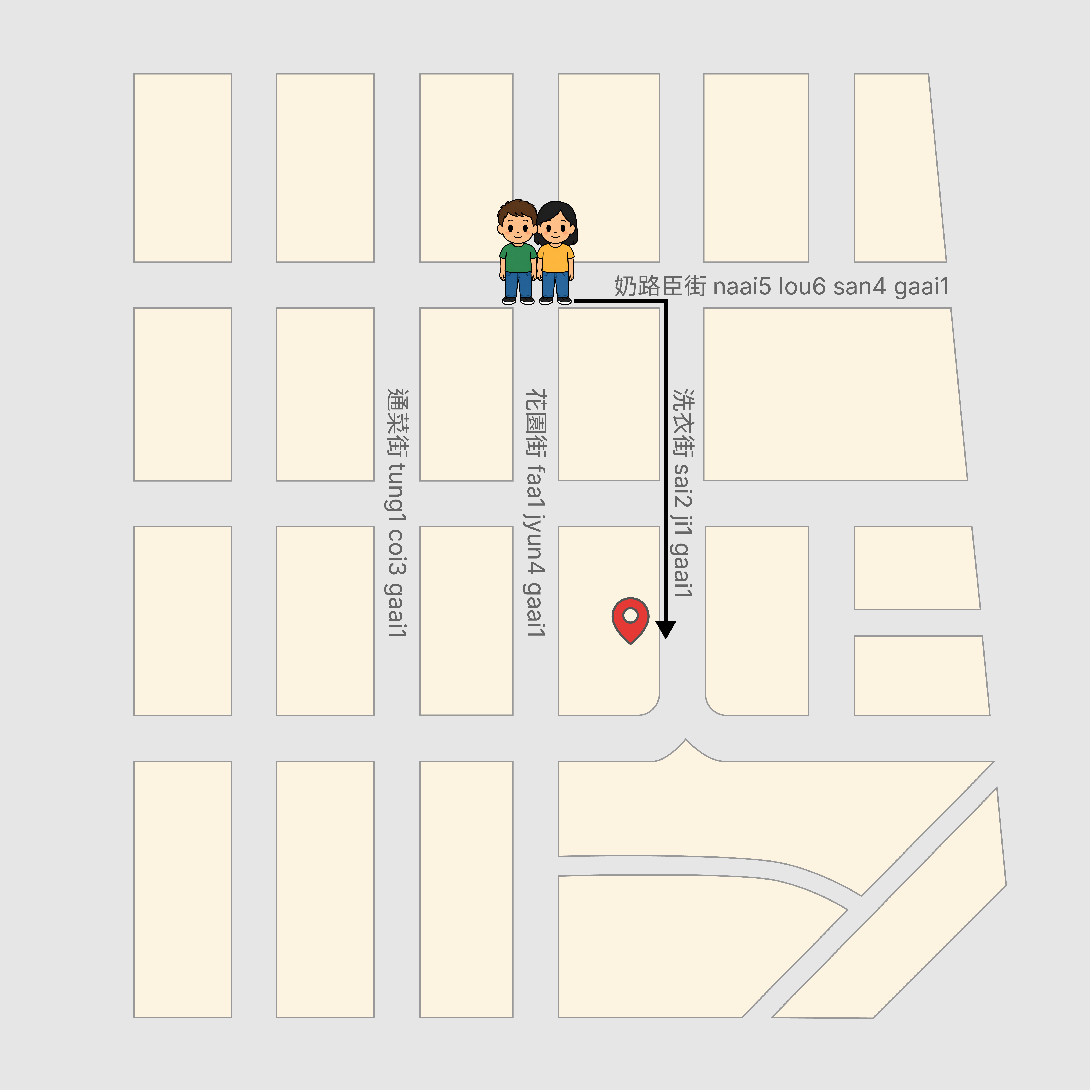
Answer: ____
| A | |
| B | |
| A | |
A few moments later… | |
| A | |
| B | |
| A | |
| B | |
A few moments later… | |
| A | |
A few moments later… | |
| B |
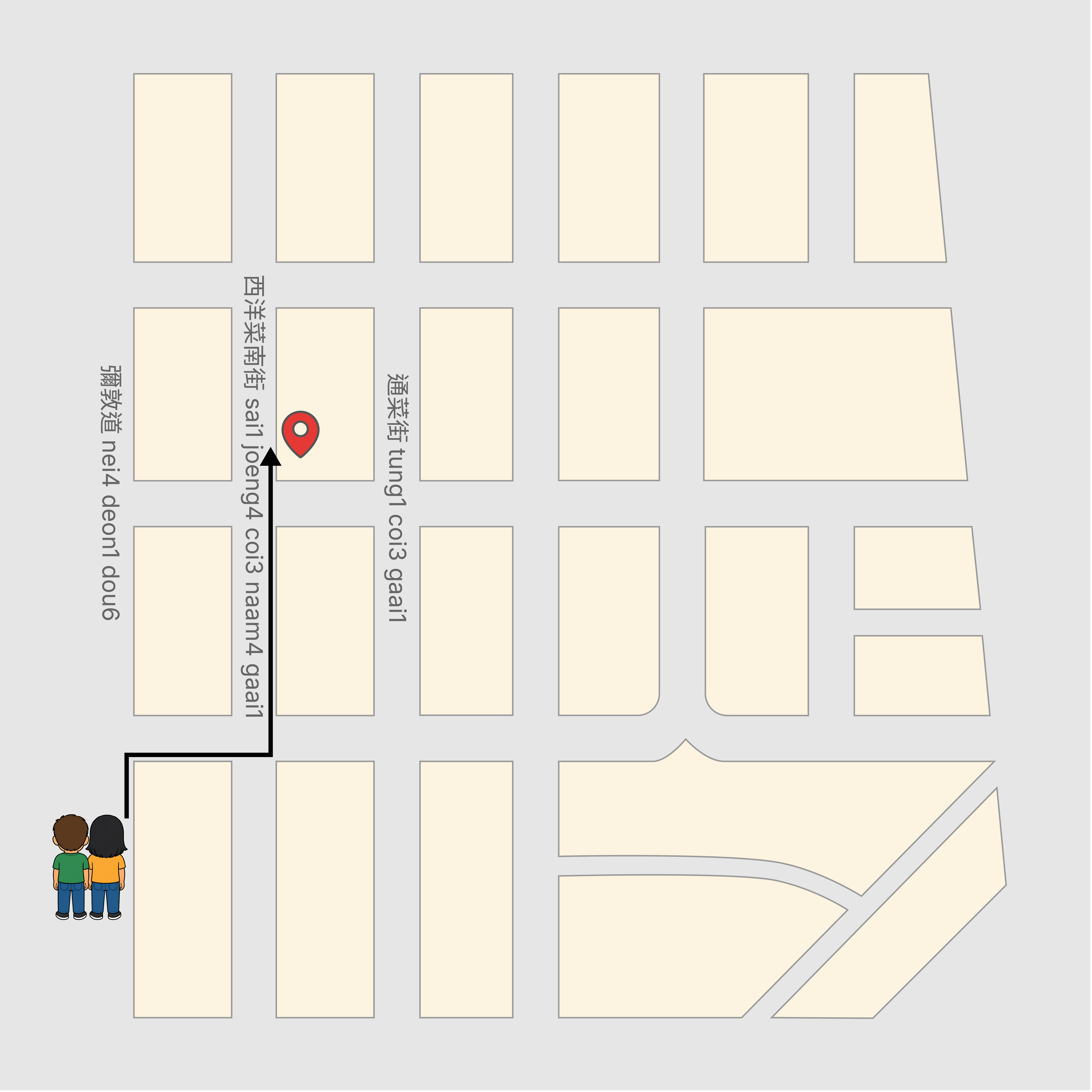
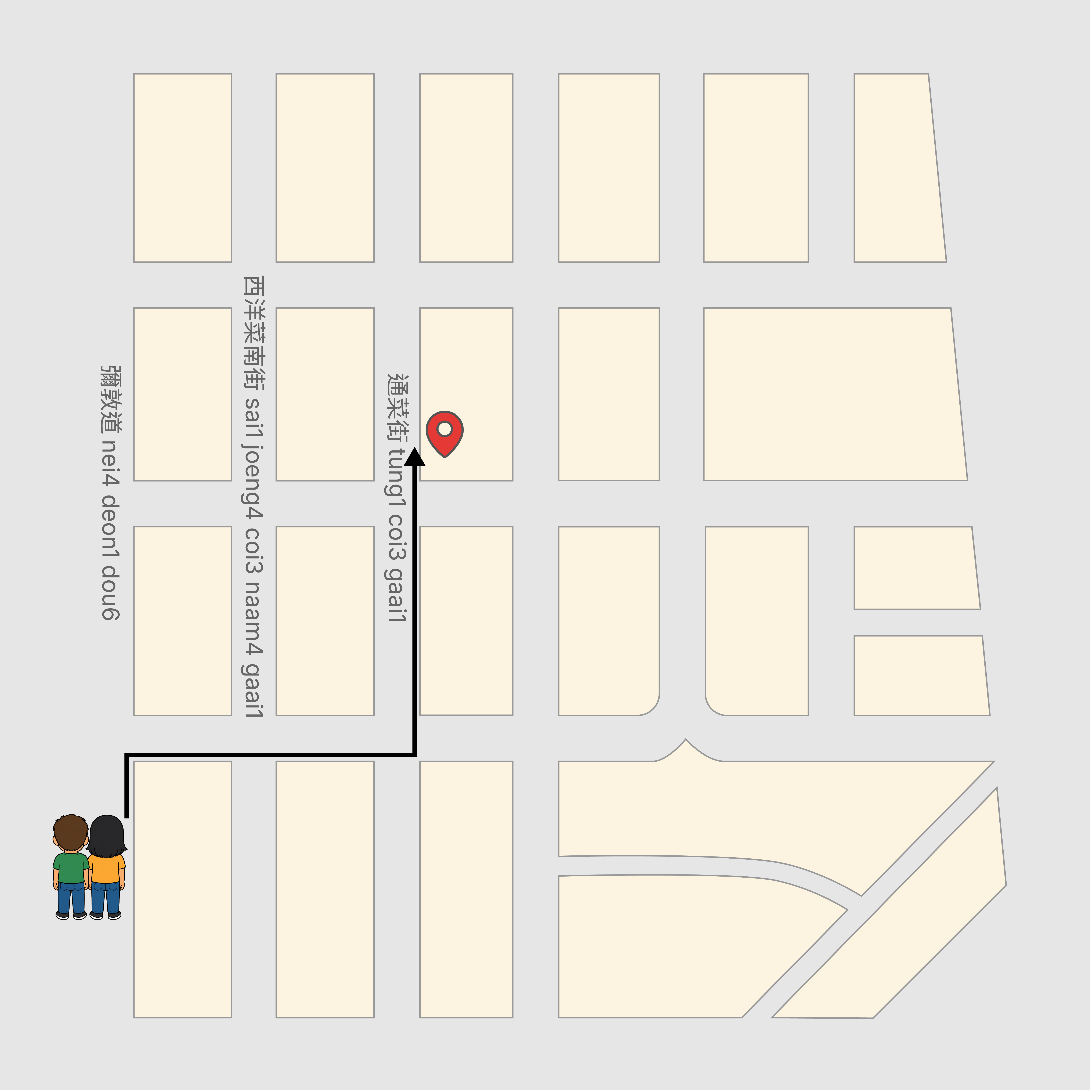
Conversation 2
A.
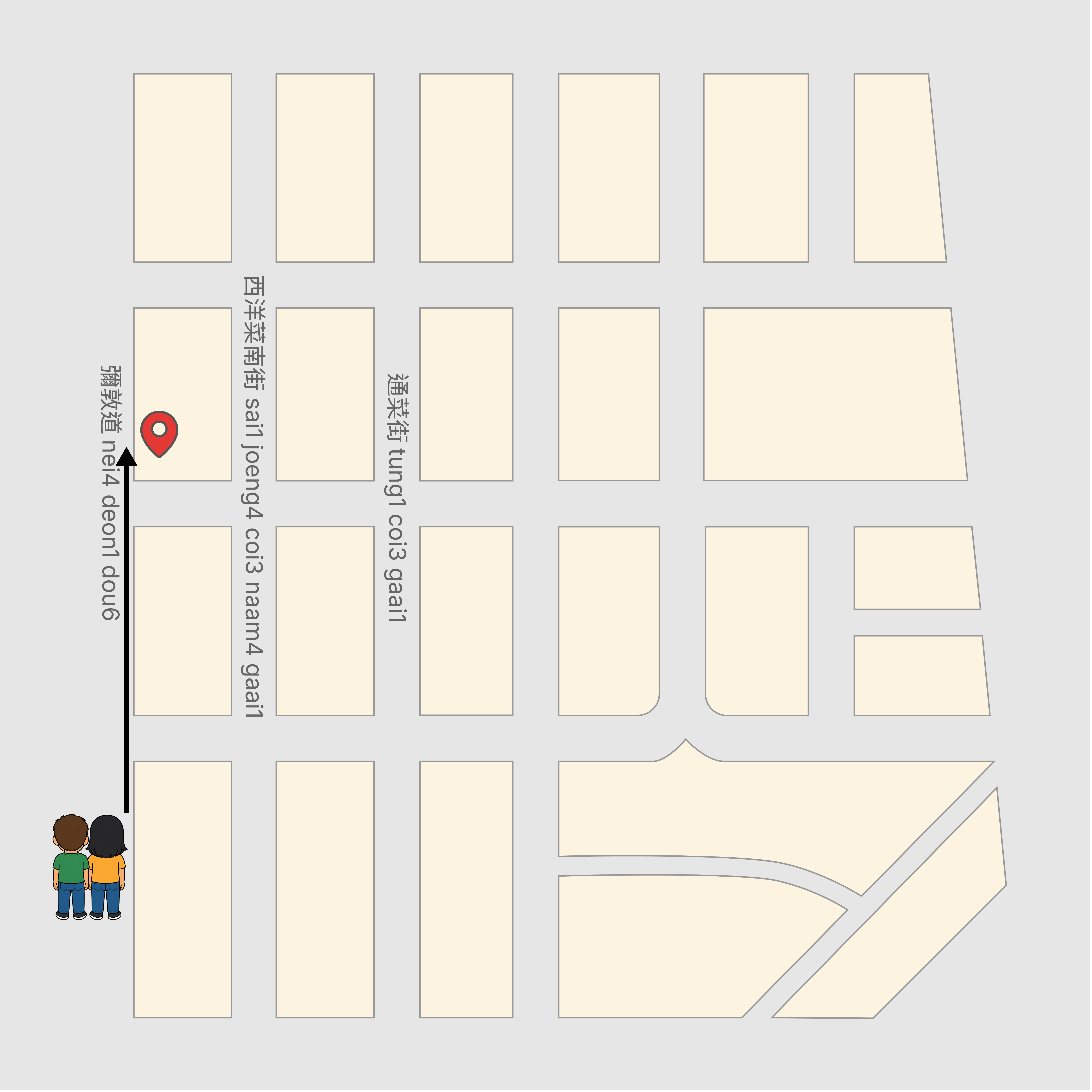
B.
C.
Answer: ____
| A | |
| B | |
| A | |
| B | |
| A | |
| B | |
| A | |
| B | |
| A | |
| B | |
A few moments later… | |
| B | |
| A | |
| B | |
A few moments later… | |
| B |
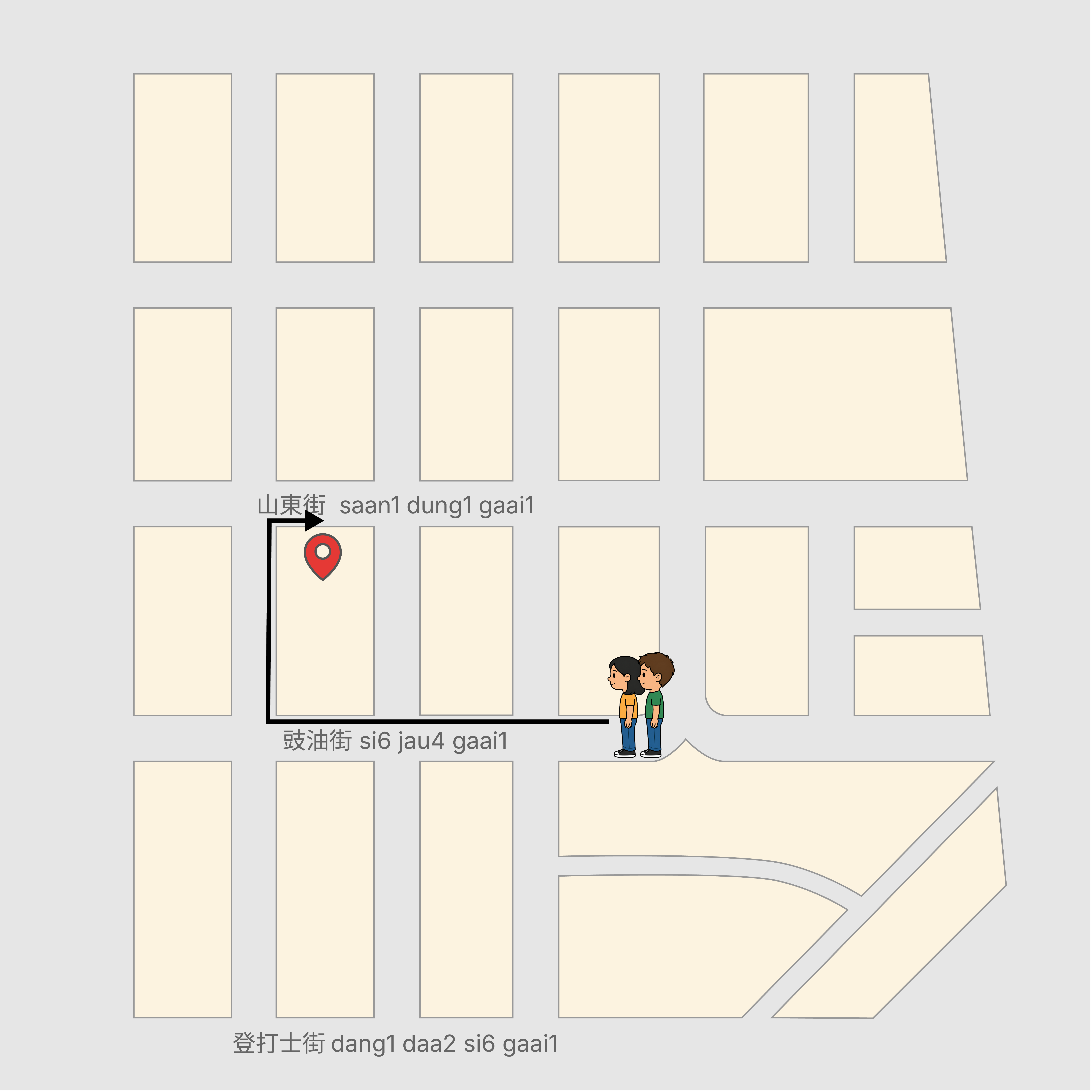
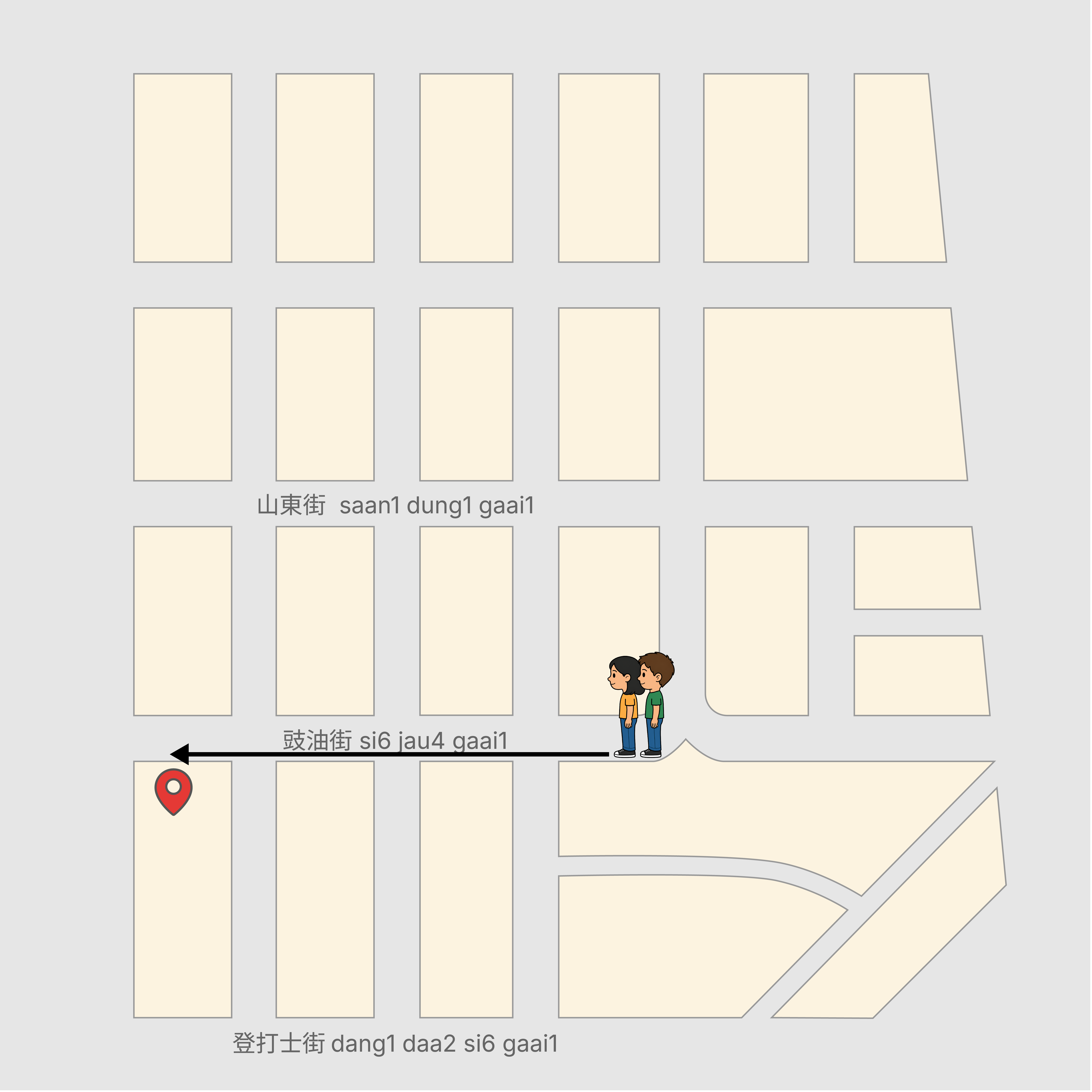
Conversation 3
A.
B.
C.
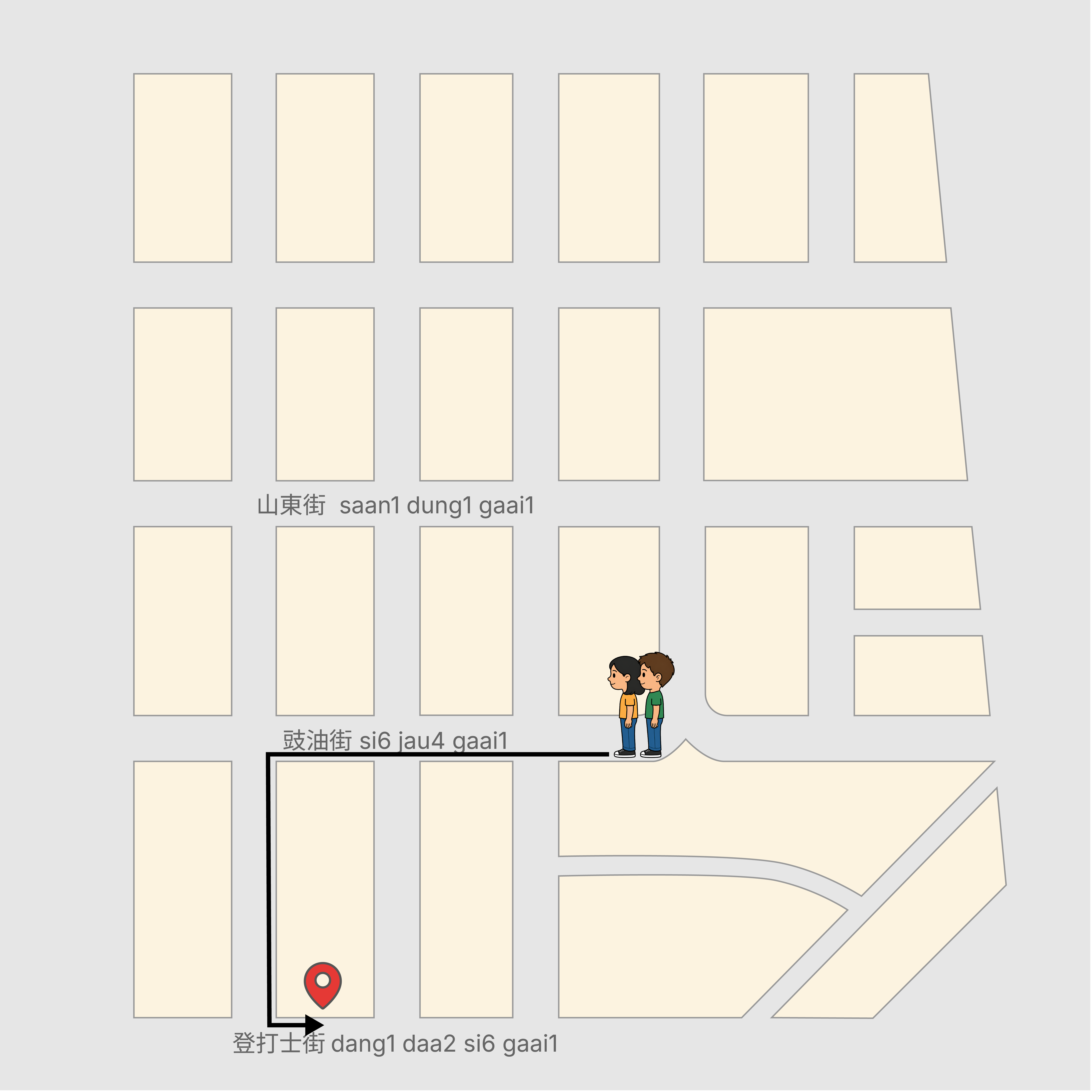
Answer: ____
| A | |
| B | |
| A | |
| B | |
| A | |
| B | |
A few moments later… | |
| A | |
| B | |
A few moments later… | |
| B | |
A few moments later… | |
| A | |
| B | |
A few moments later… | |
| A |
Transcripts with Translation
Conversation 1
| A | 呢度附近有冇公園呀?不如去公園坐下先吖。 ni1 dou6 fu6 gan6 jau5 mou5 gung1 jyun2 aa3? bat1 jyu4 heoi3 gung1 jyun2 co5 haa5 sin1 aa1. Is there a park near here? Why don’t we go to a park to sit for a while first? |
| B | 好似有呀,不如用Google Map揾下吖。 hou2 ci5 jau5 aa3, bat1 jyu4 jung6 Google Map wan2 haa5 aa1. It seems there is. Why don’t we use Google Map to have a search? |
| A | 好呀。 hou2 aa3. Good. [= Sure.] |
A few moments later… | |
| A | 附近有喎,呢條係咩街嚟㗎? fu6 gan6 jau5 wo3, ni1 tiu4 hai6 me1 gaai1 lai4 gaa3? There is one nearby. What street is this one? |
| B | 呢條係奶路臣街嚟嘅。個公園喺邊條街呀? ni1 tiu4 hai6 naai5 lou6 san4 gaai1 lai4 ge3. go3 gung1 jyun2 hai2 bin1 tiu4 gaai1 aa3? This one is Nelson Street. Which street is the park on? |
| A | 喺洗衣街呀。 hai2 sai2 ji1 gaai1 aa3. It is on Sai Yee Street. |
| B | 洗衣街應該即係左邊條街,應該向左邊行呀。 sai2 ji1 gaai1 jing1 goi1 zik1 hai6 zo2 bin6 tiu4 gaai1, jing1 goi1 hoeng3 zo2 bin6 haang4 aa3. Sai Yee Street should be equal to the street on the left. We should walk toward the left. |
A few moments later… | |
| A | 跟住應該轉左邊呀。呀,唔係,應該轉右邊呀。 gan1 zyu6 jing1 goi1 zyun3 zo2 bin6 aa3. aa3, m4 hai6, jing1 goi1 zyun3 jau6 bin6 aa3. And then we should turn left. Oh, no, we should turn right. |
A few moments later… | |
| B | 到喇,前邊呀。 dou3 laa3, cin4 bin6 aa3. We have arrived already. It’s in front. |
Conversation 2
| A | 呢度附近有冇書局呀?我想買本書呀。 ni1 dou6 fu6 gan6 jau5 mou5 syu1 guk2 aa3? ngo5 soeng2 maai5 bun2 syu1 aa3. Is there a bookstore near here? I want to buy a book. |
| B | 你想買咩書呀? nei5 soeng2 maai5 me1 syu1 aa3? What book do you want to buy? |
| A | 本書叫人生種種呀。 bun2 syu1 giu3 jan4 sang1 zung2 zung2 aa3. The book’s name is Sorts of Life. |
| B | 人生種種?個名好特別喎,呢頭好似有幾間獨立書店,我用Google Map揾下先。 jan4 sang1 zung2 zung2? go3 meng2 hou2 dak6 bit6 wo3, ni1 tau4 hou2 ci5 jau5 gei2 gaan1 duk6 laap6 syu1 dim3, ngo5 jung6 Google Map wan2 haa5 sin1. Sorts of Life? The name is very special. There seems to be several independent bookstores in this area. I will use Google Map to have a search first. 獨立書店 duk6 laap6 syu1 dim3 = independent bookstores |
| A | 好呀。 hou2 aa3. Good. [= Sure.] |
| B | 附近有幾間喎,就去呢間啦,呢條係咩街嚟㗎? fu6 gan6 jau5 gei2 gaan1 wo3, zau6 heoi3 ni1 gaan1 laa1, ni1 tiu4 hai6 me1 gaai1 lai4 gaa3? There are several nearby. Let’s just go to this one. What street is this one? |
| A | 呢條係……呢條係彌敦道呀。 ni1 tiu4 hai6… ni1 tiu4 hai6 nei4 deon1 dou6 aa3. This one is… This one is Nathan Road. |
| B | 呢條係彌敦道呀?間嘢喺西洋菜南街,西洋菜南街應該即係右邊嗰條街,應該向呢邊行呀。 ni1 tiu4 hai6 nei4 deon1 dou6 aa4? gaan1 je5 hai2 sai1 joeng4 coi3 naam4 gaai1, sai1 joeng4 coi3 naam4 gaai1 jing1 goi1 zik1 hai6 jau6 bin6 go2 tiu4 gaai1, jing1 goi1 hoeng3 ni1 bin6 haang4 aa3. This one is Nathan Road? The shop is on Sai Yeung Choi Street South. Sai Yeung Choi Street South should be equal to that street on the right. We should walk toward this side. |
| A | 間嘢叫咩名呀? gaan1 je5 giu3 me1 meng2 aa3? What is the shop’s name? |
| B | 叫後記書室呀。 giu3 hau6 gei3 syu1 sat1 aa3. The shop’s name is Epilogue Bookstore. |
A few moments later… | |
| B | 呢度係幾多號呀? ni1 dou6 hai6 gei2 do1 hou6 aa3? What number is here? |
| A | 呢度係四號,間嘢喺幾多號呀? ni1 dou6 hai6 sei3 hou6, gaan1 je5 hai2 gei2 do1 hou6 aa3? Here is No. 4. What number is the shop at? |
| B | 喺六十八號,即係應該向左邊行呀。 hai2 luk6 sap6 baat3 hou6, zik1 hai6 jing1 goi1 hoeng3 zo2 bin6 haang4 aa3. It is at No. 68. That means we should walk toward the left. |
A few moments later… | |
| B | 到喇,六十八號呀,我哋上去啦。 dou3 laa3, luk6 sap6 baat3 hou6 aa3, ngo5 dei6 soeng5 heoi3 laa1. We have arrived already. It’s No. 68. Let’s go up. |
Conversation 3
| A | 間cafe喺邊度呀? gaan1 cafe hai2 bin1 dou6 aa3? Where is the cafe? |
| B | 我用Google Map揾下先。 ngo5 jung6 Google Map wan2 haa5 sin1. I will use Google Map to have a search first. |
| A | 好呀。 hou2 aa3. Good. [= Sure.] |
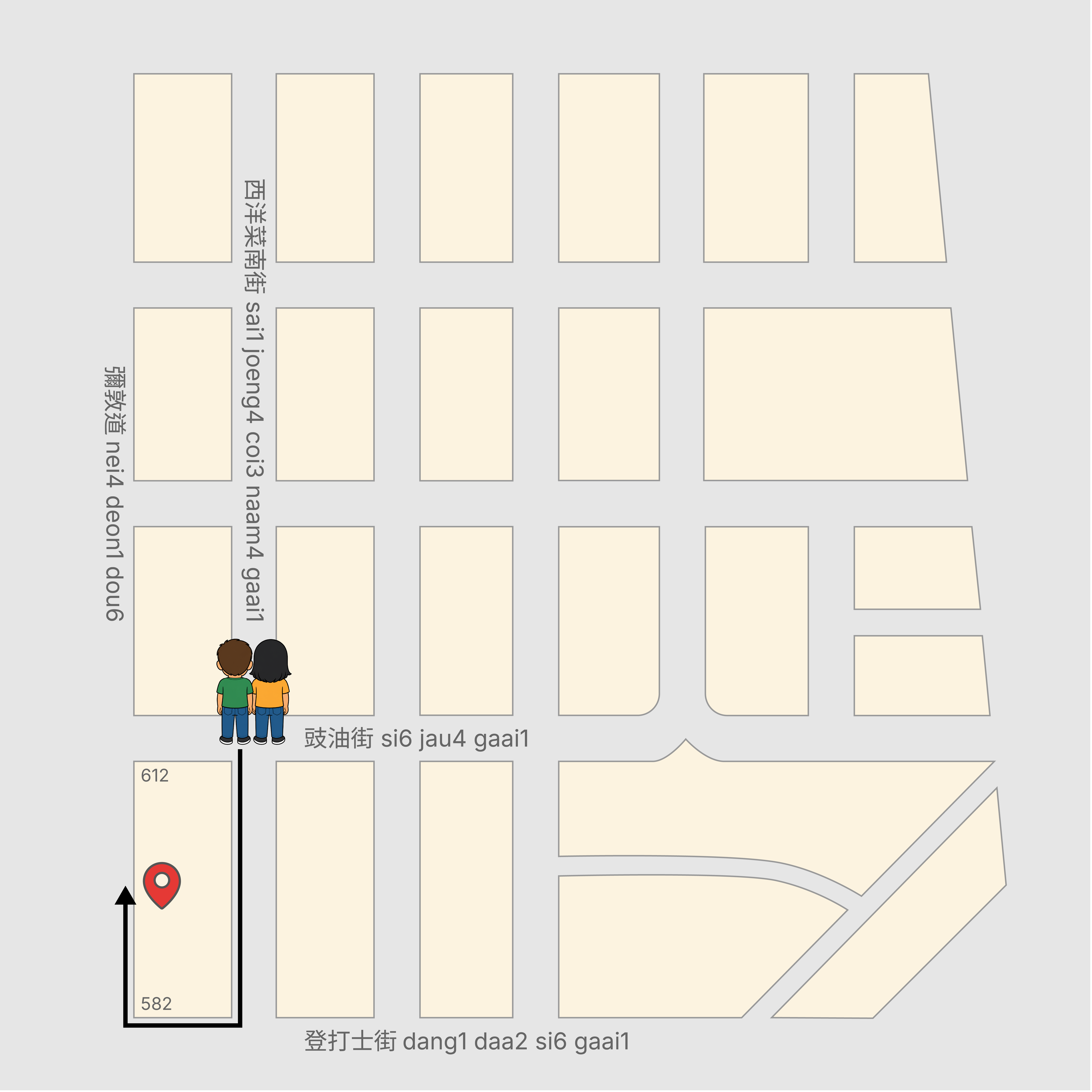
| B | 喺登打士街呀,呢條係咩街呀? hai2 dang1 daa2 si6 gaai1 aa3, ni1 tiu4 hai6 me1 gaai1 aa3? It is on Dundas Street. What street is this one? |
| A | 呢條係……豉油街呀。 ni1 tiu4 hai6… si6 jau4 gaai1 aa3. This one is… Soy Street. |
| B | 噉應該向前邊行,跟住應該轉左邊。 gam2 jing1 goi1 hoeng3 cin4 bin6 haang4, gan1 zyu6 jing1 goi1 zyun3 zo2 bin6. Then, we should walk toward the front. And then we should turn left. |
A few moments later… | |
| A | 我哋係唔係要轉左邊呀? ngo5 dei6 hai6 m4 hai6 jiu3 zyun3 zo2 bin6 aa3? Is it true that we need to turn left? |
| B | 未轉呀,要繼續向前邊行呀。 mei6 zyun3 aa3, jiu3 gai3 zuk6 hoeng3 cin4 bin6 haang4 aa3. Not yet. We need to continue to walk toward the front. |
A few moments later… | |
| B | 而家應該轉左邊,跟住要繼續向前邊行。 ji4 gaa1 jing1 goi1 zyun3 zo2 bin6, gan1 zyu6 jiu3 gai3 zuk6 hoeng3 cin4 bin6 haang4. We should turn left now. And then we need to continue to walk toward the front. |
A few moments later… | |
| A | 登打士街呀,我哋應該轉左邊定右邊呀?間嘢喺幾多號呀? dang1 daa2 si6 gaai1 aa3, ngo5 dei6 jing1 goi1 zyun3 zo2 bin6 ding6 jau6 bin6 aa3? gaan1 je5 hai2 gei2 do1 hou6 aa3? It’s Dundas Street. Should we turn left or right? What number is the shop at? |
| B | 間嘢喺四十三號,即係應該向左邊行呀。 gaan1 je5 hai2 sei3 sap6 saam1 hou6, zik1 hai6 jing1 goi1 hoeng3 zo2 bin6 haang4 aa3. The shop is at No. 43. That means we should walk toward the left. |
A few moments later… | |
| A | 到喇,呢度呀。嘩,好多人呀。 dou3 laa3, ni1 dou6 aa3. waa3, hou2 do1 jan4 aa3. We have arrived already. It’s here. Wow, a lot of people. |
Activity 4
Form a pair. Based on the routes below, make four conversations like those in Activity 3. Start your conversations with the sentences provided. You can put your fingers on the map to pretend that you are walking on the street. Swap your roles after each conversation.
Conversation 1
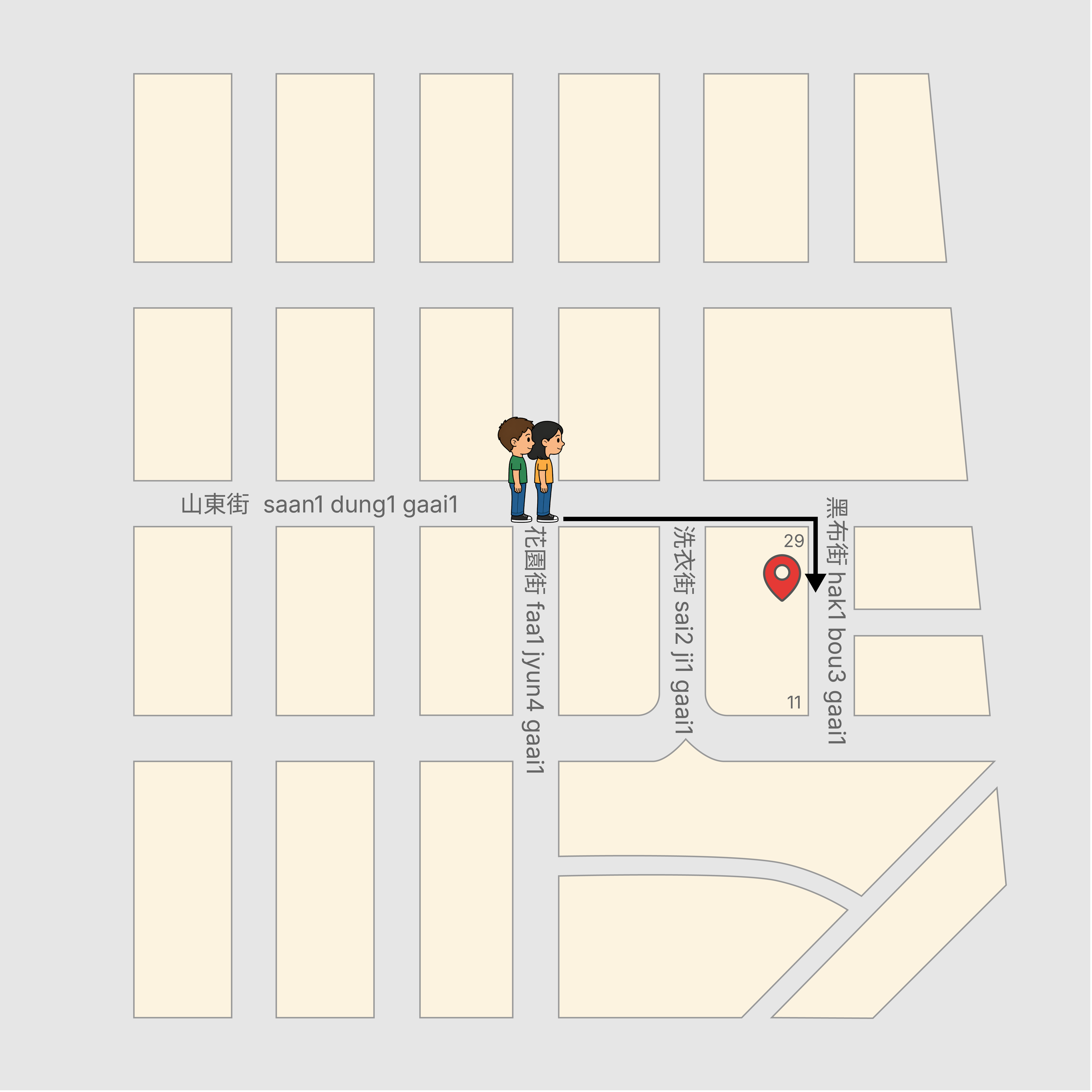
Conversation 2
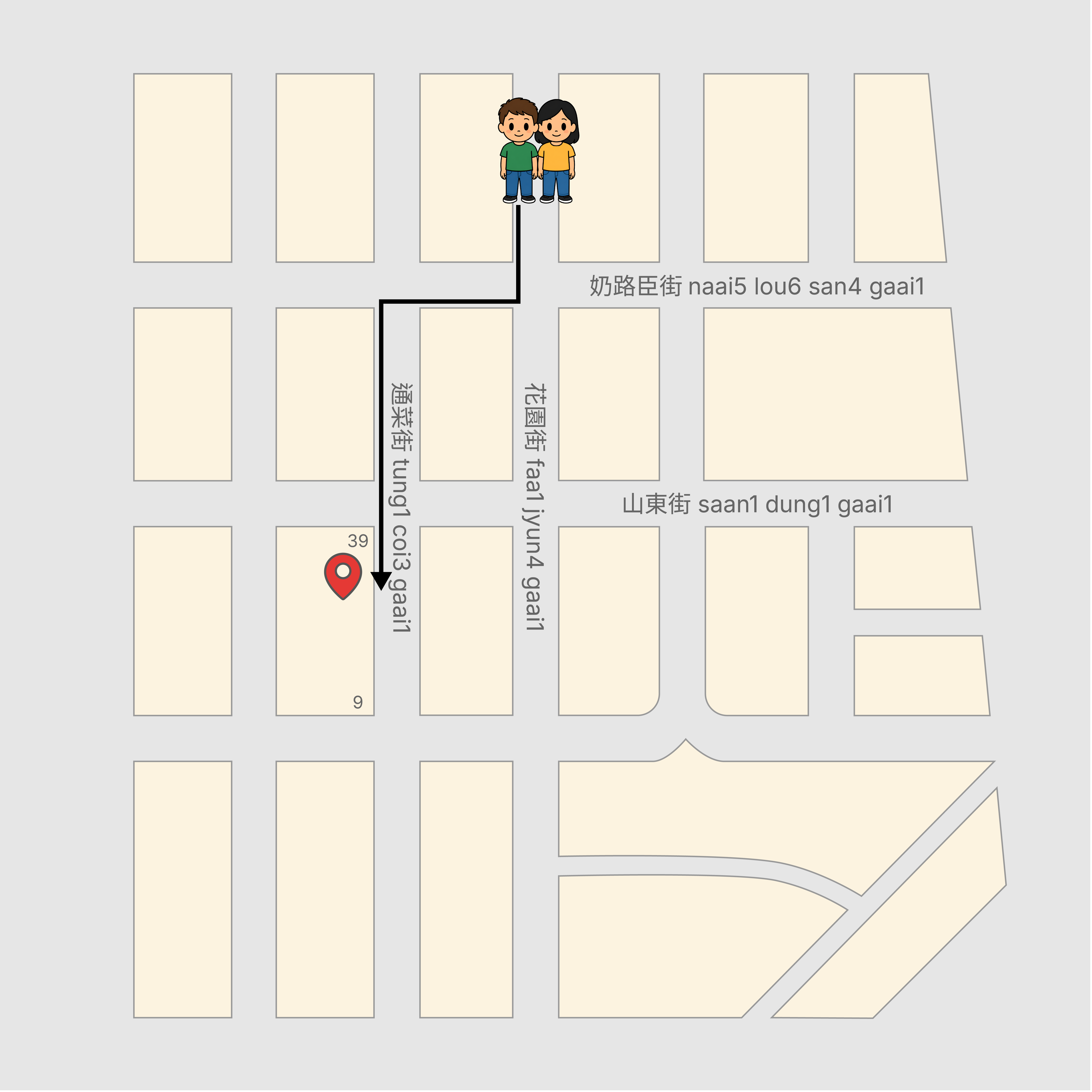
Conversation 3
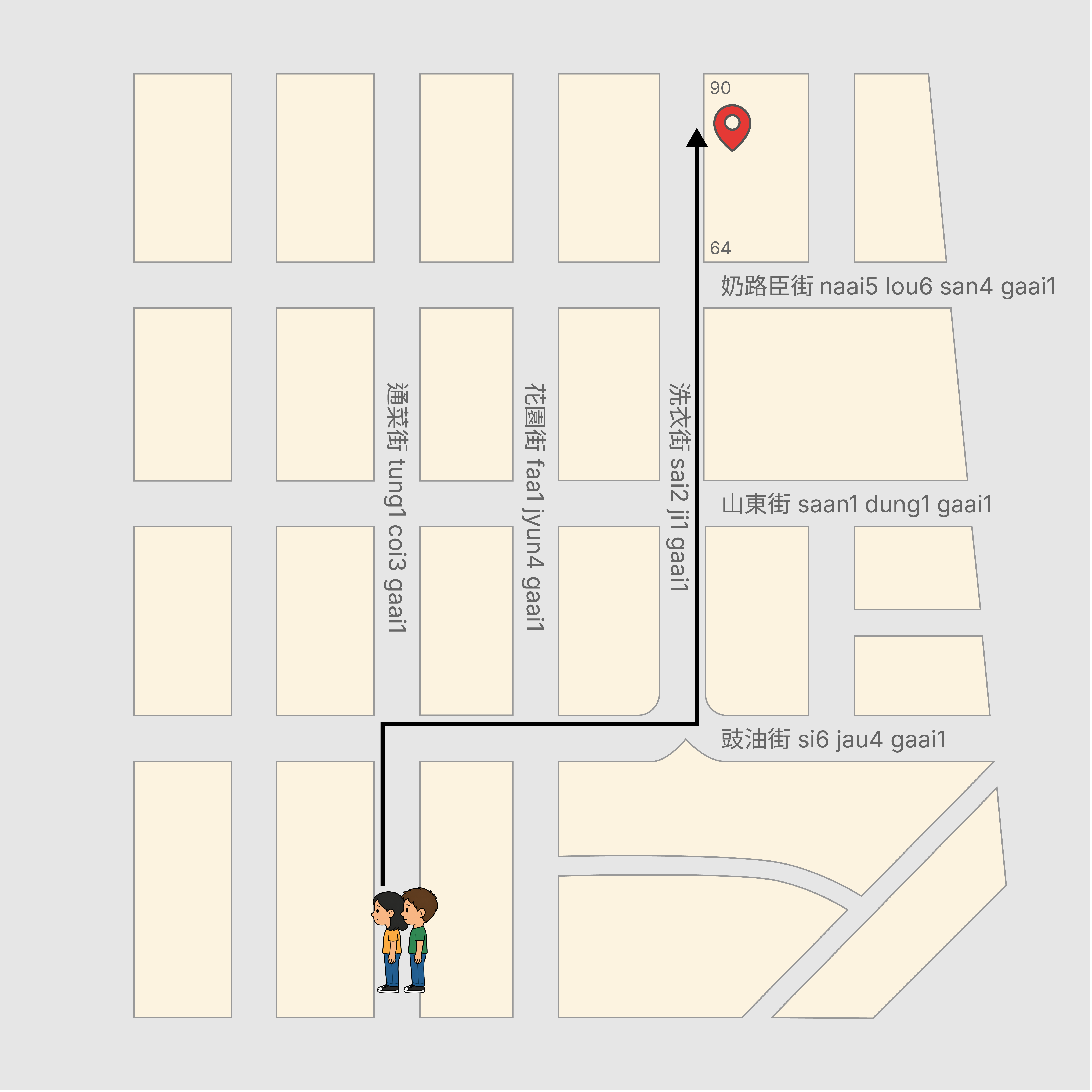
Conversation 4