Print or Export
請問有冇book位嘅?
cing2 man6 jau5 mou5 buk1 wai2 ge2?
cing2 man6 jau5 mou5 buk1 wai2 ge2?
Listen and Speak
Step 1
Listen to a conversation. A guest will talk to the receptionist at a restaurant. Choose the guest’s booking in the booking diary below.
| A | |
| B | |
| A | |
| B | |
| A | |
| B | |
| A | |
| B | |
| A |
Step 2
Listen to the conversation again. Read the script while listening. Check your answer.
| A | 歡迎光臨,請問有冇book位嘅? fun1 jing4 gwong1 lam4, cing2 man6 jau5 mou5 buk1 wai2 ge2? Welcome. May I ask if you have booked seats? |
| B | 有呀。 jau5 aa3. Yes. |
| A | 請問book咗幾多點嘅? cing2 man6 buk1 zo2 gei2 do1 dim2 ge2? May I ask what time you have booked for? |
| B | 我哋book咗八點半嘅。 ngo5 dei6 buk1 zo2 baat3 dim2 bun3 ge3. We have booked for 8:30. |
| A | 請問留咗乜嘢名嘅? cing2 man6 lau4 zo2 mat1 je5 meng2 ge2? May I ask what name you have left? [= May I ask what name you have used in the booking?] |
| B | 留咗黃生,三位嘅。 lau4 zo2 wong4 saang1, saam1 wai2 ge3. I have left Mr. Wong. 3 people. |
| A | 請問留咗幾多號電話嘅? cing2 man6 lau4 zo2 gei2 do1 hou6 din6 waa2 ge2? May I ask what phone number you have left? |
| B | 九八三四,六一二七。 gau2 baat3 saam1 sei3, luk6 jat1 ji6 cat1. 9834-6127. |
| A | 請跟我嚟。 cing2 gan1 ngo5 lai4. Please come with me. |
- 歡迎光臨 fun1 jing4 gwong1 lam4 = welcome
- 跟 gan1 = with (following someone)
Step 3
Listen and repeat.
Step 4
Replace the highlighted words in the script with the other bookings in the booking diary above.
Grammar and Vocabulary
In the Grammar and Vocabulary section, you will learn:
- Yes-No Questions with 有冇 jau5 mou5 III
- Demonstrative Expressions for Locations I
- Location Expressions I
- Referring to Something at a Specific Location
- Vocabulary List
- Vocabulary: Types of Tables
26.1 Yes-No Questions with 有冇 jau5 mou5 III
In Grammar and Vocabulary 13.1, we learned to use 有冇 jau5 mou5 to ask whether someone actually does an activity or not.
To ask whether someone has completed an activity or not, we can put 有冇 jau5 mou5 before the verb phrase for the activity to form a yes-no question in the same way. This type of question is like Have you … ? in English (as in Have you booked seats?). Notice when 有冇 jau5 mou5 is put before the verb, we don’t usually add 咗 zo2 at the same time, although we are asking whether someone has completed an activity.
To answer the question, we can give a short answer or a long answer. We give a short answer more often. Notice when 有 jau5 or 冇 mou5 is put before the verb, we don’t usually add 咗 zo2 at the same time.
For positive answers, we can add or omit 有 jau5. When we omit 有 jau5, we need to add the aspect particle 咗 zo2. For short answers, we can simply say 有呀 jau5 aa3 for ‘yes’ or 冇呀 mou5 aa3 for ‘no’. We can also form a short answer by omitting the subject and the object in the long answer. If the verb is a separate verb, we usually keep the first syllable and omit the other syllables.
我哋有book位呀。 → 有book呀。
ngo5 dei6 jau5 buk1 wai2 aa3. → jau5 buk1 aa3.
我哋book咗位呀。 → Book咗呀。
ngo5 dei6 buk1 zo2 wai2 aa3. → buk1 zo2 aa3.
We have booked seats.
In Grammar and Vocabulary 13.8, we learned that we can use 未 mei6 to form yes-no questions that asks whether an activity has been completed yet or not. The yes-no questions with 未 mei6 are different from the yes-no questions with 有冇 jau5 mou5 we have just learned about. For the yes-no questions with 未 mei6, we expect the activity will be completed sometime and ask whether it has been completed yet or not. For the yes-no questions with 有冇 jau5 mou5, we are not sure if the activity will be completed and simply ask whether it has been completed or not.
你book咗位未呀?
nei5 buk1 zo2 wai2 mei6 aa3?
Have you booked the seats yet?
Possible scenario: We will have a dinner with a person at a restaurant. The person is responsible for booking the seats. We ask whether the person has already done so.
你有冇book位嘅?
nei5 jau5 mou5 buk1 wai2 ge2?
Have you book seats?
Possible scenario: The staff at a restaurant asks whether the guest has booked seats. The guest may or may not have done so.
26.2 Demonstrative Expressions for Locations I
Note that some of the expressions below have more than one pronunciation. For these expressions, we will only use the highlighted pronunciations in this book. You can focus on them first and learn the other pronunciations later.
In Grammar and Vocabulary 2.5, we learned to form demonstrative constructions with 呢 ni1 / nei1 and 嗰 go2. We learned that we use 呢 ni1 (‘this, these’) to refer to something close to us and 嗰 go2 to refer to something far away from us (‘that, those’).
We can also use 呢 ni1 and 嗰 go2 to form demonstrative expressions to refer to a specific location based on its distance from us.
We combine 呢 ni1 and 嗰 go2 with 度 dou6 (‘place’) to mean ‘here’ and ‘there’. The 度 dou6 in these expressions is the same as the 度 dou6 in 邊度 bin1 dou6 (‘where’).
We combine 呢 ni1 and 嗰 go2 with 邊 bin6 / bin1 (‘side’) or 面 min6 (‘side’) to mean ‘this side, this way’ and ‘that side, that way’. Notice 邊 bin can be pronounced with Tone 6 (bin6) and Tone 1 (bin1).
26.3 Location Expressions I
We can use the location expressions below to refer to different locations. Most of them end with 邊 bin6 / bin1 (‘side’) or 面 min6 (‘side’). 邊 bin is usually more often pronounced with Tone 6 (bin6) nowadays, except in the words for ‘left’, ‘right’, ‘left-hand side’ and ‘right-hand side’, where 邊 bin is still commonly pronounced with both Tone 6 (bin6) and Tone 1 (bin1).
For expressions with more than one pronunciation, we will only use the highlighted pronunciations (the ones with bin6) in this book. You can focus on them first and learn the other pronunciations later.
We can add the adverb 最 zeoi3 (‘most’) before these location expressions to indicate the furthest of a side.
最 + 左邊 = 最左邊
zeoi3 + zo2 bin6 = zeoi3 zo2 bin6
most + left = leftmost
最 + 入邊 = 最入邊
zeoi3 + jap6 bin6 = zeoi3 jap6 bin6
most + in = inmost
When we add 最 zeoi3, we can optionally omit the word 邊 bin6 / bin1 or 面 min6.
最左邊 → 最左
zeoi3 zo2 bin6 → zeoi3 zo2
leftmost
最入邊 → 最入
zeoi3 jap6 bin6 → zeoi3 jap6
inmost
In the vocabulary list, these location expressions are labeled as both nouns and postpositions. We will learn when these location expressions are postpositions in later lessons.
26.4 Referring to Something at a Specific Location
We can use this structure to refer to something at a specific location:
We can add 呢 ni1 (‘this’) or 嗰 go2 (‘that’) to indicate whether the thing is close to us or far away from us.
26.5 Vocabulary List
For expressions with more than one pronunciation, we will only use the highlighted pronunciations in this book. You can focus on them first and learn the other pronunciations later.
26.6 Vocabulary: Types of Tables
For tables, we use the classifier 張 zoeng1. For 卡位 kaa1 wai2 (‘booth seat’), we can use the classifier 張 zoeng1 or 個 go3.
Communication
In the Communication section, you will learn:
- Getting a Table at the Restaurant
Getting a Table at the Restaurant
- When the receptionist asks questions, they may add the title 先生 sin1 saang1 (‘sir’), 小姐 siu2 ze2 (‘Miss’) or 太太 taai3 taai2 (‘madam’) after 請問 (‘May I ask …’). For example, they may say:
請問先生有冇book位嘅?
cing2 man6 sin1 saang1 jau5 mou5 buk1 wai2 ge2?
Sir, may I ask if you have booked seats?
Route A: With reservation
If the receptionist doesn’t ask if we have booked a table, we can take the initiative to tell them.
We can also provide all the booking details at once.
Route B: Without reservation
If the restaurant is fully-booked for the night, the receptionist will say:
If tables are available for walk-ins, the receptionist will ask:
Some restaurants offer both indoor and outdoor seating. The receptionist may ask for our preference.
If no table is available at the moment, the receptionist will usually give us a paper slip with a number, which is called 飛 fei1 (‘ticket’), and ask us to wait.
To estimate the waiting time, we can ask about the number of tables ahead of us.
When our table will be ready soon, the receptionist will call our ticket number.
When our table is ready, the receptionist will bring us to the table.
- The sentence particle 吖 aa1 is used here because the receptionist is requesting us to follow them to walk.
- The preposition 跟 gan1 means ‘with (following someone)’. We use 跟 gan1 to indicate that we follow someone to do something. 跟 gan1 is different from the preposition 同 tung4 (‘with’), which is used to indicate that we do something together with someone.
When we arrive at the table, the receptionist will say:
In some restaurants, the receptionist will just point to a table and ask us to walk to the table on our own.
- The sentence particle 吖 aa1 is used here because the staff is requesting us to sit at a specific table.
In some restaurants, we can choose our table freely. The receptionist will say:
Sometimes the receptionist will ask if we mind sharing a table with strangers.
Okay with table sharing
Not okay with table sharing
Culture
Table sharing is common in Hong Kong, especially at 茶餐廳 caa4 caan1 teng1 (‘cha chaan teng’) or fast food restaurants during peak hours. It may be because the restaurant is too small or just because there are too many people who need to eat! In the past, tabling sharing was also common in 酒樓 zau2 lau4 / 茶樓 caa4 lau4 (‘Chinese restaurant’, those for dim sum). It wasn’t unusual to see several groups of strangers sitting around a large round table and eating dim sum together!
Exercises
Exercise 1
Complete the descriptions.
1.
To ask whether someone has completed an activity or not, we can put ________ before the verb phrase for the activity to form a yes-no question.
2.
We combine 呢 ni1 and 嗰 go2 with ________ to mean ‘here’ and ‘there’ respectively.
3.
We combine 呢 ni1 and 嗰 go2 with ________ or ________ to mean ‘this side, this way’ and ‘that side, this way’ respectively.
4.
Most location expressions end with ________ or ________.
5.
We can add ________ before a location expression to indicate the furthest of a side.
Exercise 2
Listen to what A says and choose the correct responses. Then, listen to the recordings to check your answers. Finally, repeat after the recordings.
Conversation 1
| a. | 有呀。 jau5 aa3. |
| b. | 九一二三,四五六七。 gau2 jat1 ji6 saam1, sei3 ng5 luk6 cat1. |
| c. | 我哋訂咗七點半嘅。 ngo5 dei6 deng6 zo2 cat1 dim2 bun3 ge3. |
| d. | 裏邊吖唔該。 leoi5 bin6 aa1 m4 goi1. |
| e. | 留咗陳生,四位嘅。 lau4 zo2 can4 saang1, sei3 wai2 ge3. |
| f. | 唔該晒。 m4 goi1 saai3. |
| A | 歡迎光臨,請問先生有冇訂枱嘅? fun1 jing4 gwong1 lam4, cing2 man6 sin1 saang1 jau5 mou5 deng6 toi2 ge2? |
| B | ________ |
| A | 請問訂咗幾多點嘅? cing2 man6 deng6 zo2 gei2 do1 dim2 ge2? |
| B | ________ |
| A | 請問留咗乜嘢名嘅? cing2 man6 lau4 zo2 mat1 je5 meng2 ge2? |
| B | ________ |
| A | 請問留咗幾多號電話嘅? cing2 man6 lau4 zo2 gei2 do1 hou6 din6 waa2 ge2? |
| B | ________ |
| A | 請問想坐入邊定出邊嘅? cing2 man6 soeng2 co5 jap6 bin6 ding6 ceot1 bin6 ge2? |
| B | ________ |
| A | 請跟我嚟。呢邊吖。請坐。 cing2 gan1 ngo5 lai4. ni1 bin6 aa1. cing2 co5. |
| B | ________ |
Conversation 2
| a. | 兩位嘅。 loeng5 wai2 ge3. |
| b. | 我哋唔係好想搭枱呀。 ngo5 dei6 m4 hai6 hou2 soeng2 daap3 toi2 aa3. |
| c. | 冇呀。 mou5 aa3. |
| d. | 好,唔該晒。 hou2, m4 goi1 saai3. |
| e. | 呢度,我哋係七十六號飛。 ni1 dou6, ngo5 dei6 hai6 cat1 sap6 luk6 hou6 fei1. |
| f. | 請問要等幾多張枱嘅? cing2 man6 jiu3 dang2 gei2 do1 zoeng1 toi2 ge2? |
| A | 歡迎光臨,請問小姐有冇book位嘅? fun1 jing4 gwong1 lam4, cing2 man6 siu2 ze2 jau5 mou5 buk1 wai2 ge2? |
| B | ________ |
| A | 請問幾多位嘅? cing2 man6 gei2 do1 wai2 ge2? |
| B | ________ |
| A | 請問介唔介意搭枱嘅? cing2 man6 gaai3 m4 gaai3 ji3 daap3 toi2 ge2? |
| B | ________ |
| A | 而家未有枱,俾張飛你哋吖。 ji4 gaa1 mei6 jau5 toi2, bei2 zoeng1 fei1 nei5 dei6 aa1. |
| B | ________ |
| A | 仲有十張枱。 zung6 jau5 sap6 zoeng1 toi2. |
| B | ________ |
1 hour later… | |
| A | 七十六號飛,有冇七十六號飛嘅? cat1 sap6 luk6 hou6 fei1, jau5 mou5 cat1 sap6 luk6 hou6 fei1 ge2? |
| B | ________ |
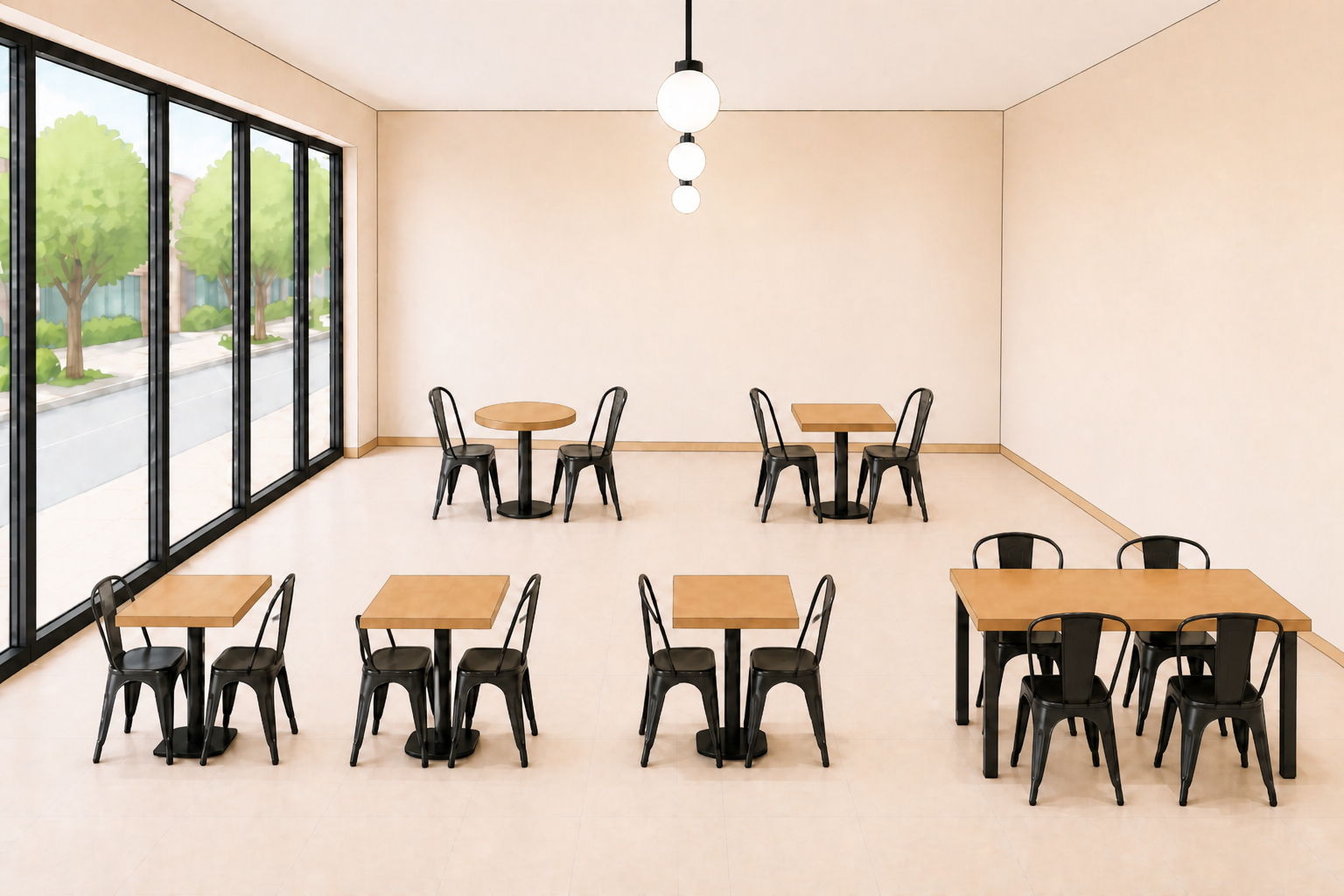
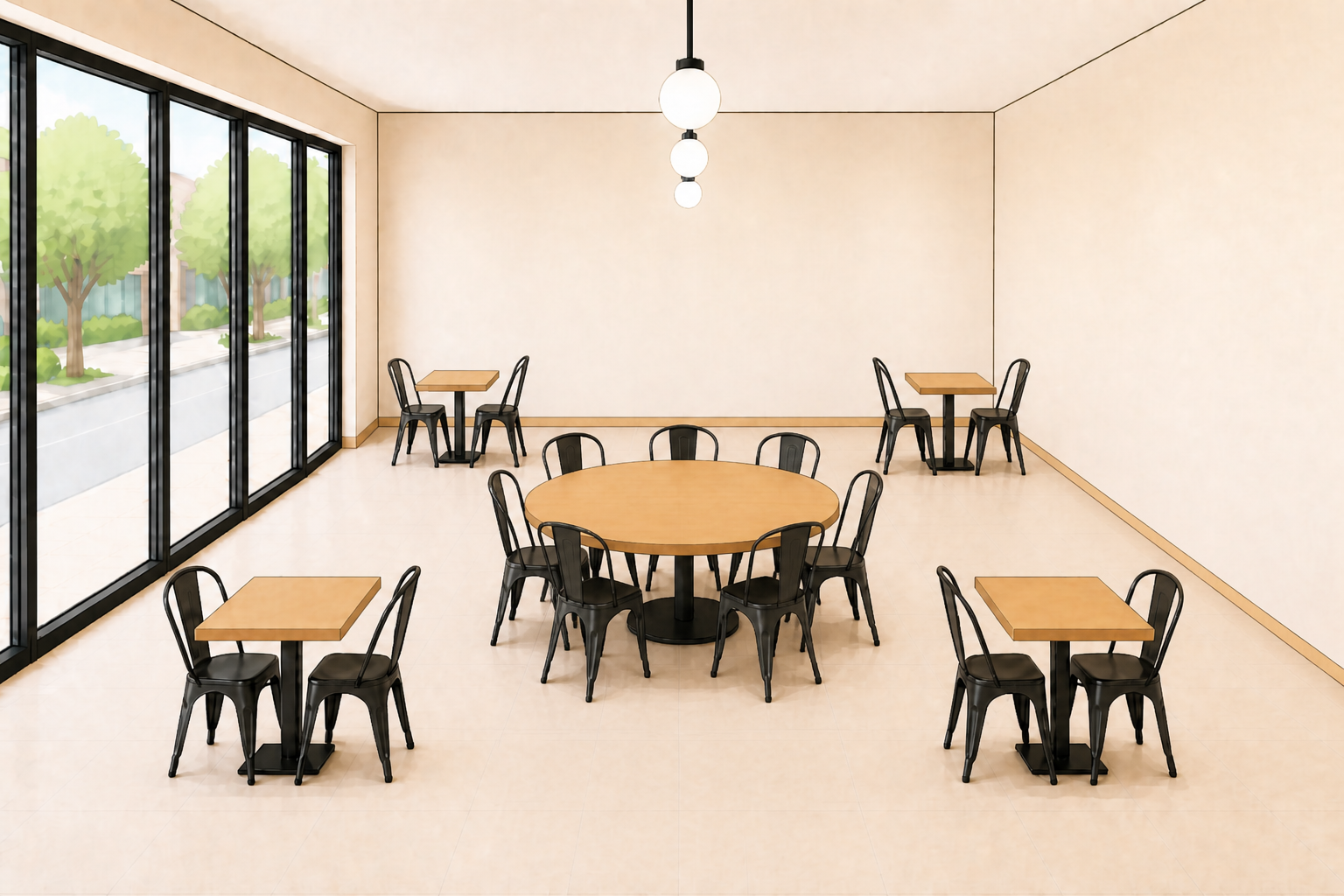
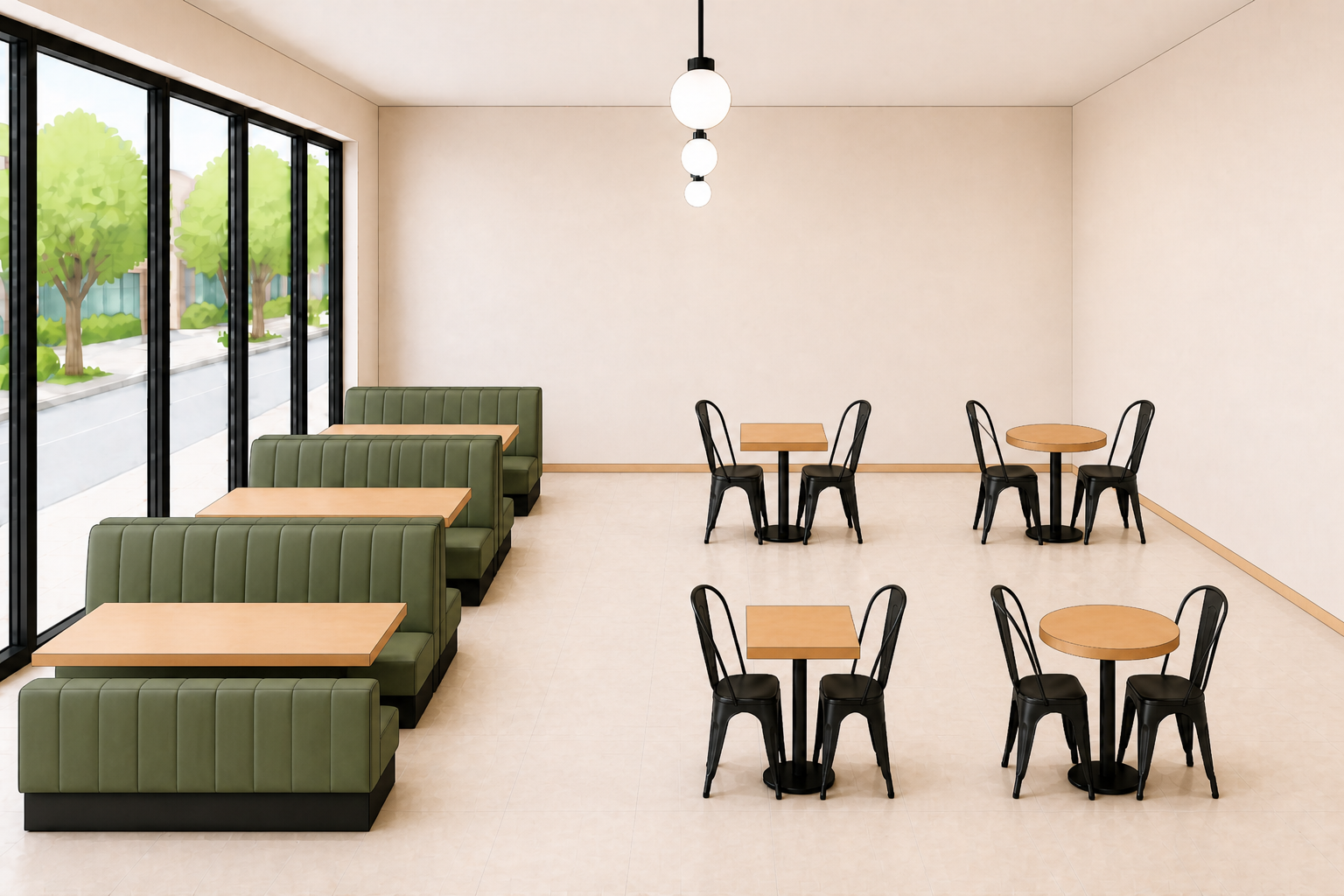
Exercise 3
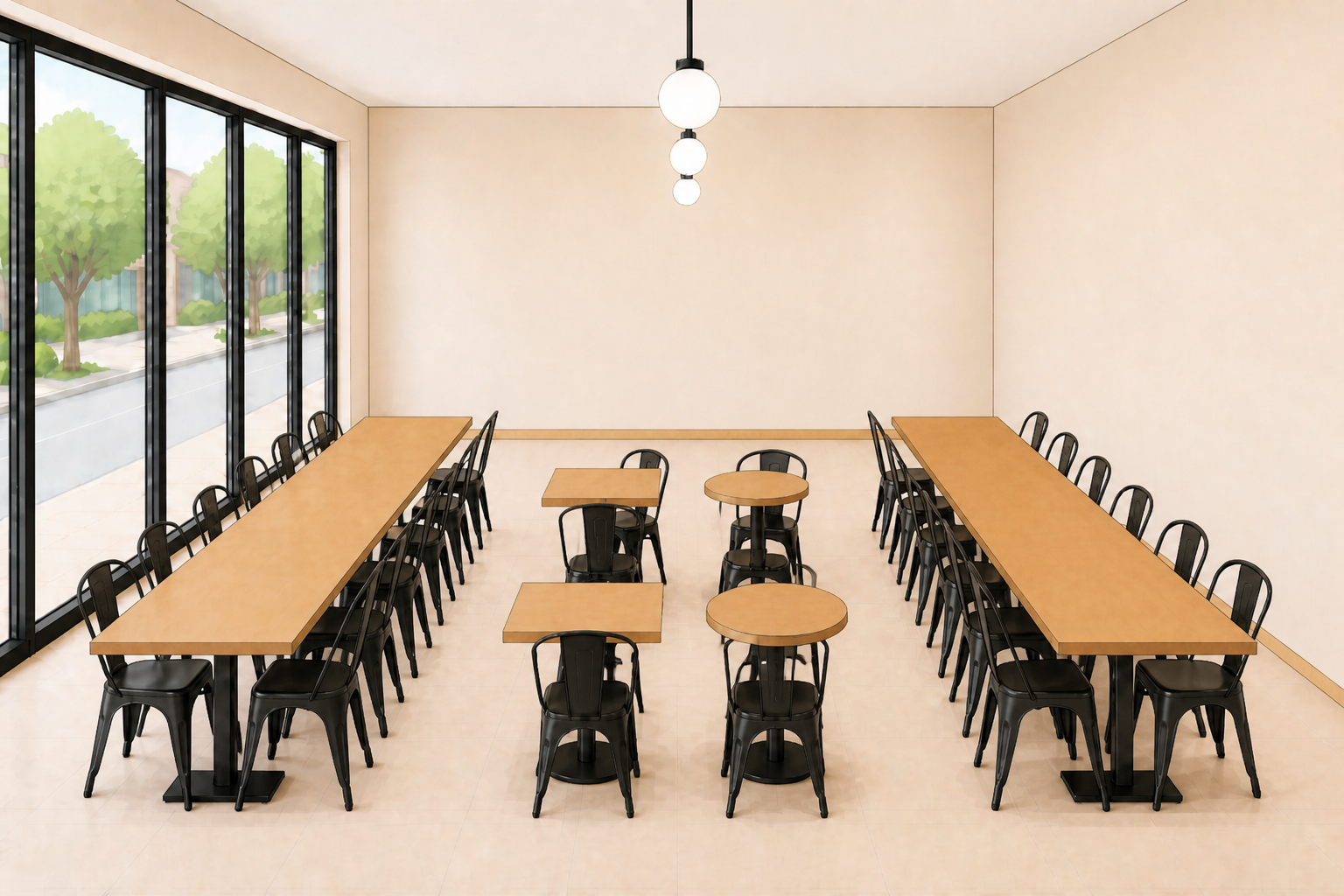
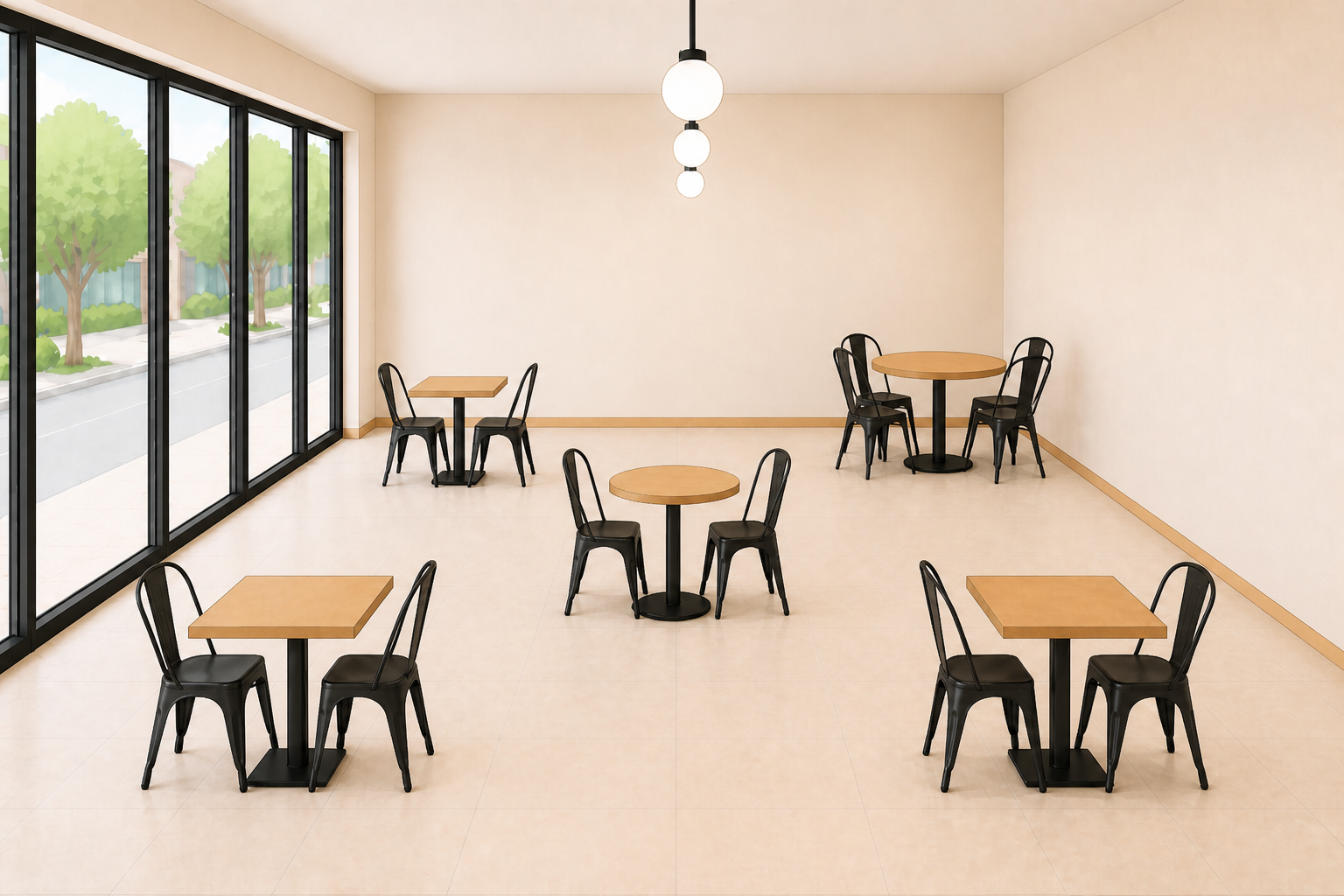
Listen and choose the correct tables. Then, repeat after the recordings.
Example
前邊呢張四人枱吖。cin4 bin6 ni1 zoeng1 sei3 jan4 toi2 aa1.
This four-person table at the front, please.
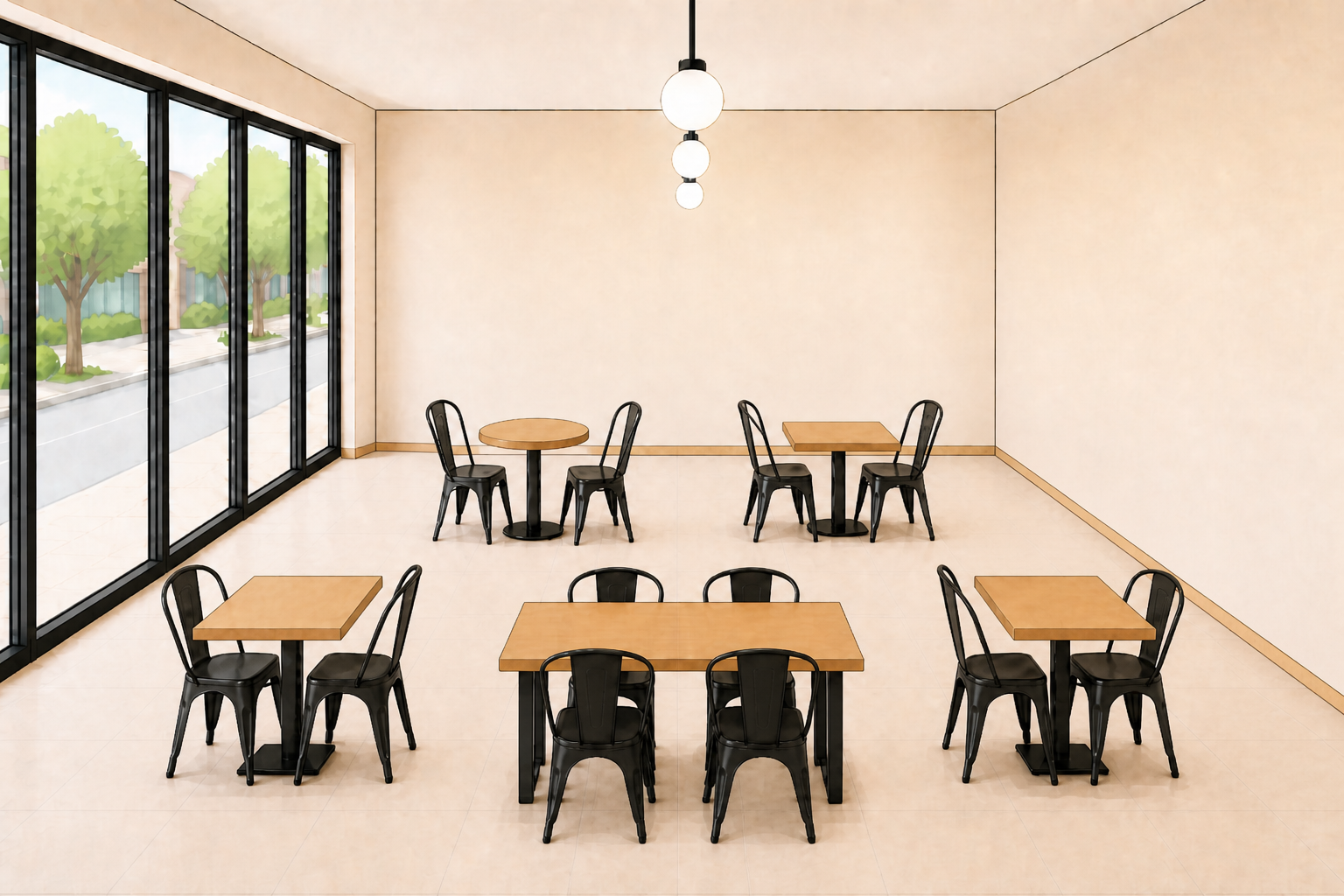
1.
________
2.
________
3.
________
4.
________
5.
________
Activities
Activity 1
Listen to two conversations. In each conversation, a guest will talk to the receptionist at the restaurant. Complete the tables. Fill in a question mark if the information is not mentioned.
Conversation 1
| A | |
| B | |
| A | |
| B | |
| A | |
| B | |
| A | |
| B | |
| A |
Conversation 2
| A | |
| B | |
| A | |
| B | |
| A | |
| B |
Transcripts with Translation
Conversation 1
| A | 歡迎光臨,請問小姐有冇訂枱嘅? fun1 jing4 gwong1 lam4, cing2 man6 siu2 ze2 jau5 mou5 deng6 toi2 ge2? Welcome. Miss, may I ask if you have booked seats? |
| B | 有呀。 jau5 aa3. Yes. |
| A | 請問訂咗幾多點嘅? cing2 man6 deng6 zo2 gei2 do1 dim2 ge2? May I ask what time you have booked for? |
| B | 我哋訂咗九點半嘅。 ngo5 dei6 deng6 zo2 gau2 dim2 bun3 ge3. We have booked for 9:30. |
| A | 請問留咗乜嘢名嘅? cing2 man6 lau4 zo2 mat1 je5 meng2 ge2? May I ask what name you have left? |
| B | 留咗梁小姐,八位嘅。 lau4 zo2 loeng4 siu2 ze2, baat3 wai2 ge3. I have left Miss Leung. 8 people. |
| A | 請問幾多號電話嘅? cing2 man6 gei2 do1 hou6 din6 waa2 ge2? May I ask your phone number? |
| B | 六三八九,一二五四。 luk6 saam1 baat3 gau2, jat1 ji6 ng5 sei3. 6389-1254. |
| A | 請跟我嚟。請坐。 cing2 gan1 ngo5 lai4. cing2 co5. Please come with me. Please sit. |
Conversation 2
| A | 歡迎光臨,請問先生有冇book位嘅? fun1 jing4 gwong1 lam4, cing2 man6 sin1 saang1 jau5 mou5 buk1 wai2 ge2? Welcome. Sir, may I ask if you have booked seats? |
| B | 我哋冇book位呀。 ngo5 dei6 mou5 buk1 wai2 aa3. We have not booked seats. |
| A | 請問先生幾多個人嘅? cing2 man6 sin1 saang1 gei2 do1 go3 jan4 ge2? Sir, may I ask how many people? |
| B | 十個人嘅。 sap6 go3 jan4 ge3. 10 people. |
| A | 唔好意思,今晚冇位喇。 m4 hou2 ji3 si1, gam1 maan5 mou5 wai2 laa3. Sorry, there are no seats already tonight. |
| B | 好,唔該晒。 hou2, m4 goi1 saai3. Good. [= Okay.] Thank you so much. |
Activity 2
Listen to three conversations. In each conversation, a guest will talk to the receptionist at the restaurant. Then, listen to the questions and answer them.
Conversation 1
1. ________
________
2. ________
jap6 bin6
ceot1 bin6
| A | |
| B | |
| A | |
| B | |
| A | |
| B | |
| A |
Conversation 2
3. ________
________
4. ________
________
5. ________
6. ________
jap6 bin6
ceot1 bin6
| A | |
| B | |
| A | |
| B | |
| A | |
| B | |
| A | |
| B | |
| A | |
| B | |
Half an hour later… | |
| A | |
| B | |
| A |
Conversation 3
7. ________
________
8. ________
9. ________
jap6 bin6
ceot1 bin6
| A | |
| B | |
| A | |
| B | |
| A | |
| B | |
| A | |
| B | |
| A | |
| B | |
Half an hour later… | |
| A | |
| B | |
| A |
Transcripts with Translation
Conversation 1
| A | 歡迎光臨,請問小姐有冇訂枱嘅? fun1 jing4 gwong1 lam4, cing2 man6 siu2 ze2 jau5 mou5 deng6 toi2 ge2? Welcome. Miss, may I ask if you have booked a table? |
| B | 冇呀。 mou5 aa3. No. |
| A | 請問小姐幾多位嘅? cing2 man6 siu2 ze2 gei2 do1 wai2 ge2? Miss, may I ask how many people? |
| B | 五位嘅。 ng5 wai2 ge3. 5 people. |
| A | 請問你哋想坐入邊定出邊嘅? cing2 man6 nei5 dei6 soeng2 co5 jap6 bin6 ding6 ceot1 bin6 ge2? May I ask whether you want to sit inside or outside? |
| B | 入邊吖唔該。 jap6 bin6 aa1 m4 goi1. Inside, please. |
| A | 請跟我嚟。最入邊嗰個卡位吖。 cing2 gan1 ngo5 lai4. zeoi3 jap6 bin6 go2 go3 kaa1 wai2 aa1. Please come with me. That inmost booth table, please. |
Conversation 2
| A | 歡迎光臨,請問有冇訂位嘅? fun1 jing4 gwong1 lam4, cing2 man6 jau5 mou5 deng6 wai2 ge2? Welcome. May I ask if you have booked seats? |
| B | 冇呀。 mou5 aa3. No. |
| A | 請問幾多位嘅? cing2 man6 gei2 do1 wai2 ge2? May I ask how many people? |
| B | 兩位嘅。 loeng5 wai2 ge3. 2 people. |
| A | 請問你哋想坐裏邊定外邊嘅? cing2 man6 nei5 dei6 soeng2 co5 leoi5 bin6 ding6 ngoi6 bin6 ge2? May I ask whether you want to sit inside or outside? |
| B | 外邊吖唔該。 ngoi6 bin6 aa1 m4 goi1. Outside, please. |
| A | 而家未有枱,俾張飛你哋吖。 ji4 gaa1 mei6 jau5 toi2, bei2 zoeng1 fei1 nei5 dei6 aa1. There is no table yet now. Let me give you a ticket. |
| B | 請問仲有幾多張枱嘅? cing2 man6 zung6 jau5 gei2 do1 zoeng1 toi2 ge2? May I ask how many tables there are still [ahead of us]? |
| A | 仲有三張枱。 zung6 jau5 saam1 zoeng1 toi2. There are still 3 tables [ahead of you]. |
| B | 好,唔該晒。 hou2, m4 goi1 saai3. Good. [= Okay.] Thank you so much. |
Half an hour later… | |
| A | 三十六號飛,有冇三十六號飛嘅? saam1 sap6 luk6 hou6 fei1, jau5 mou5 saam1 sap6 luk6 hou6 fei1 ge2? Ticket number 36. Is there ticket number 36? |
| B | 呢度,我哋係三十六號飛。 ni1 dou6, ngo5 dei6 hai6 saam1 sap6 luk6 hou6 fei1. Here, we are ticket number 36. |
| A | 中間呢張圓枱吖。 zung1 gaan1 ni1 zoeng1 jyun4 toi2 aa1. This round table at the center, please. |
Conversation 3
| A | 歡迎光臨,請問先生有冇book位嘅? fun1 jing4 gwong1 lam4, cing2 man6 sin1 saang1 jau5 mou5 buk1 wai2 ge2? Welcome. Sir, may I ask if you have booked seats? |
| B | 冇呀。 mou5 aa3. No. |
| A | 請問先生幾多位嘅? cing2 man6 sin1 saang1 gei2 do1 wai2 ge2? Sir, may I ask how many people? |
| B | 四位嘅。 sei3 wai2 ge3. 4 people. |
| A | 請問你哋想坐裏邊定外邊嘅? cing2 man6 nei5 dei6 soeng2 co5 leoi5 bin6 ding6 ngoi6 bin6 ge2? May I ask whether you want to sit inside or outside? |
| B | 裏邊吖。 leoi5 bin6 aa1. Inside, please. |
| A | 我哋而家未有位,俾張飛你哋吖。 ngo5 dei6 ji4 gaa1 mei6 jau5 wai2, bei2 zoeng1 fei1 nei5 dei6 aa1. We don’t have seats yet now. Let me give you a ticket. |
| B | 請問而家幾多號飛嘅? cing2 man6 ji4 gaa1 gei2 do1 hou6 fei1 ge2? May I ask what the ticket number is now? |
| A | 而家三十八號飛。 ji4 gaa1 saam1 sap6 baat3 hou6 fei1. Ticket number 38 now. |
| B | 好,唔該晒。 hou2, m4 goi1 saai3. Good. [= Okay.] Thank you so much. |
Half an hour later… | |
| A | 四十一號飛,有冇四十一號飛嘅? sei3 sap6 jat1 hou6 fei1, jau5 mou5 sei3 sap6 jat1 hou6 fei1 ge2? Ticket number 41. Is there ticket number 41? |
| B | 呢度,我哋係四十一號飛。 ni1 dou6, ngo5 dei6 hai6 sei3 sap6 jat1 hou6 fei1. Here, we are ticket number 41. |
| A | 呢邊吖。前邊張四人枱吖。 ni1 bin1 aa1. cin4 bin6 zoeng1 sei3 jan4 toi2 aa1. This way, please. The four-person table at the front, please. |
Activity 3
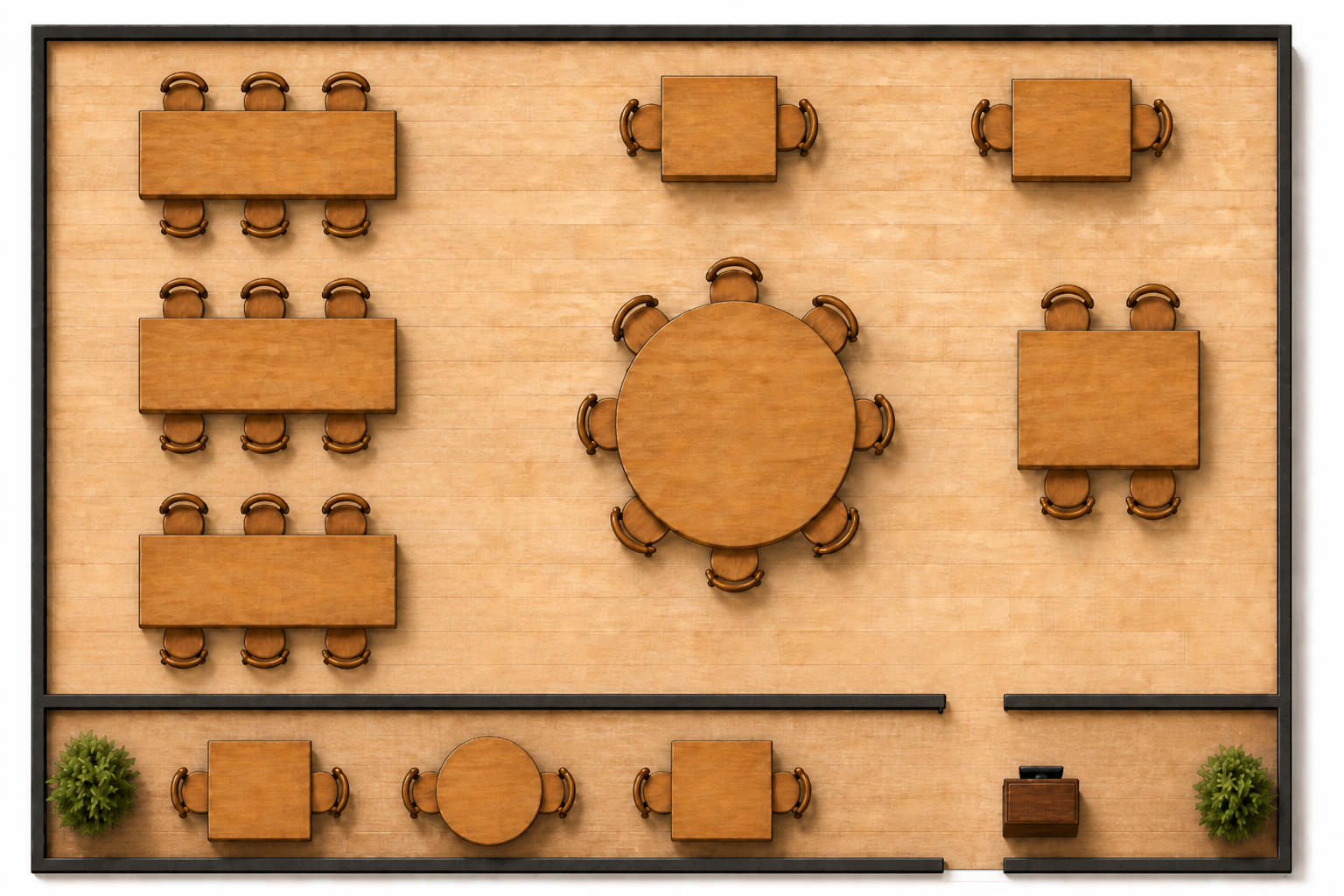
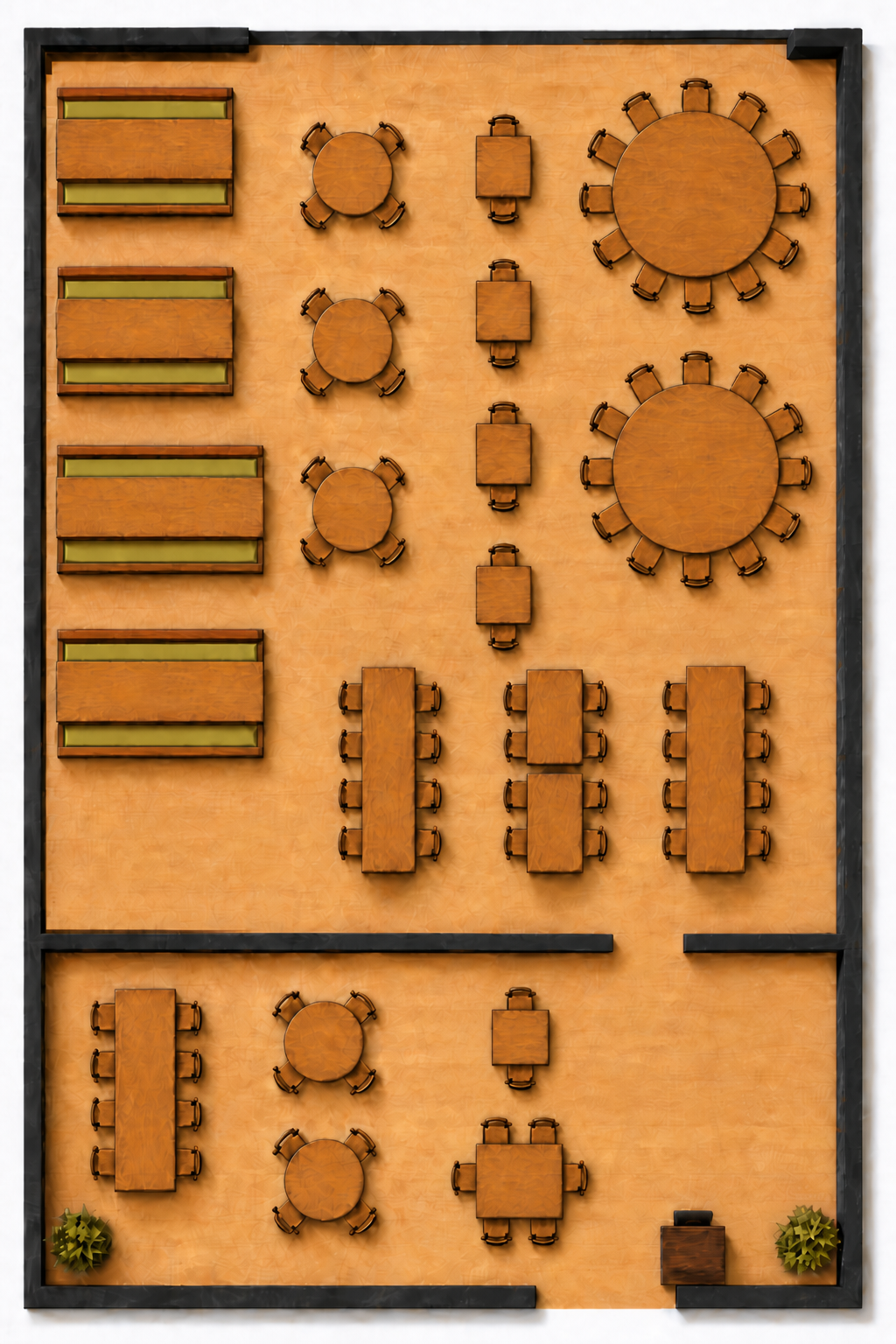
Form a pair. Use the notes below to make eight conversations. In each conversation, one of you will be the receptionist, and one of you will be the guest. Swap your roles after each conversation. Use your fingers to walk on the floor plan so that you can practice using location expressions.
jap6 bin6
ceot1 bin6