Print or Export
你想食咩呀?
nei5 soeng2 sik6 me1 aa3?
nei5 soeng2 sik6 me1 aa3?
Listen and Speak
Step 1
Listen to the words for different types of cuisine. Match each word below to the correct number.
| 1. | 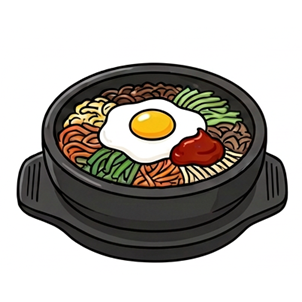 | ________ to eat Korean food |
| 2. | 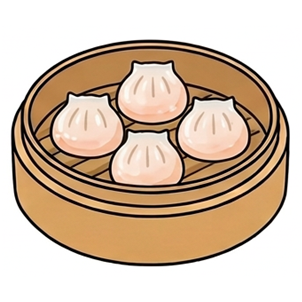 | ________ to yum cha [to have dim sum] |
| 3. | 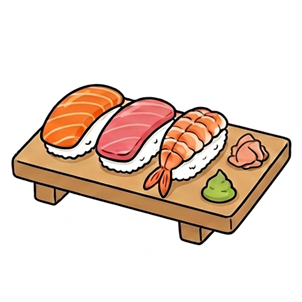 | ________ to eat Japanese food |
| 5. | 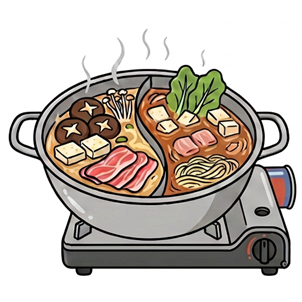 | ________ to have hotpot |
| 6. |  | ________ to eat pizza |
Step 2
Listen to a conversation. The speakers will decide on the type of cuisine for a meal. Write down the type of cuisine they have chosen.
________| A | |
| B | |
| A | |
| B | |
| A |
Step 3
Listen to the conversation again. Read the script while listening. Check your answers.
| A | 你聽晚想食咩呀? nei5 ting1 maan5 soeng2 sik6 me1 aa3? What do you want to eat tomorrow night? |
| B | 我想食日本嘢呀。 ngo5 soeng2 sik6 jat6 bun2 je5 aa3. I want to eat Japanese food. |
| A | 我都想食日本嘢呀。 ngo5 dou1 soeng2 sik6 jat6 bun2 je5 aa3. I want to eat Japanese food too. |
| B | 噉不如就食日本嘢啦。 gam2 bat1 jyu4 zau6 sik6 jat6 bun2 je5 laa1. Why don’t we just choose eating Japanese food then? |
| A | 好呀。 hou2 aa3. Good. [= Sure.] |
- 想 soeng2 = to want to
Step 4
Listen and repeat.
Step 5
Replace the highlighted words in the script with the other types of cuisine to make your conversations.
Grammar and Vocabulary
In the Grammar and Vocabulary section, you will learn:
- The Modal Verb 想 soeng2 (‘to want to’)
- Serial Verb Constructions III (Object)
- Yes-No Questions with the X-not-X Construction II (Action Verbs)
- Asking for Suggestions or Preferences with 好 hou2 (‘good’)
- Asking for Opinions on Suggestions with 好唔好 hou2 m4 hou2 (‘Is … good?’)
- The Noun 嘢 je5 (‘thing’) I
- Vocabulary List
- Vocabulary: Types of Cuisine
18.1 The Modal Verb 想 soeng2 (‘to want to’)
The modal verb 想 soeng2 means ‘to want to’. We use it to indicate we want to do an activity. We put the verb for the activity after 想 soeng2.
We put 唔 m4 (‘not’) before 想 soeng2 to negate 想 soeng2.
We can add a degree word (e.g., 好 hou2 ‘very’ and 唔係好 m4 hai6 hou2 ‘not very’) before 想 soeng2 to indicate how much we want or don’t want to do something.
We use the X-not-X construction to form yes-no questions with 想 soeng2. Notice X will be 想 soeng2 instead of the verb behind it.
你想唔想打邊爐呀?
nei5 soeng2 m4 soeng2 daa2 bin1 lou4 aa3?
Do you want to have hotpot?
To answer the question, we can give a long answer or a short answer. We give a short answer more often.
We sometimes use yes-no questions with 想 soeng2 to make suggestions. In that case, we can respond to the questions by accepting or rejecting the suggestions. The expressions for accepting or rejecting suggestions are similar to those for accepting or rejecting invitations, which we have learned in Lesson 16.
| A: | 你想唔想打邊爐呀? nei5 soeng2 m4 soeng2 daa2 bin1 lou4 aa3? Do you want to have hotpot? |
| B: | → 好呀。 hou2 aa3. Good. [= Sure.] → OK呀。 ou1 kei1 aa3. Okay. [= Sure.] → 唔喇。 m4 laa3. No. [= I’ll pass on it.] → 唔好喇。 m4 hou2 laa3. Not good. [= I’ll pass on it.] |
We can also use 想 soeng2 with a question word (e.g., 乜嘢 mat1 je5 / 咩 me1 ‘what’, 邊度 bin1 dou6 ‘where’) to ask about someone’s preferences.
你想食咩呀?
nei5 soeng2 sik6 me1 aa3?
What do you want to eat?
18.2 Serial Verb Constructions III (Object)
In Grammar and Vocabulary 16.4, we learned this type of serial verb construction: the first verb phrase is formed by 有 jau5, 冇 mou5 or 有冇 jau5 mou5 and a noun, and the second verb phrase provides details about the noun.
For this type of serial verb construction, the noun in the first verb phrase is sometimes the object of the activity in the second verb phrase. We will see a few examples like this in this lesson.
The noun 嘢 je5 in the first verb phrase can refer to anything. The second verb phrase 想食 soeng2 sik6 specifies that 嘢 je5 are the things that the listener wants to eat. 嘢 je5 can be seen as the object of 想食 soeng2 sik6. The noun 嘢 je5 in the first verb phrase can refer to anything. The second verb phrase 唔食m4 sik6 specifies that 嘢 je5 are the things that the listener doesn’t eat. 嘢 je5 can be seen as the object of 唔食 m4 sik6.The noun in the first verb phrase can also be a question word (e.g., 乜嘢 mat1 je5 / 咩 me1 ‘what’). The two examples below are similar to the two examples above in meaning. The only difference is that 嘢 je5 (‘thing’) is replaced by 咩 me1 (‘what’).
18.3 Yes-No Questions with the X-not-X Construction II (Action Verbs)
In Grammar and Vocabulary 4.4, we learned to use the X-not-X construction to form yes-no questions. So far, we have seen examples with stative verbs (e.g., 鍾意 zung1 ji3 ‘to like’), modal verbs (e.g., 識 sik1 ‘to know how to’) and the verb 係 hai6 (‘to be’).
In this lesson, we will see examples with action verbs. When we use the X-not-X construction to form a yes-no question with an action verb, the question can perform different functions, depending on the context. We will look at the first function below.
For the first function, the question asks whether someone usually does an activity or not (i.e., whether the person has the habit of doing the activity). It is like questions beginning with do you in English (e.g., Do you eat spicy food?). For this function, we usually end the question with the sentence particle 嘅 ge2 or 㗎 gaa3.
你食唔食辣嘢㗎?
nei5 sik6 m4 sik6 laat6 je5 gaa3?
Do you eat spicy food?
The question asks whether the listener eats spicy food. For example, it may be asked when we are deciding what to eat for a meal.
To answer the question, we can give a long answer or a short answer. We give a short answer more often.
18.4 Asking for Suggestions or Preferences with 好 hou2 (‘good’)
In Grammar and Vocabulary 4.3, we learned that 好 hou2 means ‘very’ as an adverb. 好 hou2 can also be an adjective. It means ‘good’ as an adjective.
We can use the adjective 好 hou2 with a question word (e.g., 乜嘢 mat1 je5 / 咩 me1 ‘what’, 邊度 bin1 dou6 ‘where’) to form a question that asks for suggestions or preferences. A question with 好 hou2 asks what will be a good choice or what we should choose. 好 hou2 adds the meaning of ‘should’ to a question (as in What should we eat? or Where should we go?). We put 好 hou2 at the end of the question and usually add the sentence particle 呀 aa3 (for questions) after it.
| A: | 我哋食咩好呀? ngo5 dei6 sik6 me1 hou2 aa3? We eat what will be good? [= What should we eat?] |
| B: | → 不如我哋打邊爐吖。 bat1 jyu4 ngo5 dei6 daa2 bin1 lou4 aa1. Why don’t we have hotpot? → 我想打邊爐呀。 ngo5 soeng2 daa2 bin1 lou4 aa3. I want to have hotpot. |
When we are not sure how to form the question with 好 hou2, we can first think of the question without 好 hou2 and then put 好 hou2 before the sentence particle.
我哋食咩呀?
ngo5 dei6 sik6 me1 aa3?
What do we eat?
↓
我哋食咩好呀?
ngo5 dei6 sik6 me1 hou2 aa3?
We eat what will be good?
[= What should we eat?]
18.5 Asking for Opinions on Suggestions with 好唔好 hou2 m4 hou2 (‘Is … good?’)
We can combine the positive and negative forms of the adjective 好 hou2 (‘good’) to form the expression 好唔好 hou2 m4 hou2.
The expression 好唔好 hou2 m4 hou2 means ‘Is … good?’. We can add it after an option to suggest the option and ask for opinions on the option at the same time. It functions like what do you think about … ? in English (as in What do you think about having hotpot?). We usually add the sentence particle 呀 aa3 (for questions) after 好唔好 hou2 m4 hou2.
我哋打邊爐好唔好呀?
ngo5 dei6 daa2 bin1 lou4 hou2 m4 hou2 aa3?
Is having hotpot good?
[= What do you think about having hotspot?]
好唔好 hou2 m4 hou2 is added after the option 我哋打邊爐 ngo5 dei6 daa2 bin1 lou4.
We can contract 好唔好 hou2 m4 hou2 as 好冇 hou2 mou2.
我哋打邊爐好冇呀?
ngo5 dei6 daa2 bin1 lou4 hou2 mou2 aa3?
Is having hotpot good?
[= What do you think about having hotspot?]
We can respond to the question this way:
| A: | 我哋打邊爐好唔好呀? ngo5 dei6 daa2 bin1 lou4 hou2 m4 hou2 aa3? Is having hotpot good? [= What do you think about having hotspot?] |
| B: | → 好呀,我都想打邊爐呀。 hou2 aa3, ngo5 dou1 soeng2 daa2 bin1 lou4 aa3. Good. [= Sure.] I want to have hotpot too. → 我唔係好想打邊爐呀。 ngo5 m4 hai6 hou2 soeng2 daa2 bin1 lou4 aa3. I don’t want to have hotpot very much. |
18.6 The Noun 嘢 je5 (‘thing’) I
The word 嘢 je5 is translated as ‘thing’ in English. However, in Cantonese, 嘢 je5 can sometimes refer to things that are not usually referred as thing in English.
For example, if we put 嘢 je5 after a place name, 嘢 je5 can refer to the type of cuisine or food from that place.
我想食日本嘢。
ngo5 soeng2 sik6 jat6 bun2 je5.
I want to eat Japanese cuisine or food.
日本嘢 jat6 bun2 je5 literally means ‘Japanese + thing’, but it means ‘Japanese cuisine or food’ here.
We will see other examples in the later lessons.
18.7 Vocabulary List
18.8 Vocabulary: Types of Cuisine
We can add the word 菜 coi3 (‘cuisine’) or 嘢 je5 (‘thing’) after a place name (e.g., 法國 faat3 gwok3 ‘France’ and 日本 jat6 bun2 ‘Japan’) to refer to the type of cuisine or food from that place. The word 嘢 je5 literally means ‘thing’ and is more colloquial than 菜 coi3.
法國 + 菜
faat3 gwok3 + coi3
French + cuisine = French cuisine
日本 + 嘢
jat6 bun2 + je5 (more colloquial)
Japan + thing = Japanese cuisine or food (more colloquial)
We can also put 嘢 je5 after 素食 sou3 sik6 (‘vegetarian food’).
素食 + 嘢
sou3 sik6 + je5
vegetarian food + thing = vegetarian cuisine or food
We use the verb 食 sik6 (‘to eat’) with these words.
食法國菜
sik6 faat3 gwok3 coi3
to eat French cuisine
食日本嘢
sik6 jat6 bun2 je5
to eat Japanese cuisine or food
We can also use other ways to refer to different types of cuisine or food:
We can also put a restaurant name after the verb 食 sik6 to mean ‘to eat at’.
食 + 麥當勞 / 麥記 / M記
sik6 + mak6 dong1 lou4 / mak6 gei3 / M gei3
to eat at McDonald’s
麥記 mak6 gei3 and M記 M gei3 are nicknames for McDonald’s. 記 gei3 is a common suffix for shop names in the past.
食 + KFC
sik6 + KFC
to eat at KFC
Communication
In the Communication section, you will learn:
- Deciding on the Type of Cuisine for a Meal
Deciding on the Type of Cuisine for a Meal
- We can contract 好唔好 hou2 m4 hou2 to 好冇 hou2 mou2.
Route A: Agree
Route B: Disagree
We can use the expressions covered to continue the conversation and decide the type of cuisine for the meal.
We can ask about the other person’s preferences before making suggestions. For example, we can ask if he or she likes a type of cuisine:
We can also ask if the other person eats spicy food:
We can also ask if the other person doesn’t eat certain foods.
Exercises
Exercise 1
Complete the descriptions.
1.
We can use the modal verb ________ to indicate we want to do an activity.
2.
When we use the X-not-X construction to form a yes-no question with an action verb to ask whether someone usually does an activity or not, we usually end the question with the sentence particle ________ or ________.
3.
We can use the adjective ________ with a question word (e.g., 乜嘢 mat1 je5 / 咩 me1 ‘what’, 邊度 bin1 dou6 ‘where’) to form a question that asks for suggestions or preferences.
4.
We can add the expression ________ after an option to suggest the option and ask for opinions on the option at the same time.
Exercise 2
Listen to the types of cuisine and complete the conversations. Then, listen to the recordings to check your answers. Finally, repeat after the recordings.
Example
| A | 你想唔想食拉麵呀? nei5 soeng2 m4 soeng2 sik6 laai1 min6 aa3? Do you want to eat ramen? |
| B | 好呀,我都想食拉麵呀。 hou2 aa3, ngo5 dou1 soeng2 sik6 laai1 min6 aa3. Good. [= Sure.] I want to eat ramen too. |
1.
| A | ________ |
| B | ________ |
2.
| A | ________ |
| B | ________ |
3.
| A | ________ |
| B | ________ |
4.
| A | ________ |
| B | ________ |
5.
| A | ________ |
| B | ________ |
Exercise 3
Listen to the types of cuisine and complete the conversations. Then, listen to the recordings to check your answers. Finally, repeat after the recordings.
Example
| A | 我哋食茶餐廳好唔好呀? ngo5 dei6 sik6 caa4 caan1 teng1 hou2 m4 hou2 aa3? Is eating at cha chaan teng good? [= What do you think about eating at cha chaan teng?] |
| B | 我唔係好想食茶餐廳呀。 ngo5 m4 hai6 hou2 soeng2 sik6 caa4 caan1 teng1 aa3. I don’t want to eat at cha chaan teng very much. |
1.
| A | ________ |
| B | ________ |
2.
| A | ________ |
| B | ________ |
3.
| A | ________ |
| B | ________ |
4.
| A | ________ |
| B | ________ |
5.
| A | ________ |
| B | ________ |
Activities
Activity 1
Listen to three conversations. The speakers will decide on the type of cuisine for their meal. Complete the table.
Conversation 1
| A | |
| B | |
| A | |
| B | |
| A | |
| B |
Conversation 2
| A | |
| B | |
| A | |
| B | |
| A | |
| B | |
| A |
Conversation 3
| A | |
| B | |
| A | |
| B | |
| A | |
| B | |
| A |
Transcripts with Translation
Conversation 1
| A | 你聽晚想食咩呀? nei5 ting1 maan5 soeng2 sik6 me1 aa3? What do you want to eat tomorrow night? |
| B | 我想食韓燒呀。你呢? ngo5 soeng2 sik6 hon4 siu1 aa3. nei5 ne1? I want to have Korean BBQ. How about you? |
| A | 我想食越南嘢或者打邊爐呀。 ngo5 soeng2 sik6 jyut6 naam4 je5 waak6 ze2 daa2 bin1 lou4 aa3. I want to eat Vietnamese cuisine or food or have hotpot. |
| B | 我都想打邊爐呀。 ngo5 dou1 soeng2 daa2 bin1 lou4 aa3. I want to have hotpot too. |
| A | 噉不如就打邊爐啦。 gam2 bat1 jyu4 zau6 daa2 bin1 lou4 laa1. Why don’t we just choose having hotpot then? |
| B | 好呀。 hou2 aa3. Good. [= Sure.] |
Conversation 2
| A | 你今個星期六有冇咩想食呀? nei5 gam1 go3 sing1 kei4 luk6 jau5 mou5 me1 soeng2 sik6 aa3? Do you have what you want to eat this Saturday? [= Is there anything that you want to eat this Saturday?] |
| B | 你食唔食辣嘢㗎? nei5 sik6 m4 sik6 laat6 je5 gaa3? Do you eat spicy things? |
| A | 食呀,我勁鍾意食辣嘢㗎。 sik6 aa3, ngo5 ging6 zung1 ji3 sik6 laat6 je5 gaa3. Yes. I super like eating spicy things. |
| B | 噉你鍾唔鍾意食泰國嘢㗎? gam2 nei5 zung1 m4 zung1 ji3 sik6 taai3 gwok3 je5 gaa3? Do you like eating Thai cuisine or food then? |
| A | 鍾意呀。 zung1 ji3 aa3. Yes. |
| B | 噉不如就食泰國嘢啦。 gam2 bat1 jyu4 zau6 sik6 taai3 gwok3 je5 laa1. Why don’t we just choose eating Thai cuisine or food then? |
| A | 好呀,就食泰國嘢啦。 hou2 aa3, zau6 sik6 taai3 gwok3 je5 laa1. Good. [= Sure.] Eating Thai cuisine or food then. [= Let’s just choose Thai cuisine or food then.] |
Conversation 3
| A | 我哋今晚食咩好呀? ngo5 dei6 gam1 maan5 sik6 me1 hou2 aa3? We eat what tonight will be good? [= What should we eat tonight?] |
| B | 你有冇嘢唔食㗎? nei5 jau5 mou5 je5 m4 sik6 gaa3? Do you have what you don’t eat? [= Is there anything that you don’t eat?] |
| A | 我唔食海鮮嘅。你呢?你有冇嘢唔食㗎? ngo5 m4 sik6 hoi2 sin1 ge3. nei5 ne1? nei5 jau5 mou5 je5 m4 sik6 gaa3? I don’t eat seafood. How about you? Do you have what you don’t eat? [= Is there anything that you don’t eat?] |
| B | 冇呀。噉我哋食拉麵好冇呀? mou5 aa3. gam2 ngo5 dei6 sik6 laai1 min6 hou2 mou2 aa3? No. Is eating ramen good then? [= What do you think about eating ramen then?] |
| A | 我今日唔係好想食拉麵呀。你想唔想食pizza呀? ngo5 gam1 jat6 m4 hai6 hou2 soeng2 sik6 laai1 min6 aa3. nei5 soeng2 m4 soeng2 sik6 pizza aa3? I don’t want to eat ramen very much today. Do you want to eat pizza? |
| B | OK呀,不如就食pizza啦。 ou1 kei1 aa3, bat1 jyu4 zau6 sik6 pizza laa1. OK. [= Sure.] Why don’t we just choose eating pizza? |
| A | 好呀。 hou2 aa3. Good. [= Sure.] |
Activity 2
Form a pair. Use the notes below to complete two conversations. Swap your roles after the first conversation.
Conversation 1
| A | 你後日想食咩呀? nei5 hau6 jat6 soeng2 sik6 me1 aa3? |
| B | ________。 ________. |
| A | ________。 ________. |
| B | 噉你有冇咩想食呀? gam2 nei5 jau5 mou5 me1 soeng2 sik6 aa3? |
| A | ________。 ________. |
| B | ________。 ________. |
| A | 噉不如就打冷啦。 gam2 bat1 jyu4 zau6 daa2 laang1 laa1. |
| B | 好呀。 hou2 aa3. |
Conversation 2
| A | 我哋下個星期一食咩好呀? ngo5 dei6 haa6 go3 sing1 kei4 jat1 sik6 me1 hou2 aa3? |
| B | ________? ________? |
| A | ________。 ________. |
| B | 噉你想唔想食大排檔呀? gam2 nei5 soeng2 m4 soeng2 sik6 daai6 paai4 dong3 aa3? |
| A | ________。 ________. |
| B | ________。 ________. |
| A | 好呀。 hou2 aa3. |
| B | 你有冇嘢唔食㗎? nei5 jau5 mou5 je5 m4 sik6 gaa3? |
| A | ________。你呢? ________. nei5 ne1? |
| B | ________。 ________. |
| A | 噉你食唔食辣嘢㗎? gam2 nei5 sik6 m4 sik6 laat6 je5 gaa3? |
| B | ________。你呢? ________. nei5 ne1? |
| A | ________。 ________. |
Activity 3
Form a group of three. Use the notes below to make a conversation.