Print or Export
坐地鐵去好唔好呀?
co5 dei6 tit3 heoi3 hou2 m4 hou2 aa3?
co5 dei6 tit3 heoi3 hou2 m4 hou2 aa3?
Listen and Speak
Step 1
Listen to a conversation. The speakers will decide how they will get to a place. Complete the script of the conversation.
| A | 我哋一陣坐咩車去觀塘呀? ngo5 dei6 jat1 zan6 co5 me1 ce1 heoi3 gun1 tong4 aa3? |
| B | 坐________去好唔好呀? co5 ________ heoi3 hou2 m4 hou2 aa3? |
| A | 除咗________,仲可以坐咩呀? ceoi4 zo2 ________, zung6 ho2 ji5 co5 me1 aa3? |
| B | 除咗________,仲可以坐________,但係坐________去耐啲。 ceoi4 zo2 ________, zung6 ho2 ji5 co5 ________, daan6 hai6 co5 ________ heoi3 noi6 di1. |
| A | 噉我哋坐________啦。 gam2 ngo5 dei6 co5 ________ laa1. |
| B | 好呀。 hou2 aa3. |
Step 2
Listen to the questions and answer them in complete sentences.
1.
2.
3.
Step 3
Listen to the conversation again. Read the script while listening. Check your answers.
| A | 我哋一陣坐咩車去觀塘呀? ngo5 dei6 jat1 zan6 co5 me1 ce1 heoi3 gun1 tong4 aa3? What public transport do we take to go to Kwun Tong [a district in Hong Kong] later? |
| B | 坐地鐵去好唔好呀? co5 dei6 tit3 heoi3 hou2 m4 hou2 aa3? Is taking the subway to go there good? |
| A | 除咗地鐵,仲可以坐咩呀? ceoi4 zo2 dei6 tit3, zung6 ho2 ji5 co5 me1 aa3? Apart from the subway, what can we take in addition? |
| B | 除咗地鐵,仲可以坐巴士,但係坐巴士去慢啲。 ceoi4 zo2 dei6 tit3, zung6 ho2 ji5 co5 baa1 si2, daan6 hai6 co5 baa1 si2 heoi3 maan6 di1. Apart from the subway, we can take the bus in addition, but taking the bus to go there takes longer. |
| A | 噉我哋坐地鐵啦。 gam2 ngo5 dei6 co5 dei6 tit3 laa1. Then, let’s take the subway. |
| B | 好呀。 hou2 aa3. Good. [= Sure.] |
- 除咗 ceoi4 zo2 = apart from
- 但係 daan6 hai6 = but
- 慢 maan6 = slow
Step 4
Listen and repeat.
Step 5
Replace the highlighted words in the script with the words below to make your conversations.
- 地方 dei6 fong1 = place
- 交通工具 gaau1 tung1 gung1 geoi6 = transport
- 快 faai3 = fast
- 慢 maan6 = slow
Grammar and Vocabulary
In the Grammar and Vocabulary section, you will learn:
- Duration II (Hour, Minute and Second)
- Approximate Numbers II
- The Question Word 幾耐 gei2 noi6 (‘how long’) II
- The Preposition 由 jau4 (‘from’)
- The Preposition 除咗 ceoi4 zo2 (‘apart from’)
- The Conjunction 但係 daan6 hai6 (‘but’)
- Vocabulary List
47.1 Duration II (Hour, Minute and Second)
The words 鐘 zung1 and 鐘頭 zung1 tau4 mean ‘hour’. 鐘 zung1 and 鐘頭 zung1 tau4 are nouns. We use the classifier 個 go3 with them. To indicate duration in hours, we first say the number of hours, then the classifier 個 go3 and then either 鐘 zung1 or 鐘頭 zung1 tau4.
The word 分鐘 fan1 zung1 means ‘minute’. 分鐘 fan1 zung1 is a measurement unit classifier. It is used alone without a noun. To indicate duration in minutes, we simply say the number of minutes and then 分鐘 fan1 zung1.
Another way to indicate duration in minutes is to use the word 字 zi6 (‘word’). In this context, 字 zi6 refers to the numbers we see on a torque clock. Each 字 zi6 on a torque clock represents five minutes. For example, the interval from the number 12 to the number 1 is five minutes long, and the interval from the number 1 to the number 2 is also five minutes long.
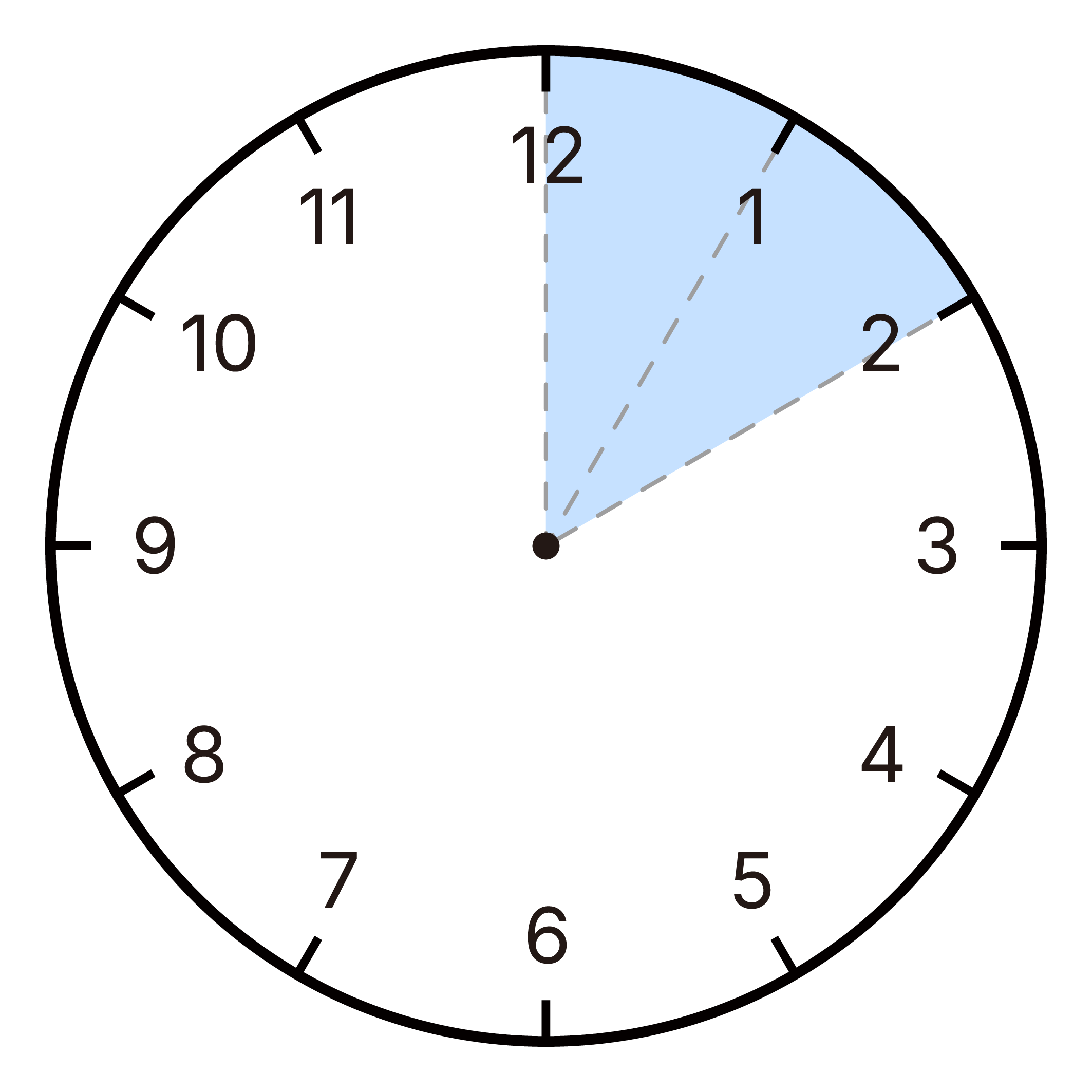
To mean ‘5 minutes, 10 minutes, etc.’, we can indicate how many 字 zi6 the duration equals to. 字 zi6 is a noun. We use the classifier 個 go3 with 字 zi6. We first say how many 字 zi6, then the classifier 個 go3 and then 字.
The words 秒 miu5 and 秒鐘 miu5 zung1 mean ‘second’. 秒 miu5 and 秒鐘 miu5 zung1 are measurement unit classifiers. They are used alone without a noun. To indicate duration in seconds, we simply say the number of seconds and then either 秒 miu5 or 秒鐘 miu5 zung1.
We say 兩 loeng5 instead of 二 ji6 for ‘two’ because we are indicating a quantity.
兩個鐘 / 兩個鐘頭
loeng5 go3 zung1 / loeng5 go3 zung1 tau4
two hours
兩分鐘
loeng5 fan1 zung1
20 minutes
兩個字
loeng5 go3 zi6
10 minutes [2 x 5 minutes]
兩秒 / 兩秒鐘
loeng5 miu5 / loeng5 miu5 zung1
2 seconds
The word 半 bun3 means ‘half’. We can put it before the classifier to mean ‘half a …’.
半個鐘 / 半個鐘頭
bun3 go3 zung1 / bun3 go3 zung1 tau4
half an hour
半分鐘
bun3 fan1 zung1
half a minute
半秒 / 半秒鐘
bun3 miu5 / bun3 miu5 zung1
half a second
We put 半 bun3 after the classifier to indicate a number and a half. If the classifier has two syllables (i.e., 分鐘 fan1 zung1 and 秒鐘 miu5 zung1), we put 半 bun3 after the first syllable.
一個半鐘 / 一個半鐘頭
jat1 go3 bun3 zung1 / jat1 go3 bun3 zung1 tau4
1 and a half hours
兩分半鐘
loeng5 fan1 bun3 zung1
2 and a half minutes
三秒半 / 三秒半鐘
saam1 miu5 bun3 / saam1 miu5 bun3 zung1
3 and a half seconds
When we put 半 bun3 after the classifier and the number is 一 jat1 (‘one’), we can optionally omit the number.
一個半鐘/ 一個半鐘頭
jat1 go3 bun3 zung1 / jat1 go3 bun3 zung1 tau4
1 and a half hours
一分半鐘
jat1 fan1 bun3 zung1
1 and a half minutes
一秒半 / 一秒半鐘
jat1 miu5 bun3 / jat1 miu5 bun3 zung1
1 and a half seconds
The word 幾 gei2 means ‘several’. We can put it before the classifier to mean ‘several …'. 幾 gei2 here usually refers to a quantity between 3 and 9 inclusive.
幾個鐘 / 幾個鐘頭
gei2 go3 zung1 / gei2 go3 zung1 tau4
several hours
gei2 fan1 zung1
several minutes
幾個字
gei2 go3 zi6
several five minutes [several words]
幾秒 / 幾秒鐘
gei2 miu5 / gei2 miu5 zung1
several seconds
We can put 幾 gei2 after 10, 20, 30, etc. to mean ’10, 20, 30 something, etc.’. 幾 gei2 here also usually refers to a quantity between 3 and 9 inclusive.
十幾個鐘 / 十幾個鐘頭
sap6 gei2 go3 zung1 / sap6 gei2 go3 zung1 tau4
10 something hours [13-19]
二十幾分鐘
ji6 sap6 gei2 fan1 zung1
20 something minutes [23-29]
三十幾秒 / 三十幾秒鐘
saam1 sap6 gei2 miu5 / saam1 sap6 gei2 miu5 zung1
30 something seconds [33-39]
We can also put 幾 gei2 after the classifier to mean ‘… and slightly more’. If the classifier has two syllables (i.e., 分鐘 fan1 zung1 and 秒鐘 miu5 zung1), we put 幾 gei2 after the first syllable. We usually use 幾 gei2 this way with a small number, usually not larger than 10.
一個幾鐘 / 一個幾鐘頭
jat1 go3 gei2 zung1 / jat1 go3 gei2 zung1 tau4
1 hour and slightly more
兩分幾鐘
loeng5 fan1 gei2 zung1
2 minutes and slightly more
四個幾字
sei3 go3 gei2 zi6
20 minutes and slightly more [four words and slightly more]
三秒幾 / 三秒幾鐘
saam1 miu5 gei2 / saam1 miu5 gei2 zung1
3 seconds and slightly more
When we put 幾 gei2 after the classifier and the number is 一 jat1 (‘one’), we can optionally omit the number.
一個幾鐘 / 一個幾鐘頭
jat1 go3 gei2 zung1 / jat1 go3 gei2 zung1 tau4
1 hour and slightly more
一分幾鐘
jat1 fan1 gei2 zung1
1 minute and slightly more
一個幾字
jat1 go3 gei2 zi6
5 minutes and slightly more [one word and slightly more]
一秒幾 / 一秒幾鐘
jat1 miu5 gei2 / jat1 miu5 gei2 zung1
1 second and slightly more
Notice the meaning changes depending on whether 幾 gei2 is put before or after the classifier.
十幾分鐘
sap6 gei2 fan1 zung1
10 something minutes
十分幾鐘
sap6 fan1 gei2 zung1
10 minutes and slightly more
We can indicate the hours and minutes at the same time. When doing so, we add the word 零 ling4 (‘zero’) between them.
We can optionally omit 零 ling4 if we use 鐘頭 zung1 tau4 in the hours.
We can use the verb 要 jiu3 (‘to need’) to indicate how long an action takes to complete.
Grammar Practice 1
Say each duration. For duration in minutes, give answers with both 分鐘 fan1 zung1 and 字 zi6 whenever possible. Then, check your answers and repeat after the recordings.
1. 3 hours
2. 15 minutes
3. 30 seconds
4. several hours
5. half a minute
6. 8 seconds and slightly more
7. 2 hours and slightly more
8. 3 and a half minutes
9. several seconds
10. half an hour
11. 50 something minutes
12. 2 and a half seconds
13. 6 minutes and slightly more
14. 20 something hours
15. 40 minutes
16. half a second
17. 1 and a half hours
18. several minutes
19. 10 something minutes
20. 50 something seconds
47.2 Approximate Numbers II
In Grammar and Vocabulary 13.3, we learned to use the following words to indicate an approximate number.
In this lesson, we will learn two more similar words.
We can add the adverb 大概 daai6 koi3 (‘about’) before a number to indicate an approximate number.
大概一個半鐘
daai6 koi3 jat1 go3 bun3 zung1
about one and a half hours
大概四十分鐘
daai6 koi3 sei3 sap6 fan1 zung1
about 40 minutes
大概四個字
daai6 koi3 sei3 go3 zi6
about 20 minutes [4 x 5 minutes]
We can also add the adjective 咁上下 gam3 soeng6 haa2 (‘about’, literally ‘this + up + down’) after a number to indicate an approximate number. Notice that 下 haa2 in 咁上下 gam3 soeng6 haa2 is pronounced with the high rising tone, instead of the low level tone that usually appears in other words (e.g., 下 haa6 in 下邊 haa6 bin6).
一個半鐘咁上下
jat1 go3 bun3 zung1 gam3 soeng6 haa2
about one and a half hours
四十分鐘咁上下
sei3 sap6 fan1 zung1 gam3 soeng6 haa2
about 40 minutes
四個字咁上下
sei3 go3 zi6 gam3 soeng6 haa2
about 20 minutes [4 x 5 minutes]
We can put 大約 daai6 joek3 or 大概 daai6 koi3 before the number and 到 dou2, 左右 zo2 jau2 or 咁上下 gam3 soeng6 haa2 after the number at the same time.
大約一個半鐘到
daai6 joek3 jat1 go3 bun3 zung1 dou2
about one and a half hours
大概四十分鐘左右
daai6 koi3 sei3 sap6 fan1 zung1 zo2 jau2
about 40 minutes
大概四個字咁上下
daai6 koi3 sei3 go3 zi6 gam3 soeng6 haa2
about 20 minutes [4 x 5 minutes]
We can use the verb 要 jiu3 (‘to need’) to indicate how long an action approximately takes to complete.
We can also add the verb 諗 nam2 (‘to think’) or 估 gu2 (‘to guess’) to indicate that we are making a guess.
47.3 The Question Word 幾耐 gei2 noi6 (‘how long’) II
In Grammar and Vocabulary 13.7, we learned to use the question word 幾耐 gei2 noi6 (‘how long’) to ask for duration.
If we want to ask how long it takes to complete an action, we often use the verb 要 jiu3 (‘to need’) with 幾耐 gei2 noi6. We put the action before 要 jiu3 and 幾耐 gei2 noi6 after 要 jiu3.
| A: | 去屯門要幾耐呀? heoi3 tyun4 mun4 jiu3 gei2 noi6 aa3? How long does it need to go to Tuen Man? |
| B: | 我諗要大概個半鐘咁上下。 ngo5 nam2 jiu3 daai6 koi3 go3 bun3 zung1 gam3 soeng6 haa2. I think it needs about one and a half hours. |
47.4 The Preposition 由 jau4 (‘from’)
The preposition 由 jau4 means ‘from’. We can use 由 jau4 to indicate the starting location of a movement. We put the location after 由 jau4 to form a prepositional phrase.
We put the prepositional phrase before the verb we want to modify.
We often use 由 jau4 with the verbs 去 heoi3 and 嚟 lai4 to form the following structure to indicate movement from one location to another location. We choose 去 heoi3 or 嚟 lai4 based on whether the movement is away from or toward our position (See Grammar and Vocabulary 36.2).
We can put this structure in a sentence.
由呢度去屯門要個半鐘。
jau4 ni1 dou6 heoi3 tyun4 mun4 jiu3 go3 bun3 zung1.
Going from here to Tuen Mun needs one and a half hours.
由旺角嚟呢度要半個鐘。
jau4 wong6 gok3 lai4 ni1 dou6 jiu3 bun3 go3 zung1.
Coming from Mong Kok to here needs half an hour.
In Grammar and Vocabulary 8.4, we also learned that the preposition 喺 hai2 (also pronounced as 响 hoeng2) means ‘from’. We can also form the structure with 喺 hai2.
喺呢度去屯門要個半鐘。
hai2 ni1 dou6 heoi3 tyun4 mun4 jiu3 go3 bun3 zung1.
Going from here to Tuen Mun needs one and a half hours.
喺旺角嚟呢度要半個鐘。
hai2 wong6 gok3 lai4 ni1 dou6 jiu3 bun3 go3 zung1.
Coming from Mong Kok to here needs half an hour.
We can usually use 由 jau4 and 喺 hai2 interchangeably to mean ‘from’.
47.5 The Preposition 除咗 ceoi4 zo2 (‘apart from’)
The preposition 除咗 ceoi4 zo2 means ‘apart from’. We put a noun after 除咗 ceoi4 zo2 to form a prepositional phrase.
We can put the prepositional phrase before the verb, or before the modal verb if there is one.
We can also put the prepositional phrase at the beginning of a sentence.
When using 除咗 ceoi4 zo2, we sometimes add the adverb 仲 zung6 to add the meaning of ‘in addition’. We put 仲 zung6 before the verb, or before the modal verb if there is one.
我哋除咗地鐵仲可以坐巴士。
ngo5 dei6 ceoi4 zo2 dei6 tit3 zung6 ho2 ji5 co5 baa1 si2.
除咗地鐵,我哋仲可以坐巴士。
ceoi4 zo2 dei6 tit3, ngo5 dei6 zung6 ho2 ji5 co5 baa1 si2.
Apart from the subway, we can take the bus in addition.
Note that if the sentence is formed with a predicative adjective, we will use the adverb 都 dou1 (‘too’) instead. We put 都 dou1 before the predicative adjective, or before the degree word if there is one.
我哋除咗地鐵坐巴士都得。
ngo5 dei6 ceoi4 zo2 dei6 tit3 co5 baa1 si2 dou1 dak1.
除咗地鐵,我哋坐巴士都得。
ceoi4 zo2 dei6 tit3, ngo5 dei6 co5 baa1 si2 dou1 dak1.
Apart from the subway, taking the bus is okay too.
The 得 dak1 (‘okay’) here is a predicative adjective. Therefore, 都 dou1 is used instead.
47.6 The Conjunction 但係 daan6 hai6 (‘but’)
The conjunction 但係 daan6 hai6 means ‘but’. We use 但係 daan6 hai6 to introduce an idea that contrasts with what was said before. We put 但係 daan6 hai6 at the beginning of the clause with the contrasting idea.
| A: | 有冇巴士去呀? jau5 mou5 baa1 si2 heoi3 aa3? Are there any buses that go there? |
| B: | 有呀,但係坐巴士去耐啲。 jau5 aa3, daan6 hai6 co5 baa1 si2 heoi3 noi6 di1. Yes, but taking the bus to go there takes longer. |
In Grammar and Vocabulary 21.8, we also learned that the conjunction 不過 bat1 gwo3 means ‘but’. While both 但係 daan6 hai6 and 不過 bat1 gwo3 mean ‘but’, they are slightly different in their tone.
We can often use 但係 daan6 hai6 and 不過 bat1 gwo3 interchangeably.
| A: | 有冇巴士去呀? jau5 mou5 baa1 si2 heoi3 aa3? Are there any buses that go there? |
| B: | 有呀,但係坐巴士去耐啲。 jau5 aa3, daan6 hai6 co5 baa1 si2 heoi3 noi6 di1. 有呀,不過坐巴士去耐啲。 jau5 aa3, bat1 gwo3 co5 baa1 si2 heoi3 noi6 di1. Yes, but taking the bus to go there takes longer. |
47.7 Vocabulary List
Communication
In the Communication section, you will learn:
- Deciding on Transport Arrangements
Deciding on Transport Arrangements
When we need to go to a place with someone, we can discuss how we will get to the place. Both the verbs 坐 co5 and 搭 daap3 can mean ‘to take’. You can replace 坐 co5 with 搭 daap3 in the expressions below.
Route A: Other options available
Route B: No other options available
We can also ask if we can take a specific means of transport.
Bus
Subway
After making the comparison, the other person may ask for our decision.
If we choose the option that the other person likes (e.g., they like the bus), we can say:
If we choose the option the other person likes less (e.g., they like the subway less), we can say:
If we want to suggest driving, we can say:
Route A: Yes
Route B: No
After deciding on the means of transport, we can talk about when we set off.
Exercises
Exercise 1
Are the following descriptions true or false? Correct the description if it is false.
1.
The words 鐘 zung1 or 鐘頭 zung1 tau4, 分鐘 fan1 zung1, and 秒 miu5 or 秒鐘 miu5 zung1 are measurement unit classifiers. They are used alone without a noun.
2.
The word 字 zi6 can refer to the numbers we see on a torque clock. Each 字 zi6 represents 1 minute.
3.
We can put 幾 gei2 before the classifier to mean ‘… and slightly more’.
4.
We can put the adverb 大概 daai6 koi3 or the adjective 咁上下 gam3 soeng6 haa2 before a number to indicate an approximate number.
5.
We always put the prepositional phrase with 除咗 ceoi4 zo2 before the verb, or before the modal verb if there is one.
6.
We can use the prepositions 由 jau4 or 喺 hai2 with the verbs 去 heoi3 or 嚟 lai4 together to indicate movement from one location to another location.
7.
Both of the conjunctions 不過 bat1 gwo3 and 但係 daan6 hai6 mean ‘but’, but they are slightly different in their tone.
Exercise 2
Each question has two sentences. Listen and choose the sentence that mentions longer duration. Then, check your answers and repeat after the recordings.
1.
a. ________
b. ________
2.
a. ________
b. ________
3.
a. ________
b. ________
4.
a. ________
b. ________
5.
a. ________
b. ________
6.
a. ________
b. ________
7.
a. ________
b. ________
8.
a. ________
b. ________
Exercise 3
Follow the example to complete the conversations. Then, check your answers and repeat after the recordings.
Example
here → there (1 hour)
| A | 由呢度去嗰度要幾耐呀? jau4 ni1 dou6 heoi3 go2 dou6 jiu3 gei2 noi6 aa3? How long does it need to go from here to there? |
| B | 我諗要大概一個鐘頭咁上下。 ngo5 nam2 jiu3 daai6 koi3 jat1 go3 zung1 tau4 gam3 soeng6 haa2. I think it needs about 1 hour. We can use 鐘 zung1 and 鐘頭 zung1 tau4 interchangeably in this exercise. |
1.
here → library (half an hour)
| A | ________ |
| B | ________ |
2.
our home → there (20 minutes)
| A | ________ |
| B | ________ ________ |
3.
here → their home (2 hours)
| A | ________ |
| B | ________ |
4.
our home → swimming pool (40 minutes)
| A | ________ |
| B | ________ ________ |
5.
here → airport (1 and a half hours)
| A | ________ |
| B | ________ |
6.
our home → Chinese restaurant (10 minutes)
| A | ________ |
| B | ________ ________ |
Exercise 4
Follow the example to complete the conversations. Then, check your answers and repeat after the recordings.
Example
| A | (地鐵 dei6 tit3) 除咗地鐵,仲可以坐咩呀? ceoi4 zo2 dei6 tit3, zung6 ho2 ji5 co5 me1 aa3? Apart from the subway, what can we take in addition? |
| B | (巴士 baa1 si2, 麻煩 maa4 faan4) 仲可以坐巴士,但係坐巴士去麻煩啲呀。 zung6 ho2 ji5 co5 baa1 si2, daan6 hai6 co5 baa1 si2 heoi3 maa4 faan4 di1 aa3. We can take the bus in addition, but taking the bus to go there is more troublesome. |
1.
| A | (小巴 siu2 baa1) ________ |
| B | (地鐵 dei6 tit3, 慢 maan6) ________ |
2.
| A | (地鐵 dei6 tit3) ________ |
| B | (電車 din6 ce1, 耐 noi6) ________ |
3.
| A | (火車 fo2 ce1) ________ |
| B | (小巴 siu2 baa1, 方便 fong1 bin6) ________ |
4.
| A | (小巴 siu2 baa1) ________ |
| B | (輕鐵 hing1 tit3, 快 faai3) ________ |
5.
| A | (船 syun4) ________ |
| B | (地鐵 dei6 tit3, 遠 jyun5) ________ |
6.
| A | (電車 din6 ce1) ________ |
| B | (小巴 siu2 baa1, 平 peng4) ________ |
7.
| A | (巴士 baa1 si2) ________ |
| B | (纜車 laam6 ce1, 貴 gwai3) ________ |
8.
| A | (電車 din6 ce1) ________ |
| B | (地鐵 dei6 tit3, 近 kan5) ________ |
Activities
Activity 1
Listen to three conversations. The speakers will decide how they will get to a place. After listening to each conversation, listen to the statements and decide if they are true or false. Correct the false ones.
Conversation 1
啱 ngaam1 Correct | 錯 co3 Wrong | ||
| 1. | ________ |  | |
| 2. | ________ | | |
| 3. | ________ | | |
| 4. | ________ | | |
| 5. | ________ | | |
| A | |
| B | |
| A | |
| B | |
| A | |
| B | |
| A | |
| B | |
| A | |
| B | |
| A | |
| B |
Conversation 2
啱 ngaam1 Correct | 錯 co3 Wrong | ||
| 6. | ________ | | |
| 7. | ________ | | |
| 8. | ________ | | |
| 9. | ________ | | |
| 10. | ________ | | |
| A | |
| B | |
| A | |
| B | |
| A | |
| B | |
| A | |
| B | |
| A | |
| B | |
| A | |
| B |
Conversation 3
啱 ngaam1 Correct | 錯 co3 Wrong | ||
| 11. | ________ | | |
| 12. | ________ | | |
| 13. | ________ | | |
| 14. | ________ | | |
| 15. | ________ | | |
| A | |
| B | |
| A | |
| B | |
| A | |
| B | |
| A | |
| B | |
| A | |
| B |
Transcripts with Translation
Conversation 1
| A | 我哋一陣坐咩車去筲箕灣呀? ngo5 dei6 jat1 zan6 co5 me1 ce1 heoi3 saau1 gei1 waan1 aa3? What public transport do we take to go to Shau Kei Wan later? |
| B | 坐地鐵去好唔好呀? co5 dei6 tit3 heoi3 hou2 m4 hou2 aa3? Is taking the subway to go there good? |
| A | 除咗坐地鐵,仲可以坐咩呀? ceoi4 zo2 co5 dei6 tit3, zung6 ho2 ji5 co5 me1 aa3? Apart from the subway, what can we take in addition? |
| B | 除咗坐地鐵,仲可以坐電車,但係坐地鐵去快啲呀。 ceoi4 zo2 co5 dei6 tit3, zung6 ho2 ji5 co5 din6 ce1, daan6 hai6 co5 dei6 tit3 heoi3 faai3 di1 aa3. Apart from the subway, we can take the tram in addition, but taking the subway to go there is faster. |
| A | 可以坐電車去呀?我想坐電車多啲呀。 ho2 ji5 co5 din6 ce1 heoi3 aa4? ngo5 soeng2 co5 din6 ce1 do1 di1 aa3. We can take the tram to go there? I want to take the tram more. |
| B | 好呀,噉我哋坐電車啦。我哋幾點出門口呀? hou2 aa3, gam2 ngo5 dei6 co5 din6 ce1 laa1. ngo5 dei6 gei2 dim2 ceot1 mun4 hau2 aa3? Good. [= Okay.] Then, let’s take the tram. What time do we leave home? |
| A | 由呢度去嗰度要幾耐呀? jau4 ni1 dou6 heoi3 go2 dou6 jiu3 gei2 noi6 aa3? How long does it need to go from here to there? |
| B | 我估要大約九個字咁上下。 ngo5 gu2 jiu3 daai6 joek3 gau2 go3 zi6 gam3 soeng6 haa2. I guess it needs about 45 minutes [9 x 5 minutes]. |
| A | 而家幾點呀? ji4 gaa1 gei2 dim2 aa3? What time is it now? |
| B | 而家六點三呀。 ji4 gaa1 luk6 dim2 saam1 aa3. It’s 6:15 now. |
| A | 噉不如七點出門口吖。 gam2 bat1 jyu4 cat1 dim2 ceot1 mun4 hau2 aa1. Then, why don’t we leave home at 7:00? |
| B | 好呀。 hou2 aa3. Good. [= Okay.] |
Conversation 2
| A | 我哋一陣坐咩車去阿哥屋企呀? ngo5 dei6 jat1 zan6 co5 me1 ce1 heoi3 aa3 go1 uk1 kei2 aa3? What public transport do we take to go to older brother’s home later? |
| B | 坐地鐵去好唔好呀? co5 dei6 tit3 heoi3 hou2 m4 hou2 aa3? Is taking the subway to go there good? |
| A | 有冇巴士去呀? jau5 mou5 baa1 si2 heoi3 aa3? Are there any buses that go there? |
| B | 有巴士去呀,但係個巴士站好遠,行去要差唔多十五分鐘呀。 jau5 baa1 si2 heoi3 aa3, daan6 hai6 go3 baa1 si2 zaam6 hou2 jyun5, haang4 heoi3 jiu3 caa1 m4 do1 sap6 ng5 fan1 zung1 aa3. There are buses that go there, but the bus stop is far away. Walking there needs almost 15 minutes. |
| A | 噉我哋坐地鐵啦。 gam2 ngo5 dei6 co5 dei6 tit3 laa1. Then, let’s take the subway. |
| B | 好呀,噉我哋幾點出門口呀? hou2 aa3, gam2 ngo5 dei6 gei2 dim2 ceot1 mun4 hau2 aa3? Good. [= Okay.] Then, what time do we leave home? |
| A | 由呢度去嗰度要幾耐呀? jau4 ni1 dou6 heoi3 go2 dou6 jiu3 gei2 noi6 aa3? How long does it need to go from here to there? |
| B | 我諗要大概半個鐘左右。 ngo5 nam2 jiu3 daai6 koi3 bun3 go3 zung1 zo2 jau2. I think it needs about half an hour. |
| A | 而家幾點呀? ji4 gaa1 gei2 dim2 aa3? What time is it now? |
| B | 而家五點半呀。 ji4 gaa1 ng5 dim2 bun3 aa3. It’s 5:30 now. |
| A | 噉不如六點三出門口吖。 gam2 bat1 jyu4 luk6 dim2 saam1 ceot1 mun4 hau2 aa1. Then, why don’t we leave home at 6:15? |
| B | 好呀。 hou2 aa3. Good. [= Okay.] |
Conversation 3
| A | 我哋聽朝搭咩車去元朗呀? ngo5 dei6 ting1 ziu1 daap3 me1 ce1 heoi3 jyun4 long5 aa3? What public transport do we take to go to Yuen Long tomorrow morning? |
| B | 搭巴士去好唔好呀?搭巴士嘅話,我哋可以搭269D(二六九D)呀。 daap3 baa1 si2 heoi3 hou2 m4 hou2 aa3? daap3 baa1 si2 ge3 waa2, ngo5 dei6 ho2 ji5 daap3 269D (ji6 luk6 gau2 di1) aa3. Is taking the bus to go there good? If we take the bus, we can take Number 269D. |
| A | 除咗巴士,仲可以搭咩呀? ceoi4 zo2 baa1 si2, zung6 ho2 ji5 daap3 me1 aa3? Apart from the bus, what can we take in addition? |
| B | 搭地鐵都得呀,如果搭地鐵,我哋可以搭屯馬線,但係搭地鐵貴啲呀。 daap3 dei6 tit3 dou1 dak1 aa3, jyu4 gwo2 daap3 dei6 tit3, ngo5 dei6 ho2 ji5 daap3 tyun4 maa5 sin3, daan6 hai6 daap3 dei6 tit3 gwai3 di1 aa3. Taking the subway is okay too. If we take the subway, we can take the Tuen Ma Line, but taking the subway is more expensive. |
| A | 噉我哋搭巴士啦。 gam2 ngo5 dei6 daap3 baa1 si2 laa1. Then, let’s take the bus. |
| B | 好呀,噉我哋幾點出發呀? hou2 aa3, gam2 ngo5 dei6 gei2 dim2 ceot1 faat3 aa3? Good. [= Okay.] Then, what time do we set off? |
| A | 由我哋屋企去元朗要幾耐呀? jau4 ngo5 dei6 uk1 kei2 heoi3 jyun4 long5 jiu3 gei2 noi6 aa3? How long does it need to go from our home to Yuen Long? |
| B | 我諗要大約一個鐘頭四個字左右。 ngo5 nam2 jiu3 daai6 joek3 jat1 go3 zung1 tau4 sei3 go3 zi6 zo2 jau2. I think it needs about one hour and 20 minutes [4 x 5 minutes]. |
| A | 噉不如八點半出門口吖。 gam2 bat1 jyu4 baat3 dim2 bun3 ceot1 mun4 hau2 aa1. Then, why don’t we leave home at 8:30? |
| B | 好呀。 hou2 aa3. Good. [= Okay.] |
Activity 2
Disclaimer: The information below is not real.
Form a pair. Make six conversations using the notes below. In each conversation, decide how you will get to the destination and when you will set off. Play these two roles in turn:
- Role A: Ask about the possible means of transport.
- Role B: Suggest and compare the possible means of transport.
Swap your roles after each conversation.
Activity 3
Form a pair. Make four conversations similar to those in Activity 2. This time, talk about how you will get to the places you are planning to visit in the next few days. You can also choose some places on Google Map randomly.