47.1 Duration II (Hour, Minute and Second)
The words 鐘 zung1 and 鐘頭 zung1 tau4 mean ‘hour’. 鐘 zung1 and 鐘頭 zung1 tau4 are nouns. We use the classifier 個 go3 with them. To indicate duration in hours, we first say the number of hours, then the classifier 個 go3 and then either 鐘 zung1 or 鐘頭 zung1 tau4.
The word 分鐘 fan1 zung1 means ‘minute’. 分鐘 fan1 zung1 is a measurement unit classifier. It is used alone without a noun. To indicate duration in minutes, we simply say the number of minutes and then 分鐘 fan1 zung1.
Another way to indicate duration in minutes is to use the word 字 zi6 (‘word’). In this context, 字 zi6 refers to the numbers we see on a torque clock. Each 字 zi6 on a torque clock represents five minutes. For example, the interval from the number 12 to the number 1 is five minutes long, and the interval from the number 1 to the number 2 is also five minutes long.
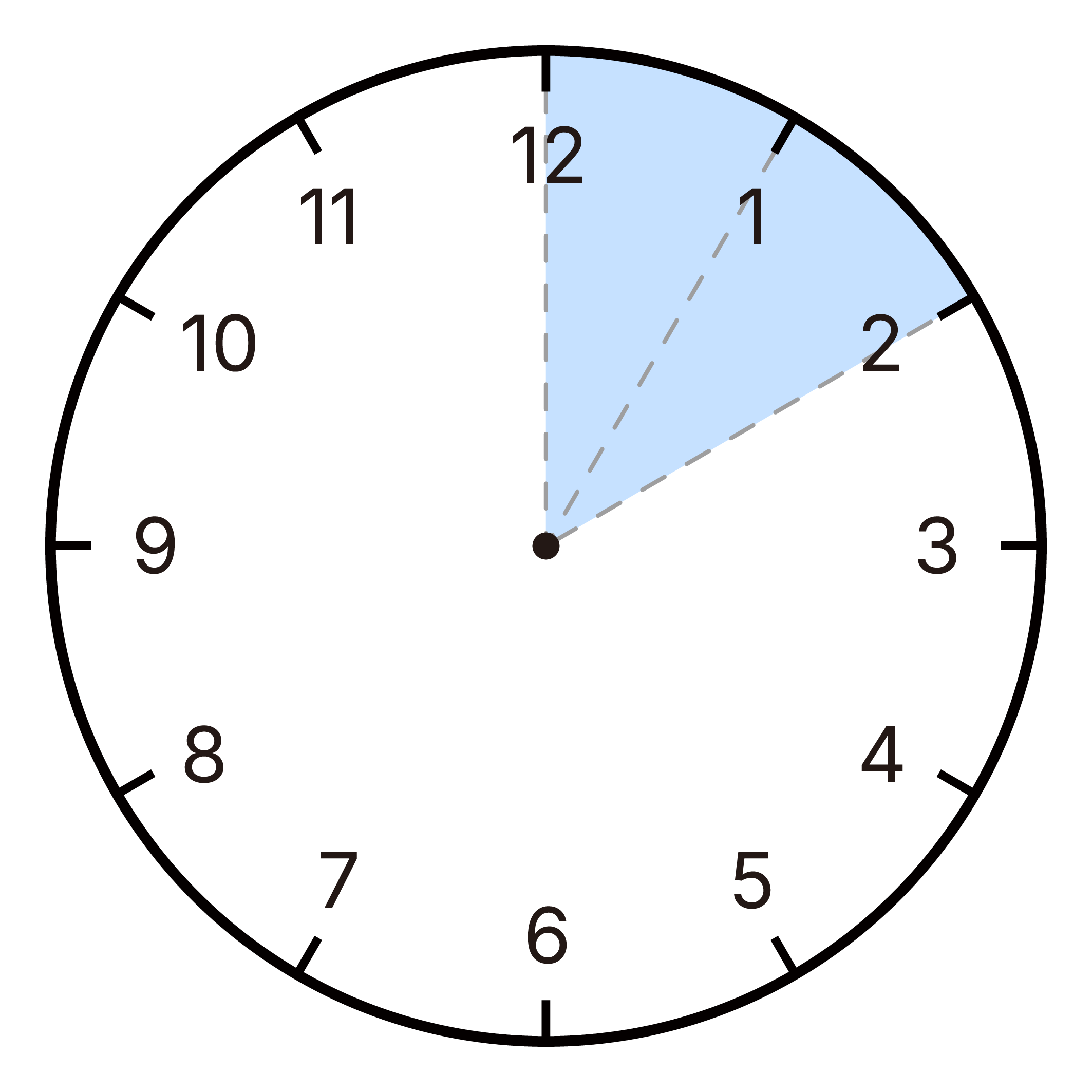
To mean ‘5 minutes, 10 minutes, etc.’, we can indicate how many 字 zi6 the duration equals to. 字 zi6 is a noun. We use the classifier 個 go3 with 字 zi6. We first say how many 字 zi6, then the classifier 個 go3 and then 字.
The words 秒 miu5 and 秒鐘 miu5 zung1 mean ‘second’. 秒 miu5 and 秒鐘 miu5 zung1 are measurement unit classifiers. They are used alone without a noun. To indicate duration in seconds, we simply say the number of seconds and then either 秒 miu5 or 秒鐘 miu5 zung1.
We say 兩 loeng5 instead of 二 ji6 for ‘two’ because we are indicating a quantity.
兩個鐘 / 兩個鐘頭
loeng5 go3 zung1 / loeng5 go3 zung1 tau4
two hours
兩分鐘
loeng5 fan1 zung1
20 minutes
兩個字
loeng5 go3 zi6
10 minutes [2 x 5 minutes]
兩秒 / 兩秒鐘
loeng5 miu5 / loeng5 miu5 zung1
2 seconds
The word 半 bun3 means ‘half’. We can put it before the classifier to mean ‘half a …’.
半個鐘 / 半個鐘頭
bun3 go3 zung1 / bun3 go3 zung1 tau4
half an hour
半分鐘
bun3 fan1 zung1
half a minute
半秒 / 半秒鐘
bun3 miu5 / bun3 miu5 zung1
half a second
We put 半 bun3 after the classifier to indicate a number and a half. If the classifier has two syllables (i.e., 分鐘 fan1 zung1 and 秒鐘 miu5 zung1), we put 半 bun3 after the first syllable.
一個半鐘 / 一個半鐘頭
jat1 go3 bun3 zung1 / jat1 go3 bun3 zung1 tau4
1 and a half hours
兩分半鐘
loeng5 fan1 bun3 zung1
2 and a half minutes
三秒半 / 三秒半鐘
saam1 miu5 bun3 / saam1 miu5 bun3 zung1
3 and a half seconds
When we put 半 bun3 after the classifier and the number is 一 jat1 (‘one’), we can optionally omit the number.
一個半鐘/ 一個半鐘頭
jat1 go3 bun3 zung1 / jat1 go3 bun3 zung1 tau4
1 and a half hours
一分半鐘
jat1 fan1 bun3 zung1
1 and a half minutes
一秒半 / 一秒半鐘
jat1 miu5 bun3 / jat1 miu5 bun3 zung1
1 and a half seconds
The word 幾 gei2 means ‘several’. We can put it before the classifier to mean ‘several …'. 幾 gei2 here usually refers to a quantity between 3 and 9 inclusive.
幾個鐘 / 幾個鐘頭
gei2 go3 zung1 / gei2 go3 zung1 tau4
several hours
gei2 fan1 zung1
several minutes
幾個字
gei2 go3 zi6
several five minutes [several words]
幾秒 / 幾秒鐘
gei2 miu5 / gei2 miu5 zung1
several seconds
We can put 幾 gei2 after 10, 20, 30, etc. to mean ’10, 20, 30 something, etc.’. 幾 gei2 here also usually refers to a quantity between 3 and 9 inclusive.
十幾個鐘 / 十幾個鐘頭
sap6 gei2 go3 zung1 / sap6 gei2 go3 zung1 tau4
10 something hours [13-19]
二十幾分鐘
ji6 sap6 gei2 fan1 zung1
20 something minutes [23-29]
三十幾秒 / 三十幾秒鐘
saam1 sap6 gei2 miu5 / saam1 sap6 gei2 miu5 zung1
30 something seconds [33-39]
We can also put 幾 gei2 after the classifier to mean ‘… and slightly more’. If the classifier has two syllables (i.e., 分鐘 fan1 zung1 and 秒鐘 miu5 zung1), we put 幾 gei2 after the first syllable. We usually use 幾 gei2 this way with a small number, usually not larger than 10.
一個幾鐘 / 一個幾鐘頭
jat1 go3 gei2 zung1 / jat1 go3 gei2 zung1 tau4
1 hour and slightly more
兩分幾鐘
loeng5 fan1 gei2 zung1
2 minutes and slightly more
四個幾字
sei3 go3 gei2 zi6
20 minutes and slightly more [four words and slightly more]
三秒幾 / 三秒幾鐘
saam1 miu5 gei2 / saam1 miu5 gei2 zung1
3 seconds and slightly more
When we put 幾 gei2 after the classifier and the number is 一 jat1 (‘one’), we can optionally omit the number.
一個幾鐘 / 一個幾鐘頭
jat1 go3 gei2 zung1 / jat1 go3 gei2 zung1 tau4
1 hour and slightly more
一分幾鐘
jat1 fan1 gei2 zung1
1 minute and slightly more
一個幾字
jat1 go3 gei2 zi6
5 minutes and slightly more [one word and slightly more]
一秒幾 / 一秒幾鐘
jat1 miu5 gei2 / jat1 miu5 gei2 zung1
1 second and slightly more
Notice the meaning changes depending on whether 幾 gei2 is put before or after the classifier.
十幾分鐘
sap6 gei2 fan1 zung1
10 something minutes
十分幾鐘
sap6 fan1 gei2 zung1
10 minutes and slightly more
We can indicate the hours and minutes at the same time. When doing so, we add the word 零 ling4 (‘zero’) between them.
We can optionally omit 零 ling4 if we use 鐘頭 zung1 tau4 in the hours.
We can use the verb 要 jiu3 (‘to need’) to indicate how long an action takes to complete.