Print or Export
請問超級市場喺幾多樓呀?
cing2 man6 ciu1 kap1 si5 coeng4 hai2 gei2 do1 lau2 aa3?
cing2 man6 ciu1 kap1 si5 coeng4 hai2 gei2 do1 lau2 aa3?
Listen and Speak
Step 1
Below is a floor plan of a shopping mall. Listen to the descriptions and match the shop or facility to each floor.
* This sentence is standard written Chinese. It often appears in the floor plan of a shopping mall.
酒樓喺五樓。 zau2 lau4 hai2 ng5 lau2. The Chinese restaurant is on the fifth floor. |
美食廣場喺三樓。 mei5 sik6 gwong2 coeng4 hai2 saam1 lau2. The food court is on the third floor. |
戲院同溜冰場都喺一樓。 hei3 jyun2 tung4 lau4 bing1 coeng4 dou1 hai2 jat1 lau2. Both the movie theater and the ice rink are on the first floor. |
超級市場喺地下。 ciu1 kap1 si5 coeng4 hai2 dei6 haa2. The supermarket is on the ground floor. |
One of the floors has disappeared from the shopping mall. Which floor is it? Can you guess why?
Step 2
Listen to a conversation between a customer and a customer service representative at the shopping mall. The customer is looking for a shop or facility. Write down the shop or facility.
________| 客 haak3 | |
| 職員 zik1 jyun4 | |
| 客 haak3 | |
| 職員 zik1 jyun4 | |
| 客 haak3 | |
| 職員 zik1 jyun4 |
Step 3
Listen to the conversation again. Read the script while listening. Check your answer.
| 客 haak3 | 唔好意思,請問超級市場喺幾多樓呀? m4 hou2 ji3 si1, cing2 man6 ciu1 kap1 si5 coeng4 hai2 gei2 do1 lau2 aa3? Excuse me. May I ask what floor the supermarket is on? |
| 職員 zik1 jyun4 | 超級市場喺地下。 ciu1 kap1 si5 coeng4 hai2 dei6 haa2. The supermarket is on the ground floor. |
| 客 haak3 | 呢度係幾多樓嚟㗎? ni1 dou6 hai6 gei2 do1 lau2 lai4 gaa3? What floor is here? |
| 職員 zik1 jyun4 | 呢度係二樓嚟嘅,你要坐扶手電梯落兩層。 ni1 dou6 hai6 ji6 lau2 lai4 ge3, nei5 jiu3 co5 fu4 sau2 din6 tai1 lok6 loeng5 cang4. Here is the second floor. You need to take the escalator to go down two floors. |
| 客 haak3 | 好,唔該晒。 hou2, m4 goi1 saai3. Good. [= Okay.] Thank you so much. |
| 職員 zik1 jyun4 | 唔使客氣。 m4 sai2 haak3 hei3. No problem. |
- 幾多樓 gei2 do1 lau2 = what floor
- 坐 co5 = to take
- 扶手電梯 fu4 sau2 din6 tai1 = escalator
- 層 cang4 = (Classifier) floor
Step 4
Listen and repeat.
Step 5
Replace the highlighted words in the script with information about other places on the floor plan to make your conversations.
Grammar and Vocabulary
In the Grammar and Vocabulary section, you will learn:
- Location Expressions III
- Floors in a Building
- Number of Floors
- The Question Word 點 dim2 / 點樣 dim2 joeng2 (‘how’) II (Way)
- Imperative Sentences
- Sequence Words
- The Verbal Particle 到 dou3 (Arrival)
- The Conjunction 就 zau6 II (‘then’)
- Serial Verb Constructions V (Method)
- Vocabulary List
- Vocabulary: Facilities in a Shopping Mall
- Vocabulary: Directions in a Shopping Mall
38.1 Location Expressions III
In this lesson, we will learn the new location expressions below. Some of them end with 邊 bin6 / bin1 (‘side’) or 面 min6 (‘side’). 邊 bin is usually more often pronounced with Tone 6 (bin6) nowadays.
For expressions with more than one pronunciation, we will only use the highlighted pronunciations in this book. You can focus on them first and learn the other pronunciations later.
We can add the word 最 zeoi3 (‘most’) before these location expressions to indicate the furthest point of a direction.
最 + 上邊 = 最上邊
zeoi3 + soeng6 bin6 = zeoi3 soeng6 bin6
most + above = top
最 + 下邊 = 最下邊
zeoi3 + haa6 bin6 = zeoi3 haa6 bin6
most + below = lowest
When we add 最 zeoi3, we can optionally omit the word 邊 bin6 / bin1 or 面 min6. When 邊 bin6 / bin1 or 面 min6 is omitted, 上 soeng6 is sometimes said with Tone 5 as soeng5.
最上邊 → 最上
zeoi3 soeng6 bin6 → zeoi3 soeng6 / soeng5
top
最下邊 → 最下
zeoi3 haa6 bin6 → zeoi3 haa6
lowest
Below are some alternative expressions for ‘top’ or ‘lowest’. They are supplementary and won’t appear in the exercises or activities.
To refer to the end of a path, we can say:
38.2 Floors in a Building
To refer to a specific floor in a building (e.g., the second floor, the third floor), we first say the floor number and then the word 樓 lau2 (‘floor’) or 層 cang4 (‘floor’). 第 dai6 is the prefix for ordinal numbers (as in 第一 dai6 jat1 ‘first’, 第二 dai6 ji6 ‘second’). When using 樓 lau2, we can add 第 dai6 before the floor number, but we more often don’t. When using 層 cang4, we usually add 第 dai6 before the floor number. Note that we use 二 ji6 instead of 兩 loeng5 for ‘the second floor’. In this book, we will use PRE to indicate a prefix in English translations.
We can use the following expressions to refer to the top or lowest floor. We add 呢 ni1 if we are currently at the specific floor and 嗰 go2 if we don’t.
Below are some alternative expressions for referring to the top or lowest floor. They are supplementary and won’t appear in the exercises or activities.
Here are the expressions for other floors in a building:
If the basement has more than one floor, we put the specific floor after 地庫 dei6 fu3 or 地牢 dei6 lou4.
地庫一樓
dei6 fu3 jat1 lau2
basement level one
地庫二樓
dei6 fu3 ji6 lau2
basement level two
To mean ‘to go up to the first floor, to go down the ground floor, etc.’, we use the verb 上去 soeng5 heoi3 (‘to go up’) or 落去 lok6 heoi3 (‘to go down’).
上去一樓
soeng5 heoi3 jat1 lau2
to go up to the first floor
落去地下
lok6 heoi3 dei6 haa2
to go down to the ground floor
To ask what floor a shop or facility is on, we can use the question expressions 幾多樓 gei2 do1 lau2 / 幾樓 gei2 lau2 (‘what floor’), 邊層 bin1 cang4 (‘which floor’) or 第幾層 dai6 gei2 cang4 (‘what floor’). Note that we usually only use 幾 gei2 but not 幾多 gei2 do1 after 第 dai6.
| A: | 超級市場喺幾多樓呀? ciu1 kap1 si5 coeng4 hai2 gei2 do1 lau2 aa3? 超級市場喺幾樓呀? ciu1 kap1 si5 coeng4 hai2 gei2 lau2 aa3? What floor is the supermarket on? 超級市場喺邊層呀? ciu1 kap1 si5 coeng4 hai2 bin1 cang4 aa3? Which floor is the supermarket on? 超級市場喺第幾層呀? ciu1 kap1 si5 coeng4 hai2 dai6 gei2 cang4 aa3? What floor is the supermarket on? |
| B: | 超級市場喺地庫。 ciu1 kap1 si5 coeng4 hai2 dei6 fu3. The supermarket is in the basement. |
To mean ‘this floor’ or ‘that floor’, we combine 呢 ni1 (‘this’) or 嗰 go2 (‘that’) with 層 cang4, but not 樓 lau2. 層 cang4 is a classifier itself so we don’t need to add a classifier.
✔️ 呢層
ni1 cang4
this floor
❌ 呢樓
ni1 lau2
✔️ 嗰層
go2 cang4
that floor
❌ 嗰樓
go2 lau2
38.3 Number of Floors
To indicate the number of floors (e.g., two floors, four floors), we use the classifier 層 cang4 (‘floor’). Note that we use 兩 loeng5 instead of 二 ji6 for ‘two floors’.
To mean ‘to go up one floor, to go down two floors, etc.’, we put the number of floors after 上 soeng5 (‘to go up’) or 落 lok6 (‘to go down’).
上一層
soeng5 jat1 cang4
to go up one floor
落兩層
lok6 loeng5 cang4
to go down two floors
Below are some expressions that look similar. Pay attention to their meanings.
上兩層
soeng5 loeng5 cang4
to go up two floors
上二樓
soeng5 ji6 lau2
to go up to the second floor
上第二層
soeng5 dai6 ji6 cang4
to go up to the second floor
To ask how many floors we need to go up or go down, we can put the question expression 幾多層 gei2 do1 cang4 / 幾層 gei2 cang4 (‘how many + floor’) after 上 soeng5 or 落 lok6.
| A: | 戲院要上幾多層呀? hei3 jyun2 jiu3 soeng5 gei2 do1 cang4 aa3? 戲院要上幾層呀? hei3 jyun2 jiu3 soeng5 gei2 cang4 aa3? For the movie theater, how many floors do I need to go up? |
| B: | 戲院要上兩層。 hei3 jyun2 jiu3 soeng5 loeng5 cang4. For the movie theater, you need to go up two floors. |
38.4 The Question Word 點 dim2 / 點樣 dim2 joeng2 (‘how’) II (Way)
In Grammar and Vocabulary 33.8, we learned to use the question word 點 dim2 / 點樣 dim2 joeng2 (‘how’) to form a question that elicits opinions about something or someone.
We can also use 點 dim2 / 點樣 dim2 joeng2 to form a question that elicits the way or method to do an activity (e.g., how to get to a place, how to make a dish). We put 點 dim2 / 點樣 dim2 joeng2 before the verb of the activity.
| A: | 請問點去戲院呀? cing2 man6 dim2 heoi3 hei3 jyun2 aa3? 請問點樣去戲院呀? cing2 man6 dim2 joeng2 heoi3 hei3 jyun2 aa3? May I ask how to go to the movie theater? |
| B: | 你可以坐𨋢上去。 nei5 ho2 ji5 co5 lip1 soeng5 heoi3. You can take the elevator to go up there. |
For this type of question, the object is often moved to the beginning of the question and becomes the topic. Note we put 請問 cing2 man6 before the topic.
請問戲院點去呀?
cing2 man6 hei3 jyun2 dim2 heoi3 aa3?
請問戲院點樣去呀?
cing2 man6 hei3 jyun2 dim2 joeng2 heoi3 aa3?
May I ask how to go to the movie theater?
If we need to add a modal verb (e.g., 要 jiu3 ‘to need to’), we can put 點 dim2 / 點樣 dim2 joeng2 after the modal verb and before the verb for the activity.
請問戲院要點去呀?
cing2 man6 hei3 jyun2 jiu3 dim2 heoi3 aa3?
請問戲院要點樣去呀?
cing2 man6 hei3 jyun2 jiu3 dim2 joeng2 heoi3 aa3?
May I ask what I need to do to go to the movie theater?
It is possible to put 點 dim2 / 點樣 dim2 joeng2 before certain modal verbs, but we won’t examine that here.
38.5 Imperative Sentences
Imperative sentences are sentences used to give instructions or commands (e.g., walk toward this side and turn left). In this lesson, we will use imperative sentences to give directions.
We use an imperative sentence to ask the listener to do an action. The subject of the sentence will generally be the listener. We will usually use 你 nei5 (‘you’) to refer to the listener. We can mention the subject explicitly or omit it.
| A: | 請問戲院點去呀? cing2 man6 hei3 jyun2 dim2 heoi3 aa3? May I ask how I go to the movie theater? |
| B: | (你)向呢邊行。 (nei5) hoeng3 ni1 bin6 haang4. Walk toward this side. |
If there is more than one listener, the subject will become 你哋 nei5 dei6 (‘you’, plural).
| A: | 請問戲院點去呀? cing2 man6 hei3 jyun2 dim2 heoi3 aa3? May I ask how I go to the movie theater? |
| B: | (你哋)向呢邊行。 (nei5 dei6) hoeng3 ni1 bin6 haang4. Walk toward this side. |
To ask the listener not to do an action, we put 唔好 m4 hou2 (don’t) before the action.
坐左邊嗰部𨋢,唔好坐右邊嗰部𨋢。
co5 zo2 bin6 go2 bou6 lip1, m4 hou2 co5 jau6 bin6 go2 bou6 lip1.
Take the elevator on the left. Don’t take the elevator on the right.
38.6 Sequence Words
When giving instructions with several steps, we often add sequence words. Here are some common sequence words:
Note that when giving instructions with several steps, we don’t usually use 第一 dai6 jat1 (‘first’), 第二 dai6 ji6 (‘second’), 第三 dai6 saam1 (‘third’), etc. as the sequence words in Cantonese.
We put a sequence word at the beginning of the sentence.
首先向呢邊行,跟住向左邊行,之後向右邊行。
sau2 sin1 hoeng3 ni1 bin6 haang4, gan1 zyu6 hoeng3 zo2 bin6 haang4, zi1 hau6 hoeng3 jau6 bin6 haang4.
First, walk toward this side. And then, walk toward the left side. After that, walk toward the right side.
If there is a subject in the sentence, we can put the sequence word before or after the subject.
首先你向呢邊行,跟住向左邊行,之後向右邊行。
sau2 sin1 nei5 hoeng3 ni1 bin6 haang4, gan1 zyu6 hoeng3 zo2 bin6 haang4, zi1 hau6 hoeng3 jau6 bin6 haang4.
你首先向呢邊行,跟住向左邊行,之後向右邊行。
nei5 sau2 sin1 hoeng3 ni1 bin6 haang4, gan1 zyu6 hoeng3 zo2 bin6 haang4, zi1 hau6 hoeng3 jau6 bin6 haang4.
First, walk toward this side. And then, walk toward the left side. After that, walk toward the right side.
38.7 The Verbal Particle 到 dou3 (Arrival)
In Grammar and Vocabulary 37.9, we learned that the verb 到 dou3 means ‘to arrive’.
We can also use the word 到 dou3 as a verbal particle. We use the verbal particle 到 dou3 with verbs involving movement of a person to indicate that the person has completed the movement and arrived at the location specified in the object.
We can use 到 dou3 with the verbs 去 heoi3 (‘to go’) or 嚟 lai4 (‘to come’).
We can also use 到 dou3 with a directional verb.
If 去 heoi3 or 嚟 lai4 is added after the directional verb to indicate the direction of the movement, we put 到 dou3 between the directional verb and 去 heoi3 or 嚟 lai4.
We also often use 到 dou3 with the verb 行 haang4 (‘to walk’). If we want to indicate the destination, we can add 去 heoi3 or 嚟 lai4. We put 到 dou3 between 行 haang4 and 去 heoi3 or 嚟 lai4.
38.8 The Conjunction 就 zau6 II (‘then’)
In Grammar and Vocabulary 14.4, we learned to use the conjunction 就 zau6 to show contrast between people or things.
The conjunction 就 zau6 can also mean ‘then’. We use 就 zau6 to connect two parts in a sentence. 就 zau6 indicates that if the condition in the first part is fulfilled, then the result in the second part will be accomplished. The two parts can be an action (e.g., you turn left) or a state (e.g., it is the movie theater). We don’t add a subject in the second part.
The second part can also be a follow-up action. In this case, 就 zau6 indicates that when the condition in the first part is fulfilled, then the follow-up action should be completed.
38.9 Serial Verb Constructions V (Method)
In Grammar and Vocabulary 8.5, 16.4, 18.2, and 23.2, we learned to form serial verb constructions.
We will see another meaning relationship in this lesson: the first verb phrase indicates the method of doing the activity in the second verb phrase. That is, the first verb phrase describes how we do the activity in the second verb phrase.
The first verb phrase 坐扶手電梯 co5 fu4 sau2 din6 tai1 indicates the method of the second verb phrase 上去 soeng5 heoi3. The speaker asks the listener to go up by taking the escalator. The first verb phrase 搭𨋢 daap3 lip1 indicates the method of the second verb phrase 落去 lok6 heoi3. The speaker asks the listener to go down by taking the elevator.The verb 用 jung6 means ‘to use’. It is commonly used in the first verb phrase to indicate the method. We put a tool after 用 jung6.
38.10 Vocabulary List
For expressions with more than one pronunciation, we will only use the highlighted pronunciations in this book. You can focus on them first and learn the other pronunciations later.
38.11 Vocabulary: Facilities in a Shopping Mall
The rightmost column is the classifiers we use with the nouns.
38.12 Vocabulary: Directions in a Shopping Mall
Below are some common expressions for giving directions in a shopping mall.
Indicating the current floor
Indicating the floor of a shop or facility
Indicating the movement direction
- The word 直 zik6 (‘straight’) is an adverb here. We put it before the verb 行 haang4 (‘to walk’).
- When 左邊 zo2 bin6 / zo2 bin1 or 左面 zo2 min6 (‘left’) and 右邊 jau6 bin6 / jau6 bin1 or 右邊 jau6 min6 (‘right’) appears after 轉 zyun3 (‘to turn’), we often omit 邊 bin6 / bin1 or 面 min6.
Taking the elevator or escalator
In the expressions below, we will see the word 坐 co5 (‘to take’) frequently. We can replace 坐 co5 with 搭 daap3, which also means ‘to take’. They are interchangeable in this context.
Indicating the destination
Communication
In the Communication section, you will learn:
- Finding a Place in a Shopping Mall
Finding a Place in a Shopping Mall
If we can’t find a place in a shopping mall, we can approach the staff and get help.
- The verbal particle 到 dou2 in this question is different from the verbal particle 到 dou3 for indicating arrival. 到 dou2 adds the meaning of ‘to be able to’ to the verb. We will learn more about it in the next lesson.
To ask if the shopping mall has a specific type of shop or facility, we can say:
To ask what floor a shop or facility is on, we can say:
We can also ask the number of floors we need to go up or down directly.
- The noun 超級市場 ciu1 kap1 si5 coeng4 at the beginning is the topic of the question.
To ask where a shop or facility is, we can say:
To get complete directions to a shop or facility, we can ask:
- The original question is 請問點去溜冰場呀 cing2 man6 dim2 heoi3 lau5 bing1 coeng4 aa3. The object 溜冰場 lau5 bing1 coeng4 (‘ice rink’) is moved to the beginning of the question and becomes the topic.
Exercises
Exercise 1
Complete the descriptions.
1.
We can use the question word ________ to form a question that elicits the way or method to do an activity.
2.
We can use the verbal particle ________ with verbs involving movement of a person (e.g., 去 heoi3, 嚟 lai4) to indicate that the person has arrived at the location specified in the object.
3.
To refer to a specific floor in a building (e.g., the second floor, the third floor), we put the word ________ or ________ after the number. When ________ is used, we usually add 第 dai6 before the number.
4.
To indicate the number of floors (e.g., two floors, four floors), we use the classifier ________.
5.
The conjunction ________ means ‘then’. We use it to connect the condition and the result or follow-up action in a sentence.
Exercise 2
Below is a floor plan of a shopping mall. Listen to the descriptions and write down the shop or facility on each floor. Then, repeat after the recordings.
Descriptions
________
________
________
________
________
________
________
________
________
________
Exercise 3
Follow the examples to complete the conversations. Then, listen to the recordings to check your answers. Finally, repeat after the recordings.
Example
5/F (current floor) → Escalator → 7/F (supermarket)
| A | 請問超級市場喺幾多樓呀? cing2 man6 ciu1 kap1 si5 coeng4 hai2 gei2 do1 lau2 aa3? May I ask what floor the supermarket is on? |
| B | 超級市場喺七樓,呢度係五樓嚟嘅,你要坐扶手電梯上兩層。 ciu1 kap1 si5 coeng4 hai2 cat1 lau2, ni1 dou6 hai6 ng5 lau2 lai4 ge3, nei5 jiu3 co5 fu4 sau2 din6 tai1 soeng5 loeng5 cang4. The supermarket is on the seventh floor. Here is the fifth floor. You need to take the escalator to go up two floors. |
1.
G/F (current floor) → Escalator → 3/F (Chinese restaurant)
| A | ________ |
| B | ________ |
2.
1/F (current floor) → Escalator → 3/F (movie theater)
| A | ________ |
| B | ________ |
3.
3/F (current floor) → Elevator → G/F (post office)
| A | ________ |
| B | ________ |
4.
9/F (current floor) → Elevator → 5/F (ice rink)
| A | ________ |
| B | ________ |
5.
10/F (current floor) → Escalator → 12/F (food court)
| A | ________ |
| B | ________ |
6.
1/F (current floor) → Elevator → B2/F (parking lot)
| A | ________ |
| B | ________ |
Exercise 4
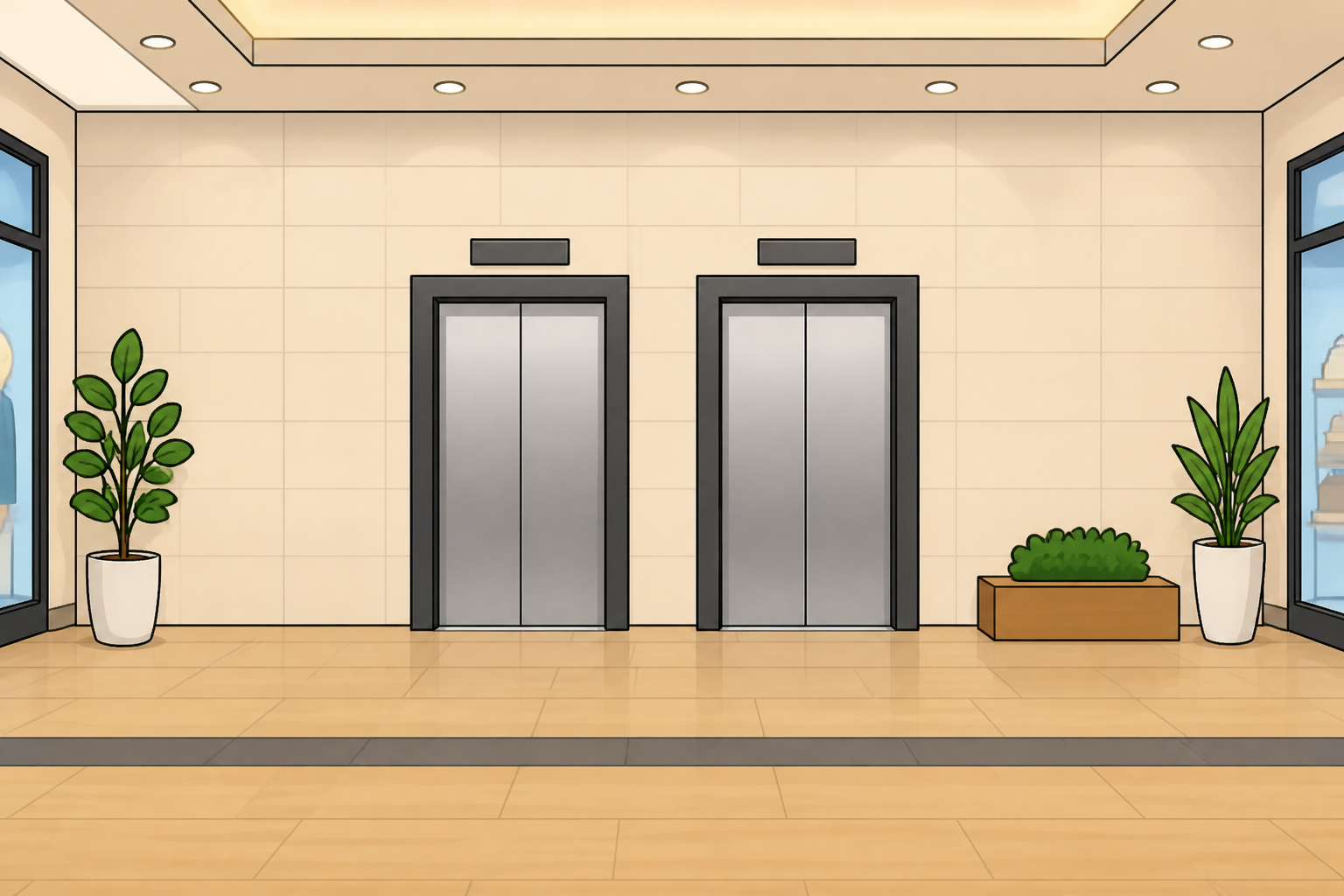
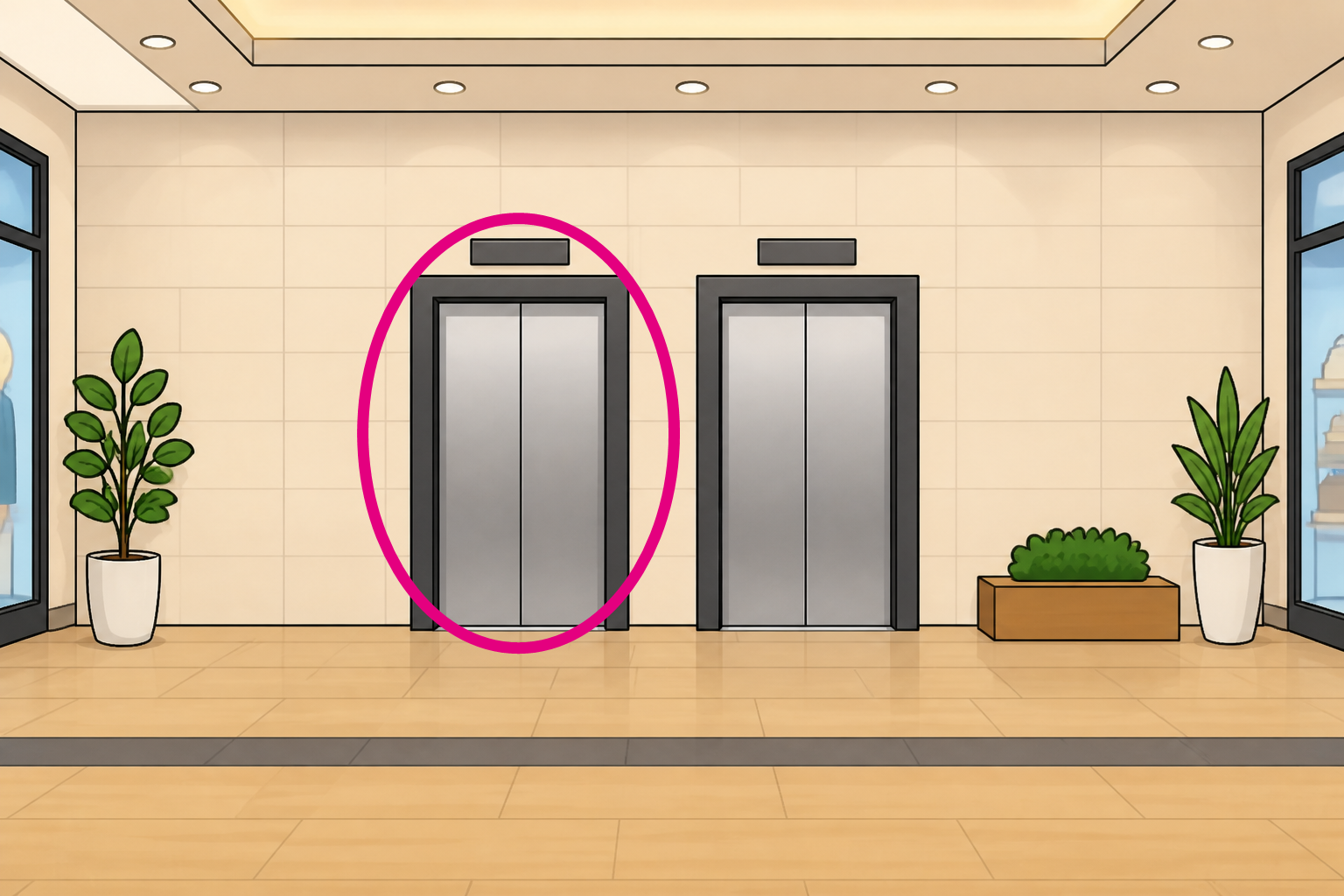
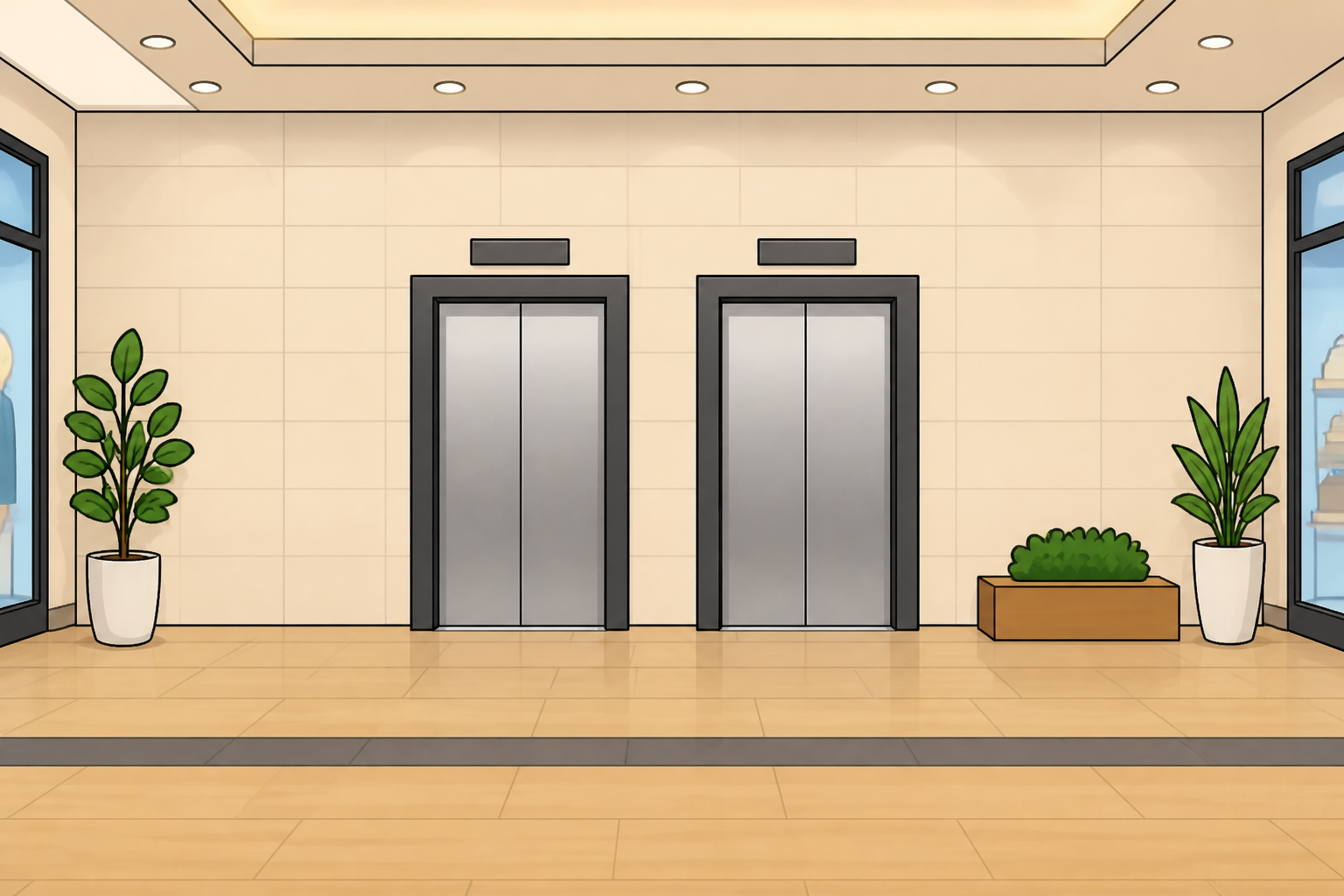
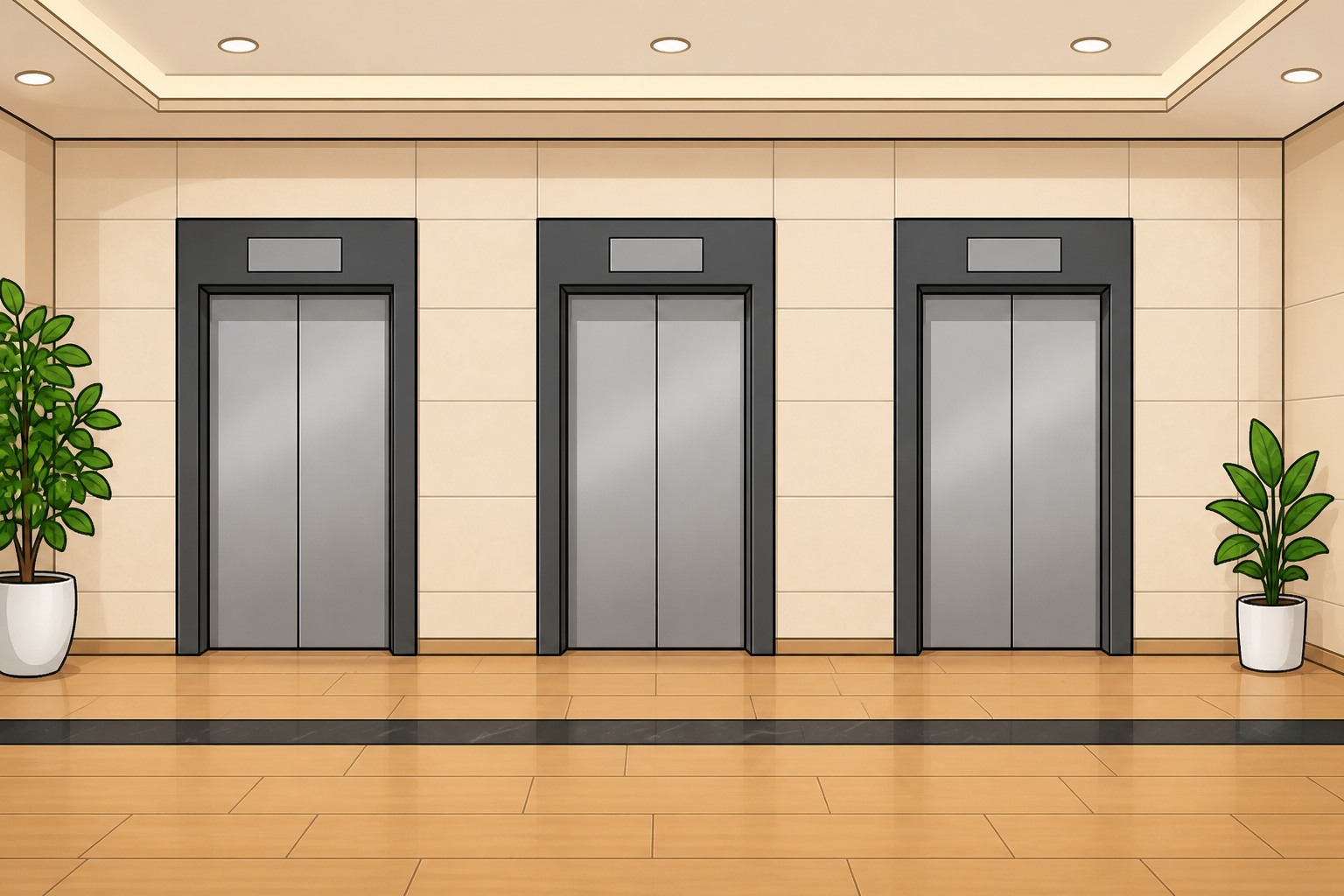
Listen to the instructions on taking the elevator. Choose the correct elevators. Then, repeat after the recordings.
Example
嗰度有兩部𨋢,坐左邊嗰部𨋢。
go2 dou6 jau5 loeng5 bou6 lip1, co5 zo2 bin6 go2 bou6 lip1.
There are two elevators there. Take that left elevator.
1.
________
2.
________
3.
________
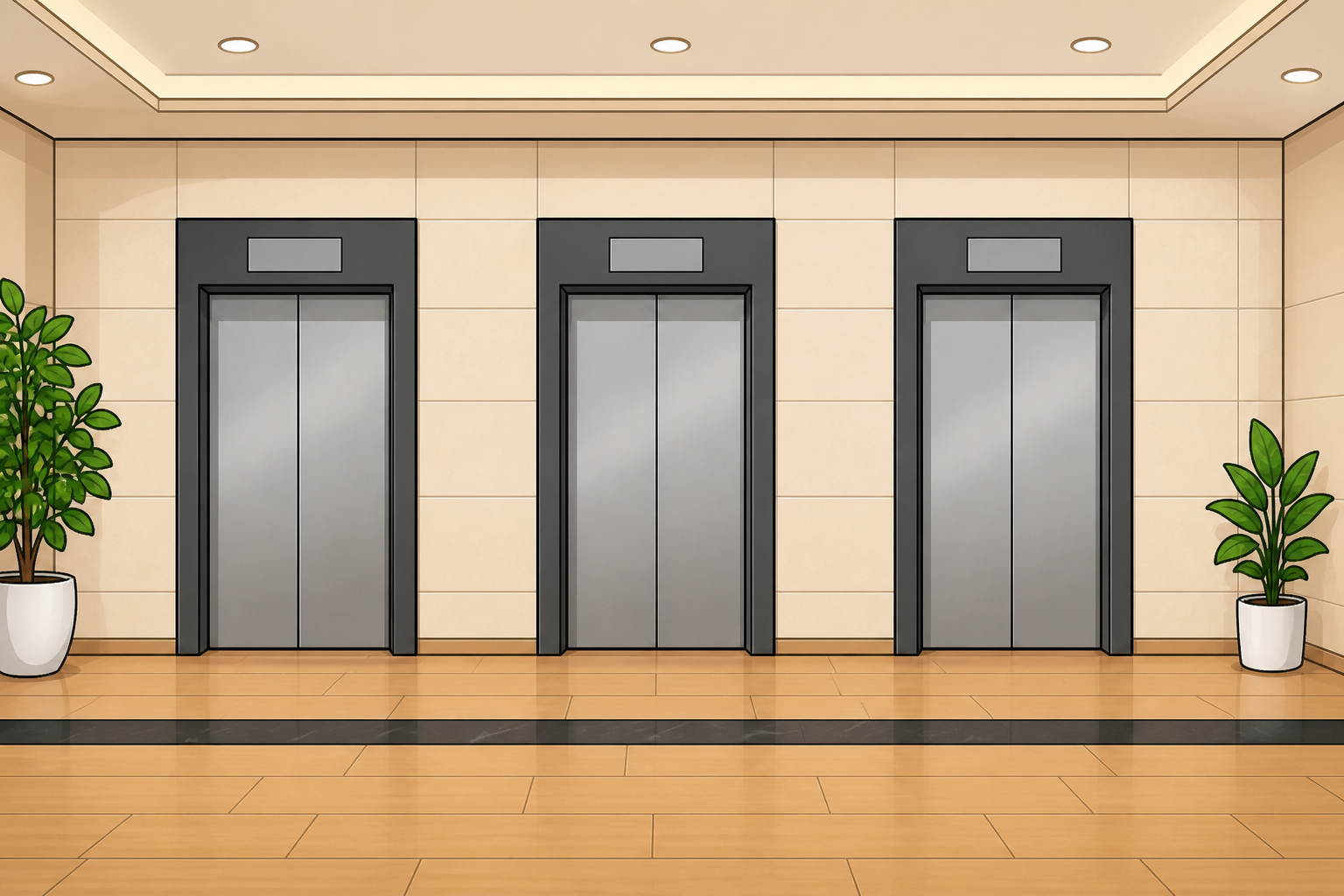
4.
________
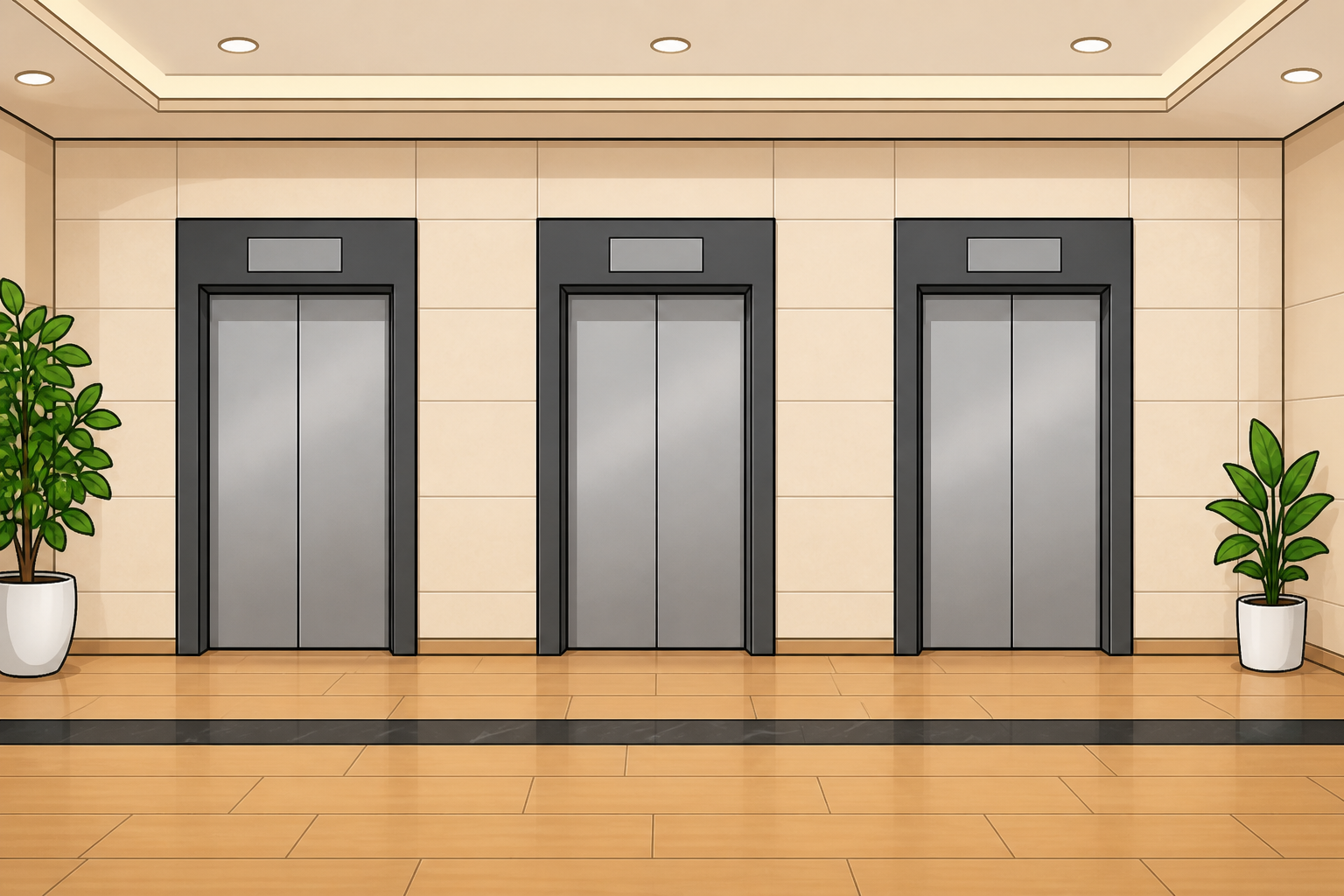
5.
________
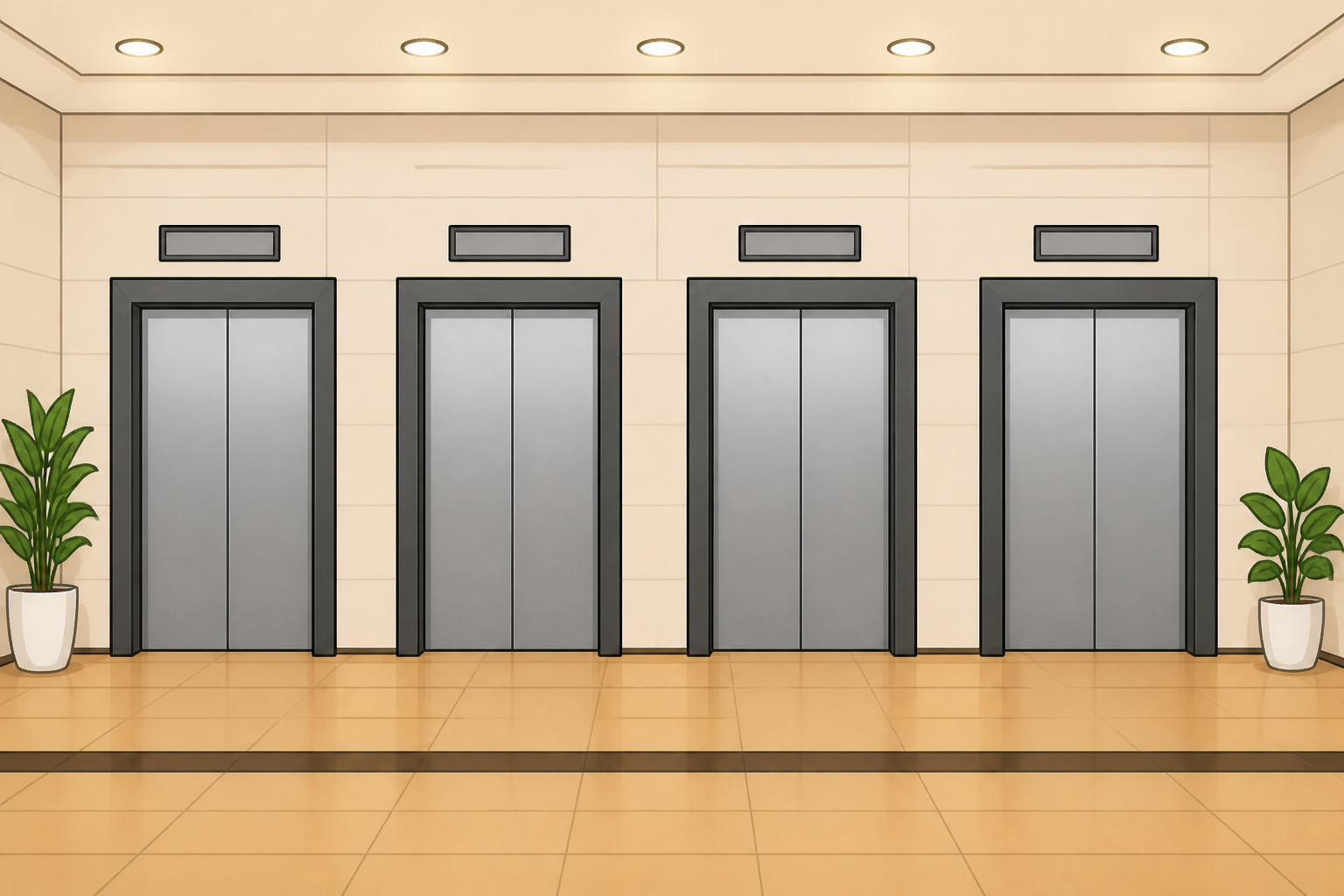
6.
________
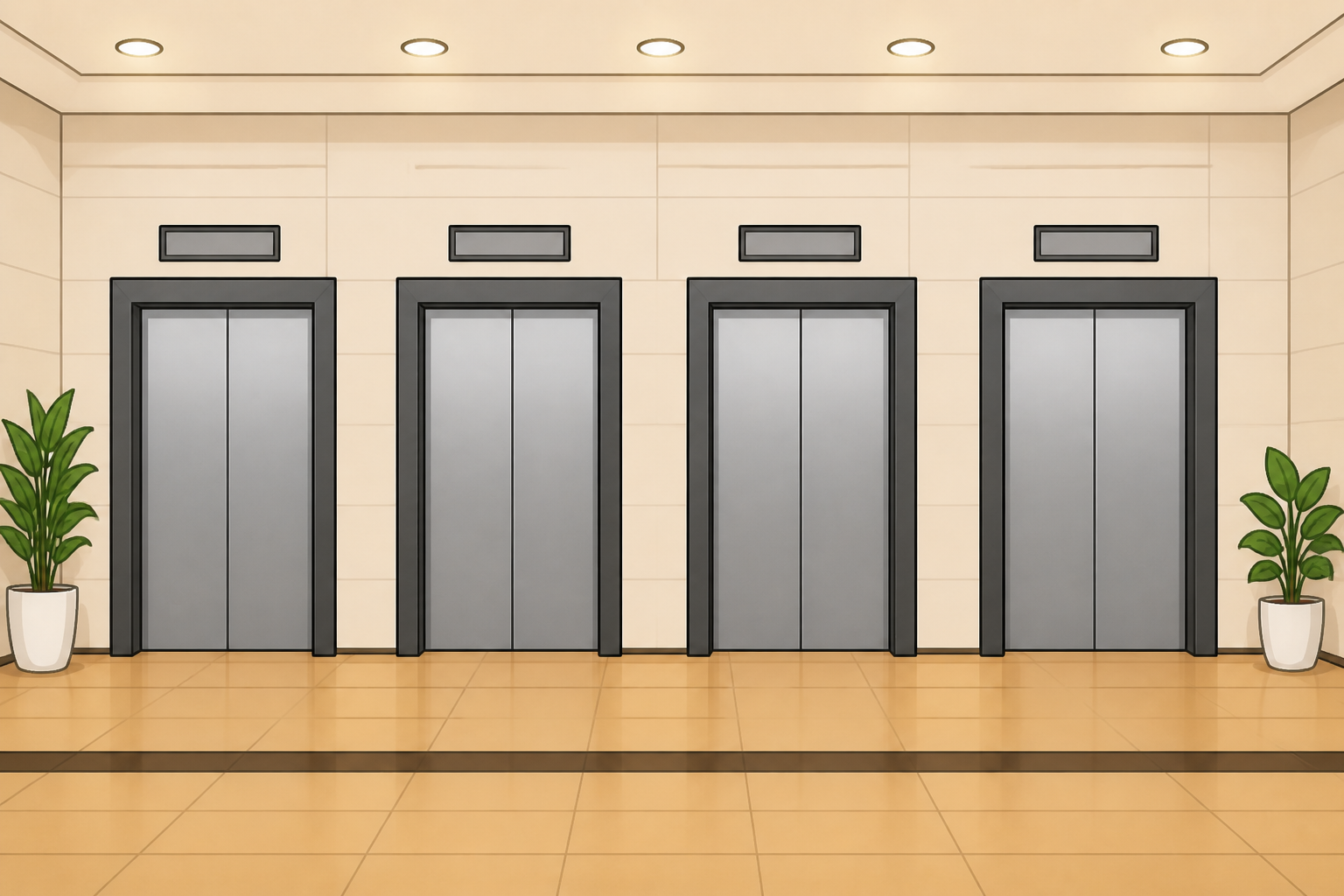
Exercise 5
Listen to the directions and write down the routes. Then, check your answers. Finally, repeat after the recordings.
Example
你首先直行,跟住轉右,之後轉左就係超級市場。
nei5 sau2 sin1 zik6 haang4, gan1 zyu6 zyun3 jau6, zi1 hau6 zyun3 zo2 zau6 hai6 ciu1 kap1 si5 coeng4.
First, walk straight. And then, turn right. After that, if you turn left, then it is the supermarket.
zik6 haang4 → zyun3 jau6 → zyun3 zo2 → ciu1 kap1 si5 coeng4
1.
________
2.
________
3.
________
4.
________
5.
________
6.
________
7.
________
8.
________
9.
________
10.
________
Activities
Activity 1
Listen to three conversations between a customer and a customer service representative in a shopping mall. The customer is looking for a shop or facility. Then, listen to the descriptions for each conversation and choose the correct one.
Conversation 1
| A. | ________ |
| B. | ________ |
| C. | ________ |
Answer: ____
| 客 haak3 | |
| 職員 zik1 jyun4 | |
| 客 haak3 | |
| 職員 zik1 jyun4 | |
| 客 haak3 | |
| 職員 zik1 jyun4 | |
| 客 haak3 | |
| 職員 zik1 jyun4 |
Conversation 2
| A. | ________ |
| B. | ________ |
| C. | ________ |
Answer: ____
| 客 haak3 | |
| 職員 zik1 jyun4 | |
| 客 haak3 | |
| 職員 zik1 jyun4 | |
| 客 haak3 | |
| 職員 zik1 jyun4 |
Conversation 3
| A. | ________ |
| B. | ________ |
| C. | ________ |
Answer: ____
| 客 haak3 | |
| 職員 zik1 jyun4 | |
| 客 haak3 | |
| 職員 zik1 jyun4 | |
| 客 haak3 | |
| 職員 zik1 jyun4 | |
| 客 haak3 | |
| 職員 zik1 jyun4 | |
| 客 haak3 | |
| 職員 zik1 jyun4 |
Transcripts with Translation
Conversation 1
| 客 haak3 | 唔好意思。 m4 hou2 ji3 si1. Excuse me. |
| 職員 zik1 jyun4 | 你好,請問有咩幫到你嘅? nei5 hou2, cing2 man6 jau5 me1 bong1 dou2 nei5 ge2? Hello. May I ask if there is anything that I am able to help you with? |
| 客 haak3 | 請問戲院喺邊層呀? cing2 man6 hei3 jyun2 hai2 bin1 cang4 aa3? May I ask which floor the movie theater is on? |
| 職員 zik1 jyun4 | 戲院喺第七層。 hei3 jyun2 hai2 dai6 cat1 cang4. The movie theater is on the seventh floor. |
| 客 haak3 | 呢層係邊層嚟㗎? ni1 cang4 hai6 bin1 cang4 lai4 gaa3? Which floor is this floor? |
| 職員 zik1 jyun4 | 呢層係第六層嚟嘅,你要坐扶手電梯上一層,你可以去嗰邊坐扶手電梯。 ni1 cang4 hai6 dai6 luk6 cang4 lai4 ge3, nei5 jiu3 co5 fu4 sau2 din6 tai1 soeng5 jat1 cang4, nei5 ho2 ji5 heoi3 go2 bin6 co5 fu4 sau2 din6 tai1. This floor is the sixth floor. You need to take the escalator to go up one floor. You can go to that side to take the escalator. |
| 客 haak3 | 好,唔該晒。 hou2, m4 goi1 saai3. Good. [= Okay.] Thank you so much. |
| 職員 zik1 jyun4 | 唔使客氣。 m4 sai2 haak3 hei3. No problem. |
Conversation 2
| 客 haak3 | 喺幾多樓呀…… hai2 gei2 do1 lau2 aa3… What floor is it on… |
| 職員 zik1 jyun4 | 小姐,你好,請問有咩幫到你嘅? siu2 ze2, nei5 hou2, cing2 man6 jau5 me1 bong1 dou2 nei5 ge2? Miss, hello. May I ask if there is anything that I am able to help you with? |
| 客 haak3 | 我想去超級市場呀,請問超級市場喺幾多樓呀? ngo5 soeng2 heoi3 ciu1 kap1 si5 coeng4 aa3, cing2 man6 ciu1 kap1 si5 coeng4 hai2 gei2 do1 lau2 aa3? I want to go to the supermarket. May I ask what floor the supermarket is on? |
| 職員 zik1 jyun4 | 超級市場喺地庫,呢度係三樓,前邊有𨋢,你可以搭𨋢落去。 ciu1 kap1 si5 coeng4 hai2 dei6 fu3, ni1 dou6 hai6 saam1 lau2, cin4 bin6 jau5 lip1, nei5 ho2 ji5 daap3 lip1 lok6 heoi3. The supermarket is in the basement. Here is the third floor. There are elevators in front. You can take the elevators to go down. |
| 客 haak3 | 好,唔該晒。 hou2, m4 goi1 saai3. Good. [= Okay.] Thank you so much. |
| 職員 zik1 jyun4 | 唔使客氣。 m4 sai2 haak3 hei3. No problem. |
Conversation 3
| 客 haak3 | 唔好意思。 m4 hou2 ji3 si1. Excuse me. |
| 職員 zik1 jyun4 | 先生,你好,請問有咩幫到你嘅? sin1 saang1, nei5 hou2, cing2 man6 jau5 me1 bong1 dou2 nei5 ge2? Sir, hello. May I ask if there is anything that I am able to help you with? |
| 客 haak3 | 我揾緊溜冰場呀,溜冰場喺第幾層呀? ngo5 wan2 gan2 lau4 bing1 coeng4 aa3, lau4 bing1 coeng4 hai2 dai6 gei2 cang4 aa3? I am looking for the ice rink. May I ask what floor the ice rink is on? |
| 職員 zik1 jyun4 | 溜冰場喺三樓。 lau4 bing1 coeng4 hai2 saam1 lau2. The ice rink is on the third floor. |
| 客 haak3 | 呢度係幾多樓嚟㗎? ni1 dou6 hai6 gei2 do1 lau2 lai4 gaa3? What floor is here? |
| 職員 zik1 jyun4 | 呢度係一樓嚟嘅,你要上兩層。 ni1 dou6 hai6 jat1 lau2 lai4 ge3, nei5 jiu3 soeng5 loeng5 cang4. Here is the first floor. You need to go up two floors. |
| 客 haak3 | 邊度有扶手電梯上去呀? bin1 dou6 jau5 fu4 sau2 din6 tai1 soeng5 heoi3 aa3? Where is the escalator for going up? |
| 職員 zik1 jyun4 | 直行就有扶手電梯上去。 zik6 haang4 zau6 jau5 fu4 sau2 din6 tai1 soeng5 heoi3. If you walk straight, then there is an escalator for going up. |
| 客 haak3 | 好,唔該晒。 hou2, m4 goi1 saai3. Good. [= Okay.] Thank you so much. |
| 職員 zik1 jyun4 | 唔使客氣。 m4 sai2 haak3 hei3. No problem. |
Activity 2
Listen to two conversations between a customer and a customer service representative in a shopping mall. The customer service representative will give directions on how to get to a shop or facility. Complete the steps.
Conversation 1
| 客 haak3 | |
| 職員 zik1 jyun4 | |
| 客 haak3 | |
| 職員 zik1 jyun4 | |
| 客 haak3 |
Conversation 2
| 客 haak3 | |
| 職員 zik1 jyun4 | |
| 客 haak3 | |
| 職員 zik1 jyun4 | |
| 客 haak3 | |
| 職員 zik1 jyun4 |
Transcripts with Translation
Conversation 1
| 客 haak3 | 唔好意思,請問戲院點去呀? m4 hou2 ji3 si1, cing2 man6 hei3 jyun2 dim2 heoi3 aa3? Excuse me. May I ask how to go to the movie theater? |
| 職員 zik1 jyun4 | 戲院喺五樓,你可以坐𨋢上去。你首先轉左,跟住直行到去最尾,嗰度有四部𨋢,坐最左邊嗰部𨋢,唔好坐右邊嗰三部𨋢,入到𨋢就撳五字,出咗𨋢就轉右,直行到去盡頭就係戲院。 hei3 jyun2 hai2 ng5 lau2, nei5 ho2 ji5 co5 lip1 soeng5 heoi3. nei5 sau2 sin1 zyun3 zo2, gan1 zyu6 zik6 haang4 dou3 heoi3 zeoi3 mei5, go2 dou6 jau5 sei3 bou6 lip1, co5 zeoi3 zo2 bin6 go2 bou6 lip1, m4 hou2 co5 jau6 bin6 go2 saam1 bou6 lip1, jap6 dou3 lip1 zau6 gam6 ng5 zi6, ceot1 zo2 lip1 zau6 zyun3 jau6, zik6 haang4 dou3 heoi3 zeon6 tau4 zau6 hai6 hei3 jyun2. The movie theater is on the fifth floor. You can take the elevator to go up. First, turn left. And then, walk straight to the end. There are four elevators there. Take the leftmost elevator. Don’t take the three elevators on the right. When you have gone into the elevator, then press 5 [the floor selection button]. When you have gone out of the elevator, then turn right. If you walk straight to the end, then it is the movie theater. |
| 客 haak3 | 好,唔該晒。 hou2, m4 goi1 saai3. Good. [= Okay.] Thank you so much. |
| 職員 zik1 jyun4 | 不如我帶你去坐𨋢吖。 bat1 jyu4 ngo5 daai3 nei5 heoi3 co5 lip1 aa1. Let me take you to go to take the elevator. |
| 客 haak3 | 好呀,唔該晒。 hou2 aa3, m4 goi1 saai3. Good. Thank you so much. |
Conversation 2
| 客 haak3 | 唔好意思。 m4 hou2 ji3 si1. Excuse me. |
| 職員 zik1 jyun4 | 太太,你好,請問有咩幫到你嘅? taai3 taai2, nei5 hou2, cing2 man6 jau5 me1 bong1 dou2 nei5 ge2? Madam, hello. May I ask if there is anything that I am able to help you with? |
| 客 haak3 | 請問呢度有冇超級市場㗎? cing2 man6 ni1 dou6 jau5 mou5 ciu1 kap1 si5 coeng4 gaa3? May I ask if there is a supermarket here? |
| 職員 zik1 jyun4 | 有呀,超級市場喺地下,你可以搭扶手電梯落去。首先你直行,之後轉右,搭中間嗰條扶手電梯落去。落到去地下就直行到去最尾,轉左就係超級市場。 jau5 aa3, ciu1 kap1 si5 coeng4 hai2 dei6 haa2, nei5 ho2 ji5 daap3 fu4 sau2 din6 tai1 lok6 heoi3. sau2 sin1 nei5 zik6 haang4, zi1 hau6 zyun3 jau6, daap3 zung1 gaan1 go2 tiu4 fu4 sau2 din6 tai1 lok6 heoi3. lok6 dou3 heoi3 dei6 haa2 zau6 zik6 haang4 dou3 heoi3 zeoi3 mei5, zyun3 zo2 zau6 hai6 ciu1 kap1 si5 coeng4. Yes, the supermarket is on the ground floor. You can take the escalator to go down. First, walk straight. And then, turn right. Take the middle escalator to go down. When you have gone down to the ground floor, then walk straight to the end. If you turn left, then it is the supermarket. |
| 客 haak3 | 好,唔該晒。 hou2, m4 goi1 saai3. Good. [= Okay.] Thank you so much. |
| 職員 zik1 jyun4 | 唔使客氣。 m4 sai2 haak3 hei3. No problem. |
Activity 3
Form a pair. Make six conversations based on the notes below. In each conversation, A (the customer) will ask B (the customer service representative) how to get to a shop or facility in the shopping mall. Swap your roles after each conversation.
Floor Plan