Print or Export
你哋有冇仔女㗎?
nei5 dei6 jau5 mou5 zai2 neoi2 gaa3?
nei5 dei6 jau5 mou5 zai2 neoi2 gaa3?
Listen and Speak
Step 1
Listen and match the words.
Step 2
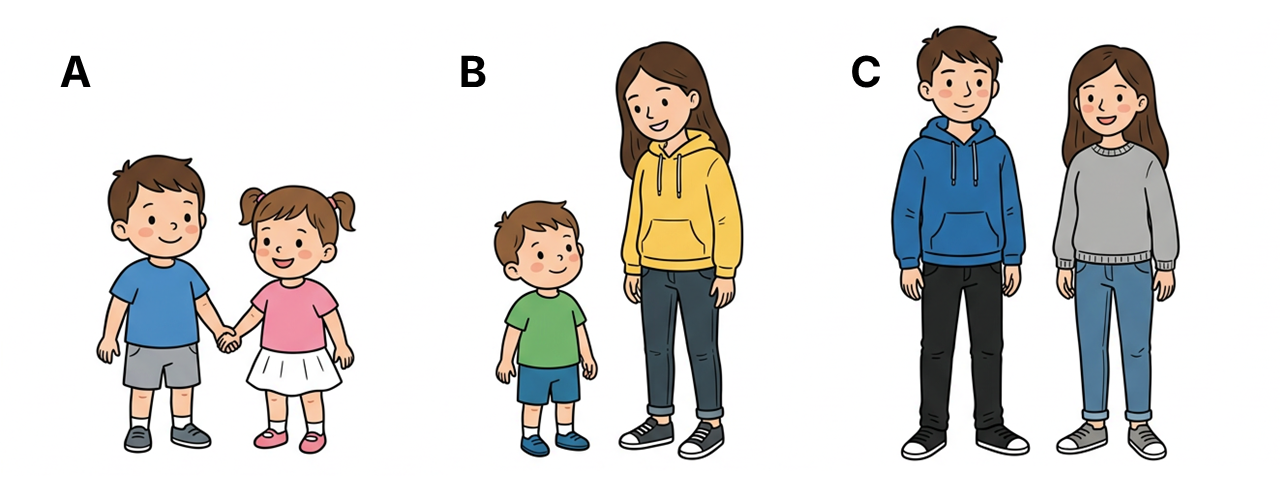
Listen to a conversation. One of the speakers will talk about his or her children. Complete the description with numbers and choose the correct picture.
阿Nick有____個仔同____個女。
aa3 Nick jau5 ____ go3 zai2 tung4 ____ go3 neoi2.
佢個仔____歲,佢個女____歲。
keoi5 go3 zai2 ____ seoi3, keoi5 go3 neoi2 ____ seoi3.
| Billy | |
| 阿Nick aa3 Nick | |
| Billy | |
| 阿Nick aa3 Nick | |
| Billy | |
| 阿Nick aa3 Nick |
Step 3
Listen to the conversation again. Read the script while listening. Check your answers.
| Billy | 你結咗婚未㗎? nei5 git3 zo2 fan1 mei6 gaa3? Have you gotten married yet? |
| 阿Nick aa3 Nick | 結咗喇。 git3 zo2 laa3. Yes already. |
| Billy | 噉你有冇仔女㗎? gam2 nei5 jau5 mou5 zai2 neoi2 gaa3? Then, do you have children? |
| 阿Nick aa3 Nick | 有呀,我有一個仔同一個女嘅。 jau5 aa3, ngo5 jau5 jat1 go3 zai2 tung4 jat1 go3 neoi2 ge3. Yes, I have one son and one daughter. |
| Billy | 佢哋今年幾多歲呀? keoi5 dei6 gam1 nin4 gei2 do1 seoi3 aa3? How old are they this year? |
| 阿Nick aa3 Nick | 我個仔就三歲,我個女就兩歲。 ngo5 go3 zai2 zau6 saam1 seoi3, ngo5 go3 neoi2 zau6 loeng5 seoi3. My son is 3 years old. My daughter is 2 years old. |
- 就 zau6 = (Used to show contrast between people or things)
Step 4
Listen and repeat the conversation.
Step 5
Replace the highlighted words in the script with the following ages to make your conversations.
Grammar and Vocabulary
In the Grammar and Vocabulary section, you will learn:
- Children’s Age
- The Adverb 都 dou1 II (‘all’)
- Referring to Members in a Group (‘one of them, two of them, etc.’)
- The Conjunction 就 zau6 I (Contrast)
- Vocabulary List
- Vocabulary: Children in a Family
- Vocabulary: Schools
- Vocabulary: Pets
14.1 Children’s Age
When we indicate children’s age, we can optionally add the adjective 大 daai6 (‘old’) after the age. We usually only add 大 daai6 if the age is from 0 to 10.
We can add 半 bun3 (‘half’) after 歲 seoi3 to mean ‘… and a half years old’.
We can add 幾 gei2 (‘and slightly more’) after 歲 seoi3 to mean ‘… year old and slightly more’.
For half a year old, we put 半 bun3 before 歲 seoi3.
For infants less than 1 year old, we can indicate their age in months, like how we indicate duration in months. Notes that we always add 大 daai6 after the age if it is in months.
We can add the adverbs 就快 zau6 faai3 (‘soon’) or 差唔多 caa1 m4 do1 (‘almost’) before an age.
我個女就快兩歲。
ngo5 go3 neoi2 zau6 faai3 loeng5 seoi3.
My daughter will be two years old soon.
我個女差唔多兩歲。
ngo5 go3 neoi2 caa1 m4 do1 loeng5 seoi3.
My daughter is almost two years old.
14.2 The Adverb 都 dou1 II (‘all’)
In Grammar and Vocabulary 3.2, we learned that the adverb 都 dou1 means ‘too, also’.
The adverb 都 dou1 can also mean ‘all’. When the subject in a sentence represents a group of people or things, we can put 都 dou1 after the subject to emphasize that all of the people or things do the same activity or share the same attribute.
我三個仔女仲讀緊書。
ngo5 saam1 go3 zai2 neoi2 zung6 duk6 gan2 syu1.
My three children are still studying.
我三個仔女都仲讀緊書。
ngo5 saam1 go3 zai2 neoi2 dou1 zung6 duk6 gan2 syu1.
All three of my children are still studying.
When the number of people or things is two, we can understand 都 dou1 as ‘both’.
我兩個女仲讀緊書。
ngo5 loeng5 go3 neoi2 zung6 duk6 gan2 syu1.
My two daughters are still studying.
我兩個女都仲讀緊書。
ngo5 loeng5 go3 neoi2 dou1 zung6 duk6 gan2 syu1.
Both of my two daughters are still studying.
14.3 Referring to Members in a Group (‘one of them, two of them, etc.’)
If we want to refer to one of the members in a group of people or things, we can say 一 jat1 (‘one’) and then the classifier to mean ‘one of them’. The classifier is determined by what we are referring to. For example, we use 個 go3 if we are referring to people.
| A: | 你兩個仔女今年幾大呀? nei5 loeng5 go3 zai2 neoi2 gam1 nin4 gei2 daai6 aa3? How old are your two children this year? |
| B: | 一個三歲,一個五歲。 jat1 go3 saam1 seoi3, jat1 go3 ng5 seoi3. One of them is 3 years old. One of them is 5 years old. |
We can also use numbers above one to mean ‘two of them, three of them, etc.’.
| A: | 你三個仔女做緊嘢定讀緊書㗎? nei5 saam1 go3 zai2 neoi2 zou6 gan2 je5 ding6 duk6 gan2 syu1 gaa3? Are your three children working or studying? |
| B: | 兩個做緊嘢,一個讀緊書。 loeng5 go3 zou6 gan2 je5, jat1 go3 duk6 gan2 syu1. Two of them are working. One of them is studying. |
We can add 都 dou1 (‘all’) after the classifier to mean ‘all two of them, all three of them, etc.’.
| A: | 你三個仔女做緊嘢定讀緊書㗎? nei5 saam1 go3 zai2 neoi2 zou6 gan2 je5 ding6 duk6 gan2 syu1 gaa3? Are your three children working or studying? |
| B: | 三個都做緊嘢喇。 saam1 go3 dou1 zou6 gan2 je5 laa3. All three of them are already working. |
14.4 The Conjunction 就 zau6 I (Contrast)
When we describe people or things in a group one by one, we can add the conjunction 就 zau6 to show contrast between the people or things. We put 就 zau6 after the subject in each sentence.
| A: | 你兩個仔女做緊嘢定讀緊書㗎? nei5 loeng5 go3 zai2 neoi2 zou6 gan2 je5 ding6 duk6 gan2 syu1 gaa3? Are your two children working or studying? |
| B: | 一個就做緊嘢,一個就讀緊書。 jat1 go3 zau6 zou6 gan2 je5, jat1 go3 zau6 duk6 gan2 syu1. One of them is working. One of them is studying. |
14.5 Vocabulary List
14.6 Vocabulary: Children in a Family
If a family has two sons or daughters, we can use 大 daai6 (‘big’) and 細 sai3 (‘small’) to distinguish between them. If a family has more than two sons or daughters, we can use numbers in addition.
Sometimes numbers are also used for the youngest son or daughter (e.g., 二仔 ji6 zai2 for the second and youngest son).
😈 Sensitive Content
三仔 saam1 zai2 (literally ‘three + son’) and 四仔 sei3 zai2 (literally ‘four + son’) can mean ‘pornographic videos’.
14.7 Vocabulary: Schools
It is common for parents in Hong Kong to use school grades to indicate their children’s age. They may indicate the grade in Cantonese or English.
Kindergarten
幼稚園
jau3 zi6 jyun2
kindergarten
(4 grades; for children aged 2 to 6 years old)
Primary School
小學
siu2 hok6
primary school
(6 grades; for children aged 6 to 12 years old; similar to elementary school)
Secondary School
中學
zung1 hok6
secondary school
(6 grades; for those aged 12 to 17 years old; similar to middle school, junior high school and high school)
Notice the grades for secondary schools start from 1 again.
University
大學
daai6 hok6
university
(usually 4 years, more years for degrees in subjects like medicine, nursing and education)
14.8 Vocabulary: Pets
Common Pets in Hong Kong
Common Dog Breeds
Common Cat Breeds
Communication
In the Communication section, you will learn:
- Talking About Children
- Talking About Pets
Talking About Children
- We usually use 小朋友 only when talking to someone whose children are likely to be young.
If we are talking to someone younger, we can also ask this way:
- 生仔 saang1 zai2 literally means ‘to give birth to + son’, but 生仔 saang1 zai2 in this context means to give birth to children who can be of any gender. If we want to be gender neutral, we can say 生仔女 saang1 zai2 neoi2 or 生小朋友 saang1 siu2 pang4 jau5.
If the person doesn’t have children, we can ask if he or she plans to have any:
If the person has children, we can ask about his or her children:
If the person is older, we can ask whether his or her children are working or studying.
Talking About Pets
Exercises
Exercise 1
Complete the descriptions.
1.
When we indicate children’s age from 0 to 10, we can optionally add ________ after the age. When we indicate children’s age in months, we always add ________ after the age.
2.
When the subject in a sentence represents a group of people or things, we can put ________ after the subject to emphasize that all of the people or things do the same activity or share the same attribute.
3.
When we describe people or things in a group one by one, we can add ________ after the subject in each sentence to show contrast between the people or things.
Exercise 2
Follow the example to complete the conversations. Then, listen to the recordings to check your answers. Finally, repeat after the recordings.
Example
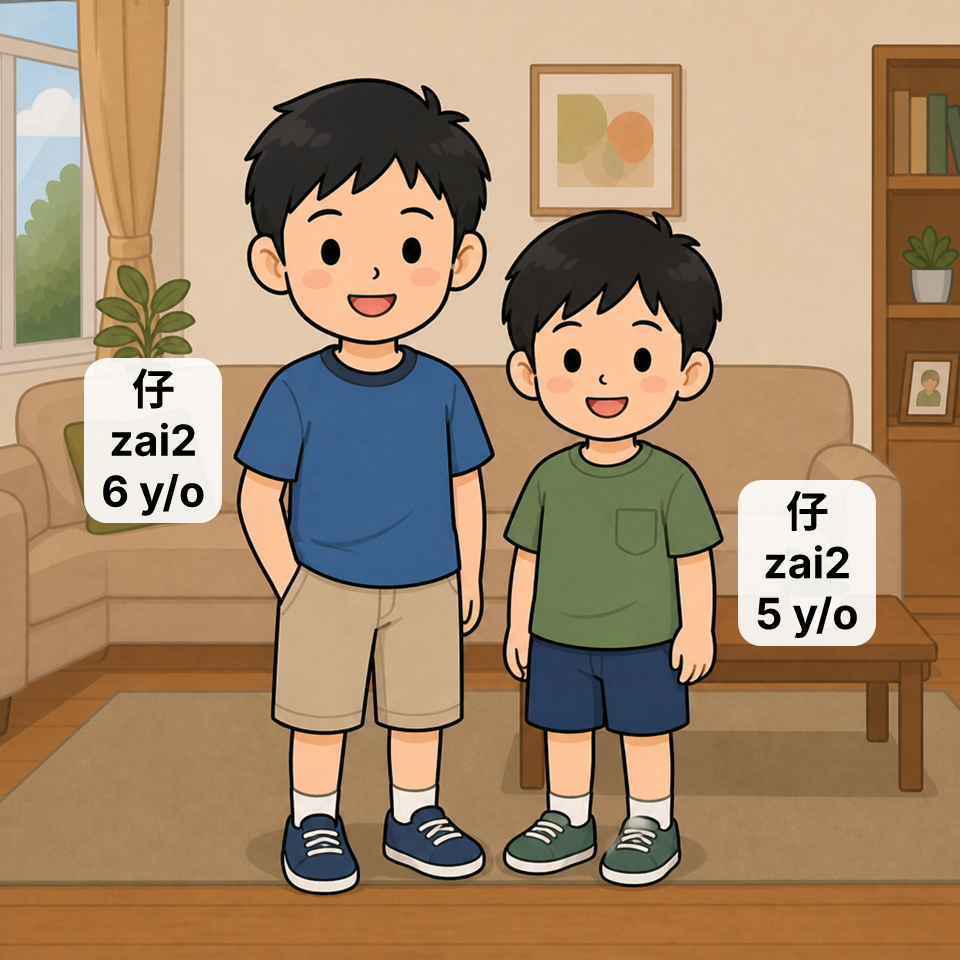
| A | 你兩個仔幾大呀? nei5 loeng5 go3 zai2 gei2 daai6 aa3? How old are your two sons? |
| B | 我個大仔就六歲,我個細仔就五歲。 ngo5 go3 daai6 zai2 zau6 luk6 seoi3, ngo5 go3 sai3 zai2 zau6 ng5 seoi3. My older son is 6 years old. My younger son is 5 years old. |
1.
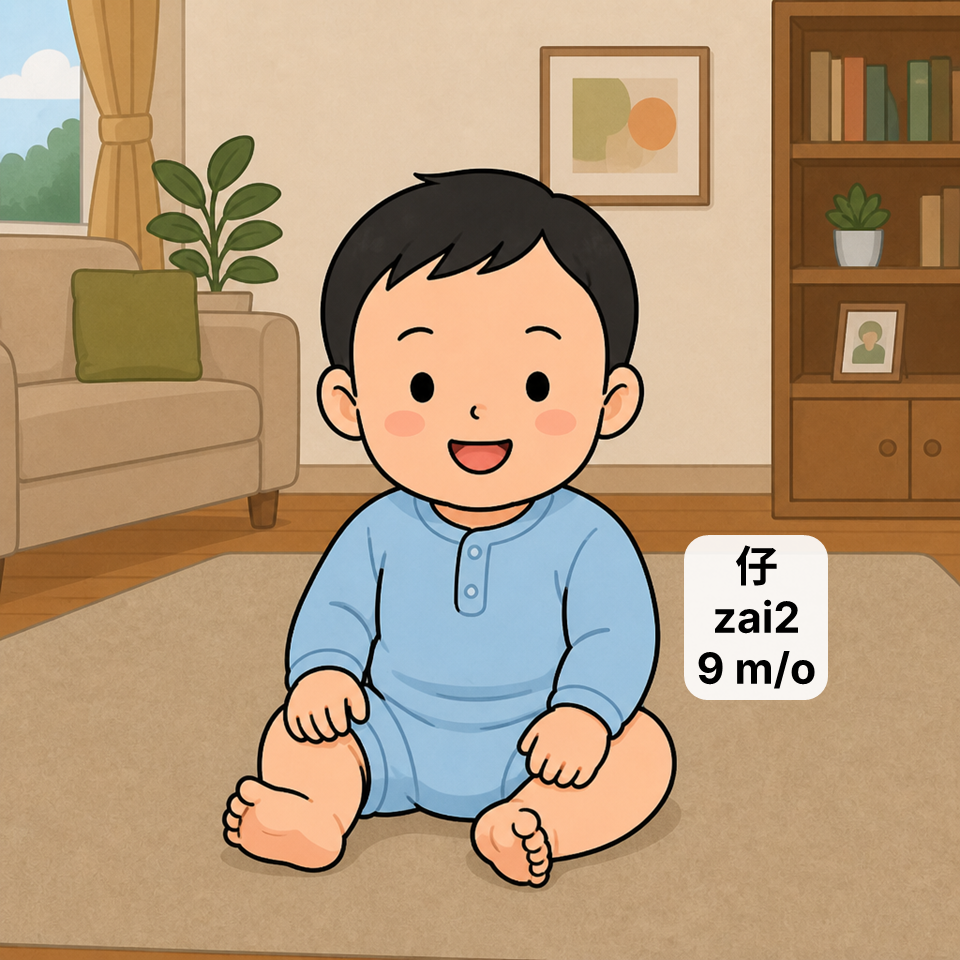
| A | ________ |
| B | ________ |
2.
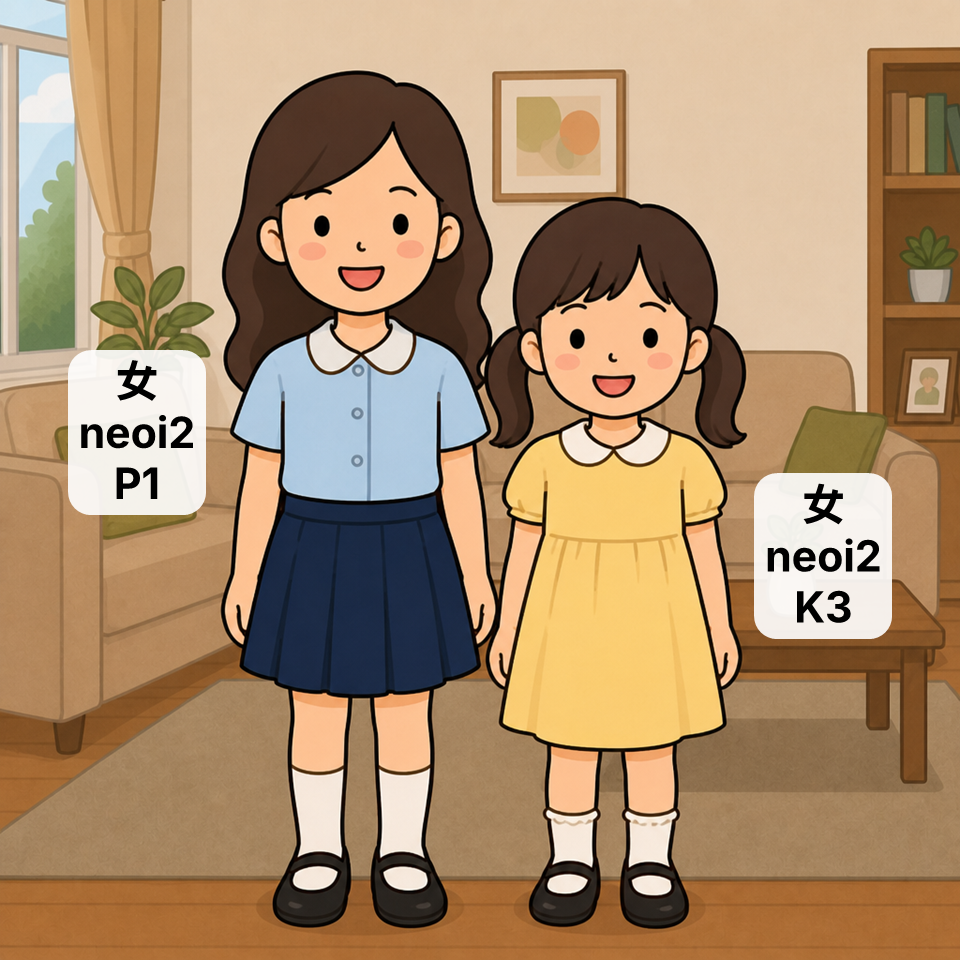
| A | ________ |
| B | ________ |
3.
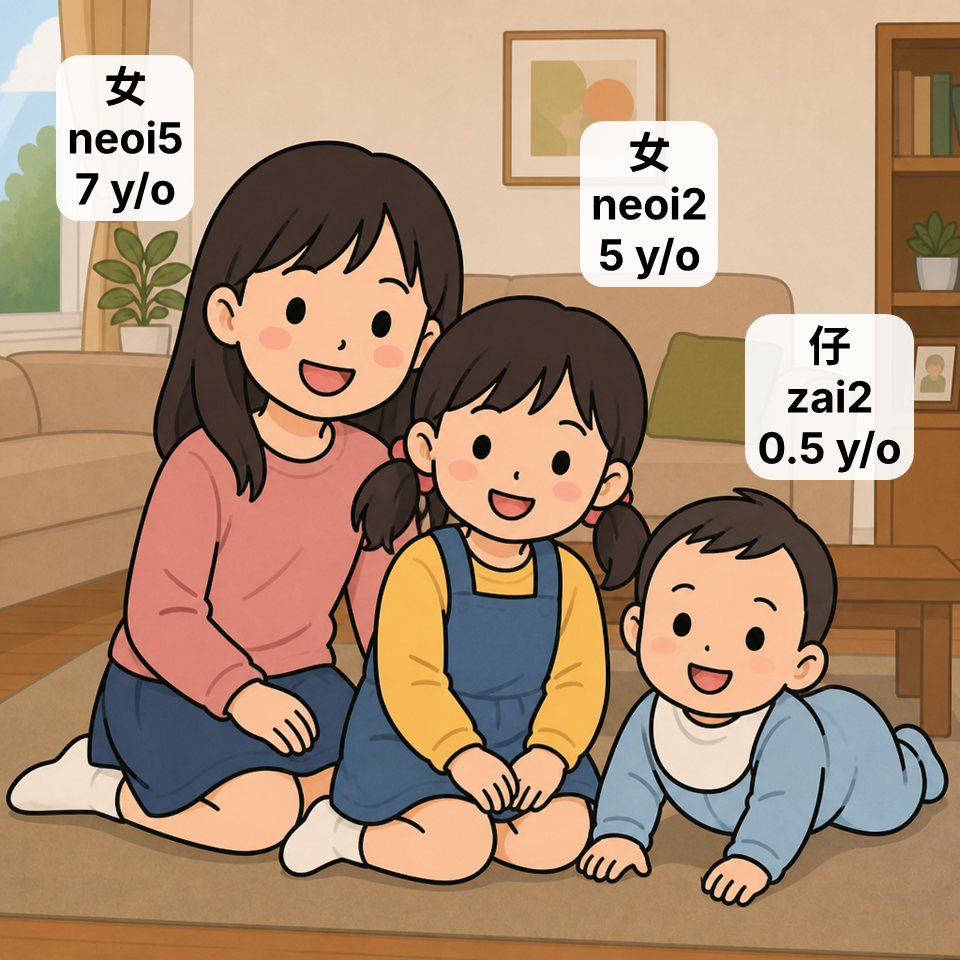
| A | ________ |
| B | ________ |
4.
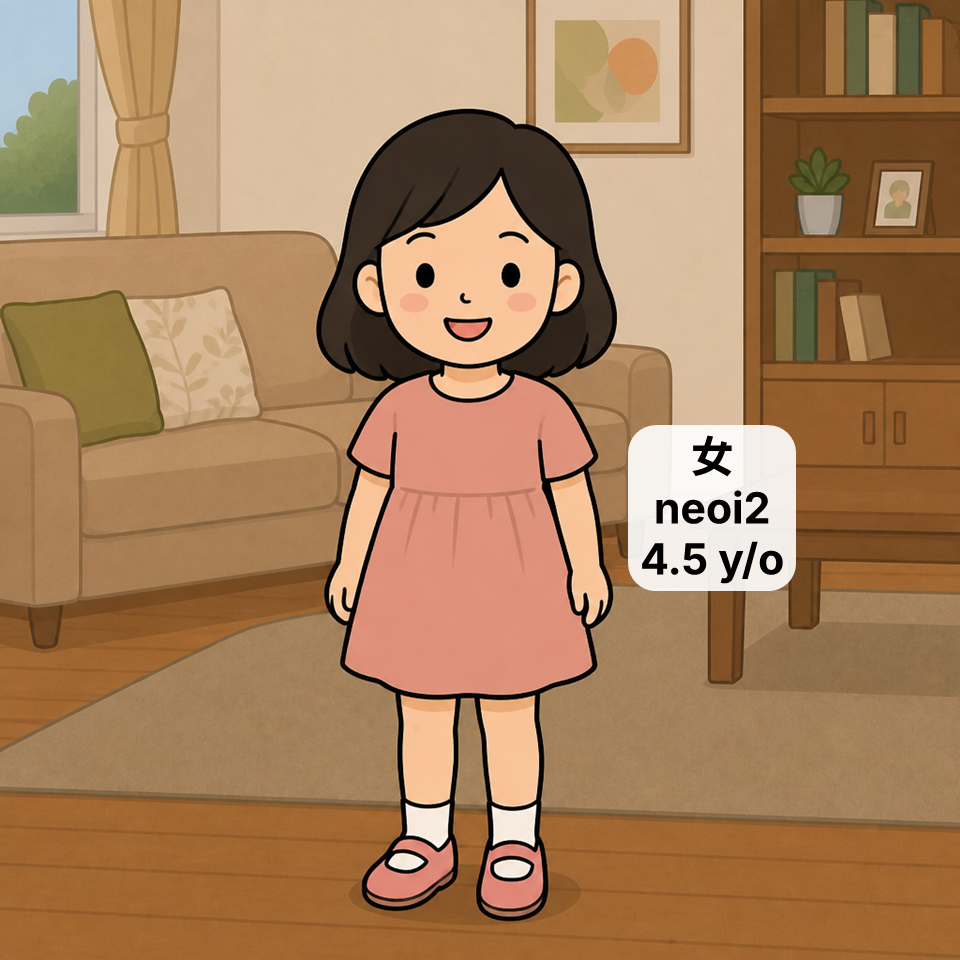
| A | ________ |
| B | ________ |
5.
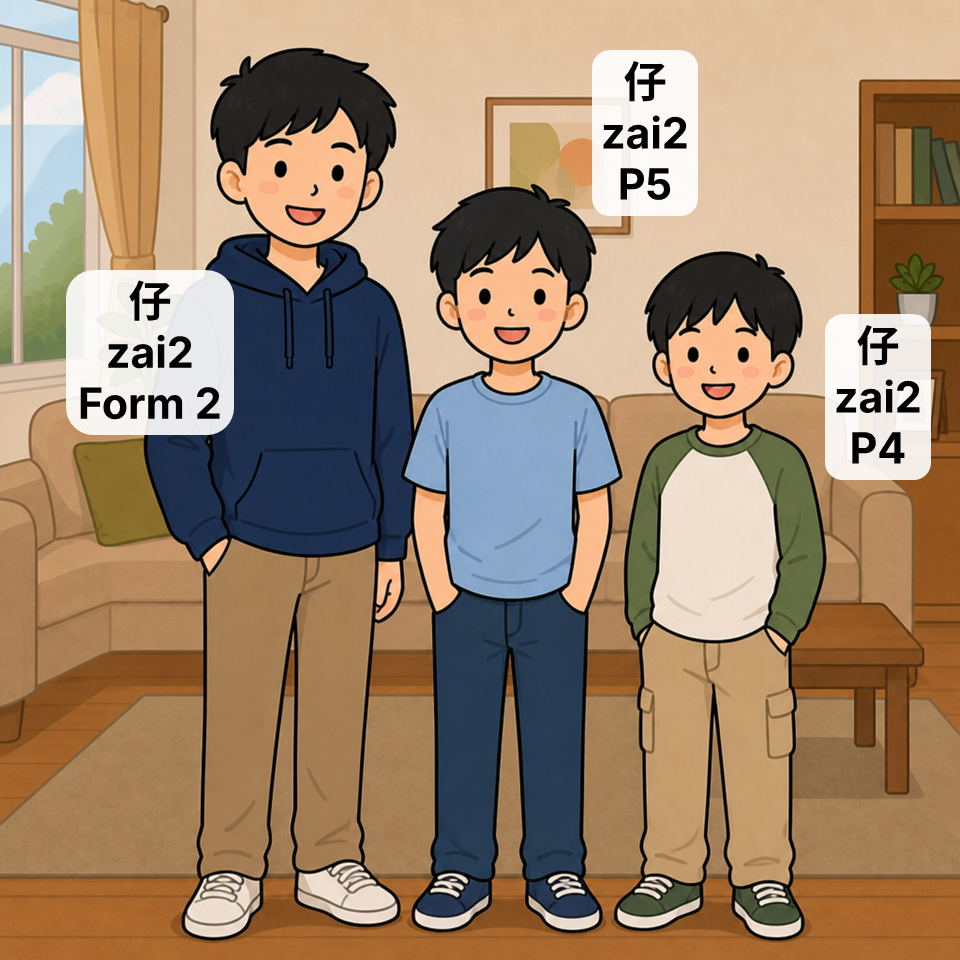
| A | ________ |
| B | ________ |
Exercise 3
Listen to information about B’s children and follow the example to complete the conversations. Then, listen to the recordings to check your answers. Finally, repeat after the recordings.
Example
佢大仔做廚師,
keoi5 daai6 zai2 zou6 cyu4 si1,
His or her older son works as a chef.
佢細仔讀緊大學第三年。
keoi5 sai3 zai2 duk6 gan2 daai6 hok6 dai6 saam1 nin4.
His or her younger son is studying Year 3 at university.
| A | 你兩個仔做緊嘢定讀緊書㗎? nei5 loeng5 go3 zai2 zou6 gan2 je5 ding6 duk6 gan2 syu1 gaa3? Are your two sons working or studying? |
| B | 一個就仲讀緊書嘅,一個就做緊嘢喇。 jat1 go3 zau6 zung6 duk6 gan2 syu1 ge3, jat1 go3 zau6 zou6 gan2 je5 laa3. One of them is still studying. One of them is already working. |
1.
________
________
________
| A | ________ |
| B | ________ |
2.
________
________
| A | ________ |
| B | ________ |
3.
________
________
________
| A | ________ |
| B | ________ |
4.
________
________
________
| A | ________ |
| B | ________ |
5.
________
| A | ________ |
| B | ________ |
Exercise 4
Follow the example to complete the conversations. Then, listen to the recordings to check your answers. Finally, repeat after the recordings.
Example
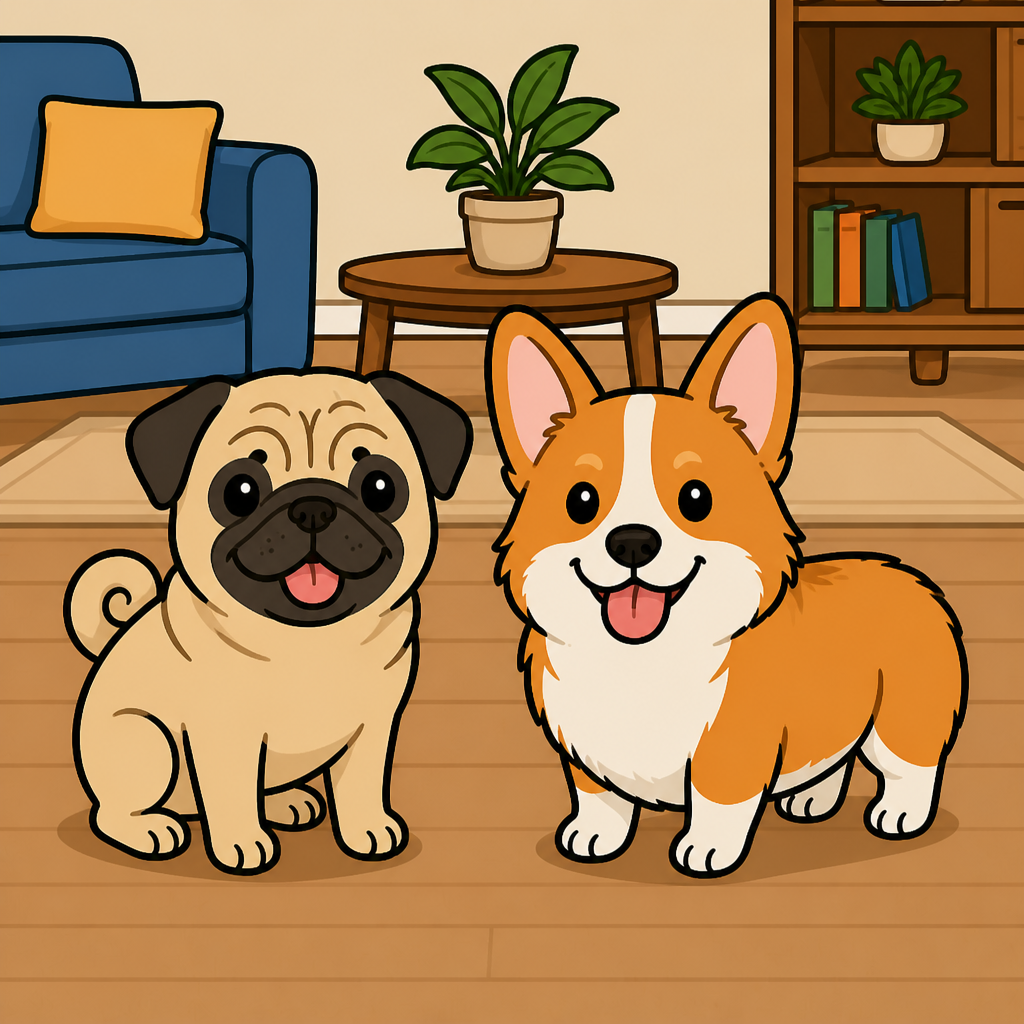
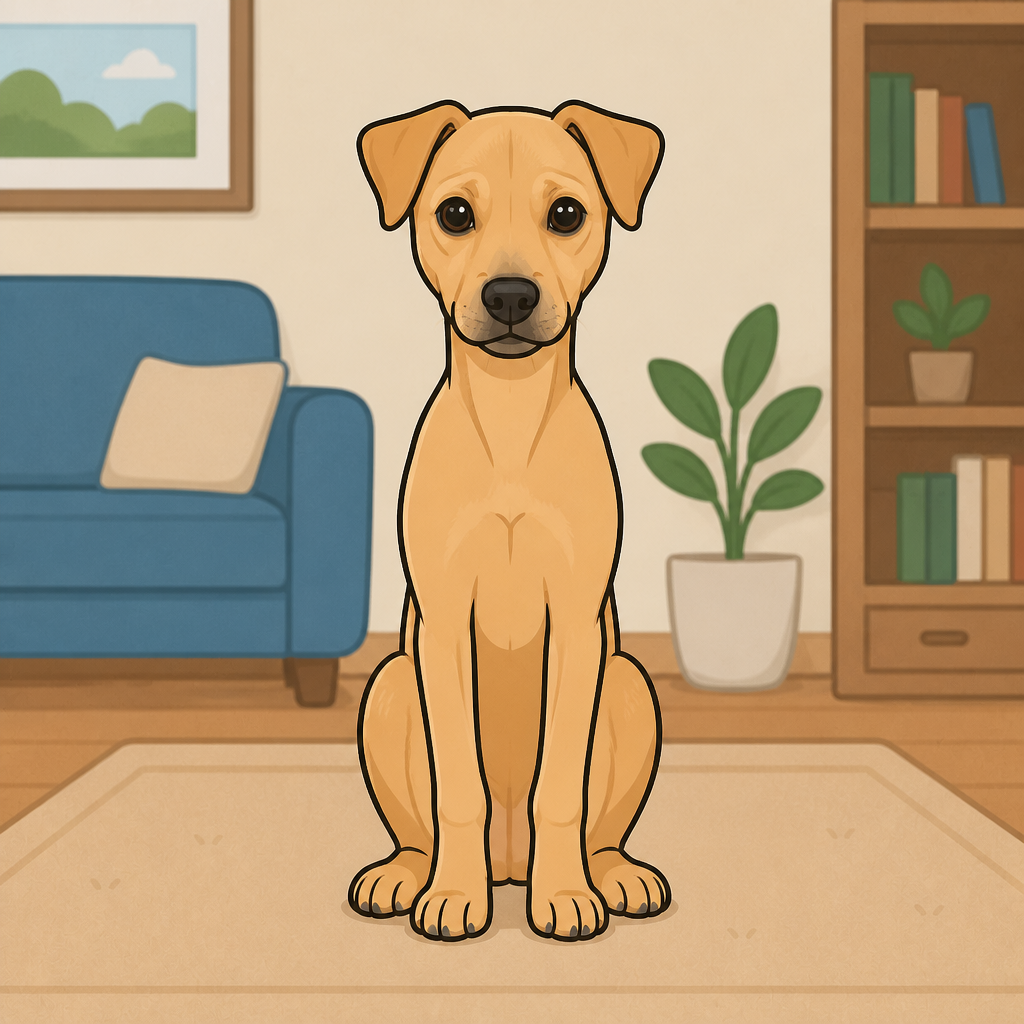
| A | 你兩隻狗係咩狗嚟㗎? nei5 loeng5 zek3 gau2 hai6 me1 gau2 lai4 gaa3? What breed are your two dogs? |
| B | 一隻就係八哥嚟嘅,一隻就係哥基嚟嘅。 jat1 zek3 zau6 hai6 baat3 go1 lai4 ge3, jat1 zek3 zau6 hai6 go1 gei1 lai4 ge3. One of them is a Pug. One of them is a Corgi. |
1.
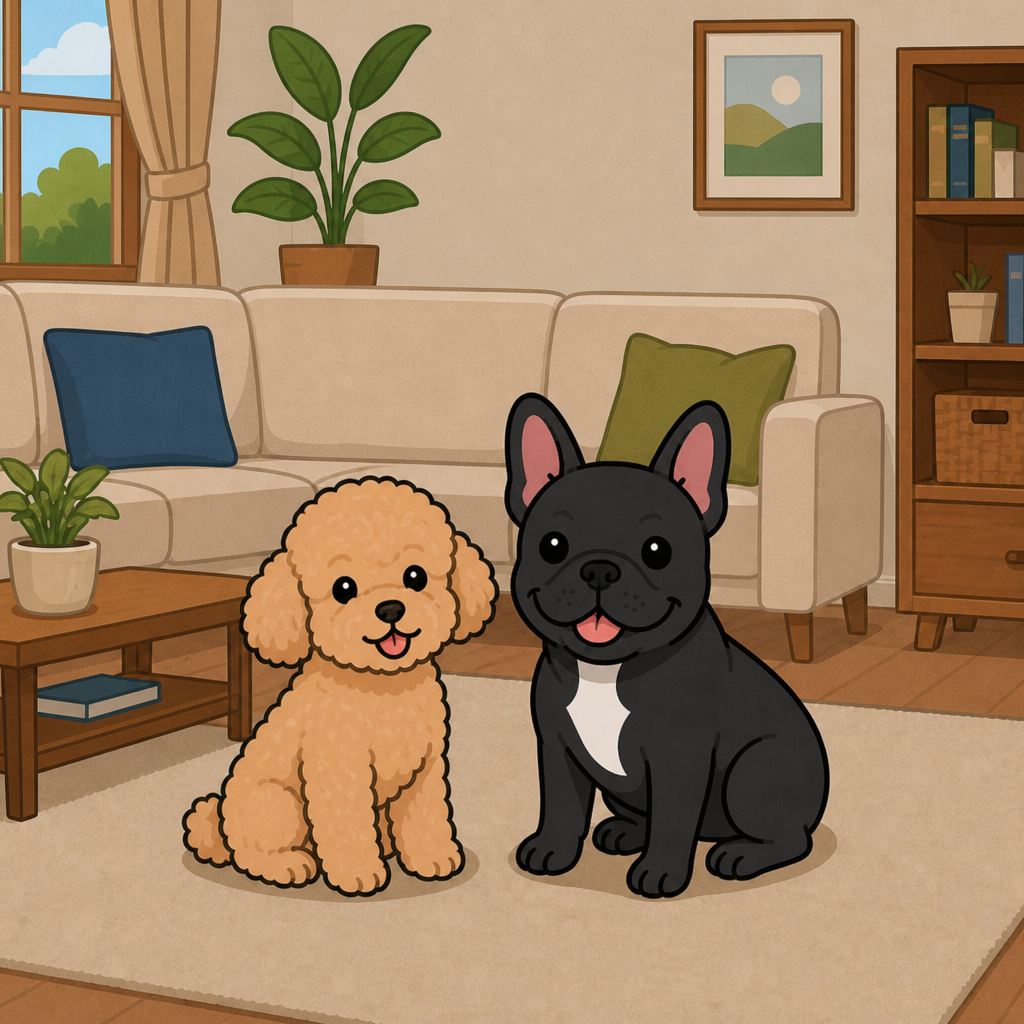
| A | ________ |
| B | ________ |
2.
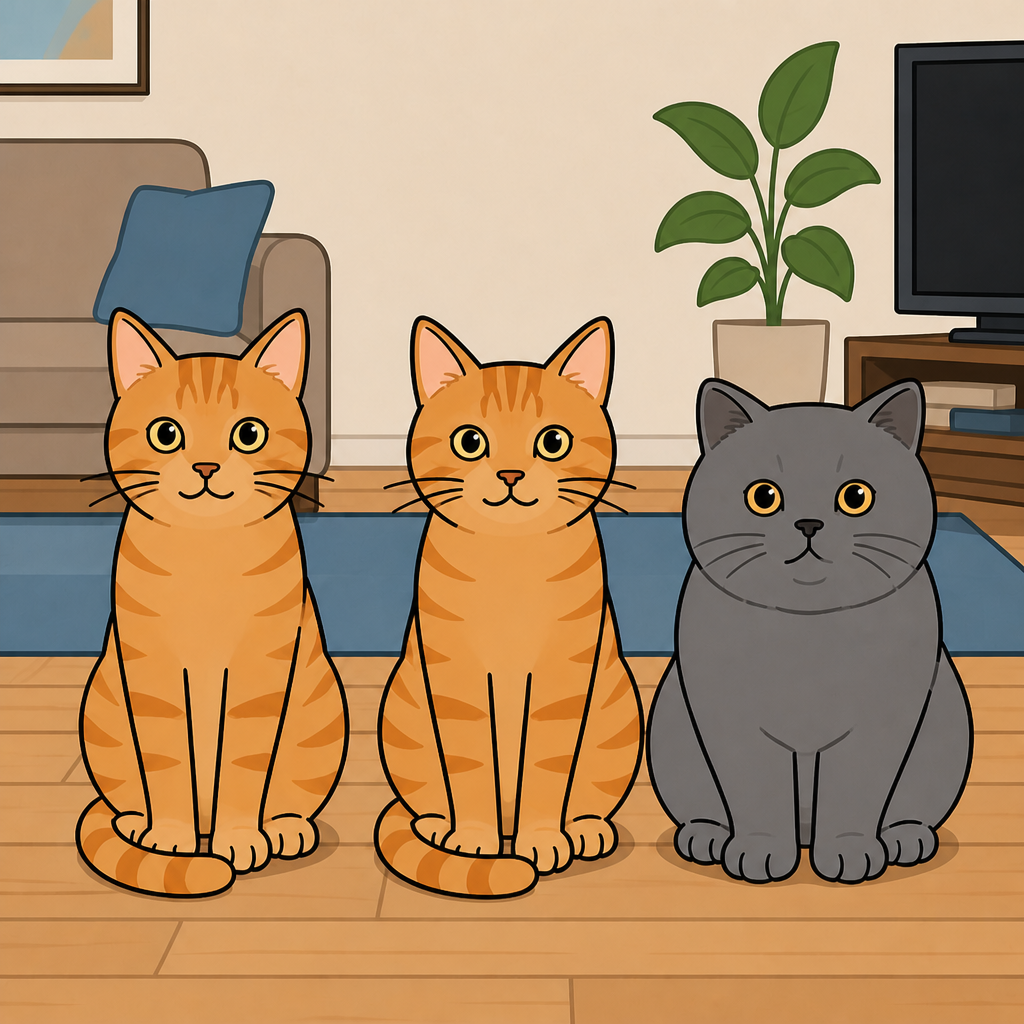
| A | ________ |
| B | ________ |
3.
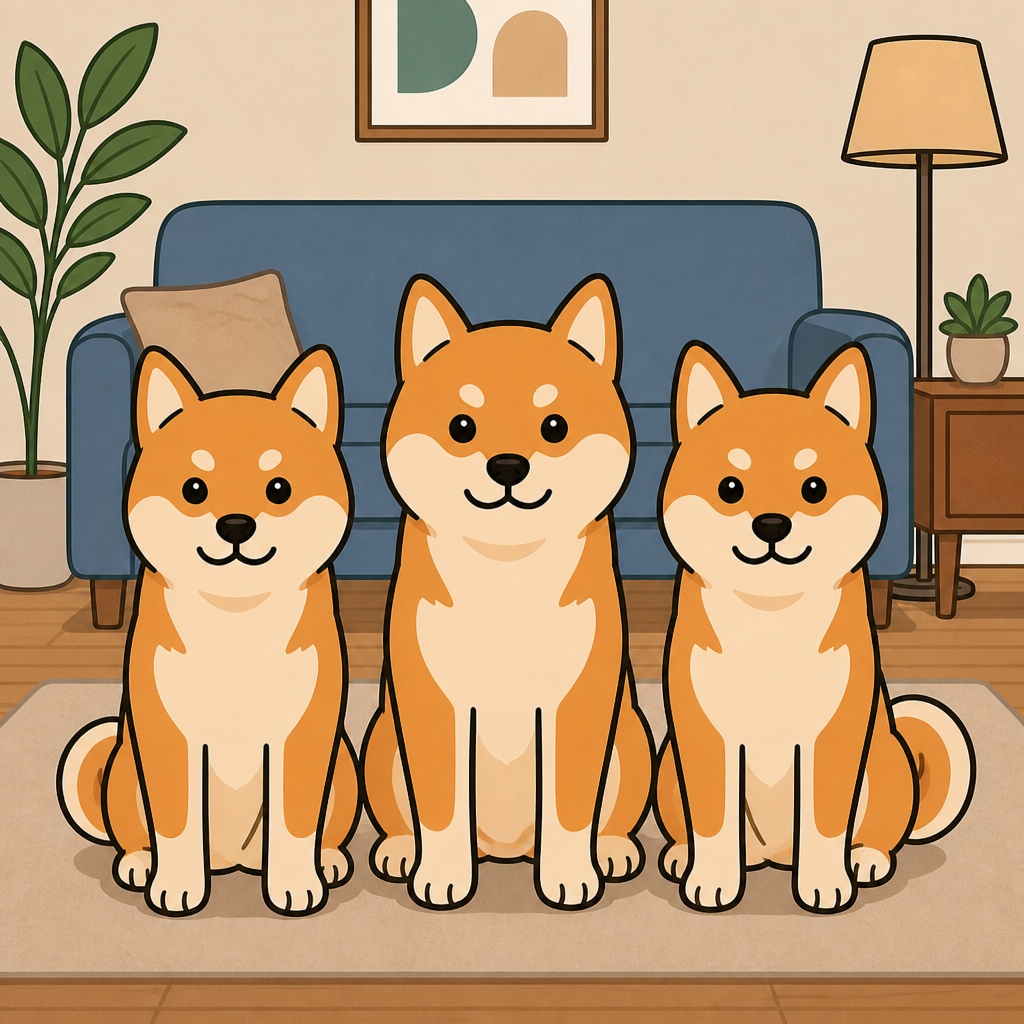
| A | ________ |
| B | ________ |
4.
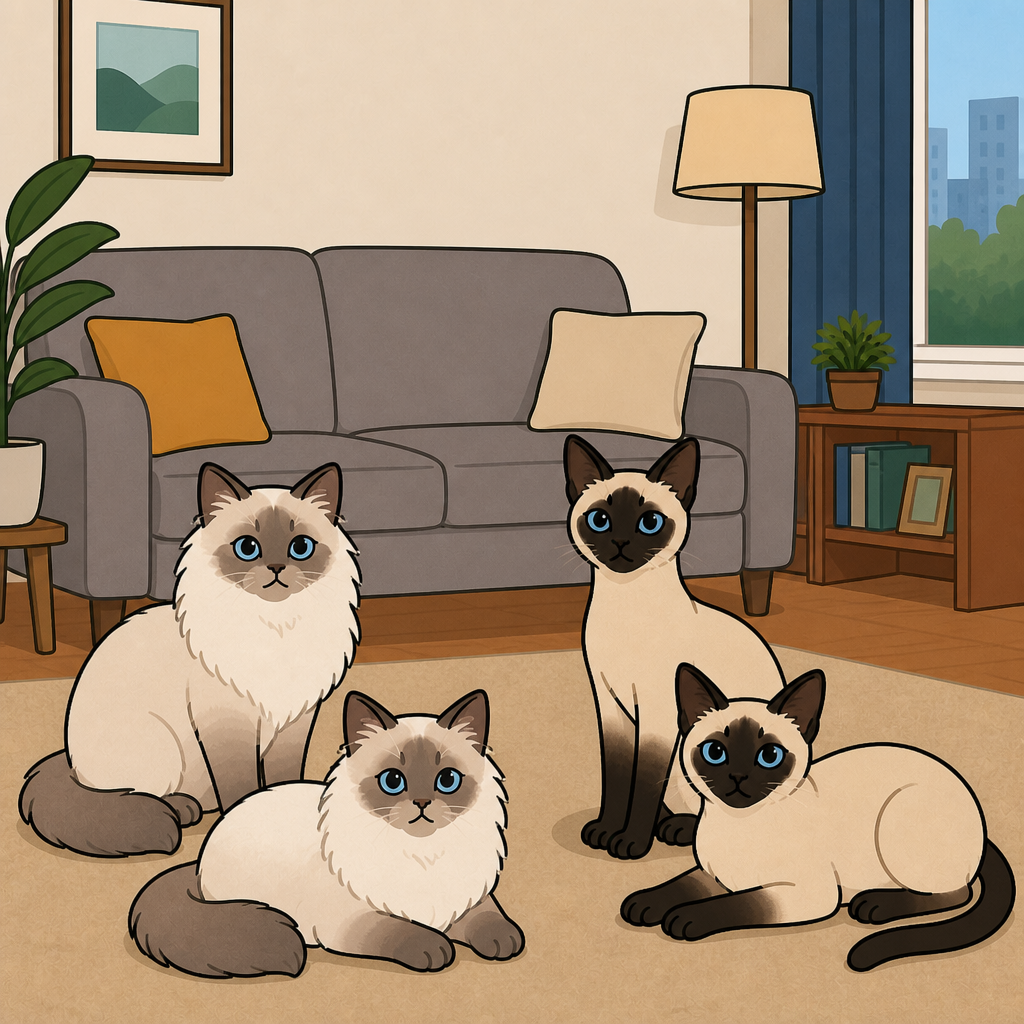
| A | ________ |
| B | ________ |
5.
| A | ________ |
| B | ________ |
Activities
Activity 1
Listen to two conversations. The speakers will talk about their families. Complete the notes on the family photos. Each blank represents one syllable.
Conversation 1
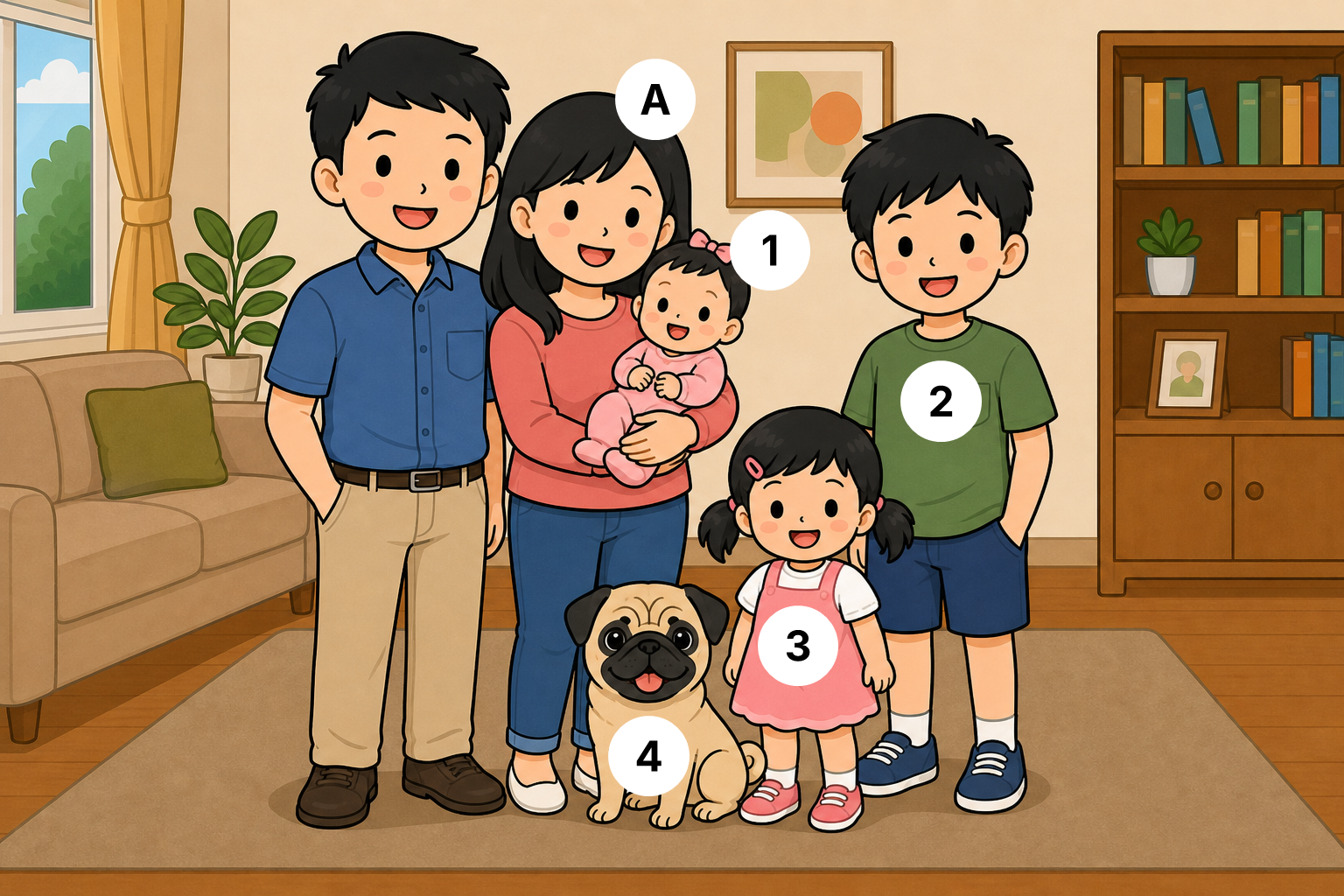
| 1. | 佢 ____ ____ ____ 大 keoi5 ____ ____ ____ daai6 |
| 2. | 佢 ____ ____ 歲 keoi5 ____ ____ seoi3 |
| 3. | 佢 ____ ____ 三歲 keoi5 ____ ____ saam1 seoi3 |
| 4. | 佢係 ____ ____ 嚟嘅 keoi5 hai6 ____ ____ lai4 ge3 |
| A | |
| B | |
| A | |
| B | |
| A | |
| B | |
| A | |
| B | |
| A | |
| B | |
| A |
Conversation 2
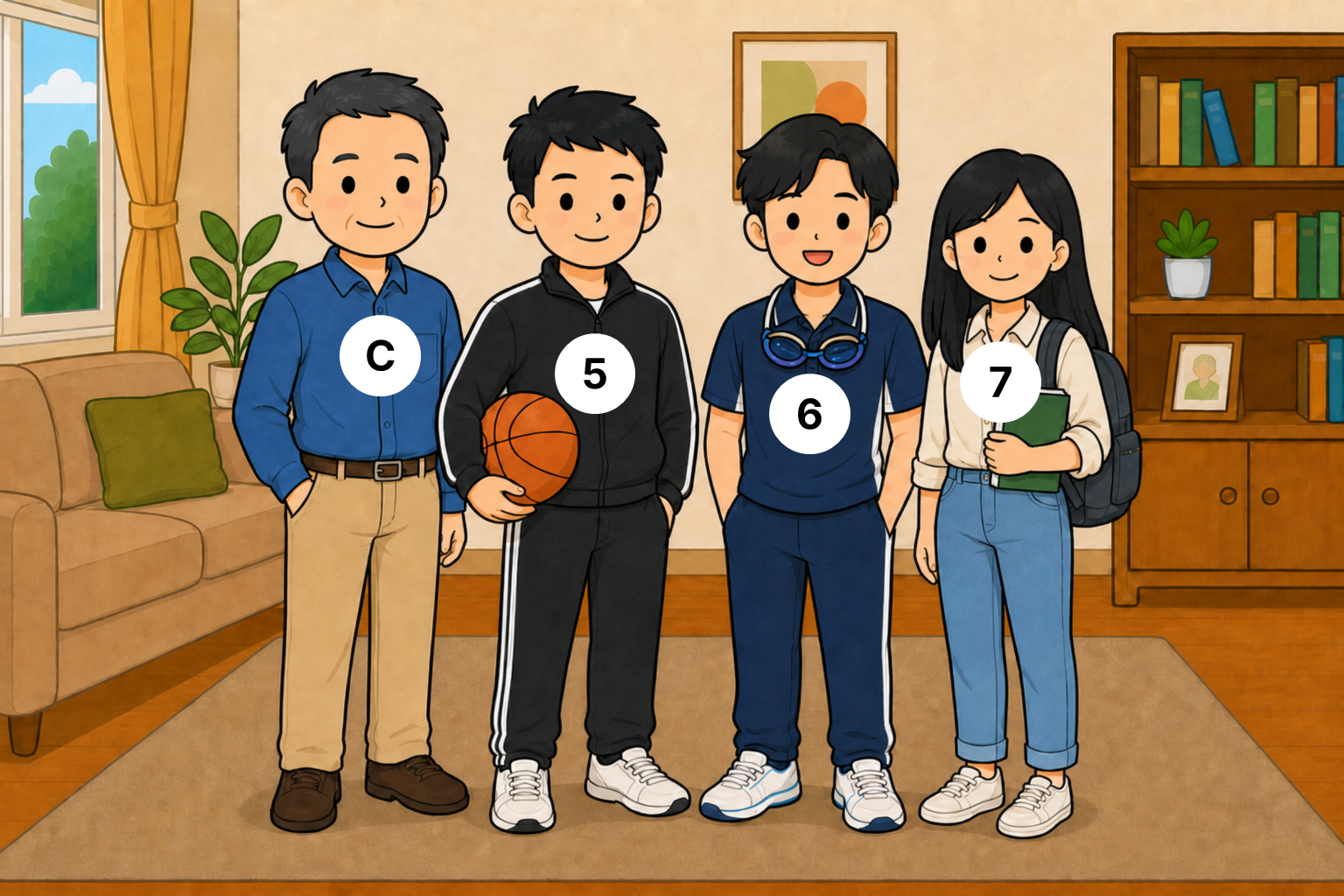
| 5. | 佢做緊籃球教練 keoi5 zou6 gan2 laam4 kau4 gaau3 lin6 |
| 6. | 佢做緊 ____ ____ ____ ____ keoi5 zou6 gan2 ____ ____ ____ ____ |
| 7. | 佢喺 ____ ____ 讀緊 ____ ____ keoi5 hai2 ____ ____ duk6 gan2 ____ ____ |
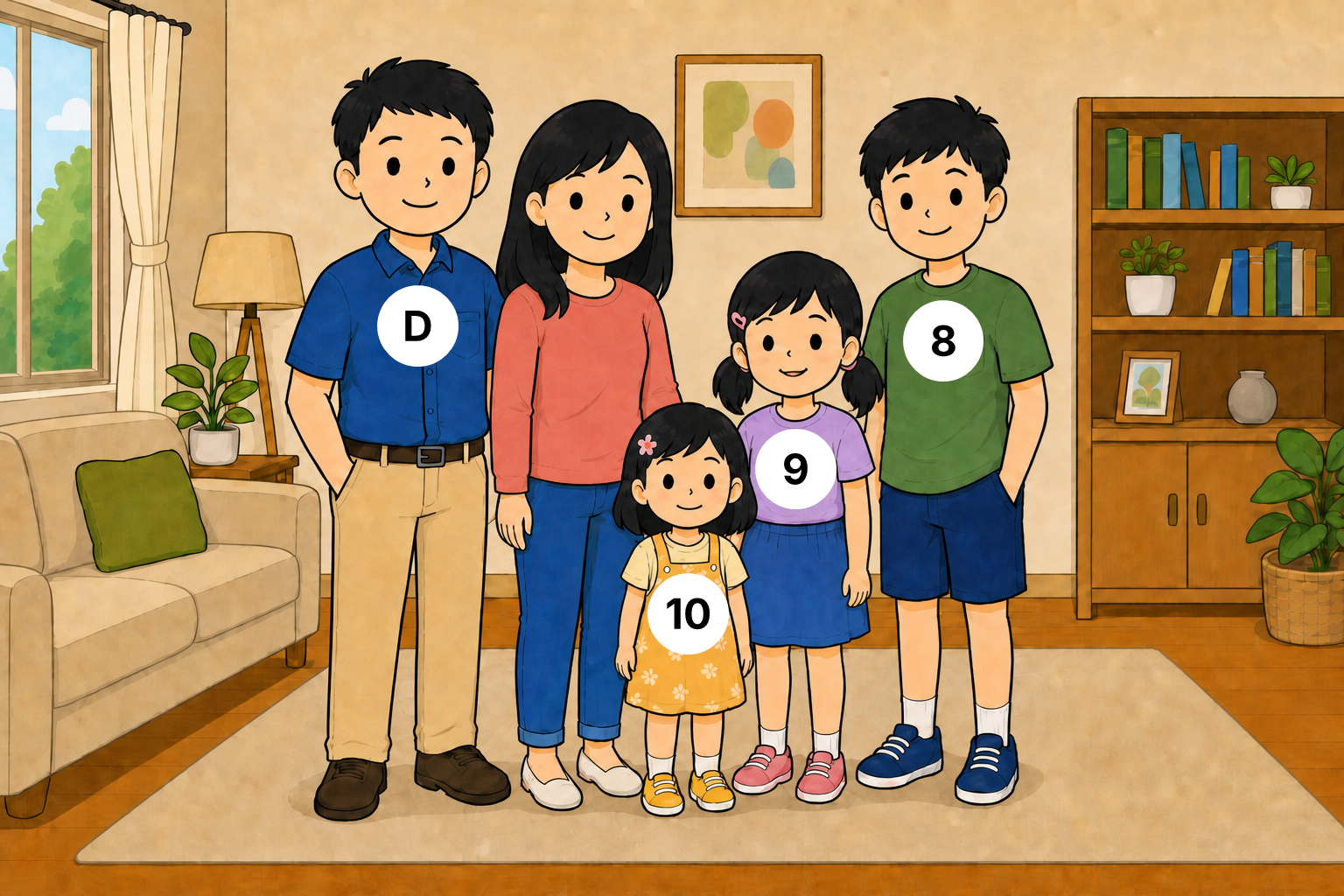
| 8. | 佢讀緊 ____ ____ keoi5 duk6 gan2 ____ ____ |
| 9. | 佢讀緊小學 ____ ____ ____ keoi5 duk6 gan2 siu2 hok6 ____ ____ ____ |
| 10. | 佢讀緊 ____ ____ ____ ____ ____ keoi5 duk6 gan2 ____ ____ ____ ____ ____ |
| C | |
| D | |
| C | |
(Silence) | |
| C | |
| D | |
| C | |
| D | |
| C | |
| D | |
| C | |
| D | |
| C | |
| D | |
| C |
Transcripts with Translation
Conversation 1
| A | 你結咗婚未㗎? nei5 git3 zo2 fan1 mei6 gaa3? Have you gotten married yet? [= Are you married yet?] |
| B | 結咗喇。 git3 zo2 laa3. Yes already. |
| A | 噉你有冇生小朋友㗎? gam2 nei5 jau5 mou5 saang1 siu2 pang4 jau5 gaa3? Then, do you give birth to children? [= Do you have children?] |
| B | 有呀,我有三個仔女嘅。 jau5 aa3, ngo5 jau5 saam1 go3 zai2 neoi2 ge3. Yes, I have three children. |
| A | 佢哋幾多歲呀? keoi5 dei6 gei2 do1 seoi3 aa3? How old are they? |
| B | 我個仔就十二歲,我個大女就差唔多三歲,我個細女就六個月大。 ngo5 go3 zai2 zau6 sap6 ji6 seoi3, ngo5 go3 daai6 neoi2 zau6 caa1 m4 do1 saam1 seoi3, ngo5 go3 sai3 neoi2 zau6 luk6 go3 jyut6 daai6. My son is 12 years old. My older daughter is almost 3 years old. My younger daughter is 6 months old. |
| A | 噉你哋有冇養寵物㗎? gam2 nei5 dei6 jau5 mou5 joeng5 cung2 mat6 gaa3? Then, do you keep pets? |
| B | 有呀,我哋有一隻狗嘅。 jau5 aa3, ngo5 dei6 jau5 jat1 zek3 gau2 ge3. Yes, we have one dog. |
| A | 噉你哋隻狗係咩狗嚟㗎? gam2 nei5 dei6 zek3 gau2 hai6 me1 gau2 lai4 gaa3? Then, what breed is your dog? |
| B | 我哋隻狗係八哥嚟嘅。 ngo5 dei6 zek3 gau2 hai6 baat3 go1 lai4 ge3. Our dog is a Pug. |
| A | 八哥?我隻狗都係八哥嚟㗎! baat3 go1? ngo5 zek3 gau2 dou1 hai6 baat3 go1 lai4 gaa3! Pug? My dog is a Pug too! |
Conversation 2
| C | 你結咗婚未㗎? nei5 git3 zo2 fan1 mei6 gaa3? Have you gotten married yet? [= Are you married yet?] |
| D | 結咗喇。你呢?你有冇結婚㗎? git3 zo2 laa3. nei5 ne1? nei5 jau5 mou5 git3 fan1 gaa3? Yes already. How about you? Do you get married? [= Are you married?] |
| C | 有呀,不過我太太二零年走咗喇。 jau5 aa3, bat1 gwo3 ngo5 taai3 taai2 ji6 ling4 nin4 zau2 zo2 laa3. Yes, but my wife already passed away in 2020. 走 zau2 usually means ‘to leave’, but it is used as a euphemism here to mean ‘to pass away’. |
(Silence) | |
| C | 噉你哋有冇生小朋友㗎? gam2 nei5 dei6 jau5 mou5 saang1 siu2 pang4 jau5 gaa3? Then, do you give birth to children? [= Do you have children?] |
| D | 有呀,我哋有三個細路嘅。 jau5 aa3, ngo5 dei6 jau5 saam1 go3 sai3 lou6 ge3. Yes, we have three children. |
| C | 佢哋而家幾大呀? keoi5 dei6 ji4 gaa1 gei2 daai6 aa3? How old are they now? |
| D | 一個就讀緊中一,一個就讀緊小學三年班,一個就讀緊幼稚園高班。你呢?你有冇仔女㗎? jat1 go3 zau6 duk6 gan2 zung1 jat1, jat1 go3 zau6 duk6 gan2 siu2 hok6 saam1 nin4 baan1, jat1 go3 zau6 duk6 gan2 jau3 zi6 jyun2 gou1 baan1. nei5 ne1? nei5 jau5 mou5 zai2 neoi2 gaa3? One of them is studying Secondary 1. One of them is studying Primary 3. One of them is studying Upper Class at kindergarten. How about you? Do you have children? |
| C | 有呀,我有兩個仔同一個女嘅。 jau5 aa3, ngo5 jau5 loeng5 go3 zai2 tung4 jat1 go3 neoi2 ge3. Yes, I have two sons and one daughter. |
| D | 佢哋做緊嘢定讀緊書㗎? keoi5 dei6 zou6 gan2 je5 ding6 duk6 gan2 syu1 gaa3? Are they working or studying? |
| C | 我個女就仲讀緊大學,我兩個仔就做緊嘢喇。 ngo5 go3 neoi2 zau6 zung6 duk6 gan2 daai6 hok6, ngo5 loeng5 go3 zai2 zau6 zou6 gan2 je5 laa3. My daughter is still studying at university. My two sons are already working. |
| D | 噉你兩個仔做咩㗎? gam2 nei5 loeng5 go3 zai2 zou6 me1 gaa3? Then, what do your two sons do? |
| C | 我兩個仔都係教練嚟嘅,一個就教籃球嘅,一個就教游水嘅。 ngo5 loeng5 go3 zai2 dou1 hai6 gaau3 lin6 lai4 ge3, jat1 go3 zau6 gaau3 laam4 kau4 ge3, jat1 go3 zau6 gaau3 jau4 seoi2 ge3. Both of my two sons are coaches. One of them teaches basketball. One of them teaches swimming. |
| D | 噉你個女喺邊度讀㗎? gam2 nei5 go3 neoi2 hai2 bin1 dou6 duk6 gaa3? Then, where does your daughter study? [= Which school does your daughter study at?] |
| C | 佢讀港大嘅,讀緊工程。 keoi5 duk6 gong2 daai6 ge3, duk6 gan2 gung1 cing4. She studies at the University of Hong Kong. She is studying engineering. |
Activity 2
Form a pair. Use the notes below to complete two conversations. Swap your roles after the first conversation.
Conversation 1
| A | 你結咗婚未㗎? nei5 git3 zo2 fan1 mei6 gaa3? |
| B | ________,你呢?你有冇結婚㗎? ________, nei5 ne1? nei5 jau5 mou5 git3 fan1 gaa3? |
| A | ________。噉你有冇生小朋友㗎? ________. gam2 nei5 jau5 mou5 saang1 siu2 pang4 jau5 gaa3? |
| B | ________。 ________. |
________。 ________. | |
| A | 佢哋幾大呀? keoi5 dei6 gei2 daai6 aa3? |
| B | ________。 ________. |
________。 ________. | |
你呢?你有冇仔女㗎? nei5 ne1? nei5 jau5 mou5 zai2 neoi2 gaa3? | |
| A | ________。 ________. |
________。 ________. | |
| B | 佢哋做緊嘢定讀緊書㗎? keoi5 dei6 zou6 gan2 je5 ding6 duk6 gan2 syu1 gaa3? |
| A | ________。 ________. |
| B | 噉佢哋做緊咩㗎? gam2 keoi5 dei6 zou6 gan2 me1 gaa3? |
| A | ________。 ________. |
________。 ________. | |
| B | 噉佢哋今年幾多歲呀? gam2 keoi5 dei6 gam1 nin4 gei2 do1 seoi3 aa3? |
| A | ________。 ________. |
________。 ________. | |
| B | 你哋有冇養寵物㗎? nei5 dei6 jau5 mou5 joeng5 cung2 mat6 gaa3? |
| A | ________。 ________. |
| B | 噉你哋兩隻貓係咩貓嚟㗎? gam2 nei5 dei6 loeng5 zek3 maau1 hai6 me1 maau1 lai4 gaa3? |
| A | ________。 ________. |
你哋呢?你哋有冇養寵物㗎? nei5 dei6 ne1? nei5 dei6 jau5 mou5 joeng5 cung2 mat6 gaa3? | |
| B | ________。 ________. |
| A | 噉你哋兩隻狗係咩狗嚟㗎? gam2 nei5 dei6 loeng5 zek3 gau2 hai6 me1 gau2 lai4 gaa3? |
| B | ________。 ________. |
Conversation 2
| A | 你結咗婚未㗎? nei5 git3 zo2 fan1 mei6 gaa3? |
| B | ________,你呢?你有冇結婚㗎? ________, nei5 ne1? nei5 jau5 mou5 git3 fan1 gaa3? |
| A | ________。噉你有冇生小朋友㗎? ________. gam2 nei5 jau5 mou5 saang1 siu2 pang4 jau5 gaa3? |
| B | ________。 ________. |
________。 ________. | |
| A | 佢哋幾大呀? keoi5 dei6 gei2 daai6 aa3? |
| B | ________。 ________. |
________。 ________. | |
你呢?你有冇仔女㗎? nei5 ne1? nei5 jau5 mou5 zai2 neoi2 gaa3? | |
| A | ________。 ________. |
| B | 佢哋做緊嘢定讀緊書㗎? keoi5 dei6 zou6 gan2 je5 ding6 duk6 gan2 syu1 gaa3? |
| A | ________。 ________. |
| B | 噉佢哋做緊咩㗎? gam2 keoi5 dei6 zou6 gan2 me1 gaa3? |
| A | ________。 ________. |
________。 ________. | |
| B | 噉佢哋今年幾多歲呀? gam2 keoi5 dei6 gam1 nin4 gei2 do1 seoi3 aa3? |
| A | ________。 ________. |
________。 ________. | |
| B | 你哋有冇養寵物㗎? nei5 dei6 jau5 mou5 joeng5 cung2 mat6 gaa3? |
| A | ________。 ________. |
| B | 噉你哋兩隻貓係咩貓嚟㗎? gam2 nei5 dei6 loeng5 zek3 maau1 hai6 me1 maau1 lai4 gaa3? |
| A | ________。 ________. |
你哋呢?你哋有冇養寵物㗎? nei5 dei6 ne1? nei5 dei6 jau5 mou5 joeng5 cung2 mat6 gaa3? | |
| B | ________。 ________. |
| A | 噉你哋兩隻狗係咩狗嚟㗎? gam2 nei5 dei6 loeng5 zek3 gau2 hai6 me1 gau2 lai4 gaa3? |
| B | ________。 ________. |
Activity 3
Form a pair. Talk about: