Print or Export
Pronunciation Lesson 1
1. How to Learn a Sound
Follow these two steps to learn each sound:
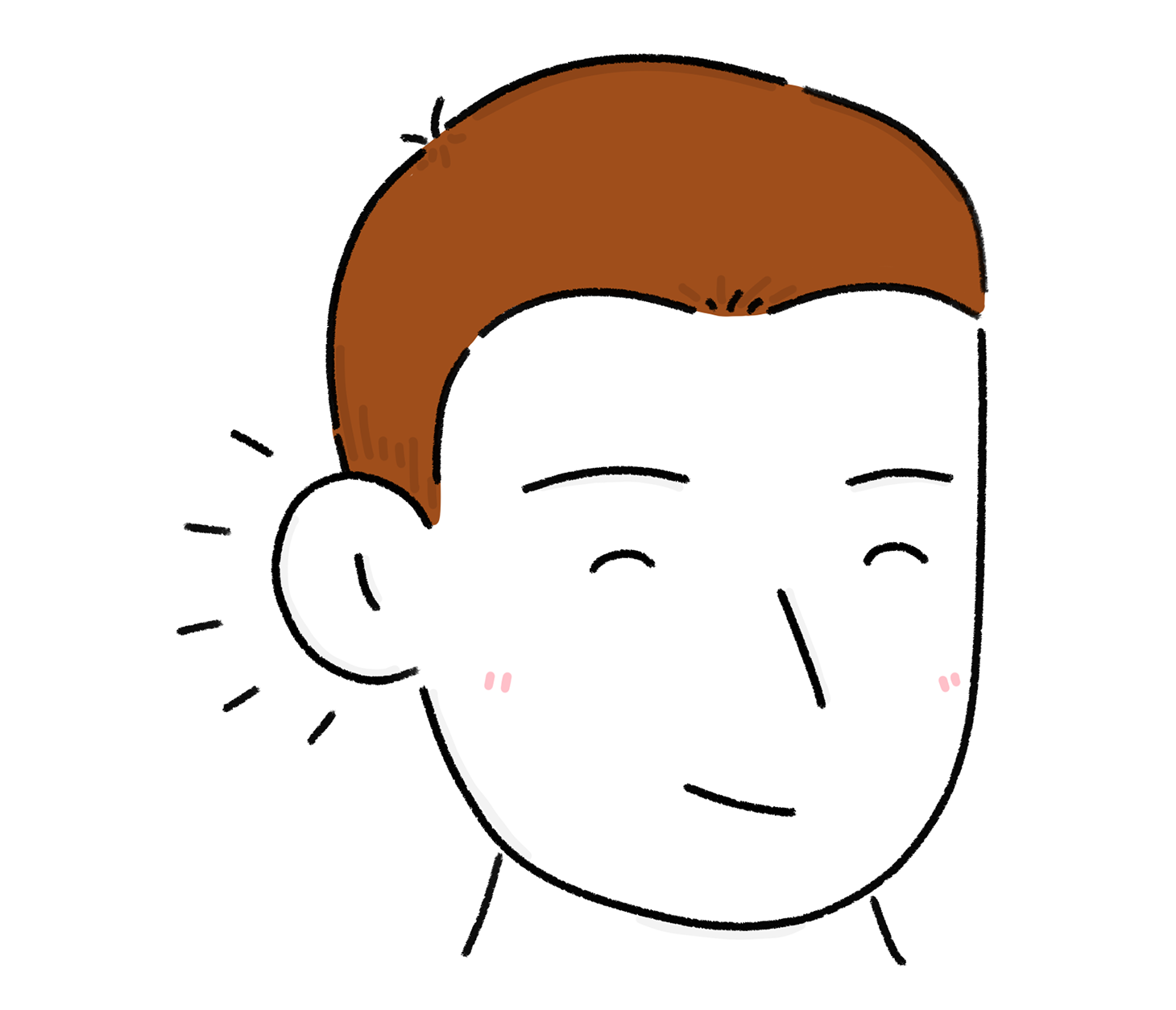
Step 1 👂
Listen to the sound.
Don't rush to say the sound aloud in this step. Just listen carefully and pay attention to how the sound actually sounds like.
Step 2 👄
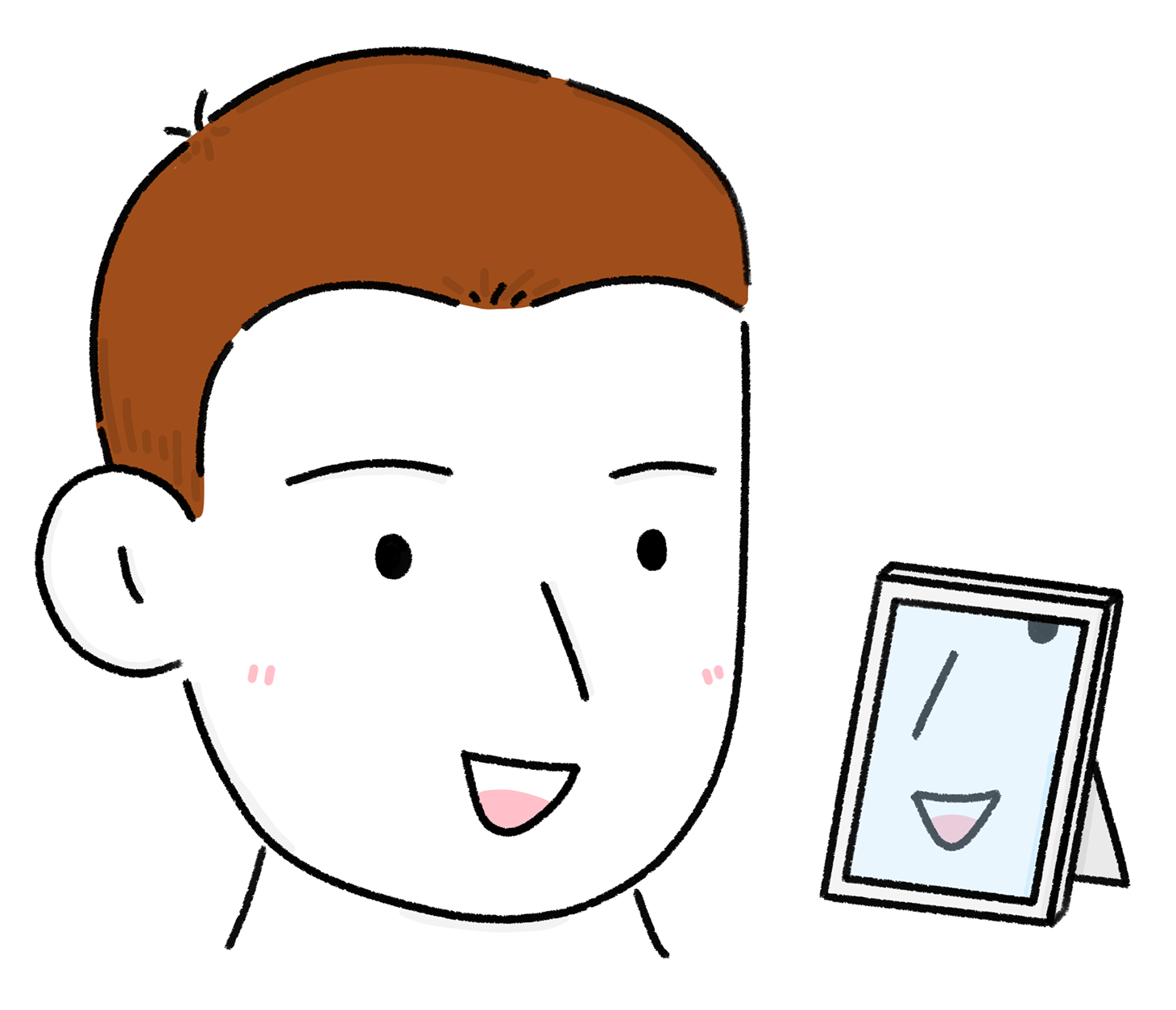
Practice saying the sound aloud.
You will see pictures which show the tongue position and lip shape for the sound. Move your tongue and lips accordingly. Use a mirror to check your mouth shape if needed.
2. The Final aa
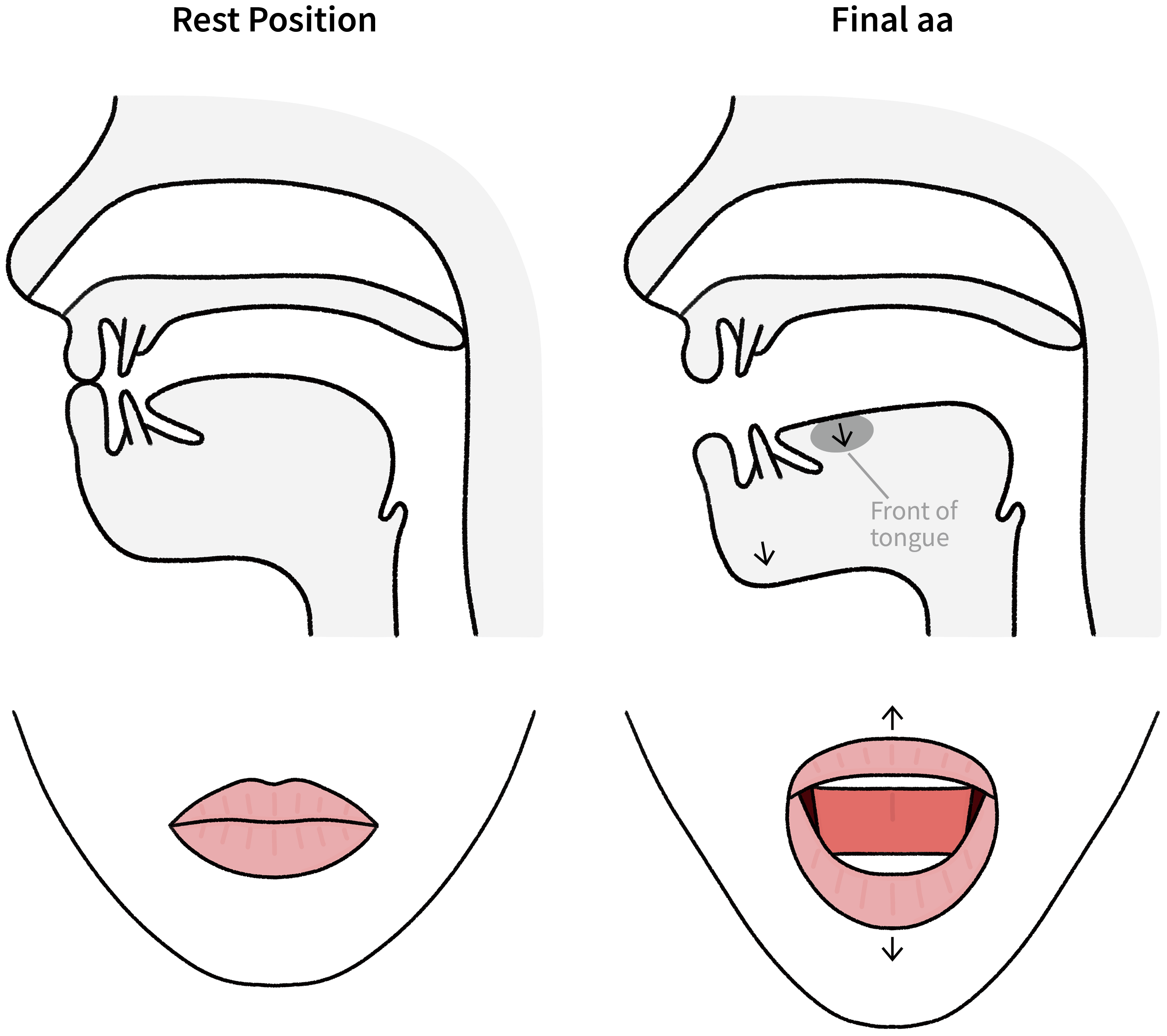
The final aa is formed by the vowel aa alone. Note that although the final aa is written down as two aʼs, it is one single sound.
Step 1 Listen to the final aa.
aa
Step 2 Listen and repeat. Pay attention to your mouth shape. Use a mirror to check it if needed.
aa
Tongue Position: Open your mouth widely by lowering your lower jaw. Lower the front of your tongue.
Lip Shape: Relax your lips. Avoid rounding or spreading them.
3. Initial Pairs
Cantonese has the following five initial pairs.
b p
d t
g k
z c
gw kw
Each initial pair consists of two initials which are produced with exactly the same parts of our mouth. The two initials only differ in whether it is unaspirated or aspirated.
| Unaspirated | Aspirated 💨 |
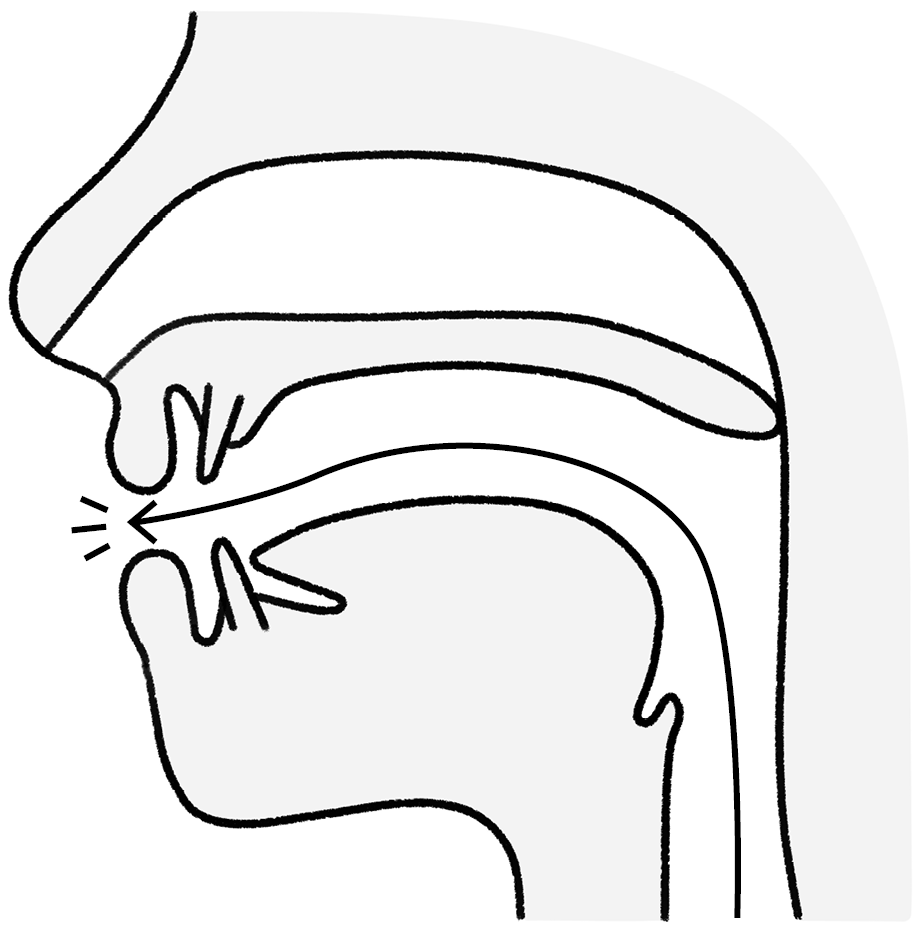 When we say an unaspirated initial, only a small amount of air is emitted from our mouth. When we say an unaspirated initial, only a small amount of air is emitted from our mouth. | 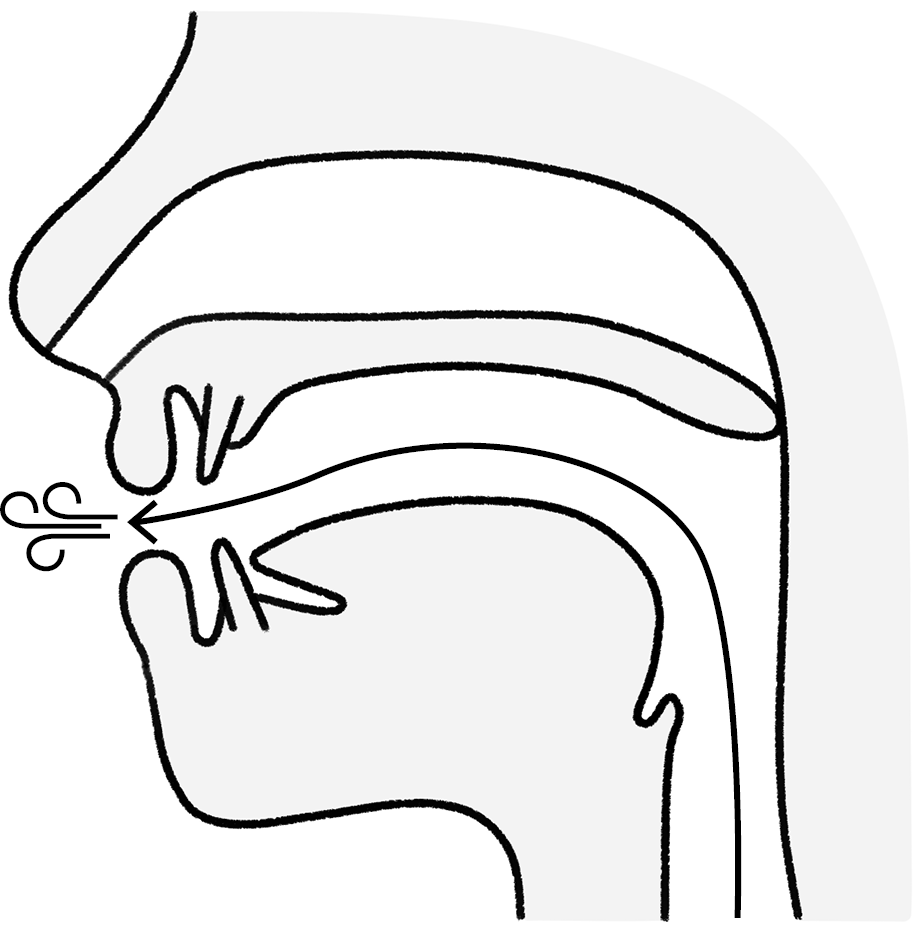 When we say an aspirated initial, a large amount of air is emitted from our mouth. The air creates a noticeable sound of breathing out. When we say an aspirated initial, a large amount of air is emitted from our mouth. The air creates a noticeable sound of breathing out. |
Listen to the initial pairs. In each pair, the first initial is unaspirated, and the second initial is aspirated.
💡 Tips
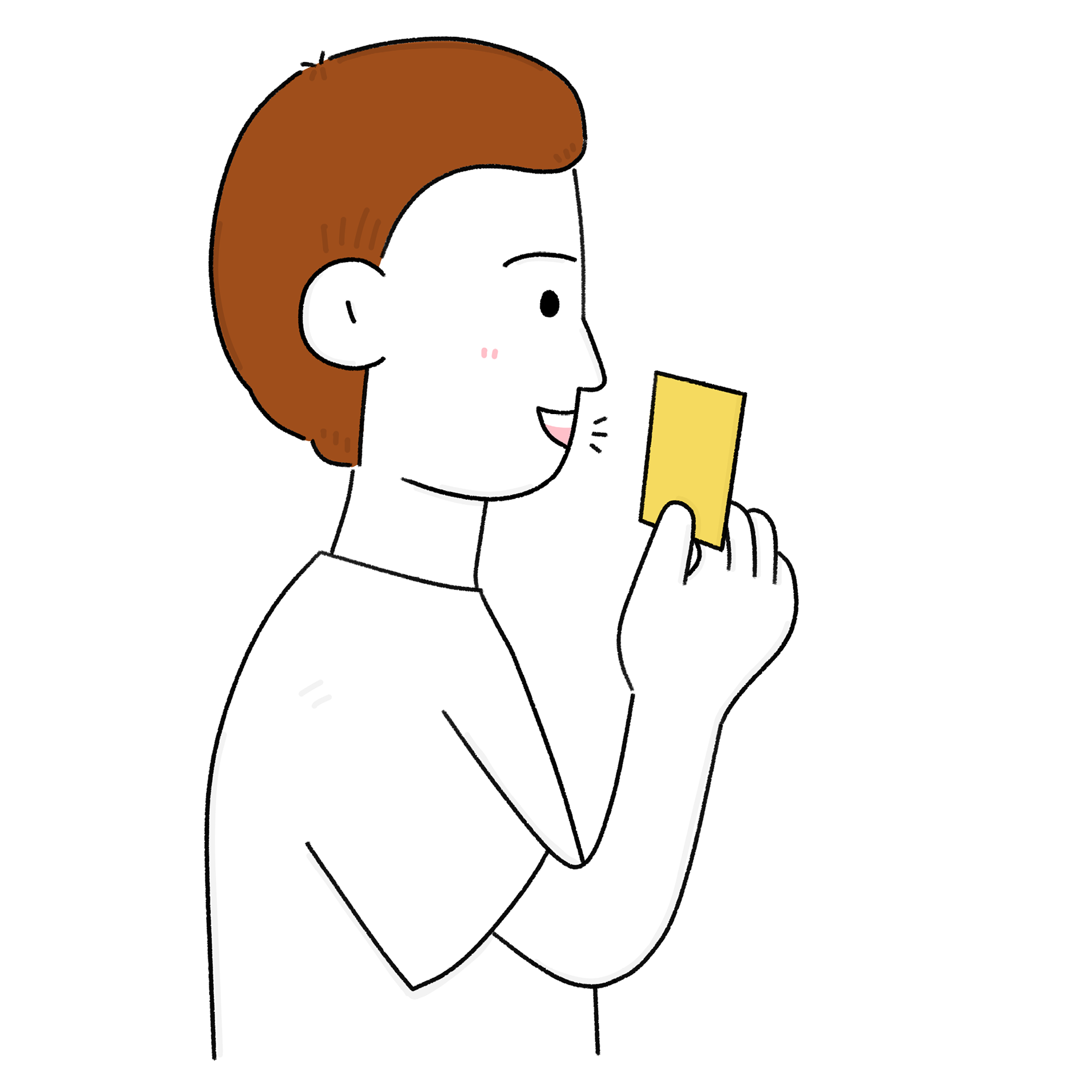
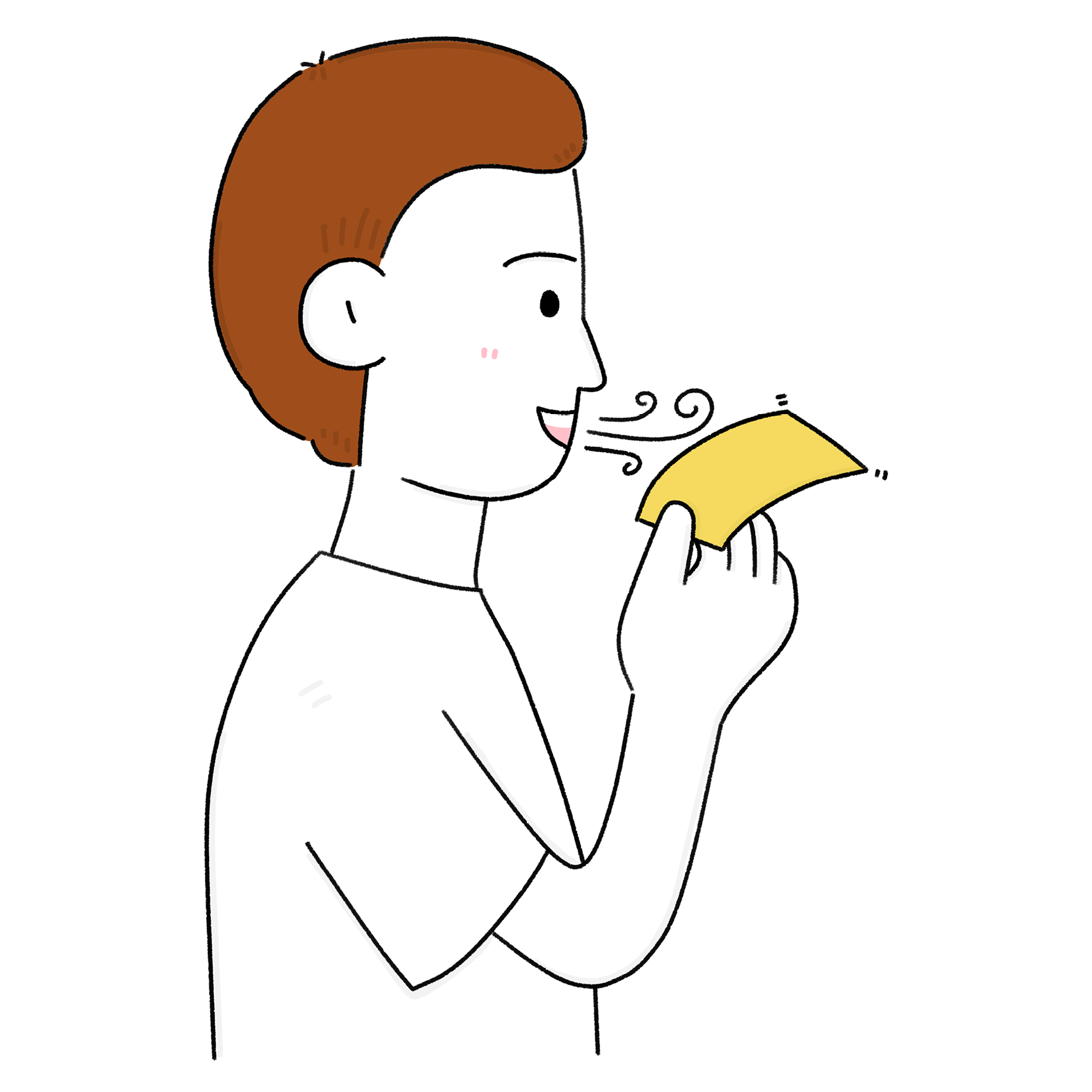
You can check whether you say an unaspirated or aspirated initial correctly using the following trick. Place a small piece of paper closely in front of your mouth and then say the initial.
When an unaspirated initial is produced, the air emitted can barely move the paper.
When an aspirated initial is produced, the air emitted should be strong enough to move the paper.
4. The Initial Pair b and p
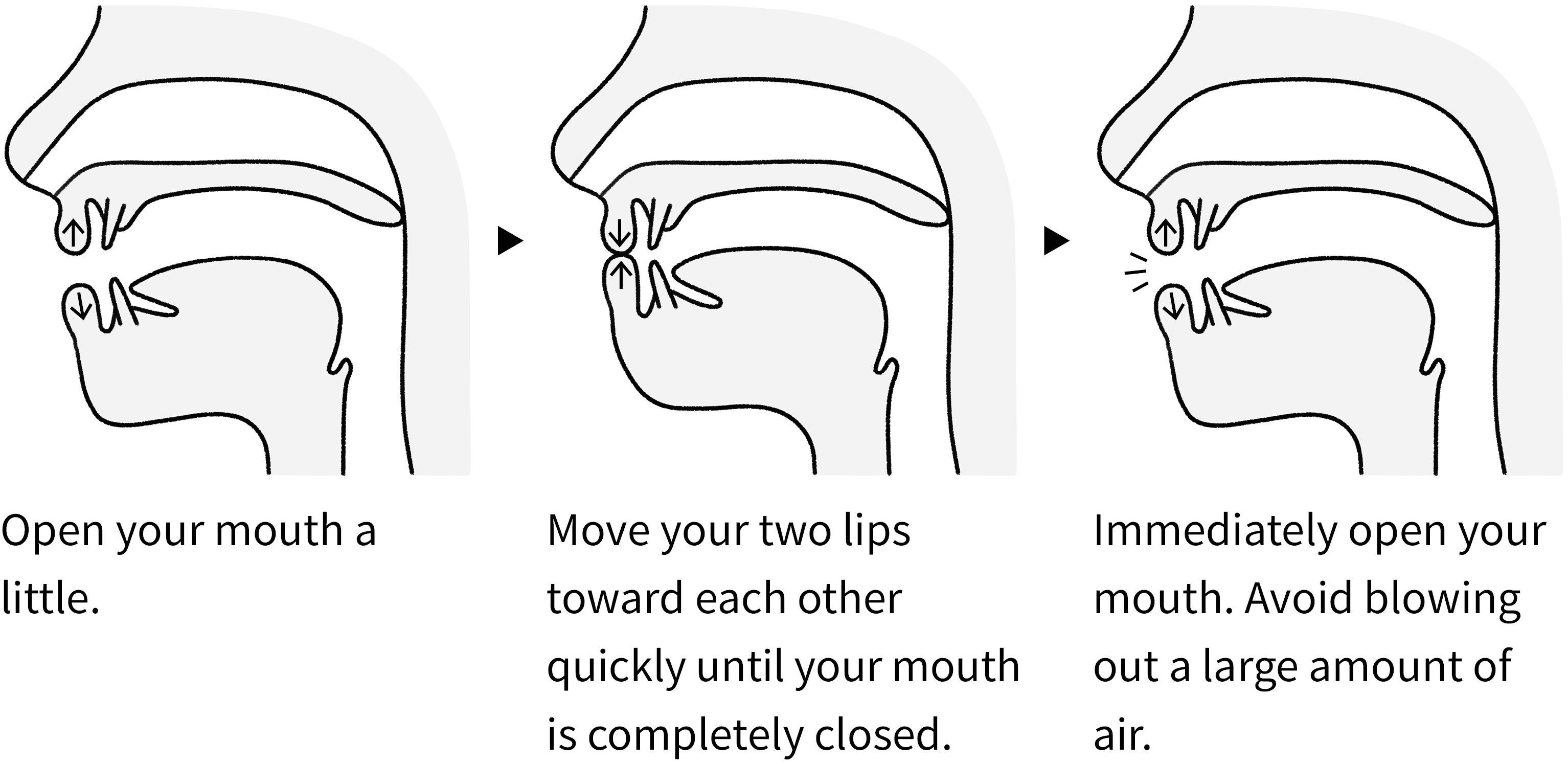
The Initial b
Step 1 Listen to the initial b.
b
Step 2 Listen and repeat.
b
The Initial p
Step 1 Listen to the initial p.
p
Step 2 Listen and repeat.
p
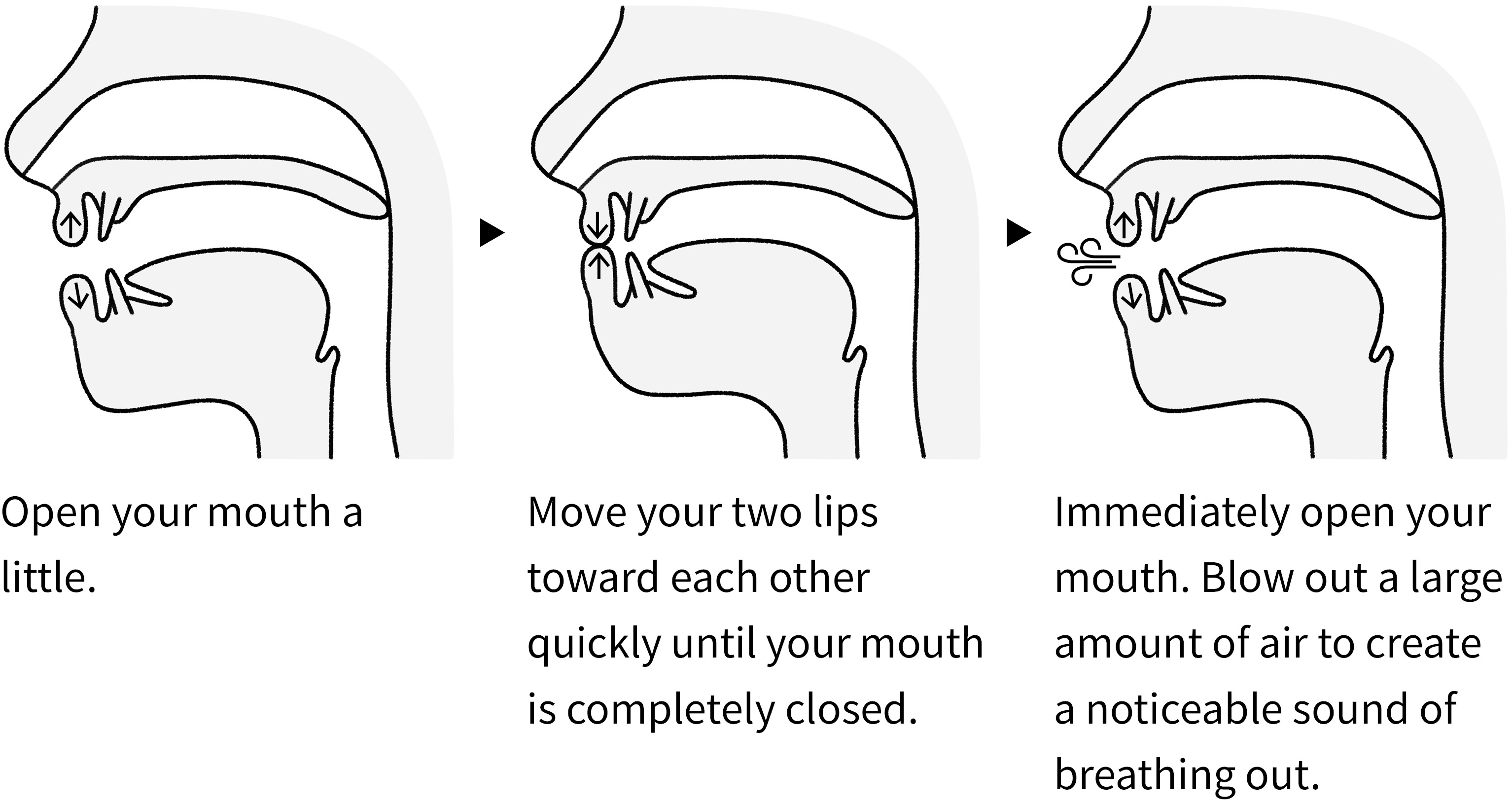
Practice Practice saying the initials b and p with the final aa. Listen and repeat.
- b ‒ aa ‒ baa1
- p ‒ aa ‒ paa1
- baa1 paa1
5. The Initial Pair d and t
The Initial d
Step 1 Listen to the initial d.
d
Step 2 Listen and repeat.
d
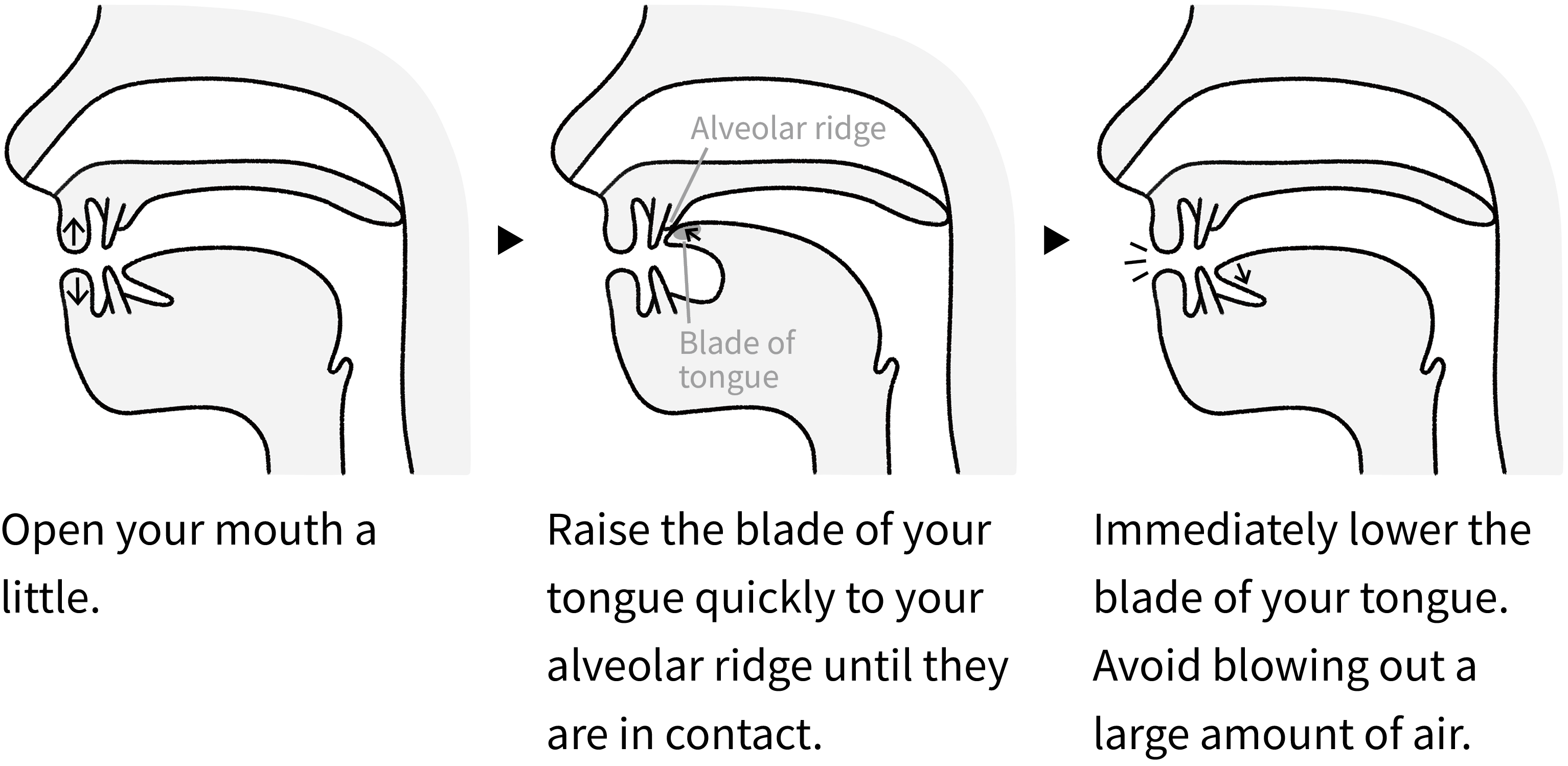
Blade of tongue: The flat part just behind your tongue tip
Alveolar ridge: The small ridge just behind your upper front teeth
The Initial t
Step 1 Listen to the initial t.
t
Step 2 Listen and repeat.
t
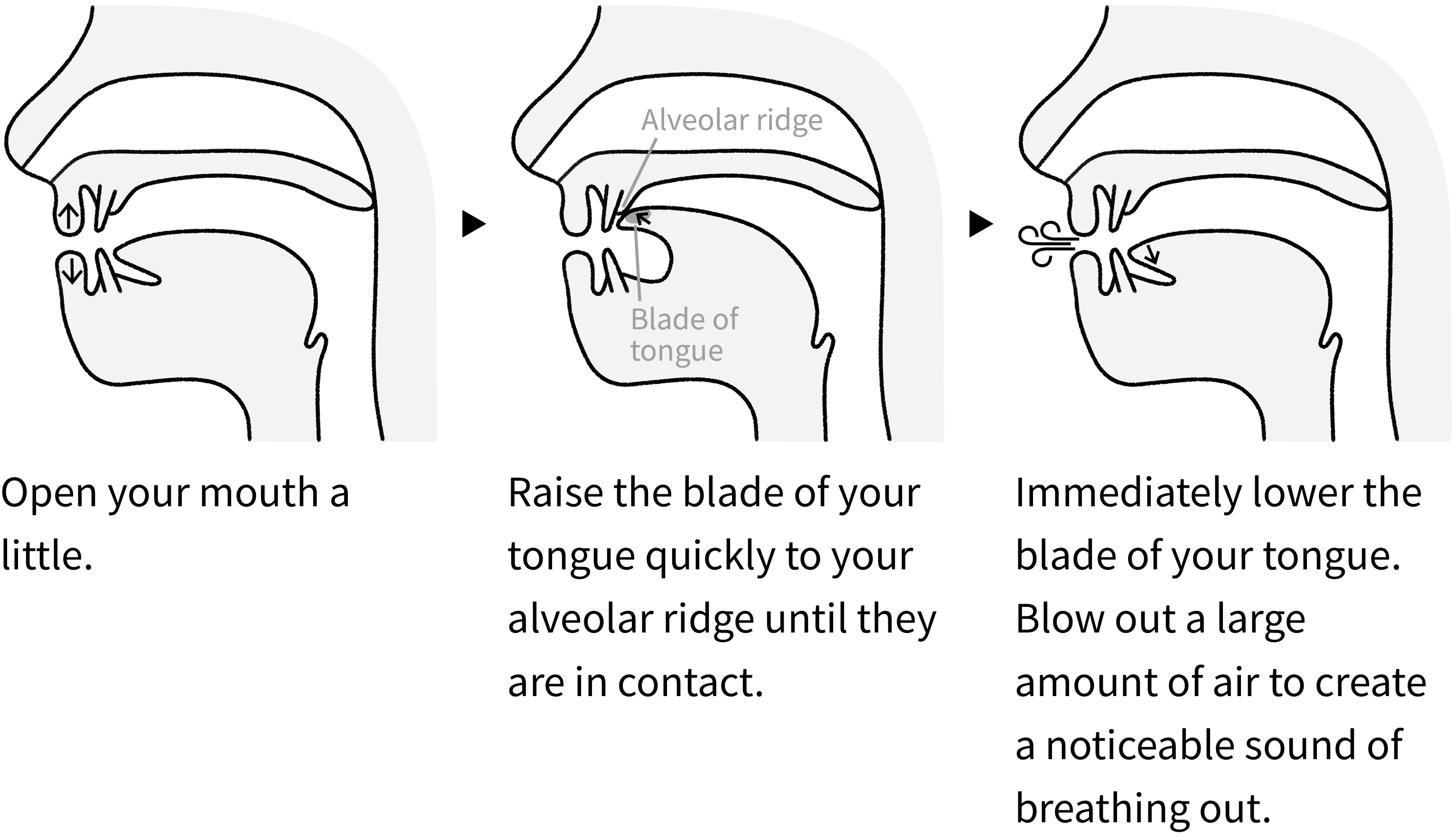
Blade of tongue: The flat part just behind your tongue tip
Alveolar ridge: The small ridge just behind your upper front teeth
Practice Practice saying the initials d and t with the final aa. Listen and repeat.
- d ‒ aa ‒ daa1
- t ‒ aa ‒ taa1
- daa1 taa1
6. The Initial Pair g and k
The Initial g
Step 1 Listen to the initial g.
g
Step 2 Listen and repeat.
g
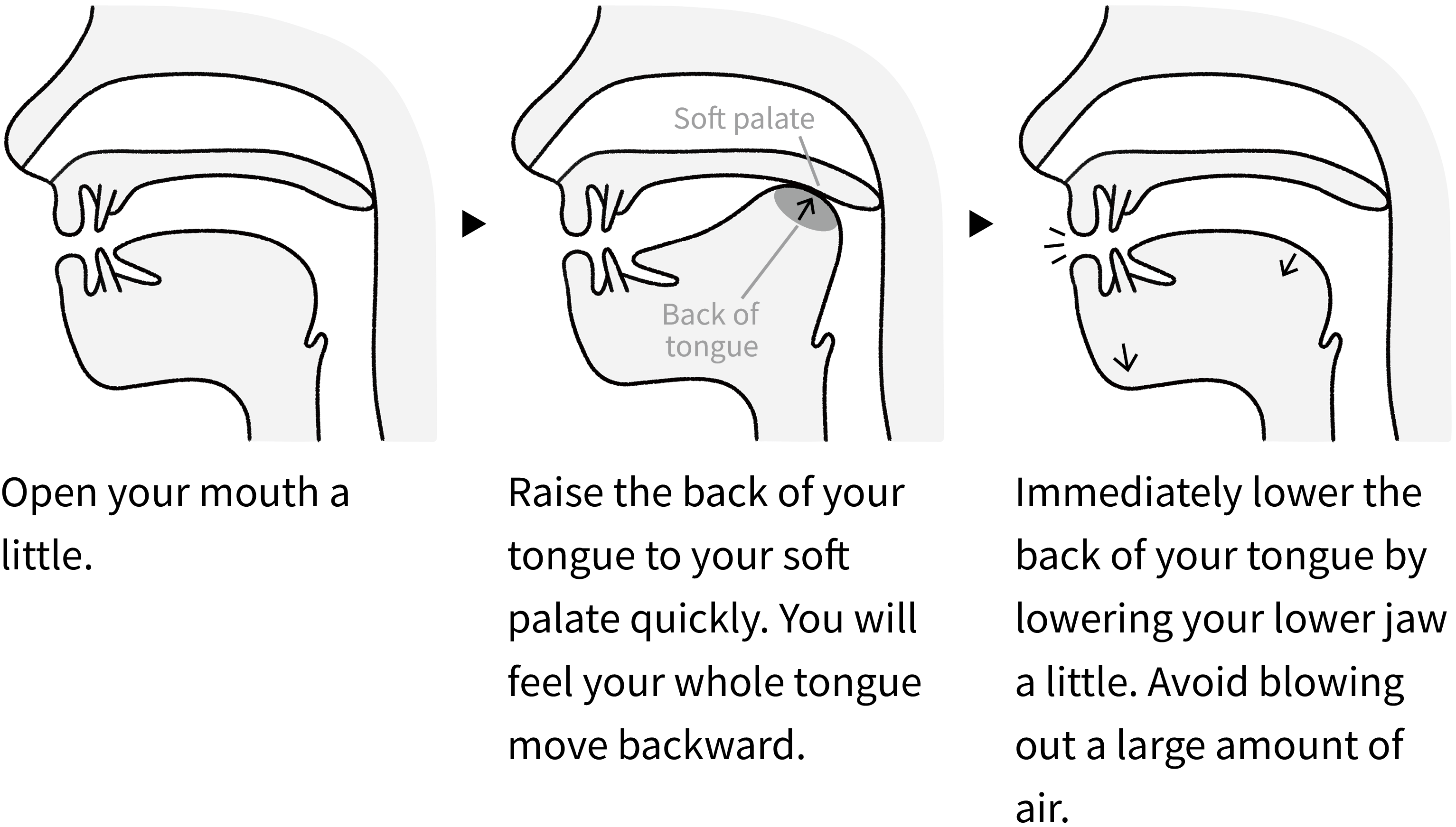
Soft palate: The back of the roof of your mouth
The Initial k
Step 1 Listen to the initial k.
k
Step 2 Listen and repeat.
k
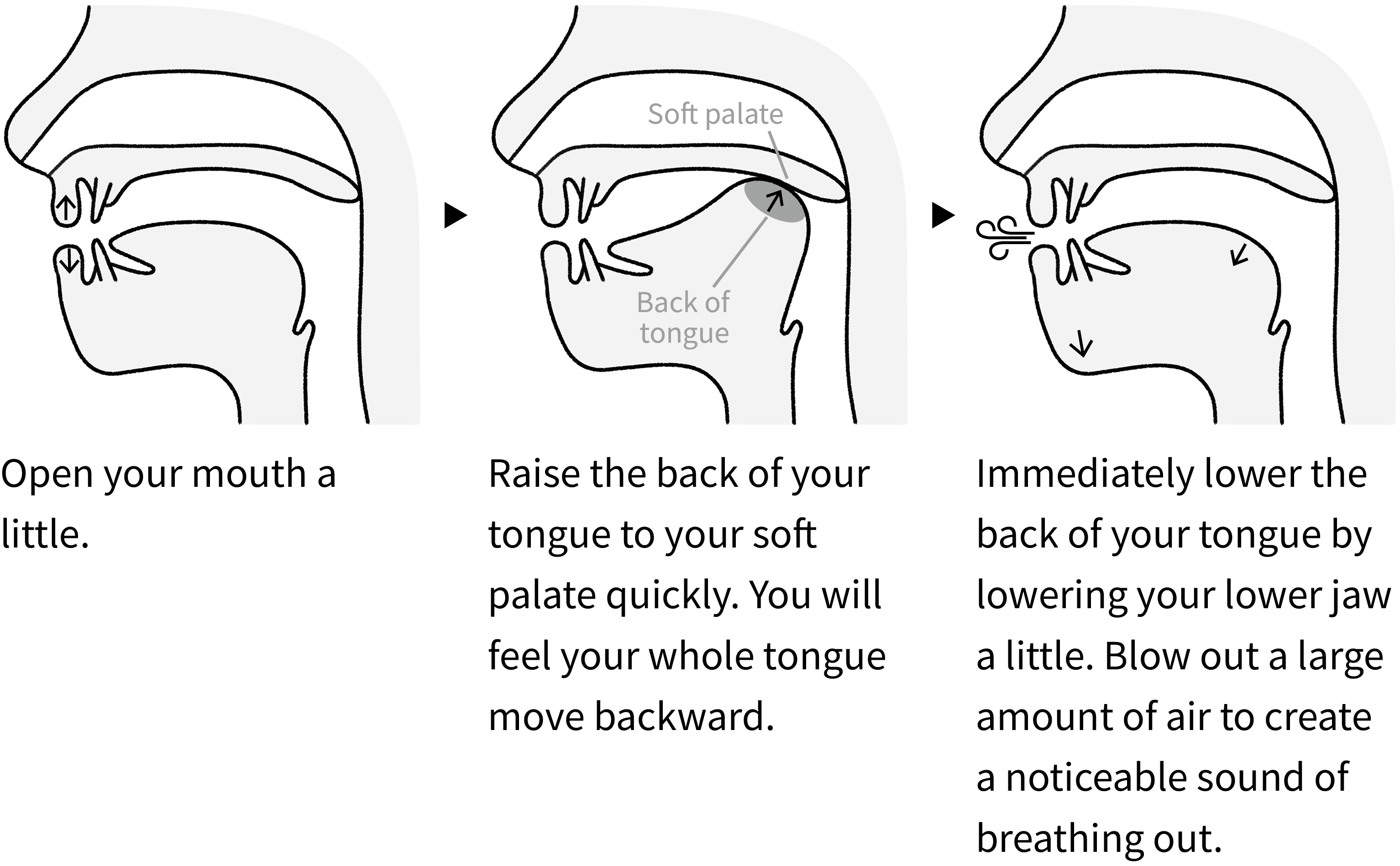
Soft palate: The back of the roof of your mouth
Practice Practice saying the initials g and k with the final aa. Listen and repeat.
- g ‒ aa ‒ gaa1
- k ‒ aa ‒ kaa1
- gaa1 kaa1
7. The Initial f
Step 1 Listen to the initial f.
f
Step 2 Listen and repeat.
f
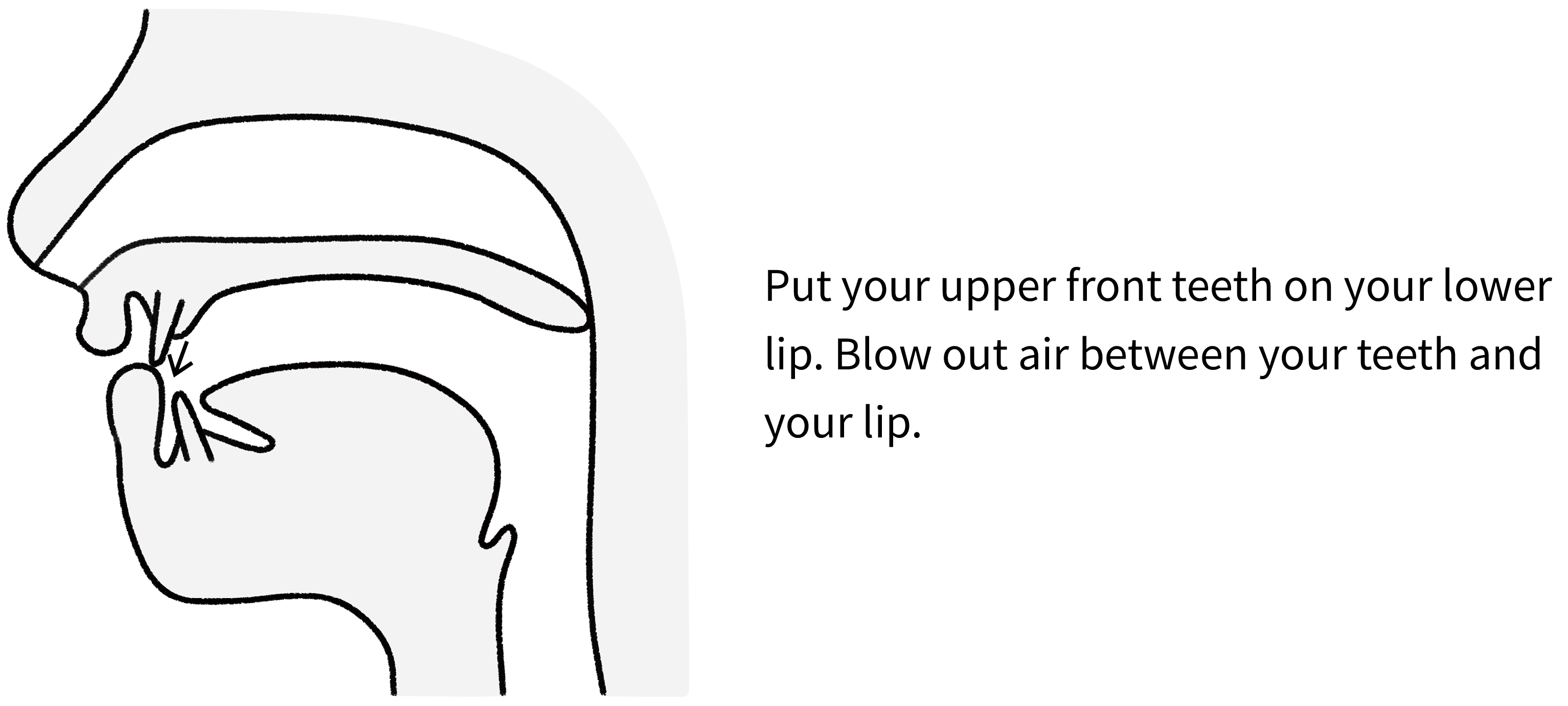
Practice Practice saying the initial f with the final aa. Listen and repeat.
f ‒ aa ‒ faa1
8. The Initial s
Step 1 Listen to the initial s.
s
Step 2 Listen and repeat.
s
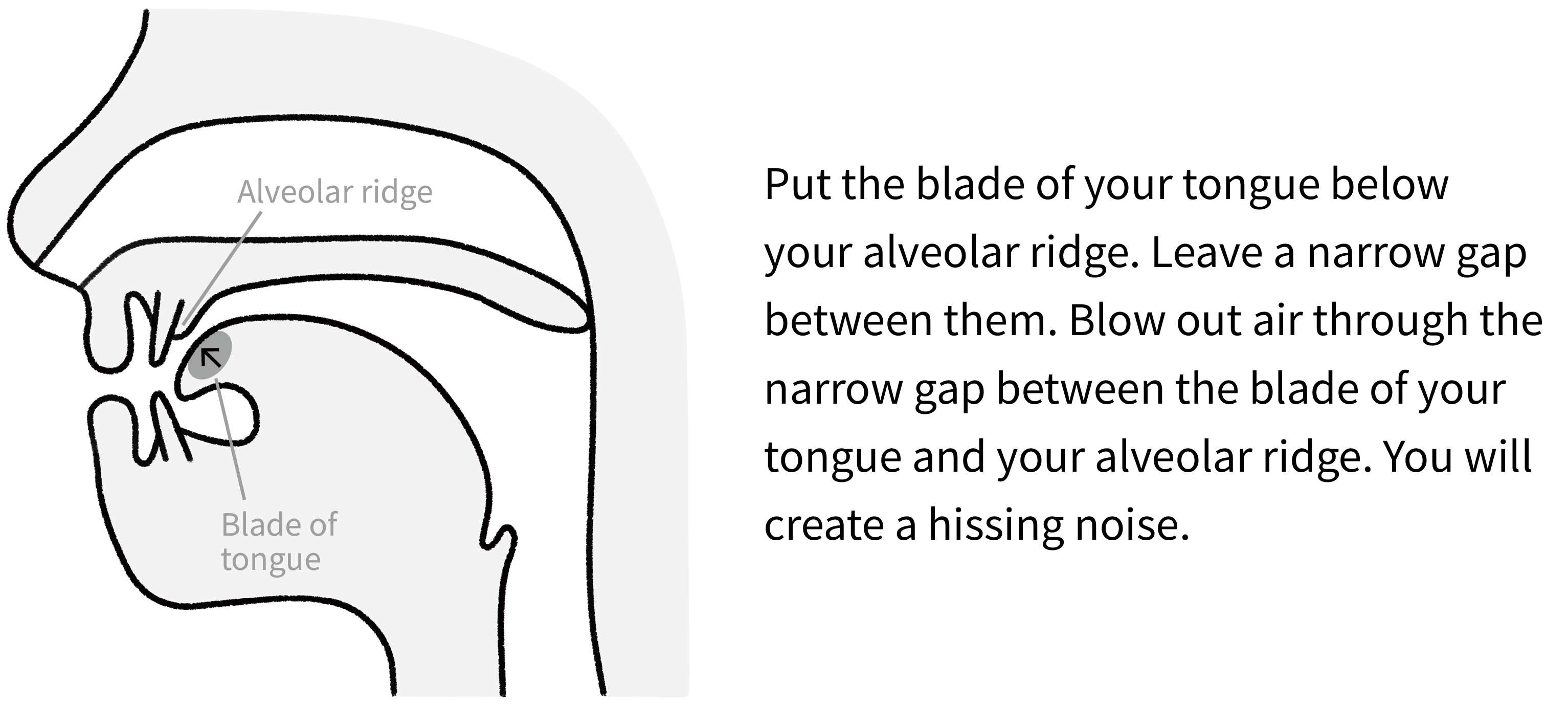
Blade of tongue: The flat part just behind your tongue tip
Alveolar ridge: The small ridge just behind your upper front teeth
Practice Practice saying the initial s with the final aa. Listen and repeat.
s ‒ aa ‒ saa1
9. The Final e
The final e is formed by the vowel e alone.
Step 1 Listen to the final e.
e
Step 2 Listen and repeat. Pay attention to your mouth shape. Use a mirror to check it if needed.
e
Tongue Position: Open your mouth a little by lowering your lower jaw a little. Raise the front of your tongue toward your hard palate a little.
Lip Shape: Spread your lips a little.
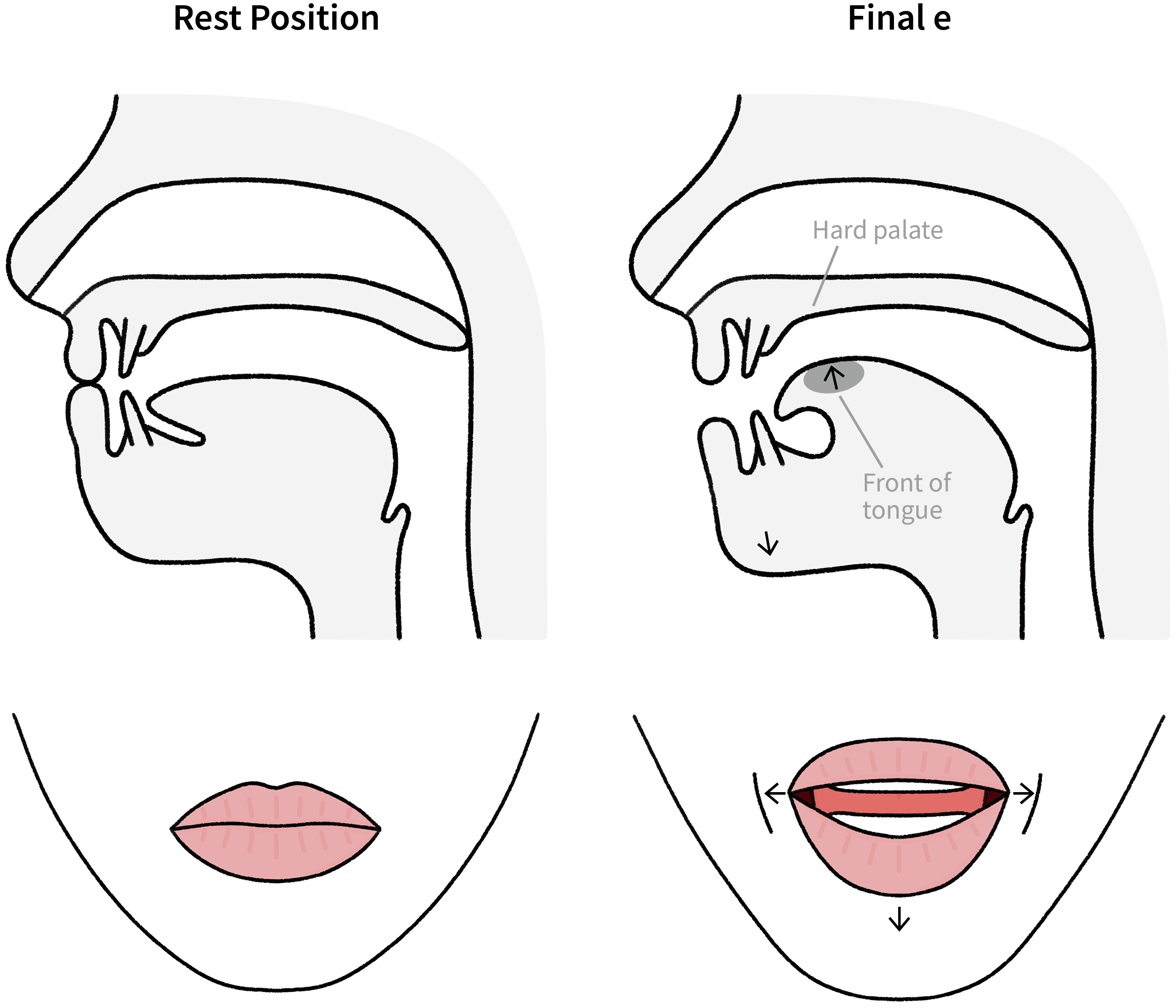
Hard palate: The part of your upper jaw just behind your alveolar ridge
Practice Practice saying the syllables with the final e. Listen and repeat.
- b ‒ e ‒ be1
- p ‒ e ‒ pe1
- d ‒ e ‒ de1
- f ‒ e ‒ fe1
- s ‒ e ‒ se1
10. The Final i
The final i is formed by the vowel i alone.
Step 1 Listen to the final i.
i
Step 2 Listen and repeat. Pay attention to your mouth shape. Use a mirror to check it if needed.
i
Tongue Position: Raise the front of your tongue toward your hard palate until they are almost in contact. You will feel the left and right sides of your tongue touch your upper teeth.
Lip Shape: Spread your lips.
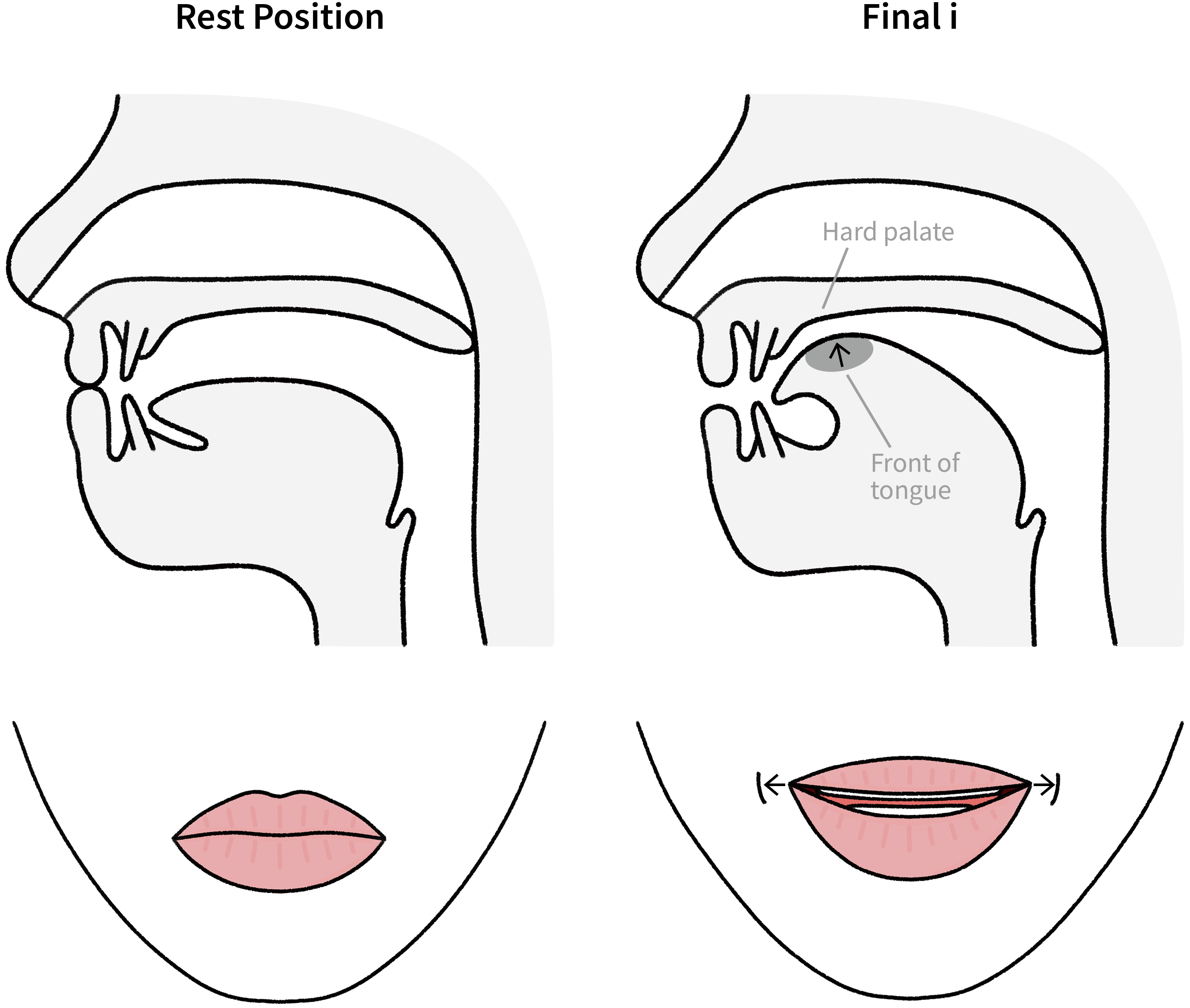
Hard palate: The part of your upper jaw just behind your alveolar ridge
Practice Practice saying the syllables with the final i. Listen and repeat.
- d ‒ i ‒ di1
- s ‒ i ‒ si1
10. The Final o
The final o is formed by the vowel o alone.
Step 1 Listen to the final o.
o
Step 2 Listen and repeat. Pay attention to your mouth shape. Use a mirror to check it if needed.
o
Tongue Position: Open your mouth a little by lowering your lower jaw a little. Raise the back of your tongue toward your soft palate a little. You will feel your whole tongue move backward a little.
Lip Shape: Round your lips a little. Your lips will move forward a little.
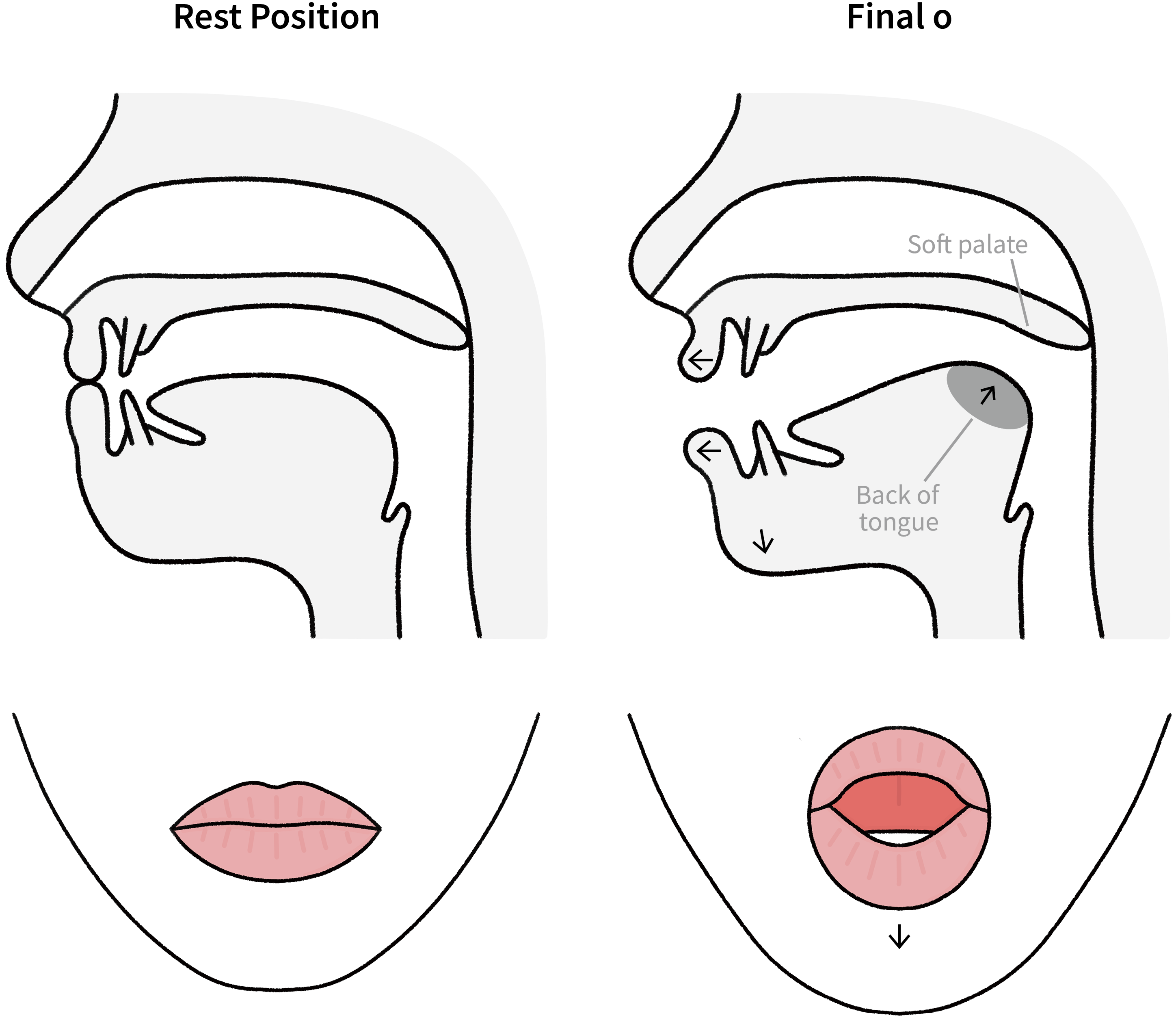
Soft palate: The back of the roof of your mouth
Practice Practice saying the syllables with the final o. Listen and repeat.
- b ‒ o ‒ bo1
- p ‒ o ‒ po1
- t ‒ o ‒ to1
- g ‒ o ‒ go1
- s ‒ o ‒ so1
12. The Final u
The final u is formed by the vowel u alone.
Step 1 Listen to the final u.
u
Step 2 Listen and repeat. Pay attention to your mouth shape. Use a mirror to check it if needed.
u
Tongue Position: Lower the tip of your tongue and raise the back of your tongue toward your soft palate. You will feel your whole tongue move backward.
Lip Shape: Round your lips tightly. Your lips will move forward.
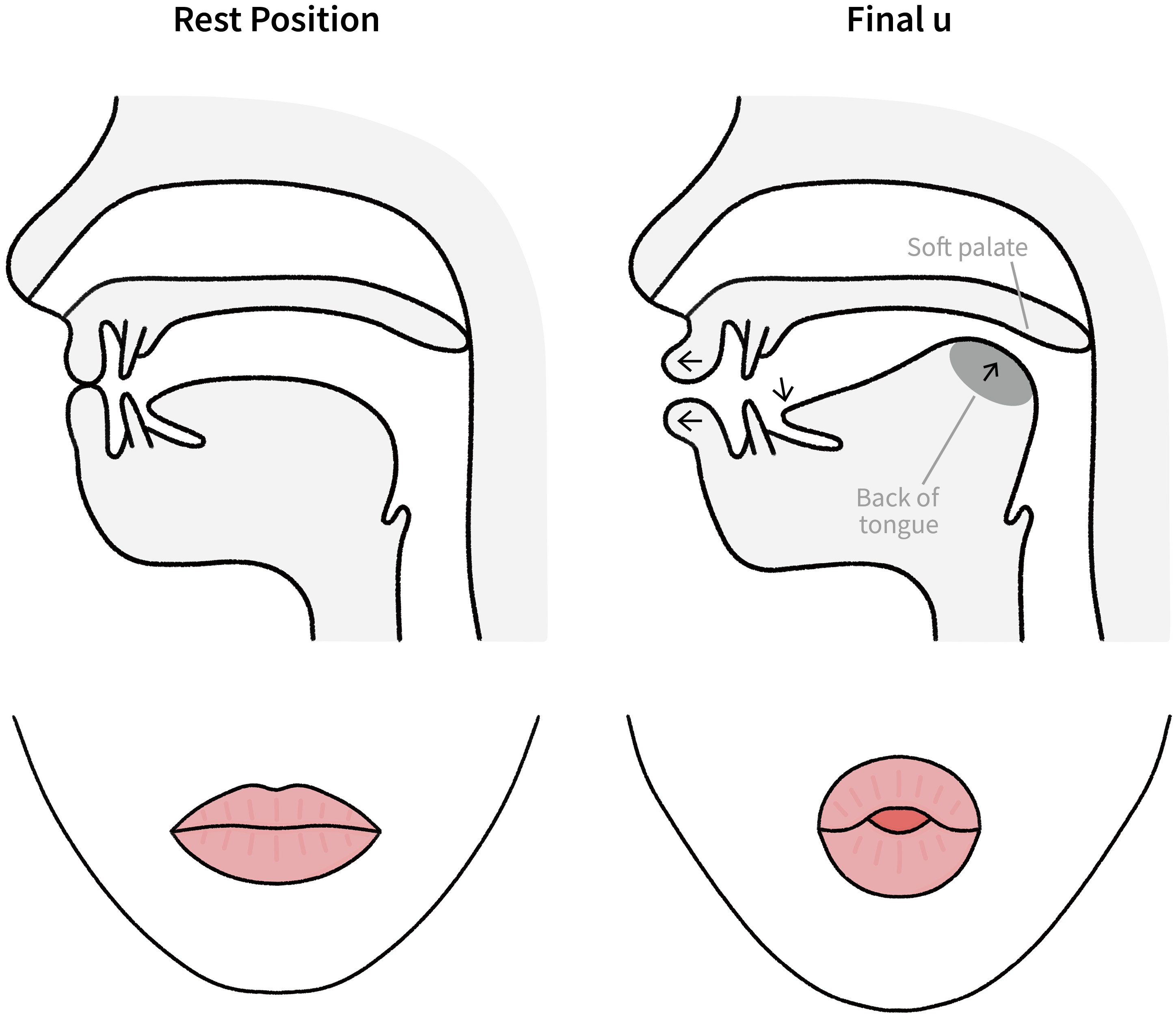
Soft palate: The back of the roof of your mouth
Practice Practice saying the syllables with the final u. Listen and repeat.
- g ‒ u ‒ gu1
- k ‒ u ‒ ku1
- f ‒ u ‒ fu1
13. Tones
Tone and Word Meaning
Cantonese is a tone language. Tone here refers to the pitch applied to a syllable. Tone can change word meaning. That is, if we change the tone of a syllable, we change the word meaning of that syllable. For example, if we say the syllable si with a high tone, it means ‘poem’. If we say the same syllable si with a low tone instead, it means ‘matter’.
Listen to the example of the syllable si in high and low tones.
If we say the syllable si with a high tone, we get 詩 si1. It means ‘poem’.
If we say the syllable si with a low tone, we get 事 si6. It means ‘matter’.
Cantonese Tones
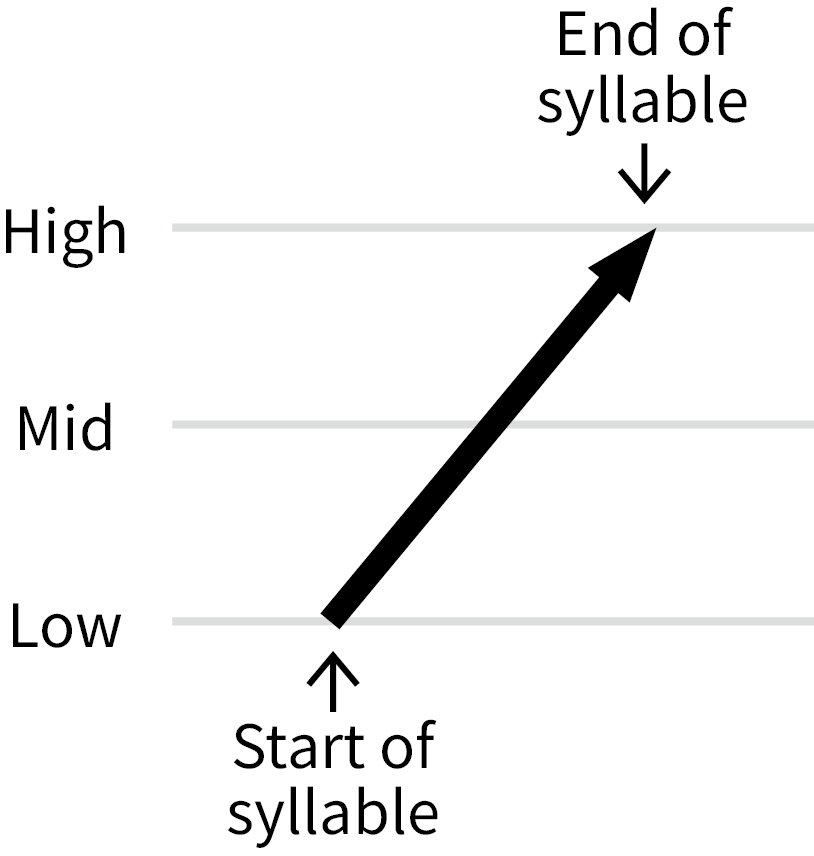
We can represent tones visually like the staff in music. The top, middle and bottom gray lines below represent the high, middle and low pitches respectively.

Cantonese has six tones. Each tone is represented visually below.
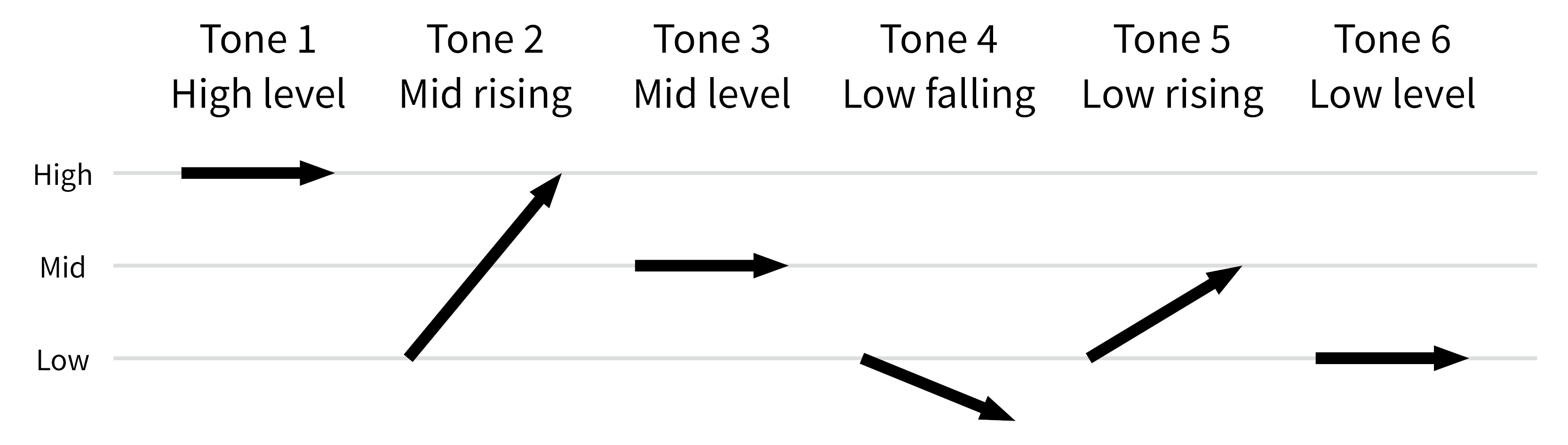
Listen to the tones applied to the syllable si as an example.
| Tone Number | Tone 1 | Tone 2 | Tone 3 | Tone 4 | Tone 5 | Tone 6 |
| Tone Name | High level | Mid rising | Mid level | Low falling | Low rising | Low level |
| Diagram | 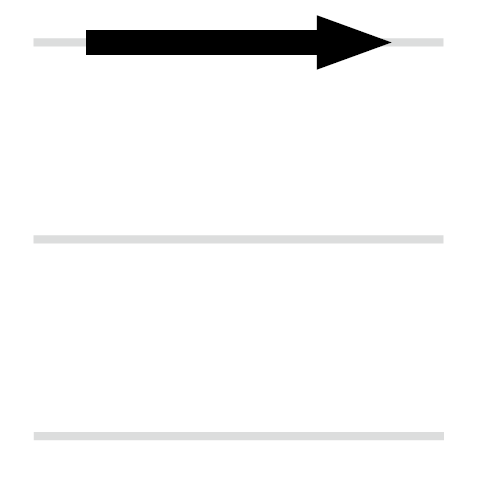 |  | 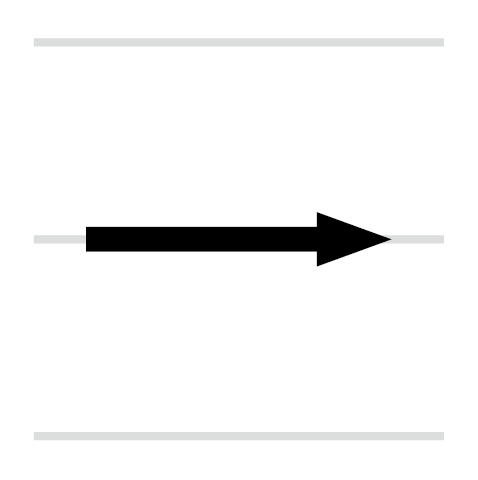 |  |  |  |
Notice that each black line shows the pitch of a tone from the start to the end of a syllable. For example, Tone 2 goes up from the low pitch at the start of the syllable to the high pitch at the end of the syllable.
Categories of Tones
We can divide the tones into two categories: level tones and contour tones.
For level tones, the pitch remains steady throughout the whole syllable. It doesn’t rise or fall. Listen to the level tones applied to the syllable si.
| Tone Number | Tone 1 | Tone 3 | Tone 6 |
| Tone Name | High level | Mid level | Low level |
| Diagram | | | |
For contour tones, the pitch rises or falls in the syllable. Listen to the contour tones applied to the syllable si.
| Tone Number | Tone 2 | Tone 4 | Tone 5 |
| Tone Name | Mid rising | Low falling | Low rising |
| Diagram | | | |
Remembering Tones
Throughout this pronunciation guide, you will be trained to remember the tones using the set of syllables below. It consists of the syllable si in all the six tones, from Tone 1 to Tone 6. It will be a useful tool that you can use to recall different tones.
si1 si2 si3 si4 si5 si6
14. Tone 1 (High Level)
Tone 1 is the high level tone. The pitch remains at the high pitch throughout the whole syllable.
| Tone Number | Tone 1 |
| Tone Name | High level |
| Diagram | 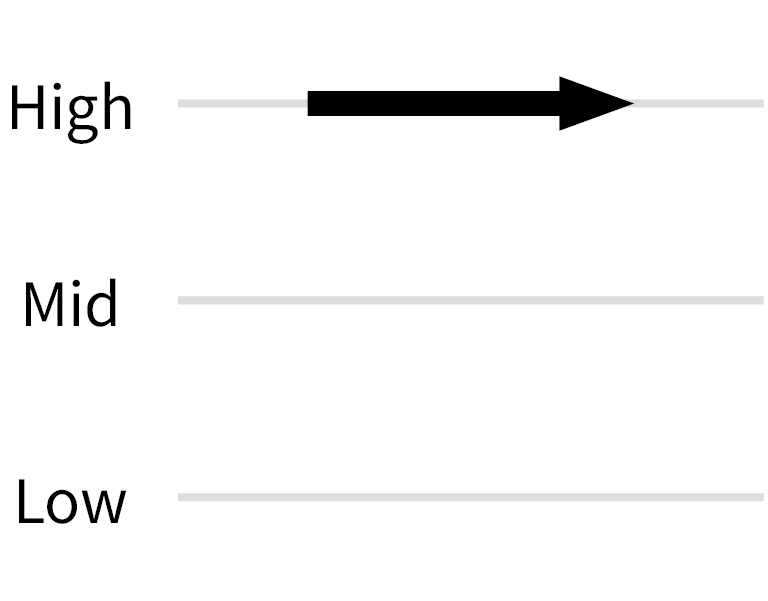 |
Step 1 Listen to the syllable si in Tone 1. Pay attention to the pitch.
si1
Step 2 Practice saying Tone 1 with the syllable si. Listen and repeat.
si1
💡 Tips
The pitch of si1 is similar to the pitch of the syllable sea in the English word seafood.
Listen.
seafood sea si1
Practice Practice saying Tone 1 with other syllables. Listen and repeat.
- paa1
- be1
- di1
- to1
- ku1
15. Tone 2 (Mid Rising)
Tone 2 is the mid rising tone. The pitch goes up from the low pitch to the high pitch in the syllable.
| Tone Number | Tone 2 |
| Tone Name | Mid rising |
| Diagram | 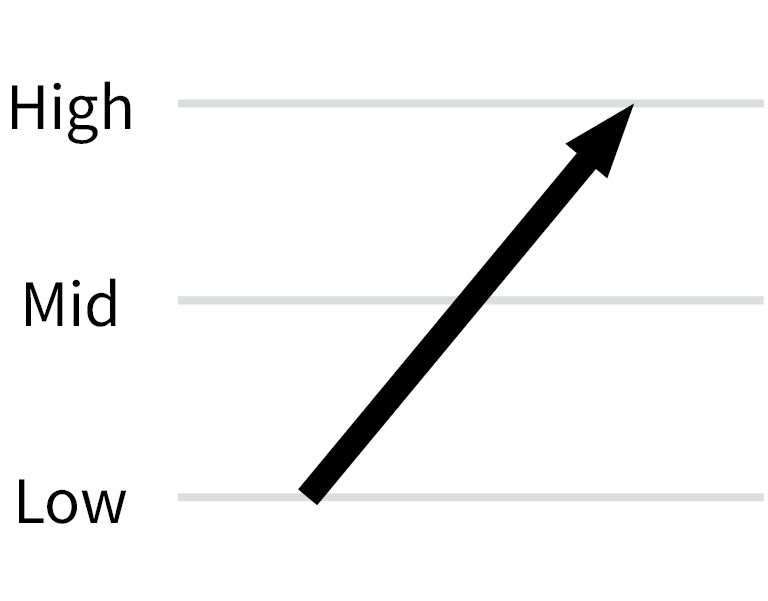 |
Step 1 Listen to the syllable si in Tone 2. Pay attention to the pitch.
si2
Step 2 Practice saying Tone 2 with the syllable si. Listen and repeat.
si2
💡 Tips
The pitch of si2 is similar to the pitch of the word sea in a question like Do they live in the sea?
Listen.
Do they live in the sea? sea? si2
Practice Practice saying Tone 2 with other syllables. Listen and repeat.
- daa2
- ge2
- si2
- po2
- fu2
16. Tone 1 to Tone 2
We have learned the first two tones. Let’s revise them together.
| Tone Number | Tone 1 | Tone 2 |
| Tone Name | High level | Mid rising |
| Diagram | | |
Step 1 Listen to the syllable si in Tone 1 and Tone 2 together. Pay attention to the pitch. The pitch of Tone 1 remains steady, whereas Tone 2 has a noticeable rise in the pitch.
si1 si2
Step 2 Practice saying the syllable si in Tone 1 and Tone 2. Listen and repeat.
si1 si2
Practice Practice saying Tone 1 and Tone 2 with other syllables. Listen and repeat.
- paa1 paa2
- de1 de2
- go1 go2
- fu1 fu2
17. How to Complete the Revision Sections
- Each pronunciation lesson ends with two revision sections. Complete each revision section at the suggested time below.
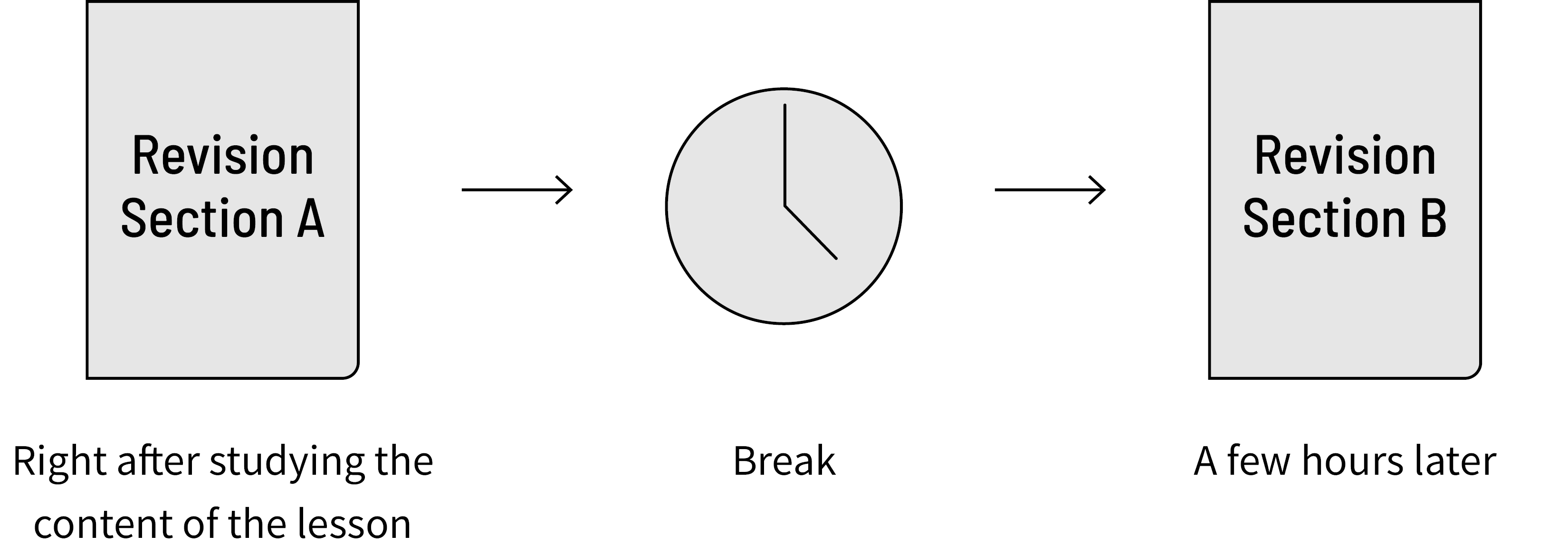
💡 Tips
Don’t complete both revision sections at once. Take a break between two revision sections. It can help you remember the content better.
- In some questions, you will be asked to recall something. Try to recall it yourself first. Don’t look for answers from the book right away.
In some other questions, you will be asked to say some syllables or words aloud and then compare your pronunciation to the recording. Make sure that you recall and say the syllables or words yourself before listening to the recording. Pause the recording to get enough time to recall if needed.
💡 Tips
Recalling the content actively can help you remember the content better.
- The answers to some questions are shown in their subsequent questions. Cover the subsequent questions to avoid seeing the answers accidentally.
18. Revision Section A
Instructions for Question 1
Follow the steps below to complete each question.
Step 1: Say the syllable aloud yourself.
Step 2: Listen to the recording and compare your pronunciation to the recording.
Step 3: Follow the recording and say the syllable again.
Question 1
Say the syllables below.
- pe1
- si2
- fu2
- to1
- di1
- bo1
- de2
- kaa1
- fo2
- ke2
- saa1
- gu2
If you find this question challenging, practice with the additional recording below. In the additional recording, you will hear:
For "Syllable in Tones", we are trying to say the syllable from Tone 1 to Tone 6 until we arrive at the tone we need. It is a useful skill that you can use to find out how a syllable sounds like in a particular tone.
- p ‒ e ‒ pe ‒ pe1 ‒ pe1
- s ‒ i ‒ si ‒ si1 si2 ‒ si2
- f ‒ u ‒ fu ‒ fu1 fu2 ‒ fu2
- t ‒ o ‒ to ‒ to1 ‒ to1
- d ‒ i ‒ di ‒ di1 ‒ di1
- b ‒ o ‒ bo ‒ bo1 ‒ bo1
- d ‒ e ‒ de ‒ de1 de2 ‒ de2
- k ‒ aa ‒ kaa ‒ kaa1 ‒ kaa1
- f ‒ o ‒ fo ‒ fo1 fo2 ‒ fo2
- k ‒ e ‒ ke ‒ ke1 ke2 ‒ ke2
- s ‒ aa ‒ saa ‒ saa1 ‒ saa1
- g ‒ u ‒ gu ‒ gu1 gu2 ‒ gu2
19. Revision Section B
Instructions for Questions 1 to 5
Follow the steps below to complete each question.
Step 1: Say the sound, syllable or word aloud yourself.
Step 2: Listen to the recording and compare your pronunciation to the recording.
Step 3: Follow the recording and say the sound, syllable or word again.
Question 1
Say the initials below. Click the initials to hear the sounds. Click + to go to the page of each initial.
Question 2
Say the finals below. Click the finals to hear the sounds. Click + to go to the page of each final.
Question 3
Say the syllable si with the tones below. Click the tones to hear the sounds. Click + to go to the page of each tone.
Question 4
Say the syllables below.
- gaa2
- be1
- si1
- fo1
- paa2
- se2
- ku1
- go2
- taa1
- fu1
- do1
- ge2
If you find this question challenging, practice with the additional recording below.
- g ‒ aa ‒ gaa ‒ gaa1 gaa2 ‒ gaa2
- b ‒ e ‒ be ‒ be1 ‒ be1
- s ‒ i ‒ si ‒ si1 ‒ si1
- f ‒ o ‒ fo ‒ fo1 ‒ fo1
- p ‒ aa ‒ paa ‒ paa1 paa2 ‒ paa2
- s ‒ e ‒ se ‒ se1 se2 ‒ se2
- k ‒ u ‒ ku ‒ ku1 ‒ ku1
- g ‒ o ‒ go ‒ go1 go2 ‒ go2
- t ‒ aa ‒ taa ‒ taa1 ‒ taa1
- f ‒ u ‒ fu ‒ fu1 ‒ fu1
- d ‒ o ‒ do ‒ do1 ‒ do1
- g ‒ e ‒ ge ‒ ge1 ge2 ‒ ge2
Question 5
Say the words below.
- 花 faa1 flower
- 波 bo1 ball
- 屎 si2 poo
- 菇 gu1 mushroom
- 梳 so1 comb
- 巴士 baa1 si2 bus
Question 6
In a Cantonese song, the lines of the lyrics usually rhyme with each other. The last syllables of the lines usually have the same final, either for the whole song or the same verse.
Listen to the following songs. In each song, the last syllable in each line of the lyrics has the same final. What is the final used in each song?
Song 1: 囍帖街 hei2 tip2 gaai1
Singer: 謝安琪 ze6 on1 kei4
Composer: Eric Kwok
Lyricist: 黃偉文 wong4 wai5 man4
Song 2: 你好嗎 lei5 hou2 maa1
Singer: 方皓玟 fong1 hou6 man4
Composer: 徐繼宗 ceoi4 gai3 zung1
Lyricist: 林夕 lam4 zik6
Song 3: 靜靜 zing6 zing6
Singer: Serrini
Composers: Serrini, Ka Shun
Lyricist: Serrini