Print or Export
你同邊個一齊住㗎?
nei5 tung4 bin1 go3 jat1 cai4 zyu6 gaa3?
nei5 tung4 bin1 go3 jat1 cai4 zyu6 gaa3?
Listen and Speak
Step 1
Listen to three sentences. Complete the descriptions.
-
我住喺屯門嘅。
ngo5 zyu6 hai2 tyun4 mun4 ge3.
I live in Tuen Mun.
The prepositional phrase with 喺 hai2 is put after the verb ________. -
我同朋友一齊住嘅。
ngo5 tung4 pang4 jau5 jat1 cai4 zyu6 ge3.
I live with a friend / friends.
The preposition ________ means ‘with’. -
我屋企有五個人嘅。
ngo5 uk1 kei2 jau5 ng5 go3 jan4 ge3.
My home has five people.
The verb ________ means ‘to have’.
Step 2
Listen to a conversation. A speaker will talk about his or her family. Circle the correct answers in the descriptions below.
Winnie住喺沙田 / 屯門 / 觀塘 / 柴灣,
Winnie zyu6 hai2 saa1 tin4 / tyun4 mun4 / gun1 tong4 / caai4 waan1,
佢同朋友 / 男朋友 / 女朋友 / 屋企人一齊住,
keoi5 tung4 pang4 jau5 / naam4 pang4 jau5 / neoi5 pang4 jau5 / uk1 kei2 jan4 jat1 cai4 zyu6,
佢屋企有兩 / 三 / 四 / 五個人。
keoi5 uk1 kei2 jau5 loeng5 / saam1 / sei3 / ng5 go3 jan4.
| Jay | |
| Winnie | |
| Jay | |
| Winnie | |
| Jay | |
| Winnie |
Step 3
Listen to the conversation again. Read the script while listening. Check your answers.
| Jay | 你住喺邊度㗎? nei5 zyu6 hai2 bin1 dou6 gaa3? Where do you live? |
| Winnie | 我住喺觀塘嘅。 ngo5 zyu6 hai2 gun1 tong4 ge3. I live in Kwun Tong. |
| Jay | 噉你同邊個一齊住㗎? gam2 nei5 tung4 bin1 go3 jat1 cai4 zyu6 gaa3? Then, who do you live with? |
| Winnie | 我同屋企人一齊住嘅。 ngo5 tung4 uk1 kei2 jan4 jat1 cai4 zyu6 ge3. I live with my family. |
| Jay | 你屋企有幾多個人㗎? nei5 uk1 kei2 jau5 gei2 do1 go3 jan4 gaa3? How many people does your family have? |
| Winnie | 我屋企有四個人嘅。 ngo5 uk1 kei2 jau5 sei3 go3 jan4 ge3. My family has four people. |
Step 4
Listen and repeat the conversation.
Step 5
Replace the highlighted words in the script with the words below to make your conversations.
Grammar and Vocabulary
In the Grammar and Vocabulary section, you will learn:
- The Verb 住 zyu6 (‘to live’)
- The Preposition 同 tung4 I (‘with’)
- Possessive Constructions II
- The Pronoun 自己 zi6 gei2 (‘oneself’)
- The Verbs 有 jau5 (‘to have’) and 冇 mou5 (‘to not have’)
- The Question Word 幾多 gei2 do1 (‘how many, how much’) I (Countable Nouns)
- Vocabulary List
- Vocabulary: Family Members
11.1 The Verb 住 zyu6 (‘to live’)
In Grammar and Vocabulary 7.2, we learned to use the preposition 喺 hai2 (‘in, on, at’, also pronounced as 响 hoeng2) to indicate where an activity takes place. We also learned that we put the prepositional phrase with 喺 hai2 before the verb we want to modify.
The verb 住 zyu6 means ‘to live’ in the sense of ‘to reside’. It is a special verb. We put the prepositional phrase with 喺 hai2 after it, instead of before it.
We put the prepositional phrase after the aspect particle if there is one.
We can still put the prepositional phrase before 住 zyu6 if we want to put emphasis on the location.
The verb 住 zyu6 can also mean ‘to live in’. We can put the location right after 住 zyu6 without 喺 hai2.
11.2 The Preposition 同 tung4 I (‘with’)
The preposition 同 tung4 means ‘with’, in the sense of ‘in the company of someone’. We use 同 tung4 to indicate the companions who we do an activity with. We put a person after 同 tung4 to form a prepositional phrase.
We put the prepositional phrase before the verb we want to modify.
We often use 同 tung4 with the adverb 一齊 jat1 cai4 (‘together’). We put 一齊 jat1 cai4 between the prepositional phrase and the verb.
11.3 Possessive Constructions II
In Grammar and Vocabulary 2.4, we learned to use possessive constructions. We also learned that in grammar, the person who owns the thing is called the possessor, and the thing being owned is called the possessed.
In a possessive construction, if we want to indicate the quantity of the possessed, we can add a number and a classifier before the possessed.
⚠️ If the quantity is one, we don’t add the number 一 jat1. Otherwise, the meaning will change. Compare:
我(個)阿哥
ngo5 (go3) aa3 go1
my older brother
我一個阿哥
ngo5 jat1 go3 aa3 go1
one of my old brothers
⚠️ When we add a number, we don’t omit the classifier even if the possessor has a close relationship with the possessed.
❌ 我兩細妹
ngo5 loeng5 sai3 mui2
✔️ 我兩個細妹
ngo5 loeng5 go3 sai3 mui2
my two little sisters
Grammar Practice 1
Use the preposition 同 tung4 to add the companions of the activity to each sentence. Also, add the adverb 一齊 jat1 cai4. Then, check your answers and repeat after the recordings.
Example
同學 tung4 hok6 👤👤👤 我睇戲。
ngo5 tai2 hei3.
我同我三個同學一齊睇戲。
ngo5 tung4 ngo5 saam1 go3 tung4 hok6 jat1 cai4 tai2 hei3.
I watch movies with my three classmates.
1.
朋友 pang4 jau5 👤👤 我打波。
ngo5 daa2 bo1.
2.
同事 tung4 si6 👤👤👤👤 我去飲嘢。
ngo5 heoi3 jam2 je5.
3.
老闆 lou5 baan2 👤👤 我踢波。
ngo5 tek3 bo1.
4.
女朋友 neoi5 pang4 jau5 👤 我學日文。
ngo5 hok6 jat6 man2.
11.4 The Pronoun 自己 zi6 gei2 (‘oneself’)
The pronoun 自己 zi6 gei2 means ‘oneself’. It can mean ‘myself, yourself, himself, herself, itself, ourselves, yourselves or themselves’ depending on the context.
We can use 自己 zi6 gei2 to express the meaning of ‘alone’ or ‘on someone’s own’. We put 自己 zi6 gei2 before an activity to indicate we do the activity alone or on our own.
The pronoun 自己 zi6 gei2 is put before the activity 住 zyu6 to indicate 住 zyu6 is done alone.11.5 The Verbs 有 jau5 (‘to have’) and 冇 mou5 (‘to not have’)
The verb 有 jau5 means ‘to have’. We use it to indicate we have something.
我有一個阿哥嘅。
ngo5 jau5 jat1 go3 aa3 go1 ge3.
I have an older brother.
The verb 冇 mou5 means ‘to not have’. We use it to indicate we don’t have something. Note that we don’t say 唔有 m4 jau5 (唔 m4 ‘not’ + 有 jau5 ‘to have’) to mean ‘to not have’.
我冇兄弟姊妹嘅。
ngo5 mou5 hing1 dai6 zi2 mui6 ge3.
I don’t have siblings.
We can combine the positive form 有 jau5 and the negative form 冇 mou5 to form yes-no questions. We use the questions to ask if someone has something. It is like questions that begin with do you have in English (e.g., Do you have siblings?).
你有冇兄弟姊妹㗎?
nei5 jau5 mou5 hing1 dai6 zi2 mui6 gaa3?
Do you have siblings?
To answer the question, we can give a short answer or a long answer. We give a short answer more often.
11.6 The Question Word 幾多 gei2 do1 (‘how many, how much’) I (Countable Nouns)
The question word 幾多 gei2 do1 is similar to how many or how much in English. We use 幾多 gei2 do1 to form a question that elicits a quantity as the answer.
We put the noun whose quantity we want to ask about after 幾多 gei2 do1. If the noun is countable (e.g., 人 jan4 ‘person’), we often add a classifier between 幾多 gei2 do1 and the noun, especially when we want to know the exact quantity. The classifier is determined based on the noun.
| A: | 你屋企有幾多(個)人㗎? nei5 uk1 kei2 jau5 gei2 do1 (go3) jan4 gaa3? How many people does your family have? |
| B: | 我屋企有四個人嘅。 ngo5 uk1 kei2 jau5 sei3 go3 jan4 ge3. My family has four people. |
When 幾多 gei2 do1 is followed by a classifier, 幾多 gei2 do1 can be contracted to 幾 gei2.
你屋企有幾個人㗎?
nei5 uk1 kei2 jau5 gei2 go3 jan4 gaa3?
How many people does your family have?
The classifier 個 go3 is added. Therefore, 幾多 gei2 do1 can be contracted to 幾 gei2.
When we are not sure where we should put 幾多 gei2 do1, we can always think of the answer to the question. We put 幾多 gei2 do1 at the position where the number appears in the answer.
| A: | 你屋企有幾多個人㗎? nei5 uk1 kei2 jau5 gei2 do1 go3 jan4 gaa3? How many people does your family have? |
| ↑ | |
| B: | 我屋企有四個人嘅。 ngo5 uk1 kei2 jau5 sei3 go3 jan4 ge3. My family has four people. |
11.7 Vocabulary List
11.8 Vocabulary: Family Members
In Grammar and Vocabulary 1.8, we learned the prefix for names 阿 aa3. 阿 aa3 also appears in some of the terms for family members below.
Parents
⚠️ We usually use 老母 lou5 mou2 to refer to our own mother only in informal contexts (e.g., when chatting with close friends). Some people find the word 老母 lou5 mou2 very offensive. You should use it with extra caution!
😈 Sensitive Content: The Word 老母 lou5 mou2
The word 老母 lou5 mou2 is part of the common swear word 屌你老母 diu2 nei5 lou5 mou2 (‘fuck your mother’). We can use it to swear at someone or simply express our anger without directing it to someone specific. We can also replace 你 nei5 with 佢 keoi5 and say 屌佢老母 diu2 keoi5 lou5 mou2 (‘fuck his or her mother’).
Siblings
兄弟姊妹
hing1 dai6 zi2 mui6
siblings (literally ‘older brother + younger brother + older sister + younger sister’)
In Cantonese, we use different terms to address siblings depending on whether they are older or younger than us.
When 阿妹 aa3 mui2 is preceded by a number and a classifier, we can omit 阿 aa3.
✔️ 我有兩個阿妹。
ngo5 jau5 loeng5 go3 aa3 mui2.
✔️ 我有兩個妹。
ngo5 jau5 loeng5 go3 mui2.
I have two younger sisters.
However, for 阿哥 aa3 go1, we don’t omit 阿 aa3 even if it is preceded by a number and a classifier.
✔️ 我有兩個阿哥。
ngo5 jau5 loeng5 go3 aa3 go1.
❌ 我有兩個哥。
ngo5 jau5 loeng5 go3 go1.
I have two older brothers.
Culture
We sometimes use 哥 go1 (‘brother’) or 姐 ze1 (‘sister’) to refer to someone, especially those who are older than us, to show respect. We take the last syllable of their name and add 哥 go1 or 姐 ze1 after it.
榮哥
wing4 go1
Brother Wing
麗姐
lai6 ze1
Sister Lai
Note that the tone of 哥 go1 or 姐 ze1 may change depending on the name it follows.
Children
仔
zai2
son
仔仔 / 囝囝
zai4 zai2
son
女 / 囡
neoi2
daughter
女女 / 囡囡
neoi4 neoi2
daughter
Note that the words 女 neoi2 (‘daughter’) and 女 neoi5 (‘female’), as in 女朋友 neoi5 pang4 jau5 (‘girlfriend’), are said with different tones.
When we use 仔仔 zai4 zai2 or 女女 neoi4 neoi2 to mean ‘son’ or ‘daughter’, we usually refer to someone who is still a child.
仔女
zai2 neoi2
son and daughter (literally ‘son + daughter’)
小朋友
siu2 pang4 jau5
child (literally ‘small + friend’)
細路
sai3 lou6
child
Note that the second syllables of the words 細路 sai3 lou6 (‘child’) and 細佬 sai3 lou2 (‘younger brother’) are said with different tones.
Pay attention to the use of these terms:
When we form a possessive construction with 仔 zai2 and 女 neoi2, we always need a classifier.
✔️ 我個仔
ngo5 go3 zai2
❌ 我仔
ngo5 zai2
my son
✔️ 我個女
ngo5 go3 neoi2
❌ 我女
ngo5 neoi2
my daughter
When parents address their children at home directly, they may use 阿仔 aa3 zai2 (阿 aa3 + 仔 zai2) and 阿女 aa3 neoi2 (阿 aa3 + 女 neoi2). However, they more often use the terms for siblings or the children’s names. For example, they may address the older son using 阿哥 aa3 go1 or his name.
Communication
In the Communication section, you will learn:
- Talking About Home
- Talking About Family
Talking About Home
Culture
Like in many other places of the world, the property prices and rents in Hong Kong is very high. Therefore, many people will continue to live with their parents and siblings even as they get older.
Talking About Family
- We usually omit 嘅 ge3 before the noun 屋企 uk1 kei2 in a possessive construction.
We can also directly ask what family members the other person has:
If we want to know whether the other person has siblings, we can ask:
Exercises
Exercise 1
Are the following descriptions true or false? Correct the description if it is false.
1.
When we use the verb 住 zyu6, we can put a prepositional phrase with 喺 hai2 after it.
2.
We use the preposition 同 tung4 to indicate the companions who we do an activity with.
3.
We put the pronoun 自己 zi6 gei2 after an activity to indicate we do the activity alone or on our own.
4.
To mean ‘to not have’, we say 唔有 m4 jau5.
5.
We use the question word 幾多 gei2 do1 to form a question that elicits a quantity as the answer.
Exercise 2
Write another term we can use to refer to each person.
| Ex. | 姐姐 ze4 ze1 | 家姐 gaa1 ze1 |
| 1. | 哥哥 go4 go1 | ________ |
| 2. | 媽媽 maa4 maa1 | ________ |
| 3. | 妹妹 mui4 mui2 | ________ |
| 4. | 細路 sai3 lou6 | ________ |
| 5. | 爸爸 baa4 baa1 | ________ |
| 6. | 弟弟 dai4 dai2 | ________ |
Exercise 3
Follow the example to complete the conversations. Then, listen to the recordings to check your answers. Finally, repeat after the recordings.
Example

aa3 on1
屯門
tyun4 mun4
| 阿輝 aa3 fai1 | 你住喺邊度㗎? nei5 zyu6 hai2 bin1 dou6 gaa3? Where do you live? |
| 阿安 aa3 on1 | 我住喺屯門嘅。 ngo5 zyu6 hai2 tyun4 mun4 ge3. I live in Tuen Mun. |
1.

aa3 jing4
馬鞍山
maa5 on1 saan1
| 阿輝 aa3 fai1 | ________ |
| 阿瑩 aa3 jing4 | ________ |
2.
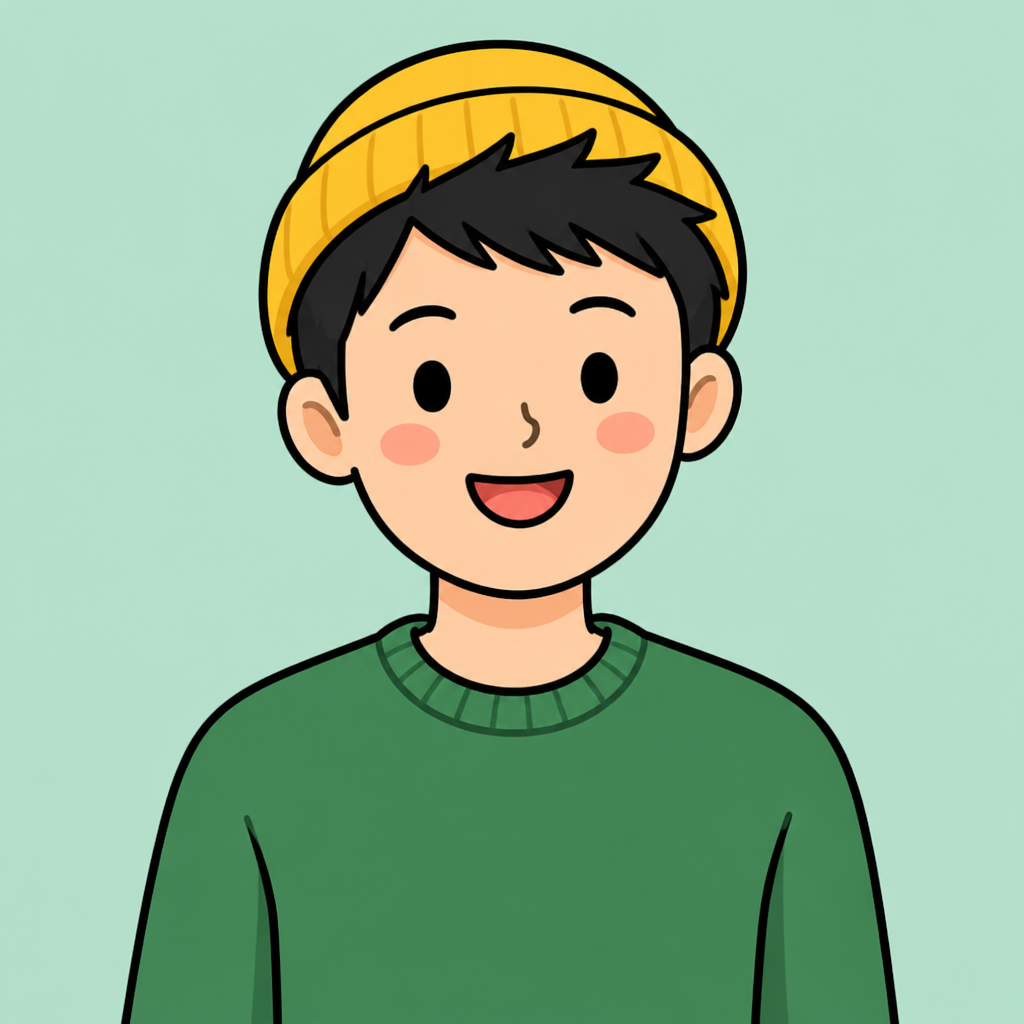
aa3 lok6
深水埗
sam1 seoi2 bou2
| 阿輝 aa3 fai1 | ________ |
| 阿樂 aa3 lok6 | ________ |
3.
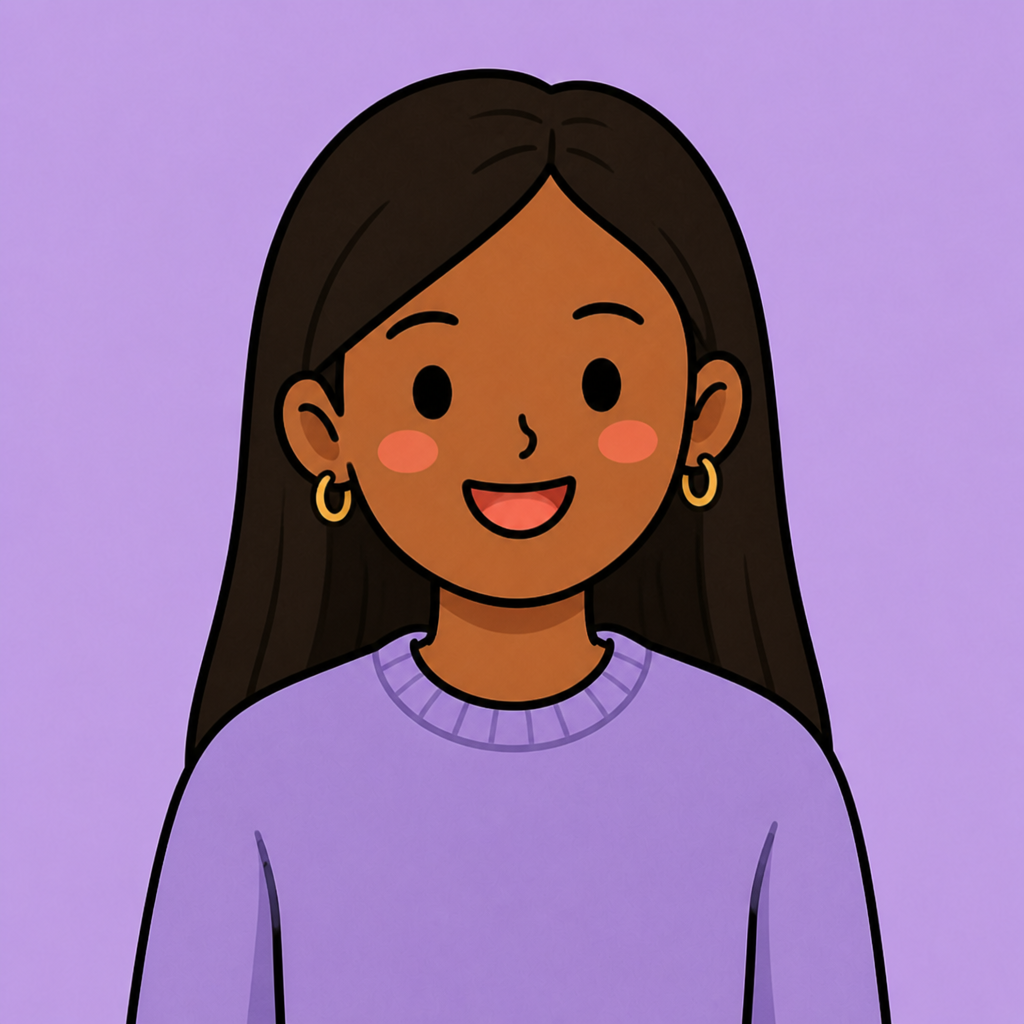
aa3 lam4
南丫島
naam4 aa1 dou2
| 阿輝 aa3 fai1 | ________ |
| 阿琳 aa3 lam4 | ________ |
4.
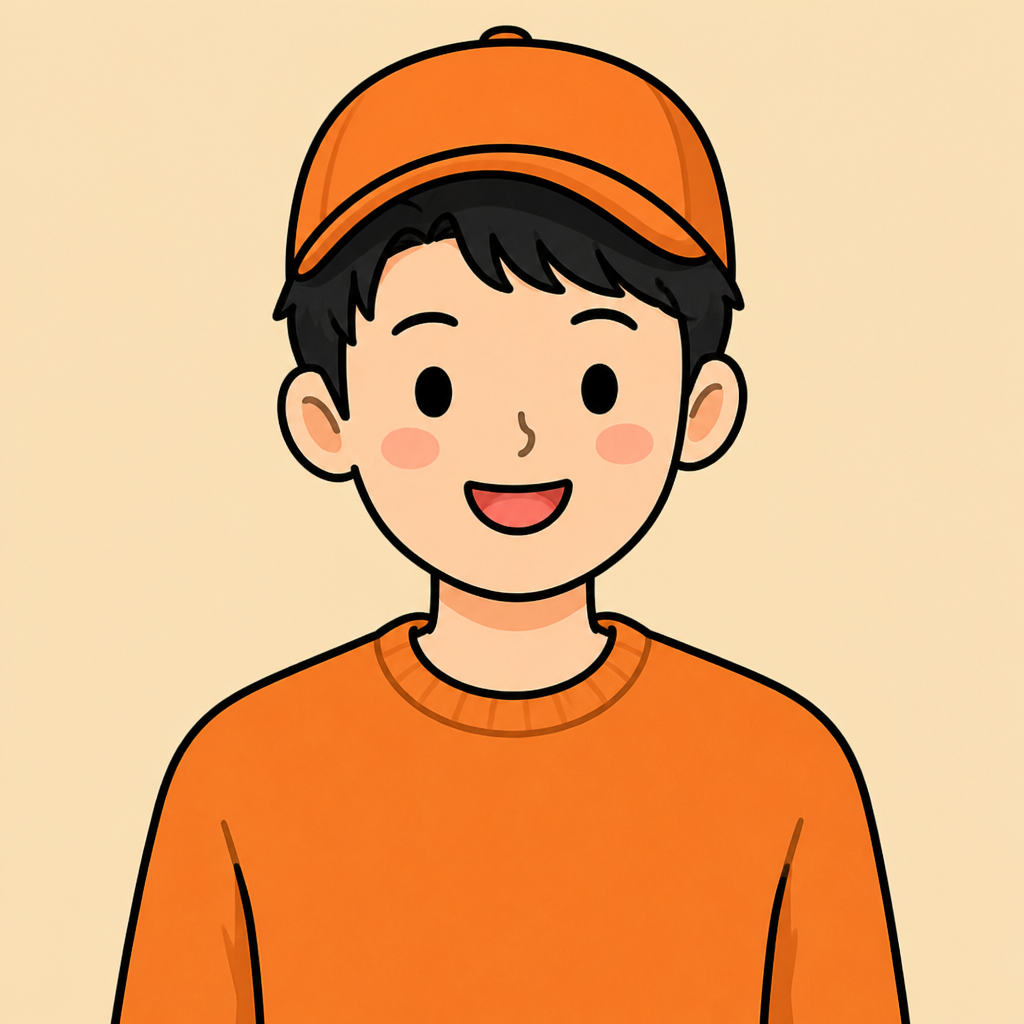
aa3 dung1
跑馬地
paau2 maa5 dei2
| 阿輝 aa3 fai1 | ________ |
| 阿東 aa3 dung1 | ________ |
5.

aa3 man5
九龍城
gau2 lung4 sing4
| 阿輝 aa3 fai1 | ________ |
| 阿敏 aa3 man5 | ________ |
Exercise 4
Follow the example to complete the conversations. Then, listen to the recordings to check your answers. Finally, repeat after the recordings.
Example
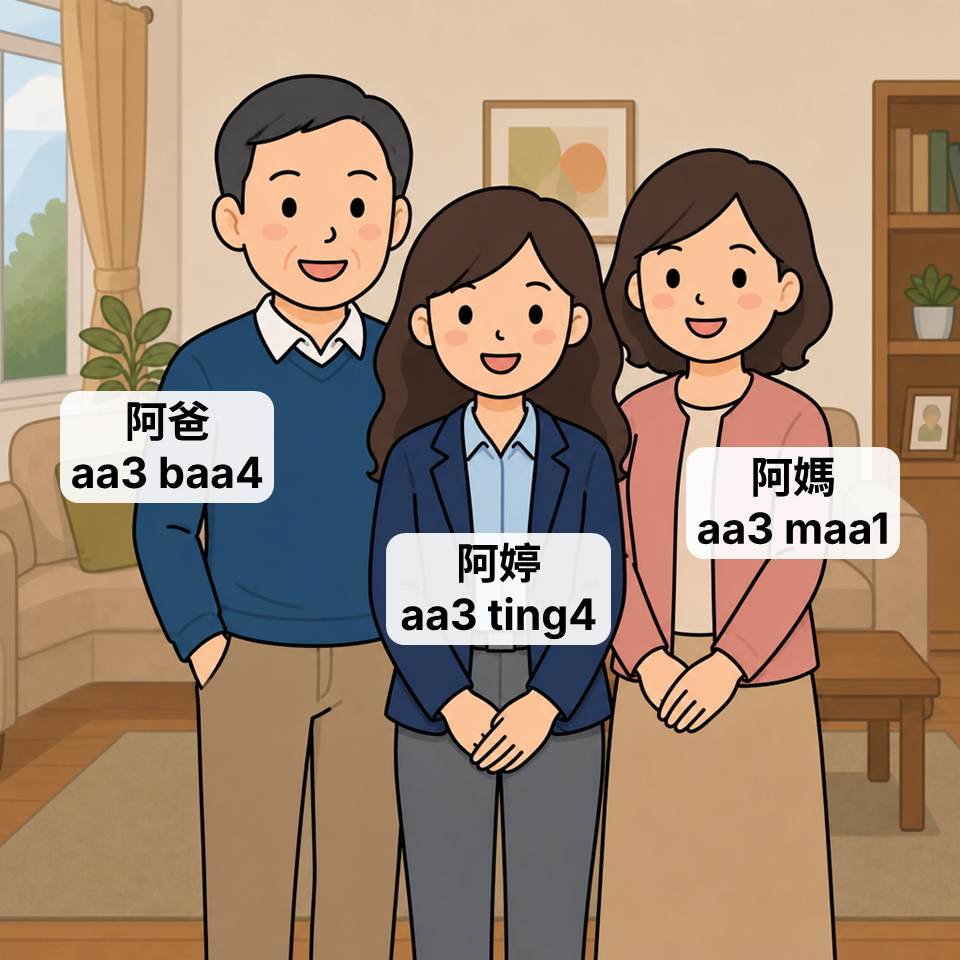
| 阿詩 aa3 si1 | 你屋企有幾多個人㗎? nei5 uk1 kei2 jau5 gei2 do1 go3 jan4 gaa3? How many people does your family have? |
| 阿婷 aa3 ting4 | 我屋企有三個人嘅,有我阿爸啦,我阿媽啦,同我。 ngo5 uk1 kei2 jau5 saam1 go3 jan4 ge3, jau5 ngo5 aa3 baa4 laa1, ngo5 aa3 maa1 laa1, tung4 ngo5. My family has three people. It has my father, my mother and me. |
1.
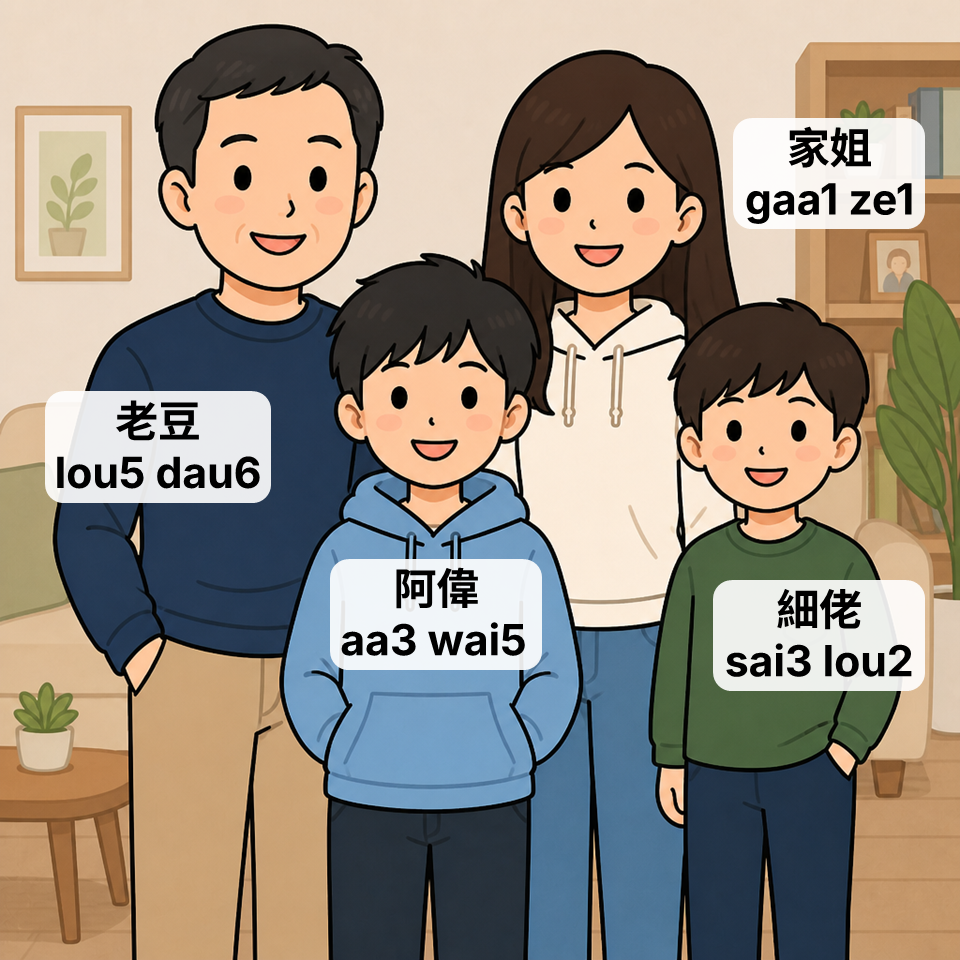
| 阿詩 aa3 si1 | ________ |
| 阿偉 aa3 wai5 | ________ |
2.
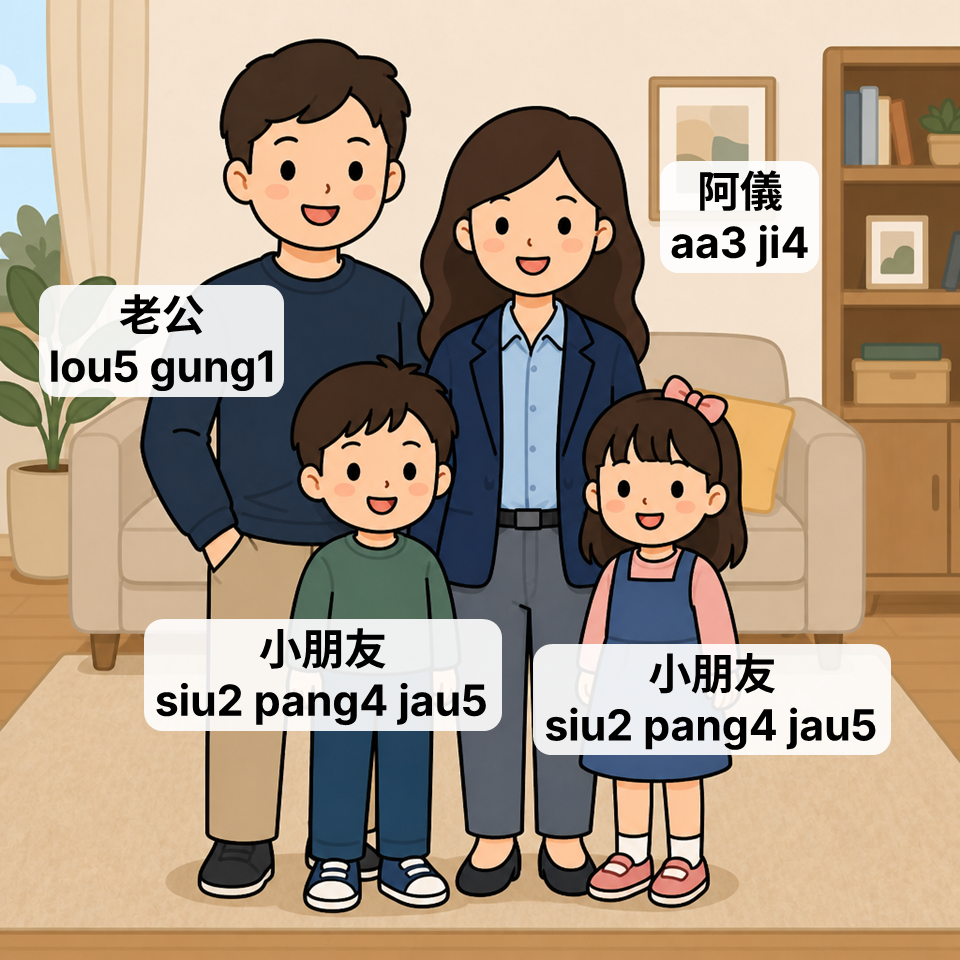
| 阿詩 aa3 si1 | ________ |
| 阿儀 aa3 ji4 | ________ |
3.
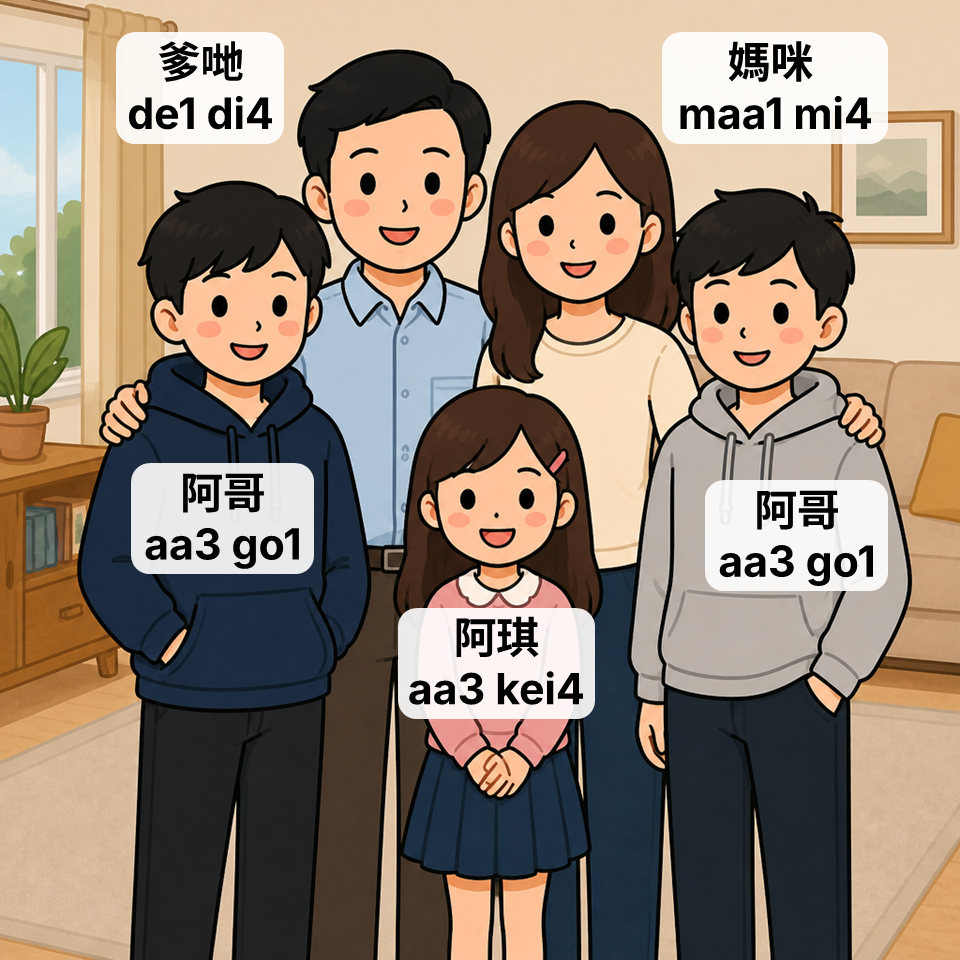
| 阿詩 aa3 si1 | ________ |
| 阿琪 aa3 kei4 | ________ |
4.
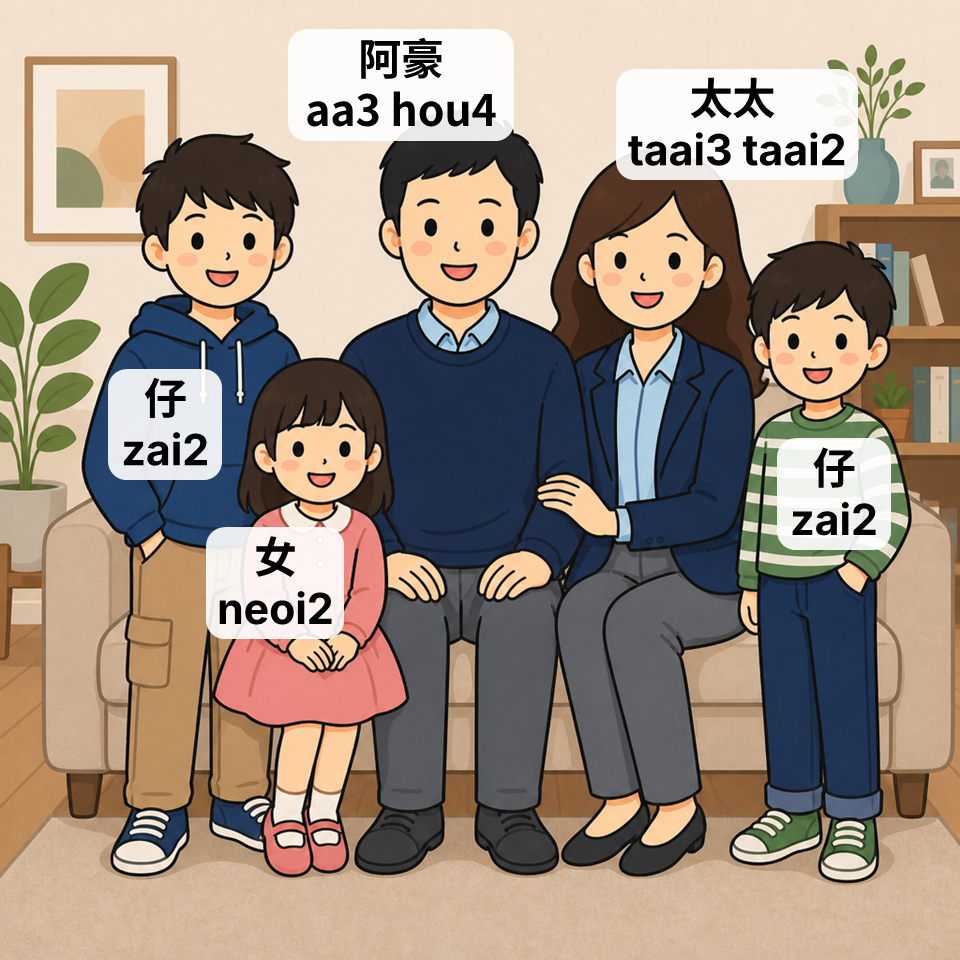
| 阿詩 aa3 si1 | ________ |
| 阿豪 aa3 hou4 | ________ |
5.
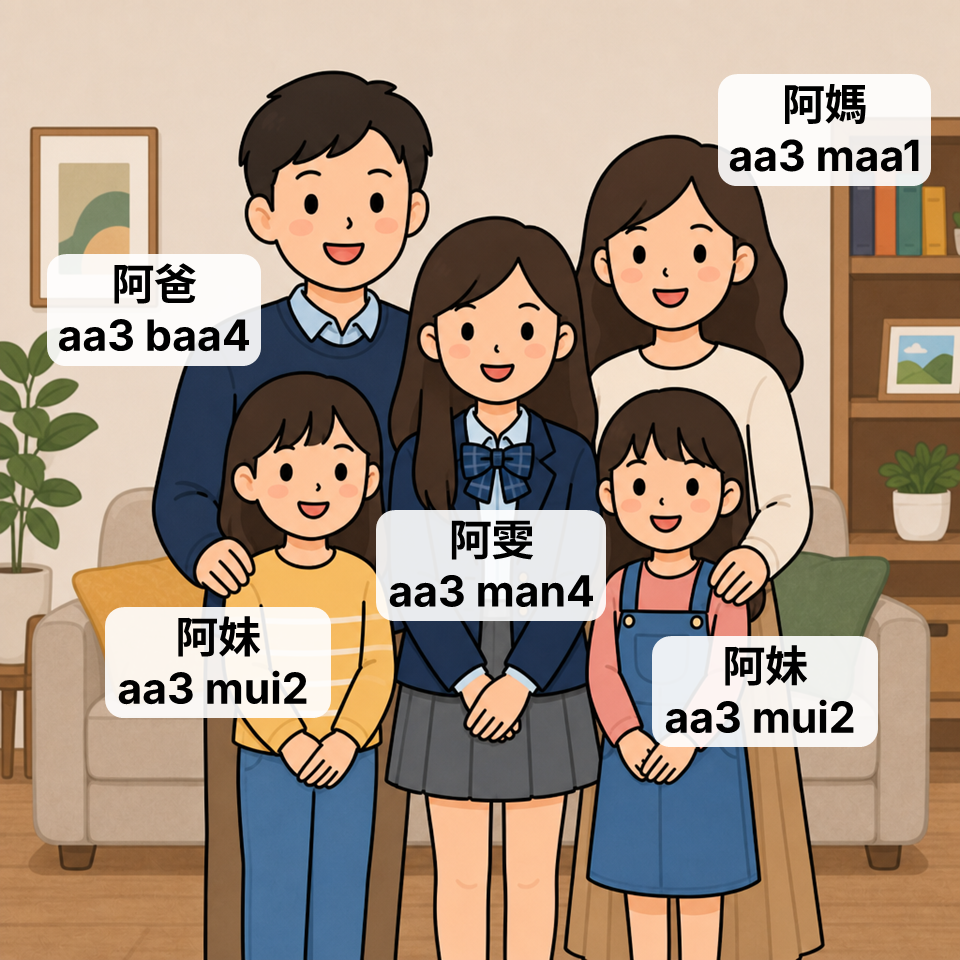
| 阿詩 aa3 si1 | ________ |
| 阿雯 aa3 man4 | ________ |
Activities
Activity 1
Listen to two conversations. The speakers will talk about their home and family. Correct the mistakes in the information below.
waan1 zai2
sei3 go3 jan4 (Alex, aa3 baa4, aa3 maa1, gaa1 ze1)
sam1 seoi2 waan1
loeng5 go3 jan4 (aa3 fai1, neoi5 pang4 jau5)
Conversation 1
| 阿文 aa3 man4 | |
| Alex | |
| 阿文 aa3 man4 | |
| Alex | |
| 阿文 aa3 man4 | |
| Alex |
Conversation 2
| 阿東 aa3 dung1 | |
| 阿輝 aa3 fai1 | |
| 阿東 aa3 dung1 | |
| 阿輝 aa3 fai1 |
Transcripts with Translation
Conversation 1
| 阿文 aa3 man4 | Alex,你住喺邊度㗎? Alex, nei5 zyu6 hai2 bin1 dou6 gaa3? Alex, where do you live? |
| Alex | 我住喺屯門嘅。 ngo5 zyu6 hai2 tyun4 mun4 ge3. I live in Tuen Mun. |
| 阿文 aa3 man4 | 嘩,咁遠?噉你同邊個一齊住㗎? waa3, gam3 jyun5? gam2 nei5 tung4 bin1 go3 jat1 cai4 zyu6 gaa3? Wow, that far away? Then, who do you live with? |
| Alex | 我同屋企人一齊住嘅。 ngo5 tung4 uk1 kei2 jan4 jat1 cai4 zyu6 ge3. I live with my family. |
| 阿文 aa3 man4 | 你屋企有幾多個人㗎? nei5 uk1 kei2 jau5 gei2 do1 go3 jan4 gaa3? How many people does your family have? |
| Alex | 我屋企有五個人嘅,有我阿爸啦,我阿媽啦,我阿哥啦,我阿妹啦,同我。 ngo5 uk1 kei2 jau5 ng5 go3 jan4 ge3, jau5 ngo5 aa3 baa4 laa1, ngo5 aa3 maa1 laa1, ngo5 aa3 go1 laa1, ngo5 aa3 mui2 laa1, tung4 ngo5. My family has five people. It has my father, my mother, my older brother, my younger sister and me. |
Conversation 2
| 阿東 aa3 dung1 | 你住邊度㗎? nei5 zyu6 bin1 dou6 gaa3? Where do you live? |
| 阿輝 aa3 fai1 | 我住深水埗嘅。 ngo5 zyu6 sam1 seoi2 bou2 ge3. I live in Sham Shui Po. |
| 阿東 aa3 dung1 | 我之前都住深水埗㗎。噉你自己住定同屋企人一齊住㗎? ngo5 zi1 cin4 dou1 zyu6 sam1 seoi2 bou2 gaa3. gam2 nei5 zi6 gei2 zyu6 ding6 tung4 uk1 kei2 jan4 jat1 cai4 zyu6 gaa3? I lived in Sham Shui Po before too. Then, do you live alone or with your family? |
| 阿輝 aa3 fai1 | 我同朋友一齊住嘅。 ngo5 tung4 pang4 jau5 jat1 cai4 zyu6 ge3. I live with my friend. |
Activity 2
Form a group of four. Each of you will get a role card. Don't show your role card to your group members. Talk to them and complete the table.
Sample Conversation
| A | 你有冇兄弟姊妹㗎? nei5 jau5 mou5 hing1 dai6 zi2 mui6 gaa3? | |
| B | 有呀,我有一個阿哥嘅。 jau5 aa3, ngo5 jau5 jat1 go3 aa3 go1 ge3. | 冇呀。 mou5 aa3. |
你呢?你有冇兄弟姊妹㗎? nei5 ne1? nei5 jau5 mou5 hing1 dai6 zi2 mui6 gaa3? | ||
… | ||
| A | 噉你住喺邊度㗎? gam2 nei5 zyu6 hai2 bin1 dou6 gaa3? | |
| B | 我住喺深水埗嘅。 ngo5 zyu6 hai2 sam1 seoi2 bou2 ge3. | |
| A | 你同邊個一齊住㗎? nei5 tung4 bin1 go3 jat1 cai4 zyu6 gaa3? | |
| B | 我自己住嘅。 ngo5 zi6 gei2 zyu6 ge3. | 我同朋友一齊住嘅。 ngo5 tung4 pang4 jau5 jat1 cai4 zyu6 ge3. |
你呢?你住喺邊度㗎? nei5 ne1? nei5 zyu6 hai2 bin1 dou6 gaa3? | ||
… | ||
Role Cards
Activity 3
Form a pair. Talk about:
- Where do you live? Who do you live with?
- How many and what family members do you have?