Print or Export
請問紅館喺邊個出口呀?
cing2 man6 hung4 gun2 hai2 bin1 go3 ceot1 hau2 aa3?
cing2 man6 hung4 gun2 hai2 bin1 go3 ceot1 hau2 aa3?
Listen and Speak
Step 1
The subway stations in Hong Kong usually have lots of exits that connect to different places. Listen to a conversation. A passenger will ask which exit they should go to. Circle the correct exit below.




| 乘客 sing4 haak3 | |
| 職員 zik1 jyun4 | |
| 乘客 sing4 haak3 | |
| 職員 zik1 jyun4 | |
| 乘客 sing4 haak3 | |
| 職員 zik1 jyun4 |
Step 2
Listen to the conversation again. Read the script while listening. Check your answers.
| 乘客 sing4 haak3 | 唔好意思。 m4 hou2 ji3 si1. Excuse me. |
| 職員 zik1 jyun4 | 你好,請問有咩幫到你嘅? nei5 hou2, cing2 man6 jau5 me1 bong1 dou2 nei5 ge2? Hello. May I ask if there is anything that I am able to help you with? |
| 乘客 sing4 haak3 | 請問如果去科學館嘅話,應該喺邊個出口出呀? cing2 man6 jyu4 gwo2 heoi3 fo1 hok6 gun2 ge3 waa2, jing1 goi1 hai2 bin1 go3 ceot1 hau2 ceot1 aa3? May I know if I go to the science museum, which exit I should go out at? |
| 職員 zik1 jyun4 | 科學館喺B2出口出。 fo1 hok6 gun2 hai2 B2 (bi1 ji6) ceot1 hau2 ceot1. For the science museum, go out at Exit B2. |
| 乘客 sing4 haak3 | 好,唔該晒。 hou2, m4 goi1 saai3. Good. [= Okay.] Thank you so much. |
| 職員 zik1 jyun4 | 唔使客氣。 m4 sai2 haak3 hei3. You are welcome. |
- 出口 ceot1 hau2 = exit
- 科學館 fo1 hok6 gun2 = science museum
Step 3
Listen and repeat.
Step 4
Replace the highlighted words in the script with the information below to make your conversations.
| 地點 dei6 dim2 place | 出口 ceot1 hau2 exit |
| 大會堂 daai6 wui6 tong4 Hong Kong City Hall |  K kei1 |
| 維園 wai4 jyun2 Victoria Park |  E ji1 |
| 駱克道市政大廈 lok3 hak1 dou6 si5 zing3 daai6 haa6 Lockhart Road Municipal Services Building |  A2 ei1 ji6 |
| 旺角政府合署 wong6 gok3 zing3 fu2 hap6 cyu5 Mong Kok Government Offices |  B3 bi1 saam1 |
Grammar and Vocabulary
In the Grammar and Vocabulary section, you will learn:
- Language of Announcements
- Introduction to Relative Clauses
- The Verbal Particle 返 / 番 / 翻 faan1 IV
- Vocabulary List
- Vocabulary: In a Subway Station
48.1 Language of Announcements
When taking the subway, we often hear different kinds of announcements. The language used in announcements is more formal than the language we use in everyday conversations.
Announcements often include some more formal vocabulary. Below are some examples.
Also, when some location expressions are put after a reference point, their short forms will be used instead. The short forms are usually the first syllable of the expressions (e.g., 上邊 soeng6 bin6 → 上 soeng6 ‘above, on’).
Announcements sometimes also include some more formal sentence structures. For example, in Grammar and Vocabulary 28.5, we learned that we put the adverb 先 sin1 (‘first’) after the verb or the object if there is one, which is what we usually do in everyday conversations. However, in announcements, we will often hear that 先 sin1 is put before the verb.
請先讓車上乘客落車。
cing2 sin1 joeng6 ce1 soeng6 sing6 haak3 lok6 ce1.
Please give way to passengers on the train to get off first.
The adverb 先 sin1 (‘first’) is put before the verb 讓 joeng6 (‘to give way’).
48.2 Introduction to Relative Clauses
We will learn the basics of relative clauses so that you can understand them if you come across them, but we won’t go into the details of how to use them in this book.
Relative clauses are used to modify nouns. A relative clause provides more information about a noun and helps us identify what the noun refers to.
Below is an example of a relative clause in English. In English, a relative clause is put after the noun it modifies.
Take the trains which go to Central.
The noun trains on its own can refer to any trains. The relative clause which go to Central provides more information about the noun and indicates that it refers to the ones which go to Central.
In Cantonese, a relative clause is put before the noun it modifies. We can use the particle 嘅 ge3 to connect the relative clause and the noun.
The noun 車 ce1 on its own can refer to any trains. The relative clause 去中環方向 heoi3 zung1 waan4 fong1 hoeng3 provides details about the noun and indicates that it refers to the ones which go to Central.We can also use 嗰 go2 (‘that’) and a classifier to connect the relative clause and the noun.
The noun 扶手電梯 fu4 sau2 din6 tai1 on its own can refer to any escalators. The relative clause 直上大堂 zik6 soeng5 daai6 tong4 provides details about the noun and indicates that it refers to the one which goes straight up to the concourse.48.3 The Verbal Particle 返 / 番 / 翻 faan1 IV
In Grammar and Vocabulary 32.5, we learned that the verb particle 返 faan1 (also written as 番 or 翻) can add the meaning of ‘left’ to the sentence. In Grammar and Vocabulary 34.4 and 39.4, we learned that the 返 faan1 can also add the meaning of ‘back’ to the sentence.
The verb particle 返 faan1 has a more abstract use. We sometimes use 返 faan1 with an action to indicate that the action is good for the listener or the speaker ourselves. Note that we usually only use 返 faan1 this way in certain expressions.
For example, in Hong Kong, we use a stored-value card called the Octopus card. When we top up the Octopus card at a store, the shopkeeper will sometimes say the following expression before we leave.
留意返餘額。
lau4 ji3 faan1 jyu4 ngaak2.
Pay attention to the remaining value [the balance of the Octopus card].
The verb particle 返 faan1 is added here to indicate that the action 留意餘額 lau4 ji3 jyu4 ngaak2 (‘to pay attention to the remaining value’) is good for the listener. 留意餘額 lau4 ji3 jyu4 ngaak2 is good for the listener because the listener can check whether their card has been topped up successfully.
We will see more examples in later lessons.
48.4 Vocabulary List
48.5 Vocabulary: In a Subway Station
Communication
In the Communication section, you will learn:
- Topping Up the Octopus Card
- Taking the Subway
Topping Up the Octopus Card
The Octopus card is a stored-value card widely used in Hong Kong. We can use it to pay fares or make purchases at stores. We tap it on a card reader to pay. We can top up the Octopus card at subway stations, convenient stores and supermarkets.
When topping up the Octopus card, we need to indicate the amount we want to top up.
The shopkeeper will sometimes repeat the amount for confirmation.
When we can tap our card on the card reader, the shopkeeper will say:
If the card reader can’t detect our card, the shopkeeper will say:
When we have tapped the card successfully, there will be a beeping sound:
機:
After that, the shopkeeper will sometimes remind us to check the remaining value (the balance of the Octopus card).
Taking the Subway
If we are not sure how to take the subway, we can ask the station staff for help.
If the station we are currently at has more than one railway line, the staff will usually indicate which line we should take.
During our subway journey, we will hear different kinds of announcements. Below are some common ones.
Before a train arrives at the platform, we will hear:
- 往堅尼地城 wong5 gin1 nei4 dei6 sing4 is supposed to be a relative clause that modifies the noun 列車 lit6 ce1, but 嘅 ge3 is not added to connect the relative clause and the noun here for some reason (🤔 maybe because omitting 嘅 ge3 makes the announcement shorter).
When the train is about to close the doors before leaving the platform, we will hear:
When the train approaches the next station, we will hear:
If it is an interchange station, the announcement will indicate which lines we can change to.
The announcement will sometimes indicate whether the doors will open on the left or right. 左邊 zo2 bin6 (‘left’) and 右邊 jau6 bin6 (‘right’) are usually pronounced as zo2 bin1 and jau6 bin1 (bin in Tone 1) in subway announcements.
The subway stations in Hong Kong usually have lots of exits that connect to different places. If we are not sure which exit we should go to, we can ask the station staff for help.
Culture
The official Chinese name of Hong Kong Coliseum is 香港體育館 hoeng1 gong2 tai2 juk6 gun2. But Hong Kong Cantonese speaker usually refer it as 紅磡體育館 hung4 ham3 tai2 juk6 gun2 (‘Hung Hom Coliseum’) or by the contracted form 紅館 hung4 gun2, because it is located in 紅磡 hung4 ham3 (‘Hung Hom’). 紅館 hung4 gun2 is a famous venue for hosting singing concerts. Hosting a concert in 紅館 hung4 gun2 is often considered a milestone in a singer’s career.
Exercises
Exercise 1
Complete the descriptions.
1.
We can use a relative clause to modify a noun. We can use either ________, or ________ and a classifier to connect the relative clause and the noun.
2.
We can use the verb particle ________ with an action to indicate that the action is good for the listener or the speaker.
Exercise 2
Listen to B and complete A. Then, check your answers and repeat after the recordings.
Example
| A | 增值一百蚊吖唔該。 zang1 zik6 jat1 baak3 man1 aa1 m4 goi1. Top up $100, please. |
| B | 增值一百蚊嘅,可以拍卡。 zang1 zik6 jat1 baak3 man1 ge3, ho2 ji5 paak3 kaat1. ← Listen to this first. Top up $100. You can tap the card. |
1.
| A | ________ |
| B | ________ |
2.
| A | ________ |
| B | ________ |
3.
| A | ________ |
| B | ________ |
4.
| A | ________ |
| B | ________ |
Exercise 3
Listen to B and complete A. Then, check your answers and repeat after the recordings.
In this exercise, imagine you are currently at Mong Kok Station. Below is the subway map.
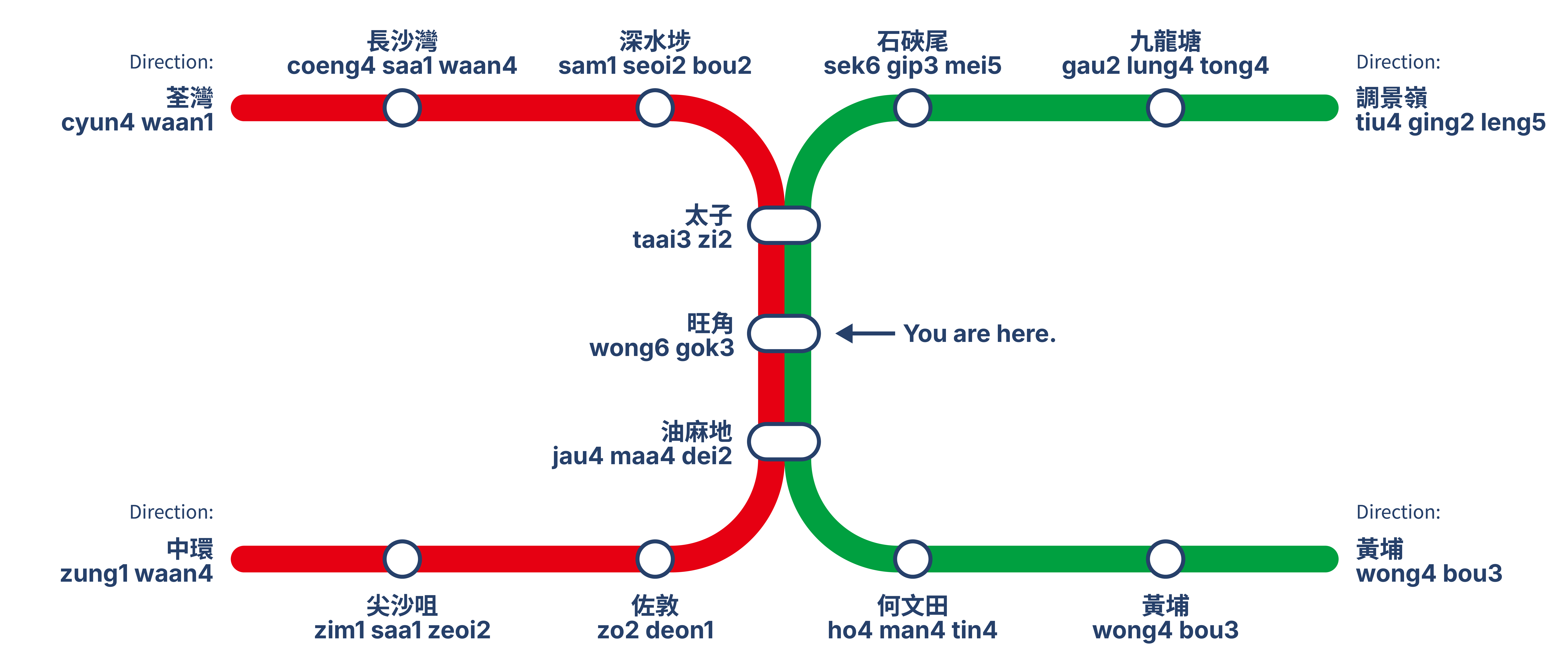
Example
| A | 請問點樣坐去深水埗呀? cing2 man6 dim2 joeng2 co5 heoi3 sam1 seoi2 bou2 aa3? May I know how I take it [the subway] to go to Sham Shui Po? |
| B | 你要搭荃灣線,搭去荃灣方向嘅車,搭兩個站就到。 nei5 jiu3 daap3 cyun4 waan1 sin3, daap3 heoi3 cyun4 waan1 fong1 hoeng3 ge3 ce1, daap3 loeng5 go3 zaam6 zau6 dou3. ← Listen to this first. You need to take the Tsuen Wan Line. Take the train that goes toward the direction of Tsuen Wan. If you take it for two stations, then you arrive. |
1.
| A | ________ |
| B | ________ |
2.
| A | ________ |
| B | ________ |
3.
| A | ________ |
| B | ________ |
4.
| A | ________ |
| B | ________ |
5.
| A | ________ |
| B | ________ |
6.
| A | ________ |
| B | ________ |
Exercise 4
Follow the example to complete the conversations. Then, check your answers and repeat after the recordings.
Example
修頓球場 sau1 deon2 kau4 coeng4 (B1)
| A | 請問如果去修頓球場嘅話,應該喺邊個出口出呀? cing2 man6 jyu4 gwo2 heoi3 sau1 deon2 kau4 coeng4 ge3 waa2, jing1 goi1 hai2 bin1 go3 ceot1 hau2 ceot1 aa3? May I know if I go to Southorn Playground, which exit I should go out at? |
| B | 修頓球場喺B1出口出。 sau1 deon2 kau4 coeng4 hai2 B1 (bi1 jat1) ceot1 hau2 ceot1. For Southorn Playground, go out at Exit B1. |
1.
彩虹邨 coi2 hung4 cyun1 (C4)
| A | ________ |
| B | ________ |
2.
演藝學院 jin2 ngai6 hok6 jyun2 (E1)
| A | ________ |
| B | ________ |
3.
文化中心 man4 faa3 zung1 sam1 (L6)
| A | ________ |
| B | ________ |
4.
東區法院 dung1 keoi1 faat3 jyun2 (A)
| A | ________ |
| B | ________ |
5.
廣華醫院 gwong2 waa4 ji1 jyun2 (E2)
| A | ________ |
| B | ________ |
6.
萬國殯儀館 maan6 gwok3 ban3 ji4 gun2 (C1)
| A | ________ |
| B | ________ |
Activities
Activity 1
Listen to three conversations. After listening to each conversation, listen to the questions and answer them in complete sentences.
Conversation 1
1. ________
________
2. ________
________
| 客 haak3 | |
| 職員 zik1 jyun4 | |
A few moments later… | |
| 職員 zik1 jyun4 | |
A few moments later… | |
| 機 gei1 | |
| 職員 zik1 jyun4 | |
| 客 haak3 | |
| 職員 zik1 jyun4 |
Conversation 2
3. ________
________
4. ________
________
5. ________
________
| 乘客 sing4 haak3 | |
| 職員 zik1 jyun4 | |
| 乘客 sing4 haak3 | |
| 職員 zik1 jyun4 | |
| 乘客 sing4 haak3 | |
| 職員 zik1 jyun4 |
Conversation 3
6. ________
________
7. ________
________
| 乘客 sing4 haak3 | |
| 職員 zik1 jyun4 | |
| 乘客 sing4 haak3 | |
| 職員 zik1 jyun4 | |
| 乘客 sing4 haak3 | |
| 職員 zik1 jyun4 |
Transcripts with Translation
Conversation 1
| 客 haak3 | 增值一百蚊吖唔該。 zang1 zik6 jat1 baak3 man1 aa1 m4 goi1. Top up $100, please. |
| 職員 zik1 jyun4 | 收你五百蚊,增值一百蚊嘅,可以拍卡。 sau1 nei5 ng5 baak3 man1, zang1 zik6 jat1 baak3 man1 ge3, ho2 ji5 paak3 kaat1. I receive $500 from you. Top up $100. You can tap the card. |
A few moments later… | |
| 職員 zik1 jyun4 | 仲未嘟到。 zung6 mei6 dut1 dou2. You are still not able to doo it yet. [= You still haven’t dooed it successfully yet.] |
A few moments later… | |
| 機 gei1 | 嘟。 dut1. Doo. |
| 職員 zik1 jyun4 | 找返你四百蚊嘅,一,二,三,四,四百蚊,留意返餘額。 zaau2 faan1 nei5 sei3 baak3 man1 ge3, jat1, ji6, saam1, sei3, sei3 baak3 man1, lau4 ji3 faan1 jyu4 ngaak2. I give change of $400 back to you. One, two, three, four, four hundred dollars. Pay attention to the remaining value [the balance of the Octopus Card]. |
| 客 haak3 | 唔該晒。 m4 goi1 saai3. Thank you so much. |
| 職員 zik1 jyun4 | 唔使客氣。 m4 sai2 haak3 hei3. You are welcome. |
Conversation 2
| 乘客 sing4 haak3 | 唔好意思。 m4 hou2 ji3 si1. Excuse me. |
| 職員 zik1 jyun4 | 先生你好,請問有咩幫到你嘅? sin1 saang1 nei5 hou2, cing2 man6 jau5 me1 bong1 dou2 nei5 ge2? Sir, hello. May I ask if there is anything that I am able to help you with? |
| 乘客 sing4 haak3 | 請問點樣坐去九龍塘呀? cing2 man6 dim2 joeng2 co5 heoi3 gau2 lung4 tong4 aa3? May I know how I take it [the subway] to go to Kowloon Tong? |
| 職員 zik1 jyun4 | 你要搭荃灣線,你去二號月台,搭去中環方向嘅車,搭到太子之後轉觀塘線,坐去調景嶺方向嘅車。 nei5 jiu3 daap3 cyun4 waan1 sin3, nei5 heoi3 ji6 hou6 jyut6 toi4, daap3 heoi3 zung1 waan4 fong1 hoeng3 ge3 ce1, daap3 dou3 taai3 zi2 zi1 hau6 zyun3 gun1 tong4 sin3, co5 heoi3 tiu4 ging2 leng5 fong1 hoeng3 ge3 ce1. You need to take the Tsuen Wan Line. Go to Platform Number 2. Take the train that goes toward the direction of Central. After you have taken it to Prince Edward, then change to the Kwun Tong Line. Take the train that goes toward the direction of Tiu Keng Leng. |
| 乘客 sing4 haak3 | 好,唔該晒。 hou2, m4 goi1 saai3. Good. [= Okay.] Thank you so much. |
| 職員 zik1 jyun4 | 唔使客氣。 m4 sai2 haak3 hei3. You are welcome. |
Conversation 3
| 乘客 sing4 haak3 | 唔該。 m4 goi1. Excuse me. |
| 職員 zik1 jyun4 | 小姐你好,請問有咩幫到你嘅? siu2 ze2 nei5 hou2, cing2 man6 jau5 me1 bong1 dou2 nei5 ge2? Miss, hello. May I ask if there is anything that I am able to help you with? |
| 乘客 sing4 haak3 | 請問金魚街喺邊個出口呀? cing2 man6 gam1 jyu4 gaai1 hai2 bin1 go3 ceot1 hau2 aa3? May I ask which exit Goldfish Market is at? 金魚街 gam1 jyu4 gaai1 literally means ‘goldfish + street’. |
| 職員 zik1 jyun4 | 金魚街喺B3出口。 gam1 jyu4 gaai1 hai2 B3 (bi1 saam1) ceot1 hau2. Goldfish Market is at Exit B3. |
| 乘客 sing4 haak3 | 好,唔該晒。 hou2, m4 goi1 saai3. Good. [= Okay.] Thank you so much. |
| 職員 zik1 jyun4 | 唔使客氣。 m4 sai2 haak3 hei3. You are welcome. |
Activity 2
Listen to four announcements. After listening to each announcement, listen to the questions and answer them in complete sentences.
Announcement 1
1. ________
________
Announcement 2
2. ________
________
Announcement 3
3. ________
________
4. ________
________
5. ________
________
Announcement 4
6. ________
________
7. ________
________
8. ________
________
Transcripts with Translation
Announcement 1
| 廣播 gwong2 bo3 | 往中環列車即將到達,請先讓車上乘客落車。 wong5 zung1 waan4 lit6 ce1 zik1 zoeng1 dou3 daat6, cing2 sin1 joeng6 ce1 soeng6 sing6 haak3 lok6 ce1. The train that goes toward Central is arriving soon. Please give way to passengers on the train to get off first. |
Announcement 2
| 廣播 gwong2 bo3 | 往荃灣列車即將到達,請先讓車上乘客落車。 wong5 cyun4 waan1 lit6 ce1 zik1 zoeng1 dou3 daat6, cing2 sin1 joeng6 ce1 soeng6 sing6 haak3 lok6 ce1. The train that goes toward Tsuen Wan is arriving soon. Please give way to passengers on the train to get off first. |
Announcement 3
| 廣播 gwong2 bo3 | 下一站旺角,乘客可以轉乘荃灣線往荃灣沿途各站,左邊嘅車門將會打開。 haa6 jat1 zaam6 wong6 gok3, sing4 haak3 ho2 ji5 zyun2 sing4 cyun4 waan1 sin3 wong5 cyun4 waan1 jyun4 tou4 gok3 zaam6, zo2 bin1 ge3 ce1 mun4 zoeng3 wui5 daa2 hoi1. The next station is Mong Kok. Passengers can change to the Tsuen Wan Line and go to each station along the way to Tsuen Wan [the terminal of the line]. The train doors on the left will open. |
Announcement 4
| 廣播 gwong2 bo3 | 下一站太子,乘客可以轉乘觀塘線往調景嶺沿途各站,左邊嘅車門將會打開。 haa6 jat1 zaam6 taai3 zi2, sing4 haak3 ho2 ji5 zyun2 sing4 gun1 tong4 sin3 wong5 tiu4 ging2 leng5 jyun4 tou4 gok3 zaam6, zo2 bin1 ge3 ce1 mun4 zoeng3 wui5 daa2 hoi1. The next station is Prince Edward. Passengers can change to the Kwun Tong Line and go to each station along the way to Tiu Keng Leng [the terminal of the line]. The train doors on the left will open. |
Activity 3
Form a pair. Each of you will get a different set of role cards. Make six conversations using your role cards.
Conversation 1
Conversation 2
Conversation 3
Conversation 4
Conversation 5
Conversation 6