Print or Export
Introduction
1. Writing down Cantonese Speech
To write down Cantonese speech, we can use Chinese characters or a Romanization system.
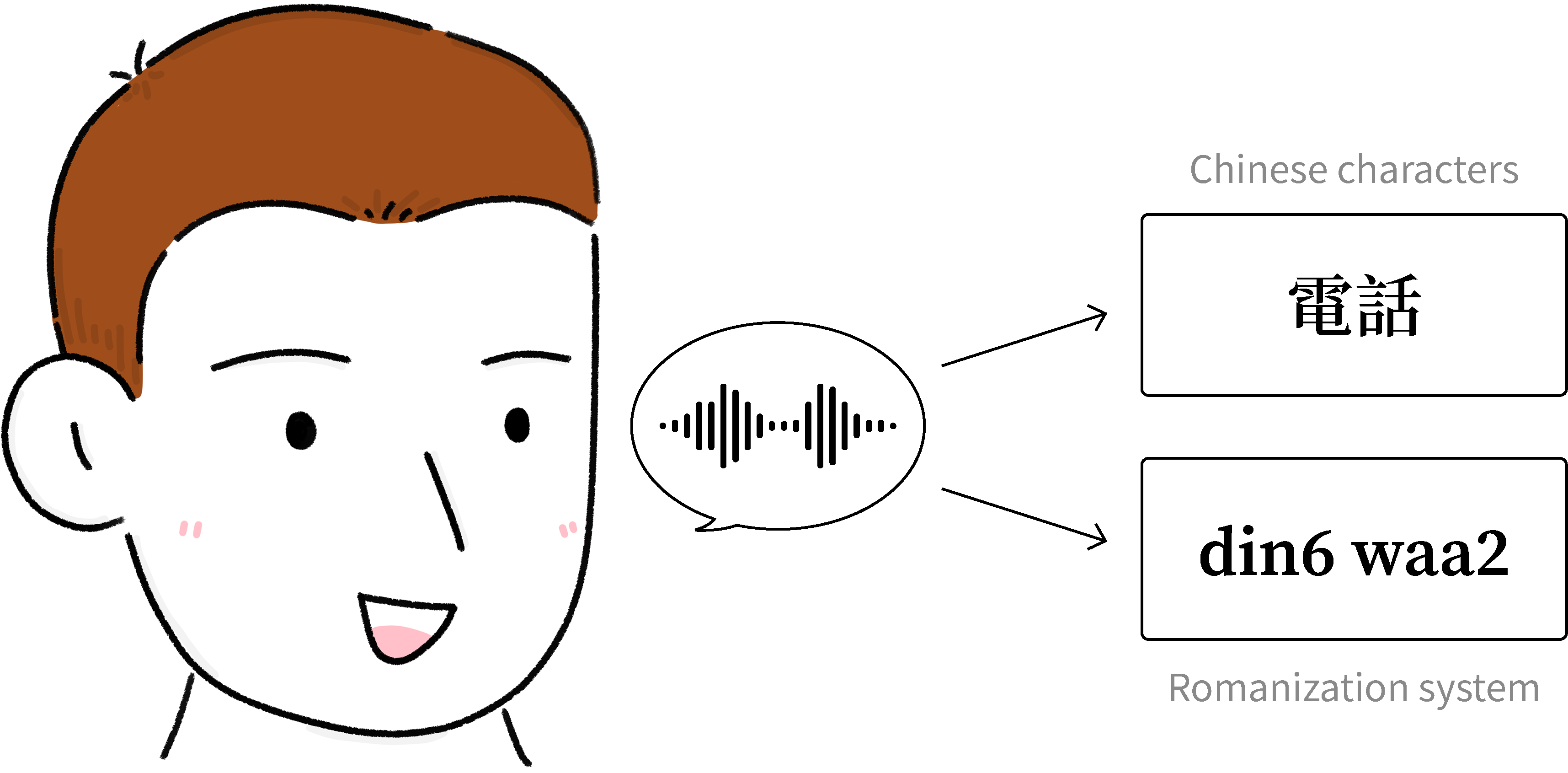
A Romanization system specifies how each sound in Cantonese is written down with the Roman alphabet. By using a Romanization system, we can use letters to write down Cantonese speech easily without knowing Chinese characters.
Listen to the examples.
For example, we use the letter E to write down the sound e.
We use the letter O to write down the sound o.
There are several Romanization systems for Cantonese. The one we use in this book is Jyutping.
When we use Chinese characters to write down Cantonese speech, we write down the speech syllable by syllable. That is, we write down each syllable with one Chinese character. For example, the Cantonese word for phone has two syllables. We write down the word as

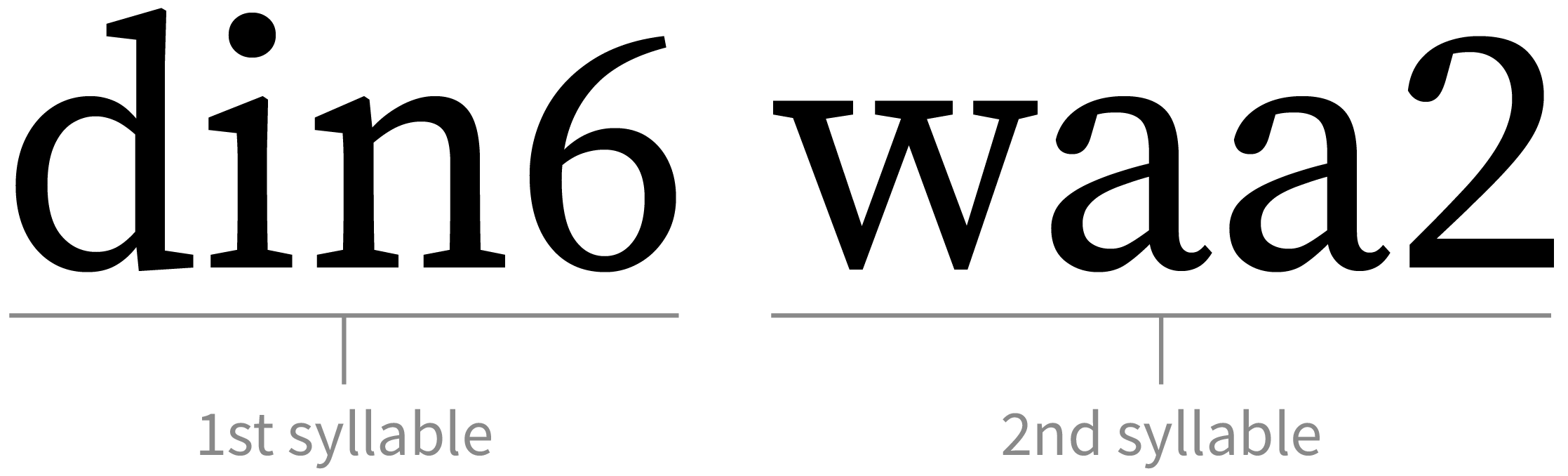
When we use a Romanization system, we also write down Cantonese speech syllable by syllable. For example, the Cantonese word for phone has two syllables. We write down the word as
Listen to the example.
電話 din6 waa2
電 din6, the first syllable
話 waa2, the second syllable
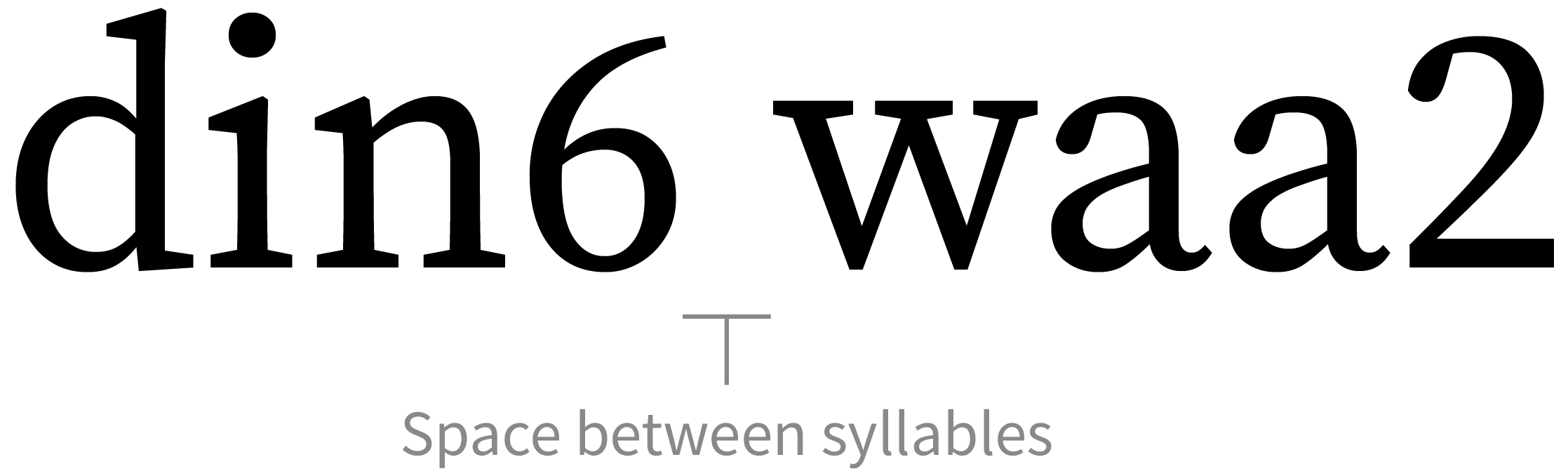
Notice that we insert a space between syllables.
We will refer to the Cantonese speech we write down with a Romanization system as Romanized Cantonese in this book.
In this pronunciation guide, you will learn to say Cantonese speech written down in Romanized Cantonese. Later in this book, you will practice writing down Cantonese speech in Romanized Cantonese yourself.
💭 Think!
Do you think it is useful to learn how to write down Cantonese speech?
2. Syllable Components
When we use a Romanization system to write down Cantonese speech, there are three components we need to write down for each syllable. They are the initial, final and tone. Each of them refers to a specific part of a syllable.
🔍 Observe!
Look at the word for phone again. Each of its syllables is labeled with the initial, final and tone below. Which part(s) of the syllable do the initial and the final refer to respectively?
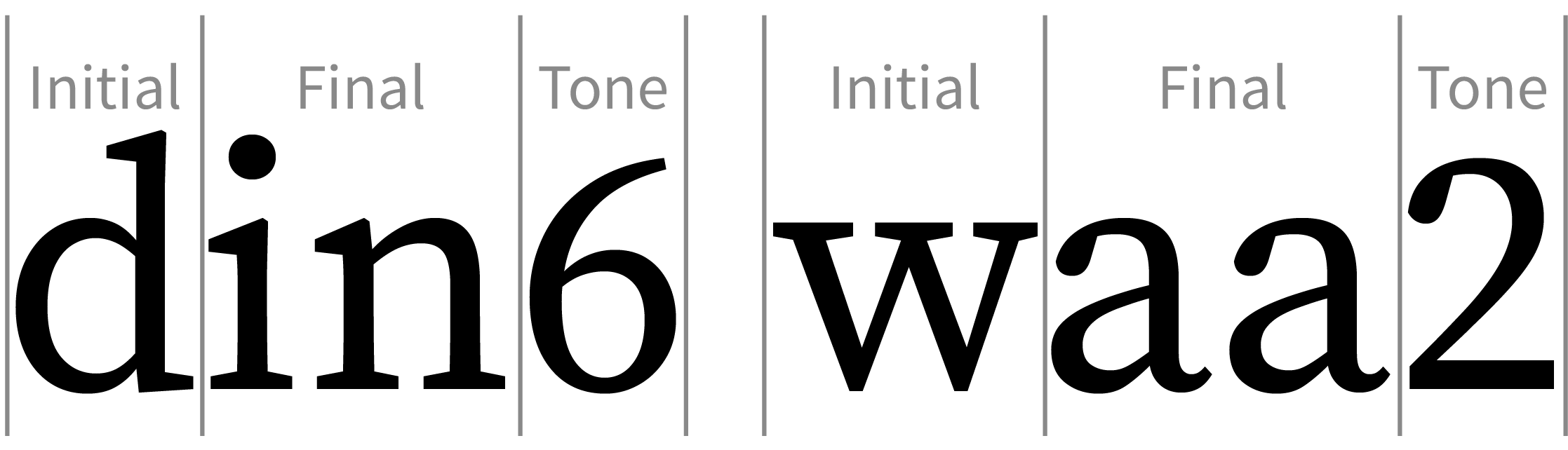
The initial refers to ________.
The final refers to ________.
💡 Tips: Click the blanks to see the answers.
The initial refers to the beginning consonant (d in din6 and w in waa2).
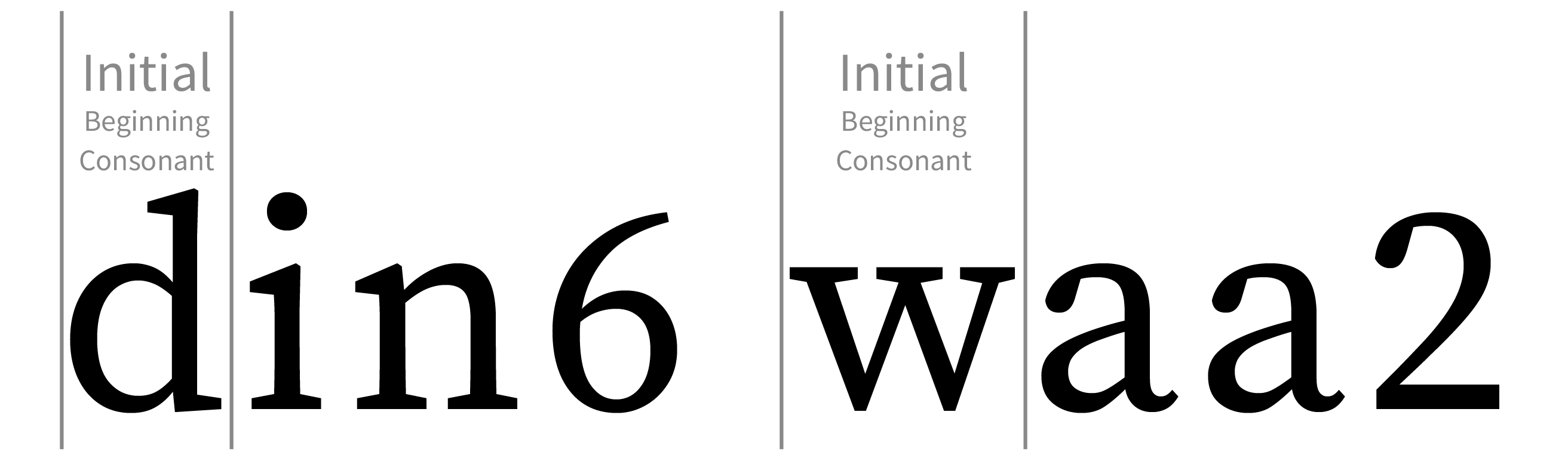
The final refers to the vowel (i in din6 and aa in waa2) and the ending consonant (n in din6 and not any in waa2). Note that some finals have an ending consonant, but some don’t.
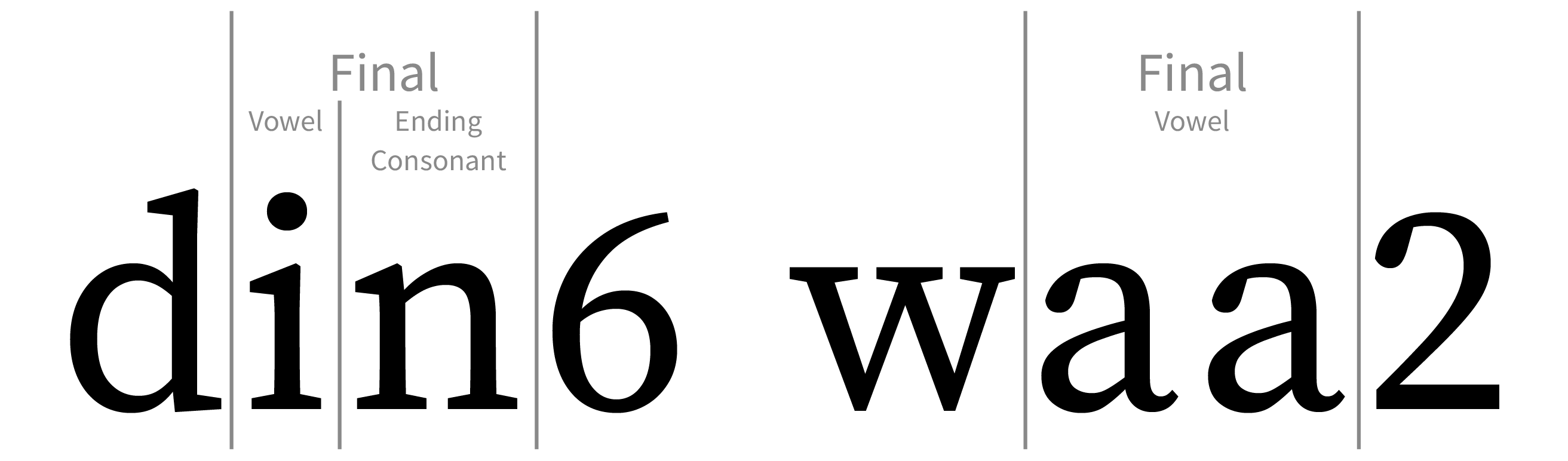
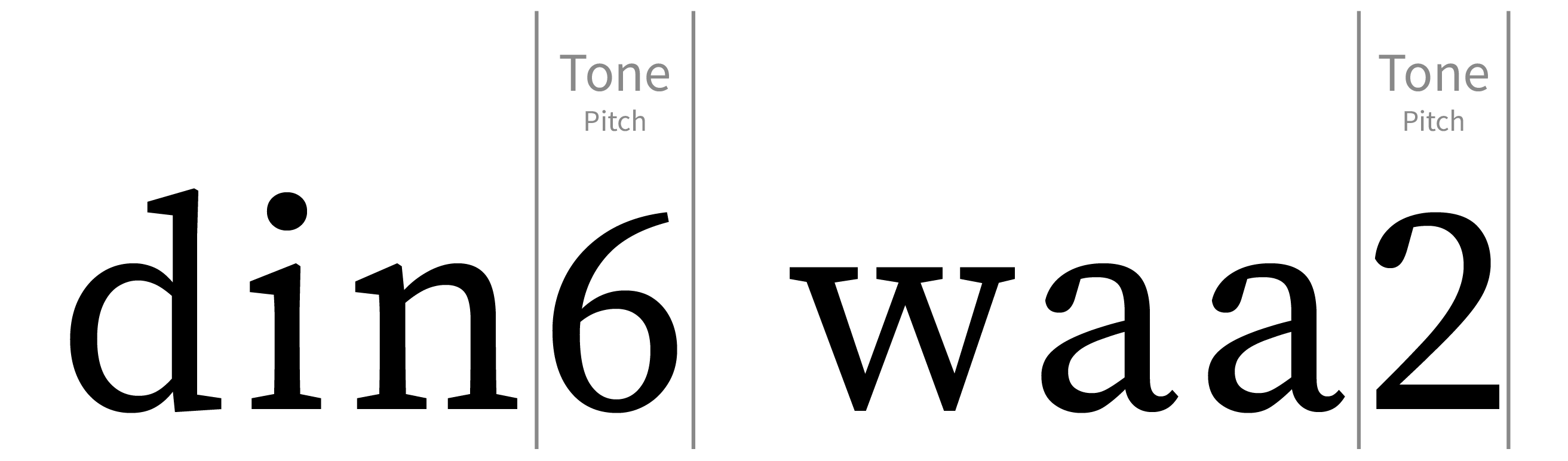
The tone refers to the pitch of the syllable. It is represented by the number after the final (6 in din6 and 2 in waa2). You will learn more about tones later in this pronunciation guide.
Here is the word phone labeled the initials, finals and tones together.
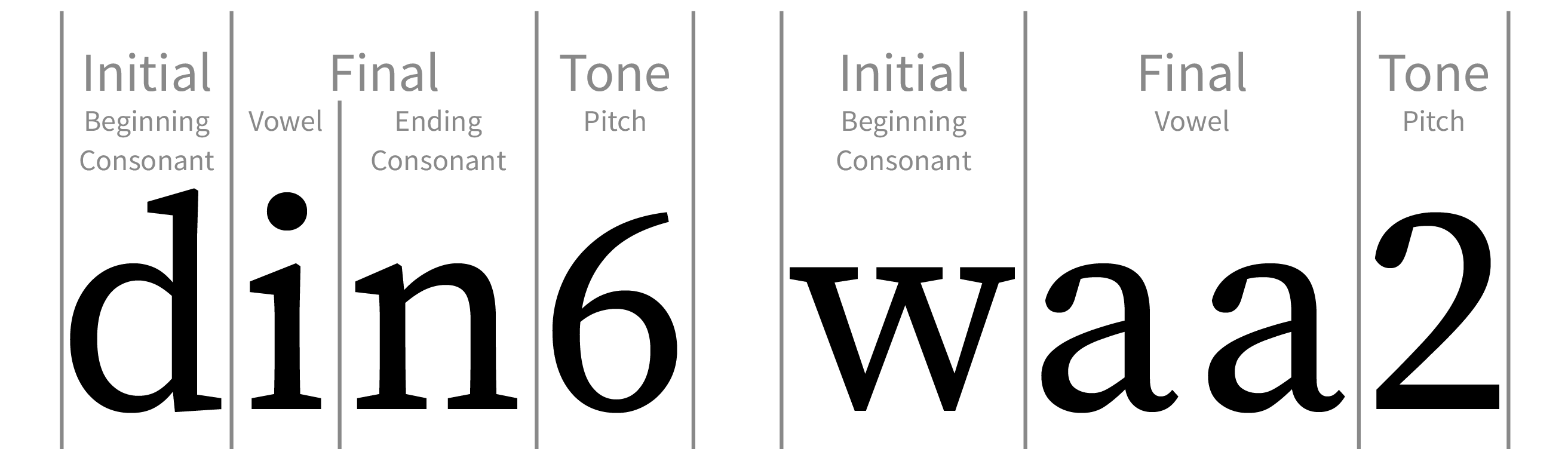
Listen to the initial and final of each syllable in the word phone.
In the syllable 電 din6, the initial is d and the final in.
In the syllable 話 waa2, the initial is w and the final aa.
Cantonese has 19 initials, 59 finals and 6 tones. You will learn all these sounds in this pronunciation guide.
3. Learning Goals in This Unit
In this pronunciation guide, you will be trained to
-
Say the sounds in Cantonese (the initials, finals and tones)
-
Say Cantonese speech written down in Romanized Cantonese using Jyutping
These skills are essential to your learning journey of Cantonese in the later units.
💭 Think!
Have you learned a foreign language before? If yes, did you find learning pronunciation easy or difficult?
4. How to Study This Unit
This pronunciation guide consists of seven lessons. Try to study one lesson a day and complete all the seven lessons in one week. To learn more effectively, remember to study on separate days, instead of studying everything all at once.
In each lesson, you will learn a new set of sounds in Cantonese and revise the sounds you have already learned. We will put a lot of emphasis on revision because revision helps you remember the sounds better.
Learning the pronunciation of a new language can sometimes be very challenging. 加油 gaa1 jau5!
💡 Tips
加油 gaa1 jau5 literally means ʻadd oilʼ. We use the expression to encourage someone and show support.